 StainList
The short answer: organic cotton can shrink
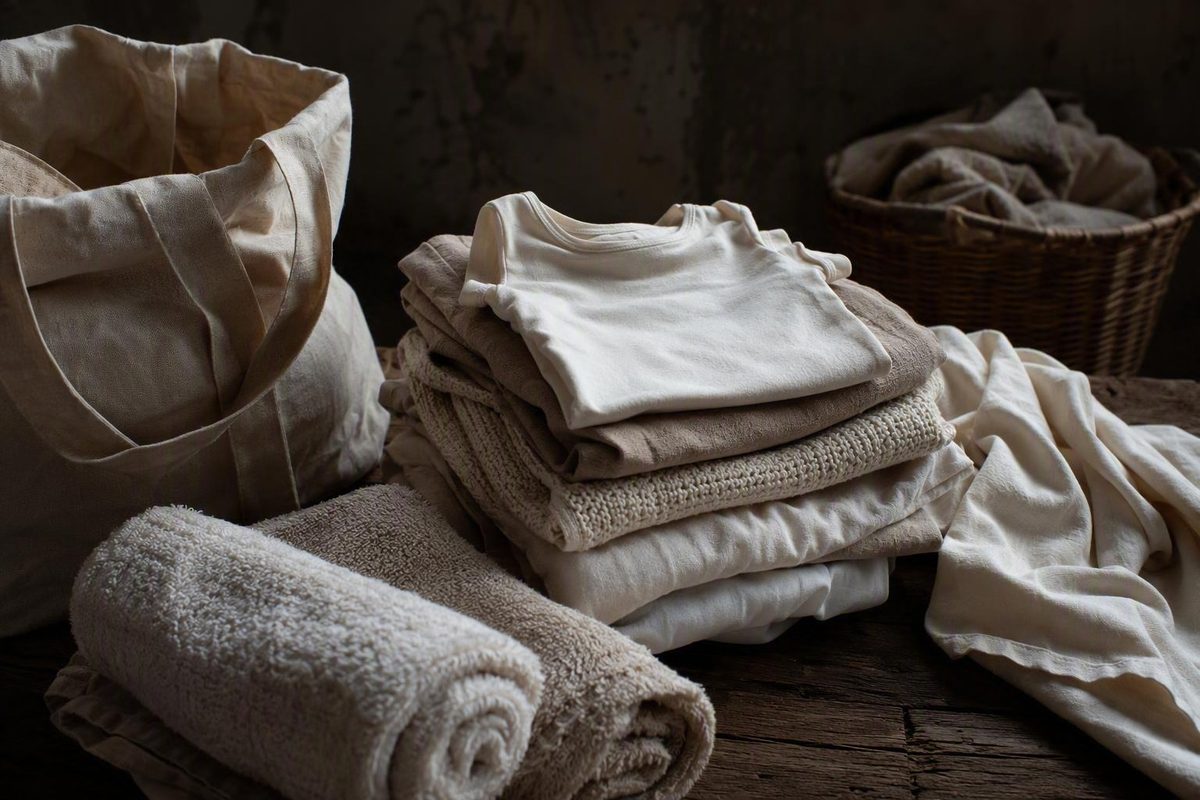
Yes. Organic-cotton clothing, sheets, towels, baby items, bags, and fabric yardage can become smaller during washing or drying.
Organic and conventional cotton are both cotton fibers. The word “organic” describes how the cotton was cultivated; it does not tell you whether the finished fabric was preshrunk, dimensionally stabilized, tightly woven, loosely knitted, or intended for machine drying. Preshrinking, construction, finishing, garment assembly, and laundry conditions are more useful indicators of shrinkage risk than the organic designation alone (MEXESS’s organic-cotton shrinkage overview).
A stabilized item washed gently may show little noticeable change. Untreated cotton exposed to hot water, strong agitation, or high dryer heat has a greater chance of changing size or shape. Even preshrunk cotton, however, may retain some potential for movement.
Commercial care sources generally place the largest dimensional change in the first wash or first few washes. Later washes may produce little visible change, but repeated exposure to heat and agitation can cause additional contraction or distortion. Cotton does not necessarily shrink after every wash, and results vary with preshrinking, weave, blends, finishes, water temperature, and drying conditions (ICE Fabrics’ cotton-shrinkage overview).
There is no universal shrinkage percentage for every organic-cotton shirt, sheet, towel, bodysuit, or length of fabric. Two products with identical fiber-content labels can behave differently because their construction, finishing, dimensions, and care histories differ.
Published estimates also require caution. Most figures available in the supplied evidence come from retailers, clothing companies, manufacturers, or textile suppliers. Their articles generally do not identify a standardized test method, fabric specification, sample size, measurement protocol, or number of laundry cycles. Those estimates can illustrate possible scale, but they cannot predict what a particular item will do.
The practical answer is:
- Organic cotton can shrink.
- The largest change is often reported during early laundering.
- Preshrinking and gentle care generally reduce the risk.
- Heat and agitation can increase the risk.
- The product’s construction and care label matter more than the word “organic.”
- No generic percentage guarantees the final fit.
Why cotton changes size in the laundry
Commercial cotton-care sources commonly describe shrinkage as the result of moisture, heat, and mechanical action working together. Because the available sources do not provide independent laboratory documentation or a recognized textile-testing standard, the following should be understood as a simplified account rather than a complete technical model.
During spinning, knitting or weaving, and finishing, fibers, yarns, and fabric may be held under tension. When cotton becomes wet, it absorbs moisture and swells. The structure can then relax from some of that manufacturing tension and settle into different dimensions as it dries. Heat is commonly described as accelerating contraction, while agitation, friction, tumbling, and fast spinning may contribute to rearrangement or distortion (Greendhobi’s explanation of clothing shrinkage).
This account helps explain why heat is not the only relevant factor. Cotton can change during a cooler wash because moisture and movement are also involved. A heated tumble dryer adds another combination of heat and repeated mechanical action.
Change may not be uniform. Length and width can respond differently, and a completed garment contains more than one simple sheet of fabric.
It is therefore useful to distinguish dimensional shrinkage from related shape changes:
- Shrinkage means a measured dimension becomes smaller.
- Twisting occurs when seams or panels rotate out of alignment.
- Puckering appears as gathered or wrinkled areas, often around seams or decorative work.
- Warping means the item no longer lies or hangs in its intended shape.
- Uneven distortion occurs when different areas change by different amounts.
An item may show more than one problem. A T-shirt, for example, can become shorter while its side seams also twist. One overall percentage cannot describe every resulting fit or shape change.
The organic label does not explain these differences. After cultivation, cotton still undergoes spinning, fabric formation, dyeing or printing, finishing, cutting, and assembly. Those stages can produce substantially different materials from the same nominal fiber content.
It is also too broad to claim that organic cotton necessarily shrinks more because it lacks particular chemical treatments. Some organic-cotton fabrics are mechanically preshrunk or otherwise stabilized, while some are sold without such processing. Conventional cotton also varies in finishing. The supplied commercial sources do not provide controlled comparisons establishing cultivation method as the deciding factor.
How much shrinkage might be noticeable?
Several commercial articles repeat an estimate of roughly 3–5% initial shrinkage, particularly for cotton that has not been preshrunk. That range is recurring commercial guidance, not an established universal rate. The sources do not document a common test method or equivalent fabric samples (The Carbon Closet’s cotton care guide).
Some seller and manufacturer articles mention larger changes under hot washing or high-heat drying, sometimes as high as 10%. That upper figure should not be treated as a forecast for a particular garment. One manufacturer article repeats both a 3–5% first-wash estimate and a possible 10% under high heat without supplying standardized, product-specific testing for those values (Gentle Packing’s organic-cotton shrinkage article).
The best use of these percentages is mathematical: they show what a stated rate would mean in inches or centimeters. They do not establish how much your item will lose.
The calculation is:
Percentage change = original measurement - new measurement ÷ original measurement × 100
Suppose a shirt measured 30 inches from a consistent shoulder point to the hem before laundering and 28.5 inches afterward:
30 - 28.5 ÷ 30 × 100 = 5\%
That is a measured 5% reduction in that particular length. It does not mean the chest, sleeves, or neckline also changed by 5%.
The following table converts hypothetical percentages for an original 30-inch dimension:
| Hypothetical dimensional change | Amount lost from 30 inches | New dimension |
|---|---|---|
| 3% | 0.9 inch | 29.1 inches |
| 5% | 1.5 inches | 28.5 inches |
| 10% | 3 inches | 27 inches |
These are mathematical illustrations, not forecasts. The 10% row demonstrates the effect of a large percentage mentioned in some commercial guidance; it does not mean an organic-cotton item is likely to lose 3 inches.
The same illustration for an original 70-centimeter dimension is:
| Hypothetical dimensional change | Amount lost from 70 centimeters | New dimension |
|---|---|---|
| 3% | 2.1 centimeters | 67.9 centimeters |
| 5% | 3.5 centimeters | 66.5 centimeters |
| 10% | 7 centimeters | 63 centimeters |
Again, these are calculations rather than expected results.
Whether a change is noticeable depends partly on fit tolerance. A modest reduction may not matter in a loosely sized towel but can matter in a fitted sleeve, baby garment, tailored shirt, fitted sheet, or sewing project cut to exact dimensions.
Measure length and width separately. Depending on the item, useful measurements include:
- shoulder-to-hem length;
- chest width measured flat;
- sleeve length from a consistent seam point;
- waistband width;
- inseam and rise;
- cuff or neckline opening;
- sheet length and width;
- towel length and width.
Do not apply one percentage automatically to every dimension. The supplied evidence does not establish a fixed directional rule for all cotton knits, weaves, and garment designs. Only consistent before-and-after measurements can show how the specific item changed.
What raises or lowers the risk of shrinkage?
Shrinkage risk reflects several variables together. Untreated cotton washed hot and tumble-dried on high combines multiple higher-risk conditions. Verified preshrinking, cool washing, gentle handling, and air drying combine lower-risk choices, although they cannot guarantee zero change.
The following matrix describes relative risk, not guaranteed outcomes:
| Factor | Lower relative risk | Intermediate or uncertain | Higher relative risk |
|---|---|---|---|
| Preshrinking status | Verified preshrunk or dimensionally stabilized | “Pre-washed” without stability information | Untreated or unknown 100% cotton |
| Fabric construction | Some compact, stable woven constructions | Product-specific construction with unknown finishing | Loose construction or shape-sensitive knit |
| Water temperature | Cool or cold, when permitted by the label | Warm | Hot |
| Cycle intensity | Gentle or delicate handling | Normal cycle | Strong agitation or high mechanical stress |
| Drying method | Air drying | Low dryer heat with early removal | High heat or prolonged heated tumbling |
| Garment construction | Simple construction | Mixed panels or moderate structure | Multiple trims, ribbing, elastic, interfacing, or shape-sensitive seams |
| Fiber content | Cotton blended with a stable synthetic fiber, depending on construction | Blend with uncertain behavior | Untreated 100% cotton under harsh care |
This is a practical summary of factors repeated in commercial guidance, not a controlled ranking of how much each variable contributes.
Preshrinking and finishing
Preshrinking is intended to reduce dimensional change before a product reaches the customer. It generally lowers the likelihood or extent of later shrinkage, but it does not promise that an item will remain unchanged under every laundry condition.
Finishing also matters. The result depends on what process was used, how effectively it stabilized the material, whether it was applied to fabric or completed goods, and how much residual change remained. A documented dimensional-stability result is more informative than a vague statement such as “minimal shrinkage.”
Knit, weave, and fabric weight
Loosely constructed materials may allow more yarn or loop movement than some compact woven fabrics. Flexible knits can also display dimensional change conspicuously. Jersey, ribbing, fleece, gauze, terry, poplin, twill, denim, and canvas should not be expected to behave identically.
These are tendencies rather than rules. Product-specific finishing, yarn properties, fabric weight, cutting, and assembly may alter the outcome. Textile-supplier guidance similarly recommends considering construction, preshrinking, and laundering conditions instead of assuming all organic-cotton fabrics behave alike (Bole Textile’s fabric-shrinkage discussion).
Water, agitation, and dryer heat
High dryer heat is repeatedly identified as a major avoidable risk because it exposes damp cotton to heat while tumbling it. Hot wash water and strong agitation can also contribute to dimensional change or distortion.
The available sources do not provide controlled evidence assigning each factor a fixed share of the result. The practical approach is to avoid stacking higher-risk conditions. A hot wash followed by prolonged high-heat drying is more concerning than a routine based on cooler washing and air drying.
Dyes, seams, trims, and design
A completed garment is not necessarily a uniform rectangle.
As a result, a garment may pucker, twist, or change unevenly even when its total length loss is modest.
Blends
Commercial care guidance generally describes cotton blended with synthetic fiber as less prone to shrinkage than untreated 100% cotton. Fiber content alone, however, is not enough to predict performance. The synthetic fiber, blend proportion, construction, finishing, and care conditions all matter.
Marketing labels such as “premium,” “high quality,” or “long-staple” are not substitutes for dimensional-stability information. Organic certification likewise does not prove that a finished product is shrink-resistant.
A low-risk first-wash routine
Start with the sewn-in care label. It is the product-specific instruction and may account for dyes, prints, trims, elastic, lining, interfacing, and approved drying methods that generic cotton advice cannot evaluate. If the label requires hand washing, flat drying, no tumble drying, or professional cleaning, follow that instruction.
When ordinary washing is permitted, this conservative routine can reduce risk:
1. Read the entire care label. Check the permitted wash temperature, cycle, drying method, ironing temperature, and bleaching restrictions. A product description may provide useful preshrinking information, but the item-specific label should take priority if generic seller advice differs.
2. Measure the item if fit matters. Place the dry item on a flat surface without stretching it. Smooth obvious folds, then record its length and width from repeatable points. Photographing the tape position can make the later comparison more consistent.
3. Use cool or cold water when permitted. Choosing a lower temperature avoids unnecessary heat exposure. Retailer guidance for organic cotton commonly pairs cool or cold water with gentle washing while emphasizing that individual care labels may differ (The Slow Label’s organic-cotton care instructions).
4. Select a gentle or delicate cycle. Use restrained mechanical action rather than an aggressive cycle when the label permits. The aim is to limit unnecessary agitation and friction.
5. Remove and support the damp item. Handle a wet item carefully, especially if it is large or heavy. Avoid pulling it from one narrow area such as a neckline, strap, cuff, or corner.
6. Reshape gently while damp. Align seams, smooth panels, and guide the item toward its original dimensions. Do not yank ribbing, necklines, cuffs, or stitching.
7. Air dry when practical and allowed. Air drying avoids heated tumbling and is the lowest-risk general drying choice. Dry flat when the label requires it or when hanging could place unwanted strain on a wet item.
8. If machine drying is permitted, use low heat. Remove the item while slightly damp and finish drying it in the air. Do not assume a dryer’s “cotton” setting is suitable; the garment label remains the better guide.
Cold washing, gentle handling, and air drying reduce risk but cannot guarantee zero shrinkage. Previously untreated cotton may still change when first laundered.
Do not intentionally use hot water or high dryer heat to make an item fit smaller unless you accept an unpredictable result. Deliberate shrinking can affect one dimension more than another and may produce twisting, puckering, tight openings, or an item that becomes too small.
Pre-shrunk, pre-washed, and other label terms
Similar-sounding processing terms do not necessarily describe the same treatment or performance.
Pre-shrunk generally means that the fabric or completed garment was processed to reduce dimensional change during later laundering. It is a risk-reduction claim, not a promise of zero further shrinkage. Residual change may remain, especially under hotter or harsher care.
Pre-washed means that the fabric or garment was washed before sale. That wash may have removed some initial change, but the term alone does not prove deliberate dimensional stabilization or testing to a stated tolerance.
For the same reason, “washed for softness” should not automatically be treated as evidence of preshrinking. It identifies a stated purpose for washing, not the amount of dimensional change that may remain.
Terms such as compressive-shrunk or Sanforized may indicate dimensional-stabilization processing. They are more specific than an unexplained “pre-washed” description, but they still do not guarantee identical performance across products or laundry routines.
When evaluating an item:
- Read the product description. Look for a direct preshrinking or dimensional-stability statement.
- Check the sewn-in care label. Give the item-specific instructions priority.
- Ask whether the claim applies to fabric or finished goods.
- Look for documented residual dimensional change. A stated test result is more useful than “minimal shrinkage.”
- Ask what laundering conditions were used.
- Ask how many cycles were included.
- Check whether length and width were reported separately.
If fit is critical, ask the manufacturer for documented residual-shrinkage or dimensional-stability results. Useful documentation identifies the product, measurement directions, laundering conditions, number of cycles, and resulting changes. If that information is unavailable, allow for uncertainty rather than treating marketing language as a guarantee.
How to test a garment or fabric before the fit matters
A home comparison cannot replace a standardized textile test, but it can show how one item or fabric sample behaved under your intended laundry routine. Consistency is more important than elaborate equipment.
For a garment:
- Start with the item completely dry.
- Lay it on the same flat surface used for every measurement.
- Smooth folds without stretching the fabric.
- Choose repeatable seams, edges, or marked reference points.
- Record at least one length and one width.
- Photograph the measuring setup if helpful.
- Wash and dry the item using the routine you realistically intend to use.
- Let it dry fully before comparing dimensions.
- Remeasure under the same conditions.
- Calculate length and width changes separately.
Suppose the original length was 70 centimeters and the postwash length is 68.6 centimeters:
70 - 68.6 ÷ 70 × 100 = 2\%
If the original width was 50 centimeters and the new width is 49.5 centimeters:
50 - 49.5 ÷ 50 × 100 = 1\%
The garment changed 2% in measured length and 1% in measured width. Reporting one overall rate would hide that difference.
For fabric yardage, test a swatch before cutting:
- Cut or mark a reasonably sized sample.
- Identify the length and width directions.
- Mark a measured rectangle inside the raw edges.
- Record both dimensions.
- Wash and dry the swatch using the intended future routine.
- Let it dry fully.
- Measure the marked rectangle again.
- Calculate change in both directions.
Textile-supplier guidance likewise recommends measuring a swatch before and after the intended washing and drying routine rather than relying only on a generic fabric description.
For sewing projects, prewash the full yardage according to the project’s intended future care before taking final measurements and cutting. A test based on hand washing and flat drying will not represent a project that will routinely be machine washed and dried. Conversely, using high heat does not represent a future air-drying routine.
Items expected to undergo frequent laundering—such as bedding, towels, baby items, or uniforms—may warrant more than one test cycle. Use the same procedure each time and record each measurement.
A home check has clear limits. It shows what that sample did under that routine. It does not establish a universal rate for a brand, production lot, fabric category, or organic cotton generally.
Use the result alongside:
- documented preshrinking status;
- the laundering routine you will actually follow;
- the amount of ease or fit tolerance available;
- manufacturer guidance;
- the seller’s applicable return policy;
- the consequences of even a small dimensional change.
Do not automatically size up. A stabilized garment may remain too loose, while an undocumented fitted item may need more tolerance. Base the decision on product-specific information rather than assuming all organic cotton loses a full size.
What to do after an item has already shrunk
Mild dimensional change may sometimes improve through careful damp reshaping, but complete or permanent recovery is not guaranteed. Severe contraction, particularly after high heat, may not respond meaningfully.
Check the care label before trying any wet treatment. Do not soak an item that is labeled for professional cleaning or whose structure, dyes, embellishments, or trims may not tolerate water.
For an ordinary washable item:
- Record its current measurements.
- Dampen or soak it evenly in cool water.
- Lift it with its weight supported.
- Place it on a clean, flat surface.
- Align the seams, hems, sleeves, and panels.
- Reshape gently in small increments.
- Compare it with any original measurements.
- Stop if seams, ribbing, openings, or prints begin to distort.
- Dry it flat or as directed by the label.
Do not stretch forcefully. Pulling hard can enlarge one area while leaving another unchanged, distort seams or openings, and create an uneven shape.
Even when damp reshaping improves a measurement temporarily, the item may settle differently as it dries or change again during later laundering. Retailer guidance presents cool-water dampening and gentle reshaping as a possible aid for mild shrinkage, not a guaranteed reversal (Fair Indigo’s guidance for shrunken cotton).
Home remedies involving conditioner, baby shampoo, vinegar, steam, or aggressive stretching should not be treated as reliably effective. The available evidence does not support promising that any such method will restore a fixed percentage of lost size.
Seek professional advice for valuable, structured, fragile, embellished, vintage, tailored, or specialty garments. Successful reshaping should be described accurately: it may improve fit or dimensions, but it does not prove that the original shrinkage was fully or permanently reversed.
Frequently asked questions
Does organic cotton shrink every time it is washed?
Not necessarily. Commercial guidance generally places the greatest change in the first wash or first few washes, especially when cotton was not fully preshrunk. Later washes may produce little noticeable change.
Additional shrinkage or distortion can still occur after repeated hot washing, high dryer heat, or strong agitation. Following the label and maintaining a cooler, gentler routine reduces the risk but cannot guarantee no further movement.
Does organic cotton shrink more than conventional cotton?
The supplied evidence does not establish that organic cultivation itself causes greater shrinkage. Both are cotton fibers, and preshrinking, finishing, construction, garment assembly, and laundering conditions are more useful variables.
A meaningful comparison would require otherwise equivalent fabrics tested under identical conditions. The available commercial articles do not provide that controlled evidence.
Does the washing machine or the dryer cause more shrinkage?
Both stages can contribute. Moisture and mechanical action are relevant during washing, while hot water may increase the risk. A heated dryer combines heat with repeated tumbling and is consistently identified as a major avoidable concern.
The sources do not establish a universal controlled ranking for every product. Manage both stages: use cool water and gentle washing when permitted, then air dry or use low dryer heat with early removal.
Should I size up when buying organic-cotton clothing?
Not automatically. Consider whether the item is documented as preshrunk, how it is intended to fit, what its care label allows, and how you realistically wash and dry clothing.
If the fit is close and no residual-shrinkage information is available, compare the size chart with the amount of ease you need and ask the seller for product-specific guidance. Check the applicable return policy before washing. Choose extra room only when the available product information and your fit tolerance justify it.
Can pre-shrunk organic cotton still shrink?
Yes. “Pre-shrunk” means the fabric or garment was processed to reduce later dimensional change. It does not guarantee zero residual shrinkage under every condition.
Preshrunk cotton generally presents less risk than comparable untreated cotton, but results depend on the process, testing, construction, and subsequent care. Follow the sewn-in label and request documented dimensional-stability results when fit is critical.
The bottom line
Organic cotton can shrink, but the organic label is not the deciding factor. Judge the risk from the item’s preshrinking status, construction, care instructions, fit tolerance, and exposure to heat and agitation.
The concise prevention sequence is: check the label, measure if fit matters, wash cool and gently, reshape while damp, and air dry when practical. Treat generic shrinkage percentages and recovery methods as uncertain guidance rather than guarantees.