 StainList
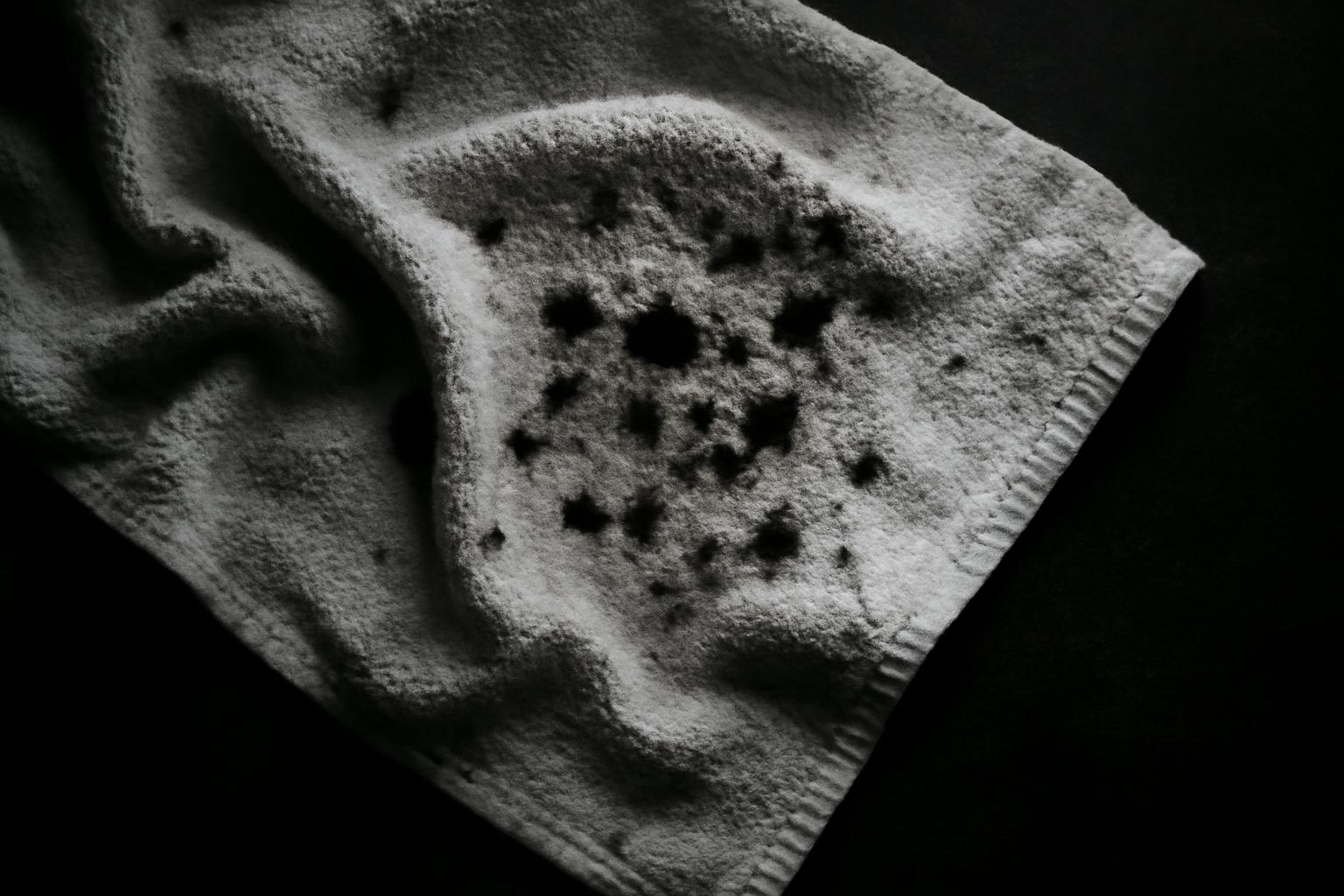
Black dots on a towel are not a diagnosis. Moisture-related growth is plausible when a towel remained damp, especially if the fully dried fabric smells musty. Greasy smears, sticky flakes, widespread gray specks, or marks that appear only after laundering point toward other possibilities, including pigments, dye transfer, laundry-product deposits, trapped particles, grease, or residue from the washing machine.
The most useful clues are when the dots appeared, how they feel, where they occur, whether the dry towel smells, and whether other laundry is affected. Start with the towel’s care label, use a compatible laundry product as directed, inspect the result before machine drying, and investigate the washer if the marks return.
What black dots on a towel can—and cannot—tell you
Black dots can be consistent with mold after prolonged dampness or humid storage. Color and appearance alone, however, cannot confirm that a substance is mold or identify its species. A photograph also cannot establish that a towel has a particular kind of mold, and “black mold” should not be assigned simply because the marks are dark. Several molds may appear dark, while dirt, pigments, grease, and old stains can look similar on fabric, according to this overview of mold appearance and exposure.
Before assuming the most alarming explanation, consider these alternatives:
- Trapped particles or pigments: Dust, soot, charcoal, lint, and other fine material may leave black or gray specks.
- Cosmetics and hair products: Mascara, eyeliner, hair dye, tinted products, and dark styling products can transfer to towels.
- Charcoal toiletries: Charcoal soap, shampoo, masks, or cleansers may release black pigment.
- Dye transfer: A dark or unstable textile in the same load may discolor a towel.
- Laundry-product deposits: Repeated fabric-softener use, excessive product, overloading, or inadequate rinsing may contribute to darkening or deposits.
- Washer residue: Material from an accessible drum, gasket, dispenser, or filter area may transfer during washing.
- Oil or grease: Body products or washer-related residue may produce gray-black smears rather than discrete dots.
A towel manufacturer’s care guide lists accumulated particles, charcoal toiletries, mold, repeated fabric-softener use, and inadequate washing or rinsing among the possible causes of black or gray discoloration. It describes particle-related darkening as generally widespread and moisture-related marks as more likely in frequently wet or slow-drying areas, although those patterns are clues rather than conclusive tests. See Uchino’s guide to towel discoloration.
Mildew is sometimes described as flatter, powderier, and lighter-colored, while mold may be described as darker, fuzzy, or dirt-like. These descriptions can help organize an inspection, but they are not diagnostic.
The key question is not simply, “Are the dots black?” It is, “What happened to the towel immediately before the dots appeared?”
Diagnose the cause by timing, smell, texture, and pattern
Lay the towel out in good light and inspect both sides. The table below is a troubleshooting aid, not a validated diagnostic test.
| Possible cause | Timing and pattern | Odor or feel | Most useful next check |
|---|---|---|---|
| Moisture-related growth | Appears after damp storage; may cluster in folds, hems, or slow-drying areas | A fully dried towel may smell musty or earthy | Check the hamper, rack, storage area, bathroom dampness, and drying routine |
| Pigments or particles | May develop gradually or after contact with a dark product; can be widespread | Often appears as fine embedded specks without a musty odor | Review cosmetics, hair products, charcoal toiletries, dust, and other items in the load |
| Dye transfer | Usually noticed after laundering with dark textiles | Generally flat discoloration rather than loose material | Inspect the rest of the load and recently purchased dark fabrics |
| Laundry-product deposits | Appears or becomes more obvious after washing | May feel coated or leave removable residue | Review product dose, load size, rinsing, dispenser condition, and softener use |
| Washer-transferred residue | First appears after a cycle or returns on freshly washed items | May be greasy, sticky, flaky, or smearable | Compare the marks with residue in areas the washer manual identifies as user-accessible |
| Oil or grease | Appears after use or laundering, often as streaks or transfer marks | Slick or smearable rather than powdery | Check body products and whether unrelated loads develop similar marks |
Ask these questions before choosing a treatment:
- Were the dots visible before washing?
- Did they first appear after the machine cycle?
- Does the fully dried towel smell musty or earthy?
- Do the marks return after rewashing?
- Are other towels, sheets, or garments affected?
- Do the marks feel dry, greasy, sticky, flaky, or embedded?
- Are they concentrated in folds and dense areas or spread across the towel?
- Does light contact with a disposable white cloth pick up any material?
Clues that make moisture-related growth more plausible
Moisture-related growth becomes more plausible when several clues occur together:
- The towel remained bunched or folded while wet.
- It sat in a closed hamper, bag, cabinet, or poorly ventilated room.
- The dots appeared before washing.
- They are concentrated in folds, hems, or other slow-drying sections.
- The towel still smells musty after drying completely.
- New dots follow repeated episodes of damp storage.
No single clue proves mold.
Clues that point toward the washer
Shift attention toward the washer when marks:
- Appear for the first time after laundering.
- Return immediately after rewashing.
- Affect items stored in different places.
- Look like greasy streaks, sticky flakes, or transfer marks.
- Resemble residue in a user-accessible washer area.
In one remote appliance-troubleshooting case, black greasy marks on white towels were discussed as potentially related to oil, grease, detergent buildup, fabric-softener residue, or material around the drum or door gasket. The cause was not confirmed by inspection, so these remain possibilities rather than a diagnosis. The limitations are important when reading this technician discussion of greasy towel marks.
Sticky or slimy deposits that return after washing also justify checking the machine. Another remote case involved black-brown material adhering to sheets after washing and recurring after rewashing. A technician proposed that accumulated soap deposits might be breaking loose, but the material was not tested and the cause was not established. That washer-deposit troubleshooting exchange illustrates why recurrence after a cycle is more informative than color alone.
Clues that point toward pigments, products, or poor rinsing
Widespread grayness or numerous fine specks may have a nonfungal cause. Review anything that recently touched the towel, including:
- Mascara, eyeliner, or makeup-removal products
- Hair dye or tinted hair products
- Charcoal soap, masks, shampoo, or body wash
- Dark washcloths, clothing, or bath mats in the same load
- Household dust or renovation debris
- Heavy detergent dosing
- Frequent fabric-softener use
- A tightly packed load that may not have washed or rinsed adequately
First response: isolate, inspect, and read the care label
Set the affected towel apart from clean linens while you assess it. Move it gently and avoid unnecessarily disturbing the marked area.
Then:
- Inspect both sides in strong light. Check folds, hems, decorative bands, and dense sections.
- Photograph the pattern. Take one full-towel image and one close-up so you can identify later changes.
- Check odor after complete drying. A wet towel’s odor is less informative than the smell that remains when it is fully dry.
- Describe the material. Note whether it looks dry, greasy, sticky, flaky, or embedded.
- Test for transfer gently. Light contact with a disposable white cloth may reveal loose grease or pigment.
- Read the care label. Check the permitted washing, bleaching, and drying instructions before selecting a product.
Do not assume that all towels tolerate the same treatment. A white-looking towel is not automatically bleach-safe, and a treatment suitable for one textile may not be permitted for another. Let the towel’s care label and the laundry product’s directions control the process.
For practical sorting:
- Plain white towel: Consider a bleach product only if the care label and product directions permit it.
- Colored or patterned towel: Select a product labeled as compatible with the towel and its color.
- Any towel with restrictive care instructions: Do not override those instructions in an attempt to erase the dots.
To make the result easier to interpret, use one label-compatible treatment at a time rather than cycling through several remedies in the same wash.
Clean the towel without confusing stain removal with disinfection
Use a conservative washing sequence:
- Read the towel’s care label and the laundry product’s directions.
- Choose a compatible detergent or labeled laundry treatment.
- Wash promptly on a permitted cycle and at a permitted temperature.
- Avoid packing the washer so tightly that the towel cannot wash and rinse adequately.
- Rinse thoroughly.
- Inspect the towel before machine drying.
- If another treatment is considered, confirm that both labels allow it.
- Dry the towel completely after treatment.
Inspecting before machine drying allows you to check whether removable residue remains. It does not mean leaving the towel damp: once inspection and any permitted retreatment are complete, dry it fully by a care-label-approved method.
Plain white towels
Chlorine bleach is an option only if:
- The towel’s care label permits chlorine bleaching.
- The bleach product is labeled for that use.
- You follow the product directions rather than an improvised recipe.
Do not substitute a universal concentration, wash temperature, or soaking time for the product instructions. If chlorine bleach is not permitted, use another labeled product compatible with the towel.
Manufacturer guidance discusses chlorine bleach only in connection with plain white towels and warns that visible mold-related marks may remain even after the underlying issue has been treated. That distinction is reflected in Uchino’s towel-care guidance linked earlier.
Colored, patterned, or otherwise restricted towels
Use a color- and textile-compatible product according to both labels. Do not assume chlorine bleach is necessary merely because a mark is dark. If the treatment needed to pursue the stain would violate the towel’s care instructions, replacement may be more practical than increasingly aggressive washing.
Vinegar and baking soda are not a stronger combined treatment
Vinegar and baking soda are often promoted together as a universal remedy, but the supplied evidence does not establish that the combination is a superior treatment or that either method reliably disinfects every towel.
One commercial towel-care guide places baking soda and vinegar in separate cycles and specifically advises against putting them in the same load because they react and foam. Its instructions should not be treated as proof of universal effectiveness, but they do show why the products should not be presented as a stronger combined remedy. See the retailer’s discussion of separate vinegar and baking-soda cycles.
Use any laundry additive only when the towel label, product directions, and washer instructions permit it.
Three outcomes that should not be confused
Cleaning can produce three separate results:
- Removing deposited material: Loose pigment, grease, lint, or washer residue is lifted from the fabric.
- Reducing microorganisms: The result depends on the labeled product and the conditions under which it is used.
- Removing discoloration: The black or gray mark becomes less visible.
Success in one category does not prove success in the others. A towel may stop shedding sticky residue but retain a stain. A mark may lighten even though its original cause was never identified.
Do not assume that detergent, vinegar, baking soda, bleach, sanitizer, or heat will always eliminate mold or make a towel safe. The supplied evidence does not establish a universally effective treatment.
An established mark may also remain after deposited material or suspected growth has been addressed. Towel-manufacturer guidance notes that deeply embedded particulate dirt can be difficult to remove and that treating mold does not necessarily erase visible pigmentation. A persistent stain alone therefore does not prove that active mold remains.
When the washing machine is putting the dots back
If the marks appear only after washing, recur immediately after rewashing, or begin showing up on unrelated items, stop escalating treatment on the towel and investigate the laundry process.
Consult the washer manual and inspect only the locations it identifies as user-accessible. Depending on the machine, those may include the visible drum or basket, a door gasket, dispensers, or a removable filter. Compare any residue with the material on the towel.
Clean the machine according to its manual
Follow the appliance manufacturer’s instructions for:
- Cleaning user-accessible parts
- Selecting an approved washing-machine cleaner
- Running a designated tub-clean, drum-clean, or maintenance cycle
- Caring for removable dispensers or filters
- Leaving the door or lid open to dry, if the manual recommends it
During troubleshooting:
- Use the amount of detergent specified for the washer, product, and load.
- Avoid tightly packed loads.
- Select adequate washing and rinsing for towels.
- Limit fabric softener if recurring buildup or reduced absorbency is suspected.
- Remove wet laundry promptly.
- Note whether the washer drains normally.
More laundry product is not necessarily more useful. If detergent or softener is not adequately dispersed and rinsed, it may contribute to deposits.
Run a controlled recurrence check
After completing the manufacturer-approved cleaning procedure, wash an old white towel by itself using the correct product dose. Photograph it before and after.
This is a practical recurrence check, not a definitive diagnostic test. Fresh marks indicate that the problem still requires attention.
Where practical, change one variable at a time:
- Clean the washer according to its manual.
- Test one old white towel.
- If marks recur, verify product dose and load settings.
- Test again.
- Seek service if oily, sticky, or dark deposits continue.
Changing the machine cleaner, detergent, softener, cycle, load size, and test fabric simultaneously makes it difficult to determine what mattered.
When to call an appliance technician
Soap deposits, grease, hidden buildup, and mechanical sources are all possible explanations for recurring marks, but the remote troubleshooting cases do not confirm any one cause.
Arrange appliance service when:
- Oily or sticky deposits continue across multiple loads.
- User-accessible areas appear clean but fresh marks keep returning.
- Manufacturer-approved maintenance does not resolve the issue.
- The washer also develops leaking, unusual noise, drainage trouble, or other abnormal behavior.
- Further investigation would require access to internal components.
One remote case suggested that persistent deposits might eventually require removal and cleaning of the inner basket by a technician. Because the source did not establish the deposit’s identity or confirm a repair, that should be understood as an escalation option rather than a diagnosis.
When to keep the towel, replace it, or seek additional help
The practical decision depends on its condition, whether the suspected source has been addressed, and whether it can be treated within its care instructions.
Keeping the towel may be reasonable when:
- The suspected source has been corrected.
- No new spots appear.
- No persistent musty or oily odor remains.
- No loose, sticky, or greasy material remains.
- The fibers remain intact.
- The towel can be washed and dried within its care instructions.
- You are comfortable using a visibly stained towel.
Replacement is reasonable when:
- A musty odor persists after appropriate washing and complete drying.
- New spots repeatedly develop.
- The affected area is extensive.
- Sticky or greasy material remains embedded.
- The fibers are deteriorating.
- Further treatment would violate the care label.
- Continued troubleshooting is not worthwhile.
If several towels develop dots before washing, investigate their environment. Check the hamper, rack, hooks, closet, shelf, bag, bathroom ventilation, and nearby dampness. A towel folded over itself or crowded with other wet textiles may dry slowly.
If several items develop oily or sticky marks after washing, appliance service is more appropriate than repeatedly treating or discarding individual towels.
Mold exposure may cause irritation or allergy-like symptoms in some people, but dark color does not establish a uniquely dangerous mold, and appearance cannot predict whether a particular person will react. Anyone with significant respiratory, eye, or skin symptoms should seek appropriate medical guidance rather than relying on a visual towel diagnosis.
Prevent dark dots from coming back
Prevention starts with moisture control. Do not leave used towels folded, bunched, or sealed while wet.
Improve airflow after every use
Hang used towels:
- Fully unfolded
- With as much surface exposed as possible
- In a ventilated location
- Without layering one damp towel over another
- Away from a wet floor, closed hamper, or sealed bag
Wet washcloths are easy to overlook. Let them dry before placing them in an enclosed hamper, or wash them promptly. Commercial laundry guidance likewise recommends drying damp towels and washcloths before storage or laundering them without delay in its guidance on random black laundry spots.
Store only completely dry towels
Before placing clean towels in a closet:
- Let the drying cycle finish.
- Check folds, hems, and other dense sections.
- Avoid tightly packing laundry that still feels damp.
- Keep the storage area dry.
- Investigate a musty cabinet, condensation, or a nearby leak.
Apply the same principle to dirty laundry. If a wet towel cannot be washed promptly, let it dry before placing it in an enclosed hamper.
Adjust the wash routine
To reduce recurring deposits and particles:
- Avoid overloading the washer.
- Give towels enough room to move.
- Use the recommended detergent amount.
- Select adequate rinsing.
- Limit fabric softener if towels feel coated or show recurring deposits.
- Separate a suspected dye-releasing item from the next test load.
- Remove washed towels promptly.
- Dry them completely.
Maintain the washer
Follow the washer manual’s maintenance schedule. Use only the maintenance cycles, cleaners, and accessible-part procedures specified for that machine.
Track products and routines
If the dots recur, keep a short laundry log. Record:
- Whether the marks existed before washing
- Which towel or washcloth was affected
- Cosmetics, hair products, or charcoal toiletries used
- Other items in the load
- Detergent and softener used
- Load size and cycle
- Drying and storage location
Save this prevention checklist:
- Airflow: Hang towels unfolded.
- Prompt washing: Do not leave damp towels sealed or bunched.
- Complete drying: Dry towels before putting them in a hamper or closet.
- Correct product dose: Follow the product and washer directions.
- Adequate rinsing: Avoid tightly overloaded towel loads.
- Washer maintenance: Follow the appliance manual.
The decision path is simple: dots associated with damp storage and a musty odor make moisture-related growth more plausible; greasy, sticky, or post-wash deposits shift attention toward the washer; widespread specks suggest pigments, particles, products, dye transfer, or inadequate rinsing. In every case, begin with the care label, use compatible products as directed, wash and dry the towel completely, and investigate the washer or replace the towel if odor, new spots, residue, or fabric damage persists.
Frequently asked questions
Are black dots on a towel always mold?
No. They may be consistent with mold after prolonged dampness, especially in slow-drying areas on a towel that smells musty when fully dry. They may also be dirt, cosmetics, charcoal pigment, dye transfer, laundry-product deposits, grease, or washer residue.
Color or a photograph cannot conclusively identify mold or determine a species. Consider timing, moisture history, texture, pattern, and recurrence together.
Why do black dots appear only after the towel is washed?
Marks that first appear after washing may have transferred from another textile or from residue in the washer. Possible sources include dye, pigments, grease, detergent or softener deposits, and other buildup.
Inspect only the areas identified as user-accessible in the washer manual, run the designated maintenance procedure, and test an old white towel by itself. If oily, sticky, or dark deposits continue across loads, arrange appliance service.
Can I use chlorine bleach on a towel with black spots?
Only when the towel’s care label and the bleach product directions both permit it. Do not assume that every white-looking towel is bleach-safe or that chlorine bleach is required for a dark mark.
If chlorine bleach is not permitted, choose another labeled laundry treatment compatible with the towel.
Does a remaining black stain mean mold is still alive?
No. A remaining stain does not by itself prove active growth. Pigment or deeply embedded particles may remain after deposited material has been removed or the suspected source has been addressed.
Assess odor after complete drying, loose residue, recurrence, moisture conditions, and whether new spots appear. Removing deposits, reducing microorganisms, and erasing discoloration are different outcomes.
Can suspected mold on a towel cause health symptoms?
Mold exposure may cause irritation or allergy-like symptoms in some people, but a dark mark cannot establish the mold type, exposure level, or medical significance. Not everyone exposed develops symptoms, and black coloring does not identify a uniquely hazardous mold. This health overview of mold-exposure symptoms describes possible respiratory, eye, and skin effects.
Set the towel aside and seek appropriate healthcare guidance if significant symptoms occur. For the towel, follow its care label, wash it with a compatible product, dry it completely, and replace it if musty odor, recurring spots, extensive contamination, or fiber deterioration persists.