 StainList
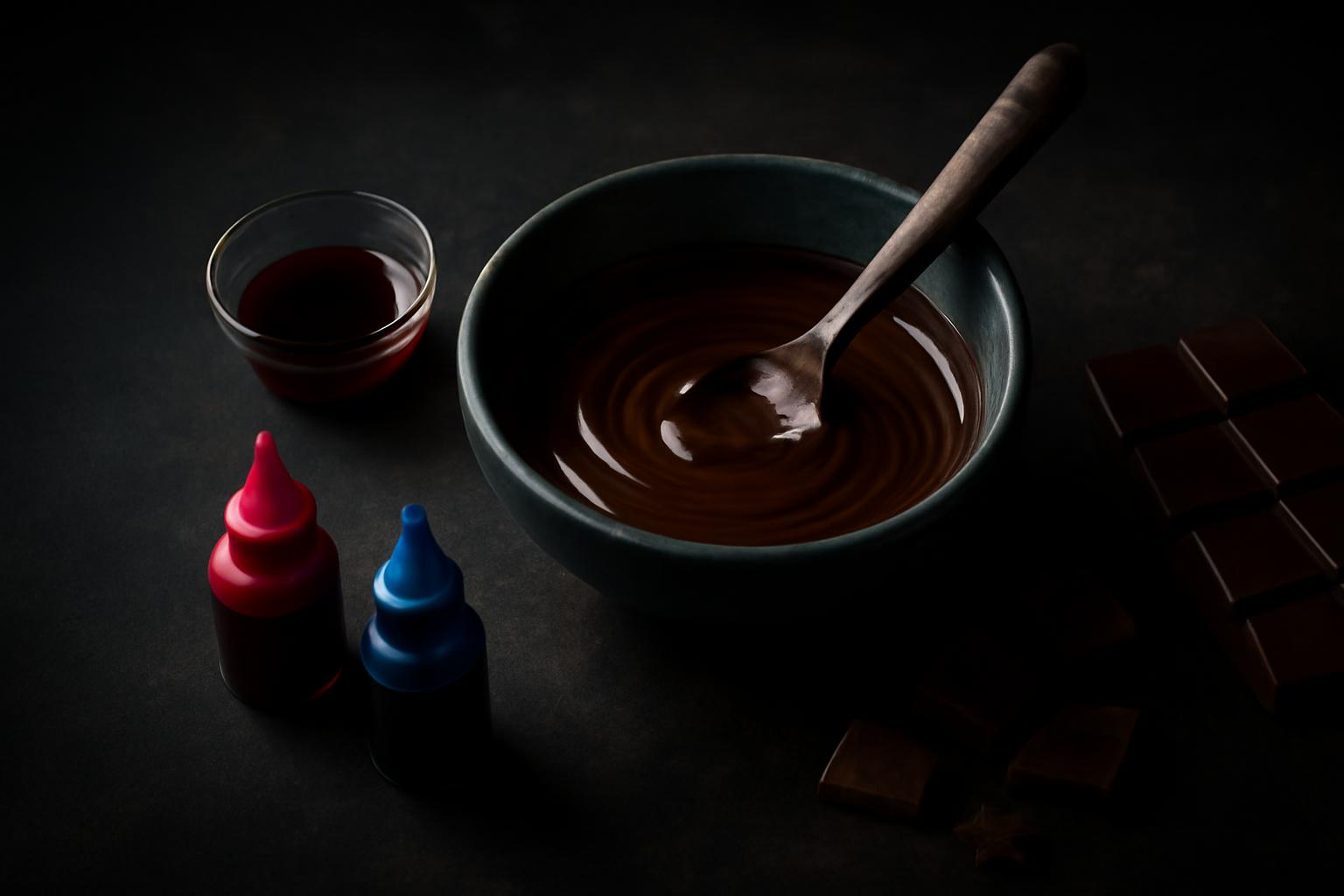
Coloring melted chocolate starts with two questions: What is the base? and Does the coloring manufacturer explicitly approve the product for that base?
Chocolate, couverture, cooking chocolate, compound coating, and candy melts are all sold for confectionery work, but they are not interchangeable. Keep bowls and utensils dry, test a small portion, and add color gradually.
Ordinary liquid food coloring and many conventional icing gels are water-based, so commercial guidance repeatedly warns that they can make melted chocolate thick or grainy. But “gel” is not a complete compatibility description. Formulations vary, and some products sold as gels are specifically intended for chocolate or other fat-rich foods.
The guidance below is therefore a cautious synthesis of current manufacturer and confectionery-retailer instructions, not an independently tested comparison of every coloring format.
The short answer: match the coloring to the fat-rich base
For melted chocolate or candy coating, look for a coloring whose current package or manufacturer directions name one or more of these applications:
- Chocolate
- White chocolate
- Cocoa butter
- Couverture
- Candy melts
- Compound or candy coating
- Other high-fat or oil-based foods
The formats most commonly recommended in the supplied commercial guidance are:
- Oil-dispersible liquid color, often sold as candy or chocolate color.
- Fat-soluble commercial powder, sold for dispersion in chocolate, cocoa butter, or another fat-rich base.
- Colored cocoa butter, particularly for decorating molds and finished chocolate surfaces.
Retailer guidance generally assigns oil-based colors to chocolate and candy melts while directing conventional water-based gels toward icing, fondant, batter, macarons, and similar foods containing more water (BakeDeco’s oil-based and water-based color guide).
Ordinary liquid dye and many conventional gels can introduce moisture associated in commercial guidance with thickening, graininess, or seizing. That does not mean every liquid or gel will inevitably ruin every batch. Results may depend on the particular color, the amount added, the chocolate or coating, and how both products are handled.
Do not choose by product name or consistency alone. A conventional icing gel may be unsuitable, while a gel specifically approved for chocolate or high-fat applications may be compatible.
Use this decision rule:
- Identify the chocolate or coating.
- Check the color manufacturer’s approved applications.
- Follow the smallest recommended starting amount.
- Test the color in a small portion.
- Color the full batch only if the sample remains workable.
Even an approved colorant may change flow, opacity, setting, or appearance. The available sources do not establish that compatibility guarantees unchanged viscosity, temper, gloss, snap, or storage stability.
Know whether you have true chocolate or a compound coating
There are two overlapping ways to describe a confectionery base:
- Chocolate type or color: white, milk, or dark.
- Product class: couverture, another cocoa-butter chocolate, or a compound coating.
Couverture is not a fourth color alongside white, milk, and dark.
Couverture is cocoa-butter-based chocolate intended for work in which fluidity and finish matter.
Candy melts and compound coatings use non-cocoa-butter fats and are designed to set without traditional chocolate tempering. They are commonly used for dipping, drizzling, molded decorations, and other convenient coating applications.
Both categories are fat-rich, so commercial sources recommend fat-compatible colors for each. They should not be treated as identical, however. One retailer guide recommends fat-soluble powders or cocoa-butter colors for couverture and oil-based or fat-soluble colors for compound coating. It also describes candy melts as somewhat more forgiving of minor moisture exposure while warning that they may still become grainy, separate, or change consistency (Zucchero Canada’s chocolate and candy-melt coloring guide).
That relative tolerance is a qualitative vendor observation, not a measured comparison. It does not establish a safe amount of water or justify adding ordinary liquid coloring freely.
“Cooking chocolate” or “baking chocolate” is not a sufficiently precise category for choosing a colorant.
| Base | Natural base color | When tempering may matter | Commonly recommended coloring choices |
|---|---|---|---|
| White cocoa-butter chocolate | Ivory to cream | When gloss, snap, or clean mold release is required | Oil-dispersible color or fat-soluble powder approved for white chocolate; compatible colored cocoa butter for decoration |
| Milk cocoa-butter chocolate | Light to medium brown | When a tempered coating or molded finish is required | Approved fat-compatible color, with the understanding that the brown base limits visible shades |
| Dark cocoa-butter chocolate | Deep brown | When a tempered coating or molded finish is required | Approved fat-compatible color, mainly for subtle adjustments or dark effects |
| White, milk, or dark couverture | Depends on chocolate type | Generally relevant when gloss, snap, and mold release matter | Product-approved fat-soluble powder, oil-dispersible color, or colored cocoa butter used as directed |
| Candy melts or compound coating | White, precolored, or chocolate-toned | Traditional chocolate tempering is not used | Oil-based or fat-soluble color approved for candy coating; alternatively, blend precolored wafers |
Package directions remain more useful than appearance. Two white products may look similar while differing in fat composition, intended use, melting method, and setting behavior.
Food-coloring formats compared
Format names are useful only when considered alongside the carrier, approved applications, and product-specific instructions.
| Coloring format | Typical chocolate application | Main advantage | Main caution |
|---|---|---|---|
| Oil-dispersible liquid | Mixed into melted chocolate or compound coating when expressly approved | Convenient for gradual, uniform tinting | Approval does not guarantee unchanged viscosity, temper, gloss, or snap |
| Fat-soluble commercial powder | Mixed or dispersed according to its directions | Concentrated color without the liquid carrier used in ordinary liquid dye | Strength and dispersion procedures vary by product |
| Colored cocoa butter | Brushed, splattered, or airbrushed into molds or onto compatible surfaces | Commonly marketed for decorative chocolate work | Melting, tempering, and working instructions are product-specific |
| Conventional gel | Usually used in icing and other water-containing foods | Concentrated and familiar to home bakers | Many are water-based; “gel” alone does not establish chocolate compatibility |
| Ordinary liquid dye | Commonly used in batter, icing, drinks, and similar mixtures | Widely available | Frequently water-based and therefore a higher-risk choice |
| Natural food powder | Added to white chocolate in very small test quantities | Can provide color without ordinary liquid dye | Adds food solids and flavor as well as pigment |
Oil-dispersible liquid color
Oil-dispersible colors are commonly marketed for direct mixing into chocolate, candy, and compound coatings. Chefmaster, for example, describes its Candy Colors as formulated for chocolate and compound coating and sells both oil-dispersible liquids and dry powders in its chocolate-coloring range (Chefmaster’s chocolate-coloring collection).
That establishes the manufacturer’s intended applications; it does not provide an independent guarantee of performance. Follow the exact product directions instead of assuming that all colors described as oil-based can be used in the same amount or manner.
Fat-soluble commercial powder
A commercial powder intended for chocolate is sold for dispersion in a fat-rich base. Because it is dry, it does not introduce the liquid carrier associated with ordinary liquid dye.
These powders can be concentrated, but their preparation methods differ. Depending on the product, the directions may call for direct mixing or prior dispersion in a compatible fat. Do not substitute a ratio or preparation method from another powder simply because both products are dry.
Colored cocoa butter
Some products may also permit direct incorporation into chocolate, but this should not be assumed. Check whether the manufacturer approves that use and follow its instructions for preparation and working conditions.
Conventional gel and ordinary liquid dye
Many conventional gels and liquid dyes are designed for water-containing foods. Suitability for frosting, batter, fondant, or royal icing does not establish suitability for melted chocolate.
If a package lists those applications but says nothing about chocolate, cocoa butter, compound coating, or high-fat foods, choose a different product rather than experimenting with the full batch.
Queen Fine Foods publishes a brand-specific exception: its tutorial combines very small amounts of Queen gel or liquid color with vegetable oil before adding the mixture to white chocolate. The company also states that its liquid colors are water-based and warns that too much can make the chocolate seize (Queen Fine Foods’ white-chocolate coloring tutorial).
That method should not be generalized to other brands.
Natural food powders
Matcha, wheatgrass, spirulina, beet powder, and berry powder are food ingredients as well as color sources. They may contribute flavor, aroma, particles, and additional solids. Their tinting strength should not be assumed to match that of a commercial coloring formulated for fat-rich foods.
When shopping, give more weight to explicit approved applications than to broad front-label terms such as “professional,” “concentrated,” or “vibrant.”
Choose a format for the color and finish you want
The appropriate method depends on both the base and the intended result. Coloring an entire batch for dipping is different from decorating a mold or creating a loose marbled pattern.
Bright and pastel shades
Some manufacturers recommend adding a compatible white color first to reduce that warm cast and then introducing the desired hue. Chefmaster, for example, markets its white candy color for brightening off-white high-fat bases and creating pastels when combined with other candy colors.
This is manufacturer guidance, not an independent comparison.
Uniform dipping, drizzling, or coating
For a uniformly colored batch:
- Prepare the chocolate or coating according to its own directions.
- Choose a color explicitly approved for direct mixing into that base.
- Begin with the smallest recommended amount.
- Stir gently but thoroughly.
- Check both the shade and the flow before adding more.
If the chocolate begins to thicken unexpectedly, stop. Repeatedly adding more color to force a darker shade may leave the batch unsuitable for dipping or thin coating.
Decorated bonbon molds
Colored cocoa butter is commonly marketed for brushing, splattering, or airbrushing the inside of bonbon molds. Properly prepared couverture is then added to form the shell.
This technique places the color at the mold surface rather than coloring the entire bowl. Follow the cocoa-butter manufacturer’s directions instead of borrowing a melting or working temperature from an unrelated product.
Candy melts
Candy melts offer two straightforward approaches:
- Add an oil-based color approved for candy coating.
- Melt two or more existing wafer colors together.
Wilton recommends both methods for its Candy Melts. Its guidance also suggests adding white wafers to lighten a mixture or more of the base color to darken it (Wilton’s Candy Melts coloring guide).
Blending precolored wafers avoids adding a separate liquid, although the final shade is limited by the available colors. Follow the package melting directions and scale any manufacturer formula proportionally.
Marbled bark
Marbled white-chocolate bark is accessible because the colors do not need to be perfectly uniform.
Prepare two or more separately colored portions. Dollop them onto a lined tray, pass a skewer briefly through the colors, and stop before they merge into one muddy shade. Let the bark set according to the directions for the chocolate or coating used.
The available sources do not provide independent side-by-side testing that would justify ranking these methods for gloss, viscosity, shelf life, snap, bloom, or color stability.
A cautious method for coloring melted chocolate
There is no universal melting temperature, number of drops, or color-to-chocolate ratio. Both the base and the colorant require their own instructions.
-
Identify the base. Determine whether you have couverture, another cocoa-butter chocolate, cooking chocolate, candy melts, or compound coating. If the label is vague, inspect the ingredients and directions.
-
Follow the base product’s preparation method. Melt or temper it as instructed. Do not automatically apply a couverture tempering method to compound coating or a candy-melt method to cocoa-butter chocolate.
-
Dry the workspace. Use dry bowls, spoons, spatulas, measuring tools, and molds. Keep steam and condensation away from the melted product.
-
Confirm compatibility. Look for the exact base among the coloring manufacturer’s approved uses. Do not rely only on the words “gel,” “powder,” “liquid,” or “candy color.”
-
Prepare the color as directed. Shake, warm, melt, or pre-disperse it only if the product instructions call for that step. Do not transfer a warming time or working temperature from another brand.
-
Test a small sample. Move a spoonful of prepared chocolate into a separate dry container and mix in a tiny amount of color.
-
Inspect the sample. Check the shade and whether the chocolate has become unusually thick, grainy, streaky, or separated.
-
Color the main batch gradually. Begin with the smallest amount recommended by the manufacturer. Mix completely before deciding whether more is necessary.
-
Stop if the texture changes. Do not keep adding color to an unexpectedly thickening batch merely to obtain a darker shade.
For Wilton Candy Melts specifically, the manufacturer recommends transferring a small amount of oil-based color with a toothpick or knife tip and using a clean tool for every later addition. This is a practical portion-control technique for that product category, not a universal ratio.
The transferable precautions are simple: verify compatibility, keep equipment dry, test a small portion, and add the color gradually. Exact temperatures, warming times, drop counts, and oil ratios should remain product-specific.
Natural powders: color comes with flavor and texture
The available evidence for natural powders is narrow. It consists of an informal test-kitchen comparison of powdered green ingredients in melted white chocolate, not controlled confectionery research.
In that test:
- Matcha produced the publisher’s preferred green, while also contributing flavor and caffeine.
- Wheatgrass blended well and was described by the publisher as mild tasting.
- Spirulina was described as mild but produced a blue-green rather than a conventional leafy green.
The publisher recommends adding these ingredients a pinch at a time because increasing the powder strengthens both the color and flavor (Brod & Taylor’s natural green color test).
For a cautious trial:
- Place a small amount of melted white chocolate in a dry bowl.
- Add one small pinch of powder.
- Mix thoroughly.
- Inspect the color and texture, then taste the sample.
- Add more only if the result remains acceptable.
Do not extend the reported green-powder results to other pigments, milk or dark chocolate, temper stability, or long-term storage.
A natural food powder and a commercial fat-soluble powdered color are not equivalent merely because both are dry. One is being used as a food ingredient; the other is sold specifically as a coloring for fat-rich applications.
Troubleshooting thick, grainy, dull, or poorly set chocolate
A change in texture does not identify its cause with certainty. Sudden graininess after adding a conventional water-based color is consistent with commercial warnings about moisture, but the available guidance does not provide a validated home test that distinguishes seizing from poor dispersion, temperature problems, or loss of temper.
| Symptom | Possible contributors described or left open by the guidance | What to do next |
|---|---|---|
| Sudden graininess after liquid or gel is added | Moisture from an incompatible color, accidental water, or condensation | Stop adding color; do not assume the batch remains suitable for thin coating or molded shells |
| Excessive thickness without obvious grains | Too much color, an incompatible product, added powder solids, or handling problems | Stop adding color, compare with an uncolored sample, and review both products’ directions |
| Streaky color | Incomplete mixing or a color that was not prepared as directed | Mix gently only while the chocolate remains workable; check whether pre-dispersion is required |
| Speckles after adding powder | Incomplete dispersion or particles from the added powder | Follow the specified preparation method and test a fresh small sample rather than adding more |
| Dull appearance | Tempering, cooling, surface conditions, or the added color | Review preparation and cooling; do not assume color is the sole cause |
| Cracking | Excess color or product, storage, temperature, or chocolate-condition issues | Avoid diagnosing from appearance alone; repeat with a smaller test and fewer variables |
| Slow or incomplete setting | Base preparation, amount of additive, storage conditions, or product incompatibility | Follow the base product’s setting directions and avoid adding random oil or water |
Queen Fine Foods has cited excess color, chocolate age, storage, and temperature fluctuations as possible explanations for cracking or poor setting reported with its method. These are manufacturer-suggested possibilities, not independently established diagnoses.
If the chocolate is grainy
Grainy chocolate may no longer be suitable for:
- Tempered dipping
- Thin enrobing
- Molded bonbon shells
- Smooth decorative work
- Applications that depend on predictable flow
Avoid both absolute claims: a seized batch does not necessarily have to be discarded, but it also cannot be assumed to be recoverable for coating or molding.
One commercial guide suggests adding substantially more liquid to turn seized chocolate into ganache. The advice does not demonstrate recovery to tempered coating quality.
If you repurpose a batch, use an established ganache, sauce, or similar recipe so the liquid is added intentionally and in the context of a different finished product. Do not add arbitrary amounts of water or oil in the hope of reversing the texture.
Buying checklist and limits of the available advice
Before purchasing chocolate and food coloring:
- Identify the base. Determine whether it is cocoa-butter chocolate, couverture, cooking chocolate, candy melts, or another compound coating.
- Define the application. Decide whether you are mixing color throughout, dipping, drizzling, marbling, brushing a mold, splattering, or airbrushing.
- Look for an explicit high-fat use. The current package or directions should name chocolate, cocoa butter, candy coating, compound coating, candy melts, or high-fat foods.
- Choose a format suited to the job. Oil-dispersible liquids and fat-soluble powders are commonly marketed for direct mixing; colored cocoa butter is commonly marketed for mold and surface decoration.
- Read the current instructions. Formulations and directions can change.
- Check current ingredient and dietary information. Use the exact package and relevant certification documents rather than an old retailer listing.
- Buy enough for a test. A small trial can prevent the loss of the full batch.
- Do not transfer ratios between brands. Pigment strength, carriers, and preparation methods vary.
- Treat guarantees skeptically. Compatibility does not necessarily preserve viscosity, temper, gloss, snap, setting time, or storage stability.
Commercial ranges are sold in numerous shades and formats, including oil-dispersible liquids and dry powders. Product breadth does not establish which option performs best.
Likewise, vegan, allergen, gluten-free, or kosher claims should be checked on the current product label and, when relevant, against current certification documentation. The supplied manufacturer pages make such claims, but the evidence does not independently verify them.
Nearly all available performance advice here comes from manufacturers and retailers that sell coloring products, coatings, chocolate, or confectionery supplies. Important evidence gaps include:
- No controlled comparison of all major coloring formats
- No universal dose
- No validated moisture threshold for seizing
- Little comparative evidence about viscosity
- Little evidence about effects on temper, gloss, snap, or bloom
- Little evidence about fading, cracking, setting, or storage life
The most defensible purchasing rule is therefore straightforward: explicit compatibility and product-specific instructions are more useful than assumptions based only on words such as “liquid,” “powder,” or “gel.”
Frequently asked questions
Can I use regular gel food coloring in chocolate?
Regular icing gel is a higher-risk choice unless its manufacturer explicitly approves it for chocolate or another fat-rich application. Many conventional gels are water-based and are therefore associated in commercial guidance with thickening or graininess.
Do not decide from the word “gel” alone. Some products marketed in a gel format are specifically approved for chocolate. Check the applications and directions, then test a small portion.
A brand-specific tutorial that permits tiny amounts of its own gel should not be treated as a universal method. Combining gel with vegetable oil does not remove water already present or guarantee normal setting.
Why did my chocolate become thick or grainy after I added food coloring?
If the change happened immediately after adding conventional liquid or gel color, moisture exposure is a plausible explanation. Other possibilities left open by the available guidance include incompatibility, too much color, added powder solids, poor dispersion, or handling and temperature problems.
There is no validated visual test in the supplied evidence for identifying the exact cause. Stop adding color and review the directions for both the chocolate and the coloring.
Can seized chocolate be saved?
It may be possible to repurpose the batch, but do not assume it can be restored for tempering, dipping, or molded shells.
A grainy batch may work in a recipe intentionally containing enough liquid, such as ganache or chocolate sauce. Use an established recipe rather than adding random quantities of oil or water. If you need a smooth tempered coating, starting again is generally the more predictable course.
What food coloring works best for white chocolate and pastel shades?
Choose an oil-dispersible color or fat-soluble powder explicitly approved for white chocolate. White chocolate is the most practical base because it does not contribute the strong brown color of milk or dark chocolate.
Some manufacturers recommend first reducing its ivory cast with a compatible white color and then adding the desired hue gradually. Treat that as product-specific commercial guidance and test it in a small sample.
Natural powders can produce certain muted colors, but they contribute flavor and food solids as well as pigment.
Can I color Candy Melts with food coloring?
Yes. Use an oil-based or fat-soluble color specifically approved for Candy Melts or compound coating. Alternatively, blend two or more existing wafer colors.
Follow the wafer manufacturer’s melting directions and add separate color in tiny increments. Guidance written for Candy Melts should not automatically be applied to cocoa-butter couverture.
The final rule is compact: determine whether the base is couverture, another cocoa-butter chocolate, or a compound coating; select a color expressly approved for that product; keep tools dry; and add the smallest recommended amount gradually. Oil-dispersible colors, fat-soluble powders, and colored cocoa butter are the formats most commonly recommended in the available commercial guidance, while conventional liquid and gel colors require greater caution. If a batch becomes grainy, do not assume it can return to coating quality—repurpose it only through a suitable recipe, and be skeptical of universal ratios or guaranteed results.