 StainList
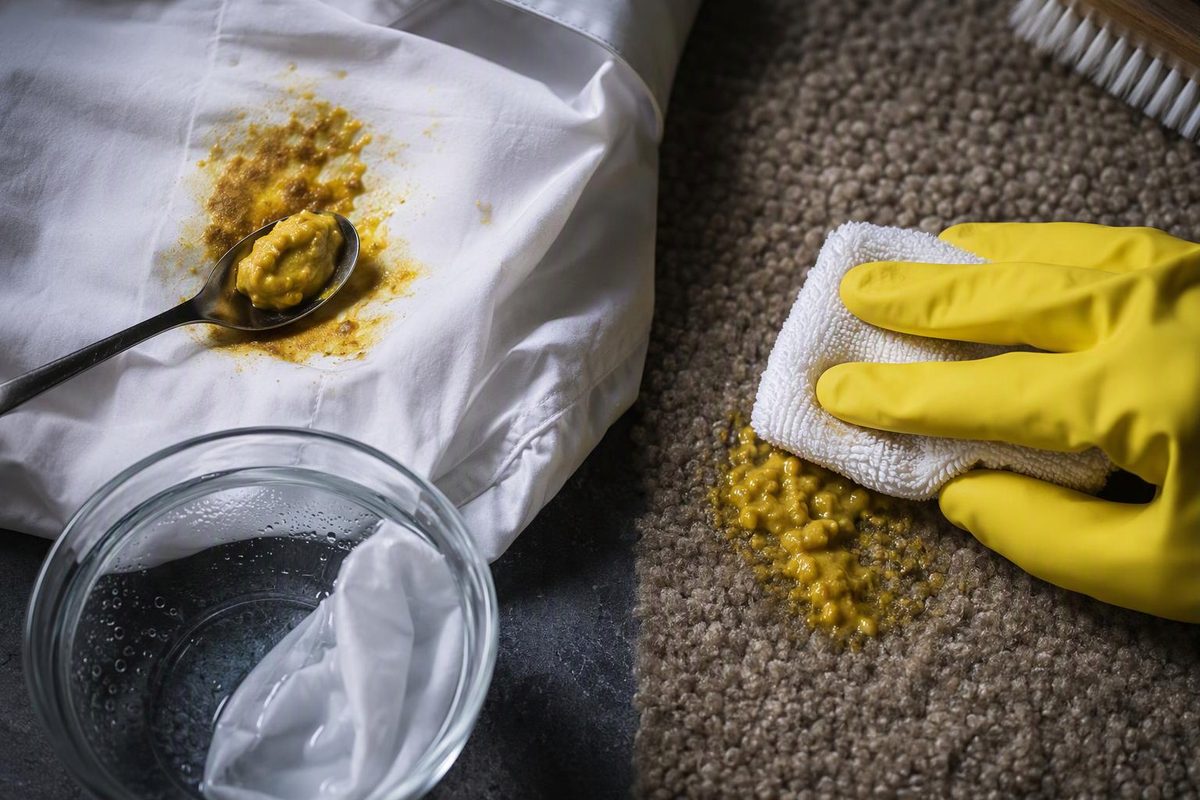
Lift off the excess mustard without rubbing it in. On washable clothes, rinse from the back with cold water, pretreat with liquid laundry detergent, then wash at the warmest care-label temperature. Inspect before tumble-drying. On carpet, use a white cloth and a weak dish-soap solution instead of laundry detergent.
The yellow mark can outlast the food residue: turmeric in yellow mustard acts as a dye and can leave permanent discoloration. Prompt treatment helps, but an old stain may not disappear completely. Clorox’s mustard guide identifies turmeric as the persistent coloring component.
First check the material
Read the garment or carpet care instructions before wetting it. Test each cleaner on a hidden area at its intended dilution and contact time; rinse if required and let the test area dry. Stop if you see dye transfer, fading or a change in texture. University of Georgia Extension recommends both care-label checks and pretesting for mustard treatments.
For dry-clean-only clothing, silk, wool or a valuable textile, lift the excess gently and consult a cleaner rather than experimenting with household bleach or solvents. Tell the cleaner what spilled and which treatments you have already used.
Fresh mustard on washable clothes
- Lift the mustard. Use a spoon or a blunt edge. Lift upward rather than smearing the condiment across the fabric.
- Flush from the back with cold water. Hold the reverse side of the stain under a gentle running stream so the water pushes mustard out rather than farther through the cloth. Clorox specifies a cool back-rinse.
- Pretreat the remaining mark. Apply enough liquid laundry detergent to cover it, preferably a formulation containing enzymes if suitable for the fabric. Work it in gently with your fingers, without hard scrubbing. Follow the product’s pretreatment contact time; a prewash stain remover is another option. These approaches are supported by Clorox and the American Cleaning Institute.
- Wash as the label allows. Use the warmest permitted water temperature—not automatically a hot cycle. Cold water is the initial flushing step, not a requirement for the entire wash. ACI’s mustard instructions specify the hottest fabric-safe wash.
- Inspect before drying. If yellow remains, repeat treatment or move to the bleach step below. Air-dry when you need to check the dry fabric. Do not tumble-dry a remaining stain; Clorox’s mustard instructions advise repeating treatment before using the dryer.
Dried mustard or a lingering yellow stain
Gently lift any dried surface crust without pulling at the fibers. Soak the stained area in cool water, then pretreat and wash as above. Tide’s set-in mustard instructions also begin with excess removal and a cold-water soak.
If detergent leaves yellow behind, consider an oxygen-bleach soak only when both the fabric label and product instructions permit it. Use the package dose, water temperature and duration; different products are not interchangeable.
For example, OxiClean Versatile Stain Remover’s clothing instructions specify dissolving a scoop filled to line 2–4 per gallon of water, then soaking for 1–6 hours before washing. That is a product-specific dose, not a recipe for every oxygen bleach; follow your package if its directions differ. Its instructions exclude wool and wool blends, silk and silk blends, leather, and dry-clean-only fabrics. Usage directions and fabric exclusions apply.
Chlorine bleach is a further option only for fabrics explicitly permitted by both labels; the American Cleaning Institute’s mustard entry recommends it when fabric-safe. Follow the bleach label’s laundry dose and dispensing instructions—do not pour undiluted bleach onto the stain. Rinse out earlier spot treatments before switching products, and do not combine bleach products. Never mix chlorine bleach with vinegar, ammonia or other cleaners: dangerous gases or reactions can result. Washington State Department of Health
If a correctly used treatment produces no further improvement, stop escalating the strength or soak time. Professional assessment may be safer, and complete removal is not assured after drying or heat exposure.
Mustard on carpet
For a carpet that permits water-based spot cleaning, follow this low-moisture sequence from the Carpet and Rug Institute’s mustard guide:
- Lift excess mustard with a rounded spoon. Do not scrub.
- Mix ¼ teaspoon of liquid hand-dishwashing detergent with 1 cup of lukewarm water. Choose a non-bleaching product—not automatic dishwasher detergent. Do not strengthen the mixture.
- After spot-testing, apply a small amount to a white cloth, not directly into the carpet. Blot gently from the outside toward the center. Allow a few minutes of contact, then blot with a clean section of cloth.
- Repeat while mustard continues transferring to the cloth.
- Rinse with small amounts of clean water and blot dry after each rinse. Avoid soaking the backing; detergent left behind can attract soil. Let the carpet dry fully.
Do not substitute laundry detergent: the Carpet and Rug Institute warns that optical brighteners in laundry formulations can alter carpet color. If the yellow mark stops transferring, use a carpet-approved spot remover according to its label or consult a professional. For wool, silk, specialty rugs or an unidentified fiber, seek material-specific advice before further treatment.