 StainList
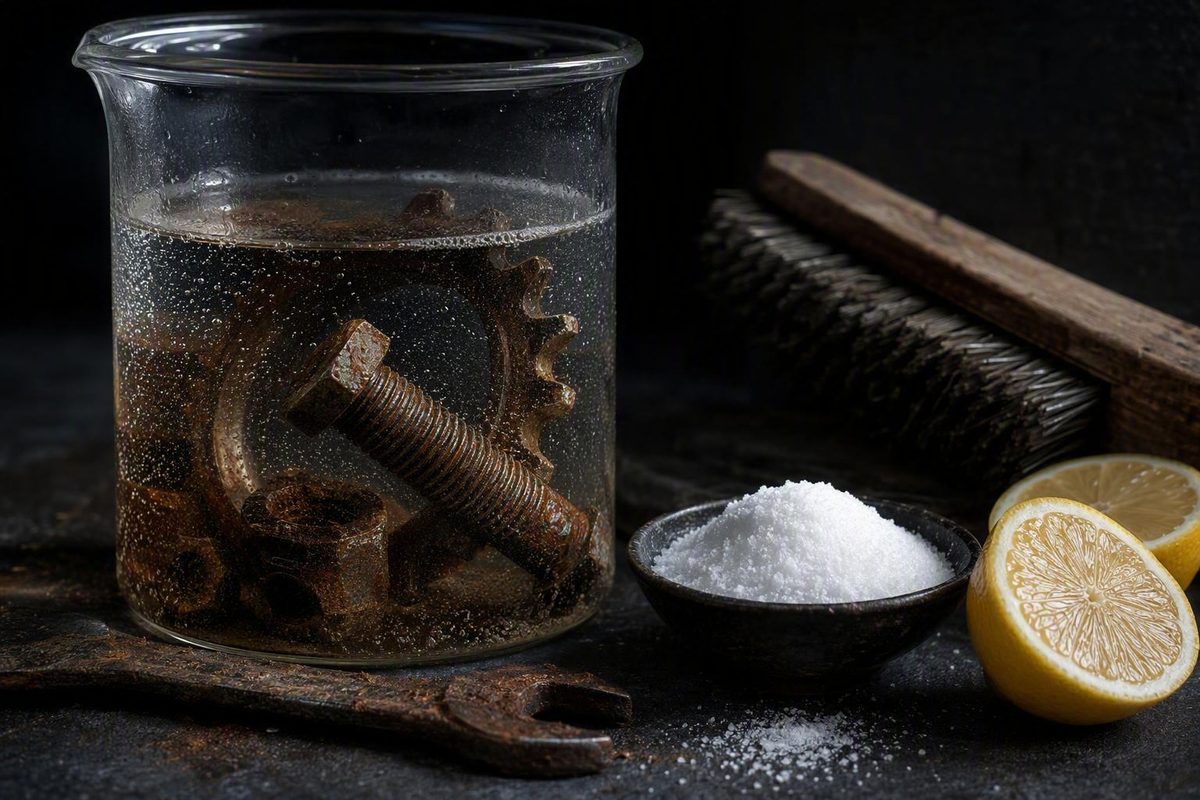
Citric acid can remove light-to-moderate rust from ordinary iron and steel, including corrosion in threads and recesses that are difficult to sand. It is not harmless, perfectly selective, or appropriate for every metal object. A bath that removes rust may also dull a finish, erase markings, disturb coatings, or eventually attack sound steel.
For a cautious household trial, start with 20–40 grams of citric acid per liter of warm water, inspect light rust after about 20–30 minutes, brush gently, and continue only in short, monitored cycles. These are practically reported starting points, not validated limits for every object or bath (illustrated citric-acid rust-removal guide).
Once the rust has released, rinse thoroughly, dry immediately, and protect the bare steel without delay.
This guide is limited to removable, identified iron or ordinary carbon-steel parts. It does not cover rust-colored stains transferred onto fabric, stone, grout, concrete, wood, or other nonmetal surfaces. The available evidence also does not provide authoritative compatibility, first-aid, or waste-disposal guidance for every material and situation, so the product supplier’s label and safety data sheet—and local disposal instructions—must take precedence.
First decide whether a citric-acid bath fits the object
A citric-acid bath is most suitable for ordinary iron or steel parts with light-to-moderate surface rust. Possible candidates include:
- Plain steel hand-tool components
- Nuts, bolts, screws, and brackets
- Small pieces of iron hardware
- Removable machine parts that are not precision-, load-, or safety-critical
- Complex steel shapes that can be completely submerged, inspected, rinsed, and dried
Immersion has a practical advantage over sanding: liquid can reach threads, holes, corners, and recesses that abrasives may miss. Personal tool-restoration demonstrations illustrate that advantage, although they are not controlled tests and do not establish universal treatment conditions.
First confirm that the corrosion is on the metal itself. A rust-colored mark transferred from metal onto fabric, stone, grout, wood, or a finished surface is a stain problem, not a reason to immerse the stained material in acid.
The part should fit completely in a stable workshop container. Partial immersion may leave an uneven boundary. If an item is too large to submerge, turn, inspect, rinse, and dry conveniently, choose a more controllable method.
What the bath will not repair
Rust removal exposes the surviving metal; it does not rebuild what corrosion consumed. Pits remain pits. Threads may remain undersized, edges rounded, and thin sections weakened. As toolmaker Ron Hock explains, oxidized iron cannot simply be returned to the original surface (Hock Tools discussion of rust removal).
Choose another method or obtain appropriate technical assessment when you find:
- Thick or lifting scale
- Deep pits in a functional surface
- Significant dimensional loss
- A visibly thinned or perforated section
- Corrosion at a cutting edge, bearing surface, seal face, or precision fit
- Uncertainty about how much sound metal remains
Do not use a successful cleaning result as proof of structural strength. Springs, lifting hardware, steering or braking parts, pressure-containing components, stressed fasteners, load-bearing assemblies, and other safety-critical items require competent inspection. The available evidence does not resolve the risks for hardened or highly stressed steel.
Objects that need testing or specialist care
Do not place a valuable, historic, sentimental, or unidentified object directly into a full bath. Exercise the same caution with anything that has:
- Etching, engraving, stamps, or fine graduations
- Bluing, patina, plating, or another conversion coating
- Paint, lacquer, or powder coating
- A polished or lapped surface
- Soldered or brazed joints
- More than one metal
- Wood, leather, plastic, rubber, seals, or adhesive
- Hidden cavities that cannot be rinsed and dried
User reports describe discoloration, dulling, lost etching, altered paint, and other finish changes. These observations do not prove that every listed material is incompatible; instead, they show that compatibility cannot be assumed. A small, inconspicuous test is essential when appearance or detail matters (reported precautions for marked and finished tools).
For antiques, historic tools, valuable pieces, and objects whose patina or markings contribute to their significance, consult a conservator. “Clean metal” is not always the correct conservation goal.
What citric acid can—and cannot—do to rusty steel
That makes it useful for derusting, but the common claim that it attacks rust without affecting steel is too absolute.
A peer-reviewed paper establishes that citric acid can participate in effective rust removal from steel. However, its process used a thin citric-acid layer together with high-intensity flashlamp radiation. It therefore supports the general role of citric acid in steel cleaning, not a household concentration, temperature, or soaking time (1981 flashlamp-assisted steel-cleaning abstract).
Rust is not uniform. Two similarly orange parts may have corrosion layers with different composition, thickness, density, and accessibility. Grease, paint, compact scale, and other deposits may also block the liquid. Consequently, one part may clean quickly while another changes little in the same bath.
Citric acid is commonly treated as less aggressive than strong mineral acids for DIY derusting, but “less aggressive” does not mean inert. Strong or prolonged exposure can affect sound steel. Possible results include:
- Dulling of a polished surface
- A rougher or etched texture
- Greater visibility of existing pits
- Discoloration
- Softened visual definition of markings
- Damage to coatings or finishes
- Loss of sound base metal
Inspection is therefore more important than following a fixed soak duration.
A gray or black film may appear during or after treatment. Practical reports often say that it wipes or brushes away, but the evidence does not establish one chemical identity for every dark residue. Remove it gently, rinse, and inspect the exposed surface before deciding that rust remains.
Set realistic expectations. A successfully derusted piece may still be gray, dark-stained, matte, uneven, or pitted. Citric acid removes corrosion products; it does not recreate a factory-ground, polished, or plated finish.
Prepare the part, workspace, and protective equipment
Begin by identifying exactly what will enter the bath. This procedure is intentionally limited to removable, identified iron or ordinary carbon-steel parts.
Do not assume that the same homemade bath is compatible with:
- Aluminum
- Zinc or galvanized coatings
- Brass or copper
- Stainless steel
- Chrome, nickel, cadmium, or other plating
- Solder or brazing alloys
- Bluing or black oxide
- Paint, lacquer, or powder coating
- Adhesives, seals, plastics, or rubber
- Mixed-metal assemblies
This is a precaution based on limited compatibility evidence, not a claim that every material on the list will always be damaged. A commercial product may advertise broader compatibility because it contains detergents, buffers, inhibitors, or other ingredients not present in plain citric acid and water.
Disassemble and degrease
Disassemble the object where practical. Keep wooden handles, plastic knobs, bearings, seals, electronics, and other non-steel parts out of the bath. Separation also improves access to mating surfaces and makes complete rinsing and drying more achievable.
Remove soil, loose debris, oil, and grease before derusting. A greasy film can prevent the solution from reaching corrosion evenly. If treatment later produces little progress, incomplete degreasing should be one of the first possibilities considered.
Set up the whole process before mixing
Prepare:
- Citric acid powder
- A scale capable of weighing grams
- Warm water
- A stable workshop container appropriate for the supplier-labeled use
- A suitable degreaser
- Gloves and splash-resistant eye protection
- A retrieval tool
- A soft brush, soft brass brush, or fine nonwoven pad
- Plenty of clean rinse water
- Clean towels and moving air
- The final protective oil, wax, primer, paint, lacquer, or other finish
Reserve the container for workshop use and keep the bath away from children, pets, food, and drink.
Practical household guidance recommends gloves and avoiding eye splashes, but it is not a complete chemical-safety standard. Follow the citric-acid supplier’s label and safety data sheet for protective equipment, handling, storage, exposure response, and first aid. Do not assume that a concentrated powder or workshop bath is hazard-free merely because citric acid is also used in food.
Before full immersion, test a hidden area. Rinse, dry, and inspect the test spot under good light, particularly if the part has a polished surface, maker’s mark, graduation, etching, unknown finish, or sentimental importance.
Mix a conservative starter bath by weight
For ordinary rusty steel, use the following cautious starting range:
20–40 grams of citric acid powder per liter of warm water
This is a practically reported DIY range, not a standardized optimum. Published household recipes vary widely, and increasing the concentration is not automatically safer or more effective.
Scaling the mixture
| Water volume | Citric acid at 20 g/L | Citric acid at 40 g/L |
|---|---|---|
| 1 liter | 20 g | 40 g |
| 2 liters | 40 g | 80 g |
| 1 US gallon | about 76 g | about 151 g |
The gallon figures are the metric range scaled to approximately 3.785 liters. Weighing is preferable because cup and spoon measurements vary with granule size, settling, scooping, and packing (reported 20–40 g/L working range).
Use only enough solution to cover the part completely. A tall, narrow container may reduce the required volume for long pieces.
Mixing procedure
- Measure the required volume of warm water into the container.
- Weigh the citric acid separately.
- Add the powder gradually while stirring.
- Continue stirring until the powder has dissolved.
- Add the degreased part only after the solution is uniform.
Warm water helps dissolve the powder and is commonly reported to improve cleaning progress. The supplied evidence does not establish one validated ideal temperature, so do not treat hotter water as automatically better. Avoid boiling water and consider the container, the part’s heat tolerance, and splash risk.
Do not add vinegar, salt, sodium hydroxide, strong acid, or other improvised ingredients. Those additions create a different treatment with different compatibility, handling, and disposal questions.
Do not borrow directions from a formulated product
Plain citric acid and water are not equivalent to a commercial citric-acid-based detergent. One marketed formulation, for example, gives product-specific immersion dilutions and contact times measured in minutes, but its exact citric-acid concentration and other ingredients are not stated on the sales page (commercial Rust CITRIC directions).
Follow a commercial product’s own label, technical bulletin, and safety data sheet. Do not apply its dilution or timing to citric acid powder, and do not use this homemade recipe to override manufacturer instructions.
Soak, inspect, and scrub by checkpoints—not by a fixed deadline
Place the degreased steel fully into the prepared solution and begin timing. Reposition the part if trapped air is keeping liquid out of holes or recesses.
For light rust, make the first inspection after about 20–30 minutes. This is an early checkpoint, not a promise that the part will be clean. Practical steel-tool guidance reports that fresh solution can work in as little as approximately 20 minutes, depending on concentration, temperature, and agitation (steel-tool citric-acid procedure).
At every checkpoint
- Remove the part.
- Let excess solution drain into the container.
- Wipe or gently brush away loosened material.
- Rinse a small area if residue obscures the surface.
- Examine clean steel, edges, markings, and finished areas under good light.
- Return the part only if rust remains and the underlying surface appears unchanged.
Continue with similarly short, regular checks. Do not lengthen the interval merely because the first inspection showed no obvious damage, and do not leave the part soaking unattended overnight.
Moderate corrosion may require several hours or repeated cleaning cycles. Long soak times reported for one object do not establish that an equally long exposure is safe for another.
Brush with the least aggressive tool that works
Start with a soft nylon brush or cloth. If that is insufficient and a hidden-area test shows that the surface tolerates more abrasion, try a fine nonwoven pad or soft brass brush.
Use particular care around:
- Etched logos and graduations
- Sharp corners
- Precision surfaces
- Polished faces
- Threads
- Thin edges
The brush can scratch, round, or erase detail independently of the acid. A mild bath can still produce an aggressive overall treatment when combined with coarse abrasives or forceful scrubbing.
Do not use bath activity as a dosing gauge
Bubbles, yellow or brown solution, floating flakes, and dark residue are commonly reported observations. They are not validated indicators of correct concentration, completion, or the need for more acid.
Judge progress by removing residue and inspecting the metal. Do not add powder simply because the bath looks inactive.
Stop at the first sign of unwanted surface change
Stop treatment if you observe:
- Unexpected dulling of clean steel
- Yellowing or another unexplained discoloration
- New roughness
- Apparent pitting
- Fading etching, stamps, or graduations
- Lifting or softening paint
- Changed bluing or plating
- Attack on areas that were already clean
Rinse immediately. Continuing “a little longer” may convert a usable result into permanent finish or dimensional damage.
If progress is slow, do not automatically make the bath much stronger. Instead:
- Degrease the part again.
- Brush away loose material.
- Gently agitate the bath or reposition the part.
- Check whether the bath has cooled.
- Replace a dirty or apparently exhausted solution.
- Look for paint, scale, or another barrier.
- Reassess whether the corrosion is too heavy for this method.
Rinse, dry, and protect immediately to prevent flash rust
Plan the aftercare before the part enters the bath. Freshly exposed steel may develop a fine orange haze if it remains wet or unprotected.
1. Remove loosened residue
Gently brush or wipe away loosened material. Pay attention to threads, blind holes, seams, and recessed lettering. Dark residue may continue to come off even after the red-orange rust is gone.
2. Rinse thoroughly
Use plenty of clean water. Rotate the part so water passes through holes and cavities rather than merely flowing over the outside. Flush threaded holes, joints, recesses, and anywhere the solution could pool.
3. Treat a baking-soda rinse as optional
Some community chemistry guidance suggests a brief rinse in dilute baking-soda solution as additional assurance after a weak-acid bath, while also stating that thorough water rinsing may be sufficient. The available evidence does not define a validated household concentration or demonstrate that this step is superior (citric-acid neutralization discussion).
If you choose to use an optional dilute alkaline rinse, follow it with another thorough clean-water rinse. Do not let baking-soda residue remain in pores, seams, or threads. Neutralization is not a substitute for rinsing, drying, or coating.
4. Dry immediately and completely
Dry the part with clean towels and then moving air. Give particular attention to:
- Blind threaded holes
- Hollow sections
- Seams and crevices
- Undercuts
- Mating faces
- Areas beneath fastener heads
Use heated drying only for an all-metal item that is known to tolerate the chosen temperature. Do not heat an assembly containing wood, plastic, rubber, seals, adhesives, coatings, electronics, or other heat-sensitive materials.
5. Apply protection
As soon as the steel is fully dry, apply a suitable protective system. Depending on the object, that may be:
- Light machine or tool oil
- Paste wax
- A corrosion-preventive coating
- Primer and paint
- Lacquer
- Another finish suited to the part’s service conditions
Match the coating to the use. An indoor hand tool has different requirements from outdoor hardware, a paint-ready component, or a sliding precision surface.
If an orange haze appears soon after rinsing, the derusting stage may have worked; the aftercare was simply too slow or incomplete. Remove the light haze with the least aggressive appropriate method, then repeat the rinse-dry-protect sequence without delay.
Troubleshoot residue, slow cleaning, flash rust, and overexposure
The part is dark gray or black
Do not assume that all dark material is active rust. Wipe or brush gently, rinse, and inspect the exposed surface. Practical reports describe removable gray or black haze, but they do not establish that every dark film has the same composition.
If the underlying surface is solid and red-orange corrosion is gone, more acid may be unnecessary. Some dark staining can remain after removable corrosion products have been cleared.
Rust remains after the first interval
The initial inspection is deliberately early. Brush away loosened material, inspect the base surface, and repeat another short monitored cycle if the steel still appears stable.
For moderate rust, several cycles may be more controllable than one uninterrupted soak. Gentle agitation or a fresh bath may help. Do not assume that a much stronger mixture is the best next step.
Little or nothing is happening
Check likely obstacles in this order:
- Grease or oil: Degrease again.
- Paint or another coating: The liquid may not be reaching the corrosion.
- Cold solution: Mild warmth may improve progress.
- Compact scale: Gentle brushing may expose the underlying layer.
- Dirty or exhausted bath: Replace it rather than adding random ingredients.
- Unidentified material or corrosion: Stop and identify the object.
- Corrosion too heavy: Select another method.
Neither the absence nor presence of bubbles reliably establishes bath strength or safe progress.
Orange haze appears during drying
This is likely flash rust: newly exposed steel remained damp or unprotected long enough to oxidize again. Before the next rinse, arrange the towels, airflow, and protective finish so drying and coating can proceed without a pause.
Check hidden cavities as well. A part that appears dry on the outside may still contain water in a blind hole or seam.
The surface has become dull or rough
Stop treatment. The exposure may be affecting sound steel, although derusting may also reveal pre-existing texture and pits that corrosion had concealed.
Rinse thoroughly and inspect after drying. Light polishing or refinishing may improve appearance where appropriate, but metal removed by corrosion, acid exposure, or abrasion cannot be replaced. Do not polish a precision surface without understanding its tolerances.
New pits seem to have appeared
Rust can fill and disguise pits, so some apparently new pitting is old damage revealed by cleaning. Prolonged exposure can also roughen or etch the underlying steel. Stop in either case; more soaking will not restore the surface.
If pitting affects a cutting edge, bearing surface, seal face, thread, spring, or load-bearing section, seek technical assessment rather than judging serviceability by appearance alone.
Etching, paint, bluing, or plating has changed
Stop and do not repeat the same treatment. Woodworking-community reports describe damage to etching, paint, and metal surfaces after stronger or prolonged exposure, illustrating why delicate features require testing and close monitoring (tool-finish compatibility reports).
These features may not be recoverable. Continued soaking is more likely to enlarge the damage than make the finish acceptably uniform.
Deep pits or scale remain
Citric acid may remove loose corrosion products while leaving pits, staining, dimensional loss, and weakened sections. Heavy scale may call for mechanical removal, electrolysis, an appropriate commercial rust-removal system, or professional work.
If strength matters, visible oxide removal is not proof that the part is safe to return to service.
Know when to use another method—and how to handle the spent bath
Citric acid is one option, not a universal winner. Choose a method according to the object’s geometry, rust severity, finish, value, and tolerance for surface change.
Match the method to the job
Localized light rust: Careful hand abrasion with oil and a fine nonwoven pad or another suitable mild abrasive may offer more control than immersing the entire object.
Intricate removable steel parts: A citric-acid bath can reach threads, recesses, and complex geometry. It is most appropriate when the whole part can be watched, rinsed, dried, and protected.
Heavy scale: Mechanical treatment, electrolysis, an appropriate phosphoric-acid product, or professional cleaning may be more efficient. Each method brings its own surface, safety, and disposal considerations.
Finished, precision, valuable, or historic objects: Localized treatment or professional conservation is generally more defensible than a general bath.
Stronger mineral acids may act faster, but community chemistry discussion also describes greater handling hazards, more aggressive attack on sound metal, and more difficult disposal. Speed alone is not a sufficient reason to escalate to a stronger acid.
Do not mix vinegar into the bath
An anecdotal comparison reported no benefit from combining vinegar and citric acid and found citric acid alone more effective in that particular test. It was not a controlled trial, so it cannot establish a universal performance ranking (citric acid and vinegar discussion).
Adding vinegar also makes the bath harder to interpret. If following this guide, use a plain, measured citric-acid-and-water solution.
Citrate formulas are a different process
Partially neutralized citrate baths and commercial chelating removers are not synonyms for citric acid dissolved in water. Informal creator experiments have used added alkali and detergent, but those comparisons were neither standardized nor independently replicated. They also do not establish that a homemade citrate formula is superior or harmless to base metal.
Do not reproduce additive formulas involving sodium hydroxide from this guide. If you choose a commercial remover, follow its own label, product bulletin, and safety data sheet.
Reusing the bath
There is no supported fixed number of reuses for a homemade citric-acid bath. Useful life depends on solution volume, the amount and type of corrosion removed, contamination, and operating conditions.
Replace the bath when:
- Cleaning has slowed substantially
- Heavy sediment or floating debris has accumulated
- Oil or grease is visible
- Paint or plating may have entered the solution
- Its contents or treatment history are uncertain
Do not compensate for an unknown or dirty bath by adding improvised chemicals. A fresh measured bath is easier to control.
Disposal depends on contamination
The starting ingredients do not determine the condition of the used bath. After treatment, it may contain dissolved iron along with oil, grease, paint, plating metals, dirt, or unidentified residues from the part.
This evidence pack does not establish a universal legal disposal route, so do not assume that every used bath belongs in a household drain. Ask the relevant local wastewater or household hazardous-waste authority how to handle the solution, especially if it contacted:
- Old or unidentified paint
- Galvanized or plated parts
- Oily machinery
- Unknown alloys
- Automotive or industrial components
- Materials that may contain hazardous metals
Keep the solution labeled and secured while determining the appropriate route. Do not mix it with other waste chemicals.
For valuable, historic, precision, hardened, stressed, safety-critical, or structurally compromised parts, the appropriate next step is not a stronger bath. Seek professional conservation, metallurgical advice, or competent technical inspection.
Frequently asked questions
What is a reasonable citric-acid-to-water ratio for cleaning rust from steel?
A cautious, practically reported starting range is 20–40 grams of citric acid powder per liter of warm water. That equals 20–40 g for 1 liter, 40–80 g for 2 liters, or approximately 76–151 g for 1 US gallon (reported household working range).
This is not a universal optimum. Weigh the powder because spoon and cup measures vary. Start at the lower end for light rust or an uncertain surface, then rely on inspection and gentle brushing rather than automatically increasing the concentration.
How long should rusty steel soak in citric acid?
Inspect light rust after approximately 20–30 minutes. Remove the part, brush or wipe away loosened material, and return it only if corrosion remains and the exposed surface still appears stable. Practical reports range from about 20 minutes for some light deposits to several hours for moderate rust, but those observations are object-specific rather than validated deadlines.
Avoid unattended overnight soaking. Citric acid can eventually attack steel, and the condition of the surface is a better endpoint than a predetermined number of hours.
Do I need to neutralize citric acid with baking soda after rust removal?
Not necessarily. Thorough clean-water rinsing may be sufficient after a weak citric-acid bath. Some community guidance suggests an optional dilute baking-soda rinse, but the evidence does not provide a validated formula or show that it is superior to thorough rinsing and rapid drying.
If you use an alkaline rinse, rinse again with clean water. Then dry immediately and apply protection. Neutralization does not replace rinsing, drying, or coating.
Can citric acid damage steel, paint, plating, or etched markings?
Yes. User reports also describe altered paint, plating, bluing, polished finishes, and etched markings.
Test an inconspicuous area, use a conservative bath, inspect frequently, and stop at the first unexpected surface change. Do not immerse valuable or historically important objects without specialist advice.
Does mixing citric acid with vinegar remove rust faster?
There is no reliable evidence here that it does. One anecdotal comparison found no benefit from combining them, but it was not controlled testing and cannot establish performance for every bath or object.
For a more predictable household process, use measured citric acid and water without vinegar, salt, strong alkali, or other improvised additives. Start conservatively, inspect early and often, and complete the rinse-dry-protect sequence as soon as the rust has released.