 StainList
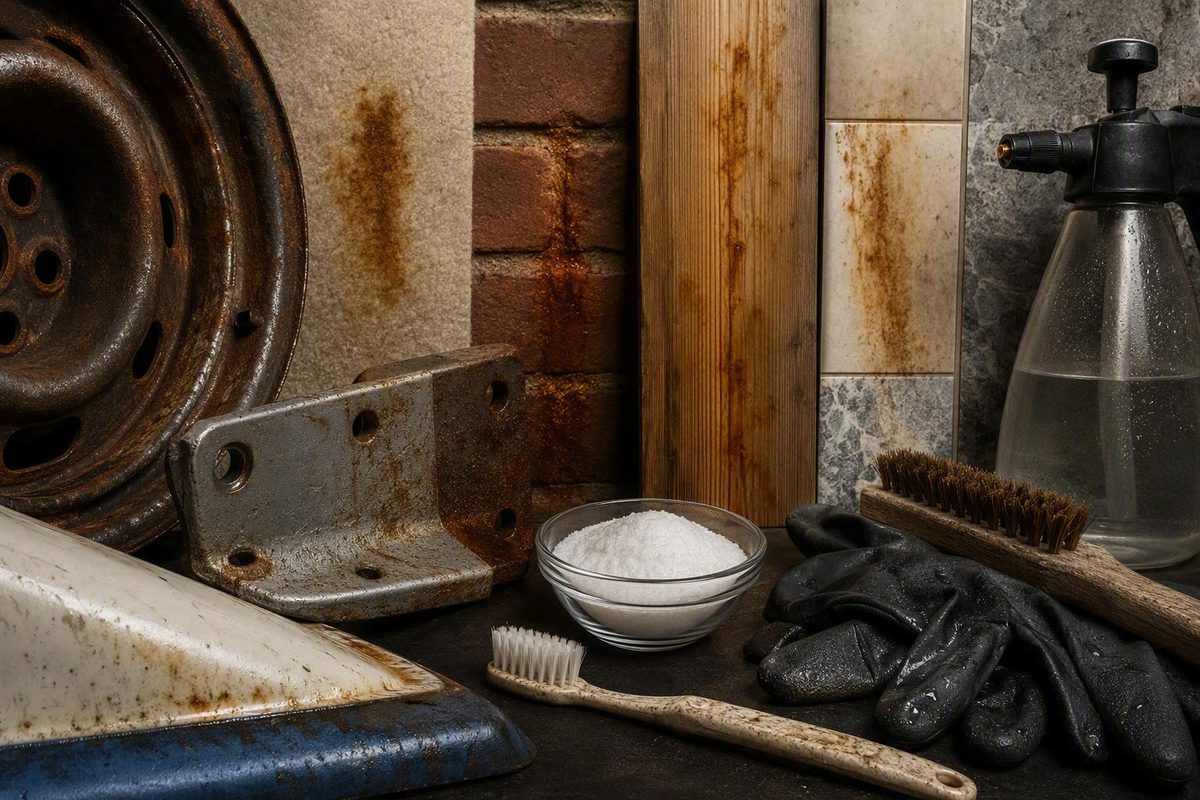
Oxalic acid can remove visible iron oxide, but the same recipe cannot safely move from a steel part to carpet, brick, wood, tile, stone, or a boat hull. Effective oxalic acid rust removal depends on identifying the underlying material, selecting a surface-specific method, limiting contact, inspecting frequently, rinsing thoroughly, and drying promptly.
Whenever possible, use a labeled rust-removal product approved for the exact surface rather than mixing raw crystals. The available evidence does not establish universal rules for material compatibility, chemical-resistant glove selection, ventilation requirements, wastewater disposal, hydrogen-embrittlement risk, neutralization, or post-treatment corrosion protection. Those details must come from the exact product label and Safety Data Sheet (SDS), the object’s manufacturer, local authorities, or an appropriate specialist.
Removing rust is also not restoration. Removing an orange-brown mark from carpet or masonry is different again: the iron may have transferred from another object while the stained substrate remains intact.
First identify the job: corroded metal or a rust stain on another surface?
Begin by placing the problem in one of two branches:
- Corrosion on a metal object: The metal itself has oxidized. Treatment must remove oxide without unnecessarily attacking the remaining metal, plating, coating, enamel, or adjacent components.
- An iron stain on a nonmetal surface: Rust has been deposited on carpet, fabric, upholstery, tile, brick, concrete, wood, stone, GRP, or another material. Treatment must remove the iron while preserving fibers, dyes, finishes, binders, sealers, and surface texture.
The orange color may look similar in both cases, but the risks are different. An immersion bath that reaches every side of a bare steel part could oversaturate carpet, bleach wood unevenly, or etch acid-sensitive stone. Conversely, a tile poultice is not automatically suitable for metal or textiles.
Surface characteristics determine whether treatment is reasonable:
- Porosity: Brick, concrete, unfinished wood, carpet, and some stone can absorb treatment and dissolved iron below the visible surface.
- Fiber and dye type: Carpet and textiles may lose color, distort, weaken, or retain treatment residue.
- Finish or coating: Paint, varnish, enamel, gel coat, plating, galvanizing, and sealers may respond differently from the material beneath them.
- Acid sensitivity: Carbonate stone and some metals, coatings, or finishes can be visibly attacked by acids.
- Construction: Upholstery, installed carpet, assemblies, and marine equipment may contain hidden backing, adhesive, seals, fittings, or dissimilar materials.
Use this decision sequence before selecting a product or procedure:
- Identify the substrate. Determine the alloy, stone family, fiber, finish, or coating where possible rather than settling for “metal,” “stone,” or “fabric.”
- Check care and product information. Read care labels, coating documentation, cleaning restrictions, warranty conditions, and the rust remover’s label and SDS.
- Decide whether immersion is appropriate. A removable bare part may permit soaking. A fixed or mixed-material assembly generally calls for localized treatment, if treatment is appropriate at all.
- Assess value and consequences. Consider what happens if the surface changes color, loses gloss, becomes etched, or suffers further corrosion.
- Choose the treatment level. That may mean a cautious hidden-area test, a labeled surface-specific rust remover, or professional treatment.
Seek professional evaluation for antiques and valuable objects, unknown alloys or finishes, safety-critical components, wool or silk, unknown upholstery, sensitive stone, and large stains that have soaked into porous material. Springs, brakes, load-bearing parts, high-strength fasteners, and components with uncertain heat treatment do not belong in an informal acid experiment.
This surface-first approach is consistent with Stain List’s stated practice of organizing removal guidance by stain and substrate rather than treating marketed formulas as universally applicable, as outlined in its editorial methodology.
What oxalic acid does to rust—and what it cannot do
For practical cleaning purposes, rust is iron-oxide material rather than ordinary organic dirt. Soap may remove grease surrounding a rusty area, but it does not necessarily make the mineral oxide rinseable.
Oxalic acid acts on the iron in the oxide layer. It binds iron ions and forms complexes that can be carried away during rinsing. This chemical action can reduce the need for forceful scraping or abrasion that might scratch a finish, remove plating, polish away detail, or distort fibers. A commercial chemical supplier describes oxalic acid as an iron-selective chelator, although its performance comparisons are seller claims rather than independent test results in its discussion of rust-removing acids.
Chemical action does not mean damage-free action. Results vary with:
- Rust thickness and composition
- Solution concentration
- Temperature
- Agitation
- Amount of fresh solution available
- Porosity and chemistry of the substrate
- Contact time
- Whether the iron is on the surface or embedded below it
Concentration is only one control. Heating may speed the reaction but reduce the margin for observation.
Rust removal must also be distinguished from rust conversion. Oxalic acid is used to remove oxide. Phosphoric-acid products are often positioned for converting residual rust before painting. Citric acid may fit situations where a slower, potentially more conservative process is preferred, while hydrochloric acid is generally described as more aggressive. These are purpose-based distinctions, not a universal ranking of which acid is “best” as summarized by a commercial supplier.
Claims that oxalic acid is always the safest, fastest, or most effective rust remover exceed the evidence. Performance changes with the metal, deposit, concentration, heat, exposure, and intended finishing step.
A patent publication also discloses fabric formulations that combine oxalic and ascorbic acids, including claimed concentration ranges and sequential-treatment options. A patent records a proposed invention; it is not a household instruction, an independent safety evaluation, or proof that the claimed combination is suitable for a particular garment as shown in the patent publication.
After oxide removal:
- Pits remain pits.
- Thin metal remains thin.
- Lost edges and threads are not rebuilt.
- Structural capacity is not recovered.
- Newly exposed metal may corrode again.
- A porous or finished material may retain a shadow where iron penetrated deeply or altered the surface.
If strength, dimensions, sealing, appearance, or historical value matter, cleaning is only one part of the assessment.
The conservative workflow: clean, test, treat, inspect, rinse and dry
There is no universal formula, but there is a broadly useful process:
- Remove loose contamination.
- Identify the material and finish.
- Read the cleaner’s label and SDS.
- Test the proposed treatment in a concealed area.
- Apply a bounded amount for a limited initial interval.
- Inspect frequently.
- Stop at the first sign of substrate damage.
- Rinse, blot, or extract thoroughly as appropriate.
- Dry promptly.
Pre-clean without spreading the problem
Remove loose dirt, scale, grease, and grime before applying an acid treatment.
On metal, use a compatible pre-cleaning method and remove loose flakes without grinding into sound surfaces. On carpet or textiles, lift dry debris gently rather than rubbing iron particles farther into the fibers.
Pre-cleaning does not mean mixing cleaners. Complete one compatible process, remove its residue, and follow the applicable label before introducing another product.
Run a meaningful hidden-area test
A quick dab followed by an immediate glance is not enough. Test the actual proposed working solution and application method:
- Select a small concealed area made from the same material and carrying the same dye, coating, or finish.
- Apply approximately the amount planned for the visible stain.
- Limit contact to the proposed initial interval.
- Use the intended agitation, if any.
- Rinse, blot, or extract in the same way planned for the main area.
- Let the test area dry fully.
- Compare it with the untreated material under good light.
Look for dye transfer, discoloration, gloss change, softening, etching, fiber distortion, raised grain, texture change, whitening, tackiness, coating disturbance, or a visible boundary around the treated spot.
Start at the conservative end
Use the weakest surface-appropriate treatment supported by the product label or a credible procedure specific to that substrate. Do not jump to a strong raw-crystal mixture simply because the stain looks dark.
Concentration, temperature, time, and agitation interact:
- Greater concentration may accelerate iron removal but increase substrate attack.
- Greater heat may speed the reaction but reduce the time available to detect damage.
- Longer contact may reach thicker deposits but also exposes the underlying material longer.
- More agitation may dislodge oxide but scratch finishes or damage fibers.
Repeated, monitored mild treatments are preferable to an unattended strong treatment or prolonged soak. Keep a timer running and inspect often enough to detect change before it becomes extensive.
Stop immediately if you see:
- Dye transferring to a cloth or applicator
- Unexpected lightening or darkening
- A stain boundary spreading
- Fibers changing shape or texture
- Etching or loss of gloss
- Paint, coating, or adhesive softening
- Raised, roughened, or unevenly bleached wood
- Visible attack on the underlying metal or adjacent fittings
Treat rinsing and drying as part of the process
Rinsing removes dissolved iron, residual treatment, and loosened contamination. The method depends on the surface: a compatible removable metal part may permit free rinsing, whereas installed carpet or upholstery requires controlled extraction without flooding backing or padding.
Dry promptly, particularly when bare metal has been exposed. Pay attention to pits, seams, holes, threads, and joints where moisture may remain.
The evidence does not establish one universal neutralizer, flash-rust prevention procedure, drying technique, or protective coating for every metal and finish. Follow the labeled product procedure and obtain object-specific advice when corrosion protection matters.
Concentrations and application formats: why no single ratio fits every job
Oxalic-acid recommendations differ substantially, including among commercial sellers. Every figure below is tied to its original source and application; none is a universal formula.
One supplier recommends approximately 1–3% for general rust, increasing to 5–10% for tougher work, with approximately 15–30 minutes of monitored contact. These are commercial recommendations, not independently validated limits according to Allan Chemical’s procedure.
Another supplier describes soaking machinery parts in ten parts water to one part oxalic acid, with heavily rusted parts potentially remaining in the bath for up to one day. The source does not establish whether “parts” means mass or volume, what crystal form is assumed, or whether the ratio describes final solution volume. It therefore cannot be normalized reliably or treated as a reproducible concentration. The same supplier warns that prolonged contact may leach metal ions or damage some surfaces in CORECHEM’s application guidance.
Understanding percentages
If a percentage is explicitly defined as grams of pure product per final solution volume, the approximate weight-per-volume calculations are:
- 1%: 10 grams per final litre
- 3%: 30 grams per final litre
- 5%: 50 grams per final litre
- 10%: 100 grams per final litre
“Final litre” means that the completed solution is brought to one litre. It does not mean adding crystals to a full litre of water. These calculations are not preparation instructions: product purity, hydrated versus anhydrous form, technical grade, and label-specific directions can change what is appropriate.
Weighed formulations are more reproducible than cup measurements. Crystal size, packing, moisture or hydration, product form, and purity can all affect the mass contained in a cup. A cup-based recipe cannot responsibly be converted into an exact percentage unless the product’s mass per measure and acid form are known.
Match the format to the physical problem
- Immersion: Reaches complex shapes and internal recesses on removable, compatible parts. It also exposes every submerged surface, including sound metal, plating, threads, and hidden finishes.
- Brushed liquid: Offers more localized control and easier inspection but may run into seams or dry unevenly.
- Spray: Can cover a broad area but introduces drift and inhalation concerns. Use it only when the product label specifically supports spraying.
- Paste or poultice: Holds treatment against a vertical or localized stain. The absorbent or thickener must also be compatible.
- Minimal-liquid application: Usually offers better control on carpet, upholstery, and other absorbent surfaces where excess moisture may carry iron and treatment deeper.
Adding detergent, wallpaper paste, flour, cellulose, talc, or another thickener creates a new mixture. Compatibility and handling cannot be inferred merely because oxalic acid itself is familiar.
| Surface | Source-reported concentration or recipe | Method | Source-reported contact time | Evidence grade |
|---|---|---|---|---|
| General rust; substrate not universally specified | 1–3%; 5–10% for tougher work | Controlled liquid application | 15–30 minutes | Commercial supplier recommendation; not an independent standard |
| Metal machinery parts | Ten parts water to one part oxalic acid; unit basis and acid form undefined | Immersion after pre-cleaning | Up to one day for heavy rust | Commercial supplier recommendation; unusually long and not reproducibly specified |
| Carpet | 1 tablespoon in 1 cup warm water | Toothbrush application with light agitation | Dry and repeat if needed; no fixed dwell stated | University extension guidance from UGA |
| Ceramic or plastic tile | Crystals dissolved in hot water and thickened with whiting or talc | Localized paste or poultice | Let the paste dry | University extension guidance |
| Exterior brick with new light-brown stains | 1 pound per gallon of water | Stiff-bristle scrubbing | No fixed dwell stated | Strong, narrowly defined university extension procedure from UGA |
| Concrete or outdoor surfaces | 1 cup per gallon warm water; crystal mass undefined | Apply and scrub as appropriate | Not standardized | Commercial supplier recommendation; cup measure is ambiguous |
| GRP boat surface | 200 g powder added per 1 L water, plus detergent and wallpaper-paste powder | Brushed gel | 10–15 minutes | Unverified forum anecdote; not an approved recipe |
Evidence-quality note on GRP: A forum user reported adding 200 grams of oxalic-acid powder to one litre of water, plus detergent and wallpaper-paste powder, then leaving the gel for 10–15 minutes. This is not a defined 20% weight-per-final-volume solution because final volume, acid form, purity, and added ingredients are unspecified. Gel-coat compatibility was not established through controlled testing, so the report should not be adopted as an instructional formula from the original forum discussion.
Removing corrosion from metal parts
Limit DIY acid treatment to non-safety-critical parts whose material and finish are known. Refer springs, brakes, high-strength fasteners, load-bearing components, tools with uncertain heat treatment, and other consequential parts to an appropriate specialist. The available evidence does not resolve hydrogen-embrittlement risk for those applications.
1. Inspect before cleaning
Determine whether the object is bare steel, plated, galvanized, painted, enameled, or assembled with other materials. Look for deep pitting, perforation, cracking, thinning, loose plating, or structural deformation. If corrosion has compromised the part, cleaning will not restore safe service.
Remove or protect incompatible seals, handles, labels, wood, plastics, electrical components, and dissimilar-metal fittings where this can be done safely.
2. Degrease and remove loose contamination
Remove oil and grime with a method compatible with the part. Clear away cleaner residue and loose rust without grinding away intact detail or driving contamination into pits.
3. Follow the product label
A labeled rust remover provides instructions tied to a known formulation. Raw crystals transfer responsibility for concentration, acid form, mixing, compatibility, ventilation, PPE, and waste handling to the user.
As a seller-reported reference rather than a validated standard, Allan Chemical recommends 1–3% and 15–30 minutes for general rust, reserving 5–10% for tougher work. If the product information and substrate permit treatment, begin at the mild end, inspect frequently, and escalate only when justified according to the supplier’s technical procedure.
4. Choose immersion or localized brushing
Immersion gives uniform access to complex geometry but exposes sound surfaces as well as rusty ones. Position the part so it can be removed promptly for inspection.
Brushing limits treatment to an accessible area and makes observation easier. Control runs and splashes, and do not allow liquid to migrate into bearings, electrical assemblies, seams, or cavities that cannot be adequately rinsed and dried.
Do not leave either process unattended. Stop when the oxide has loosened sufficiently or at the first sign that the substrate, plating, enamel, paint, or another finish is changing.
Longer and stronger treatment is not automatically better. Broad claims of compatibility with stainless steel, aluminum, brass, copper, chrome, galvanized steel, paint, varnish, enamel, plastics, or rubber should not be generalized across grades and formulations.
5. Rinse, inspect and dry
Rinse exactly as the product directs, paying attention to pits, seams, holes, and threads. Dry promptly and completely using a method compatible with the part and its finishes.
One supplier proposes a baking-soda solution for residual acid followed by another clean-water rinse. That is a supplier procedure, not evidence that neutralization is necessary or suitable for every object. Follow the controlling product label rather than improvising a neutralization step.
Bare metal can rust again. The evidence does not support one universal procedure for flash-rust prevention, protective oil, coating selection, or paint preparation. Choose post-treatment protection according to the alloy, service environment, tolerances, and intended finish—or obtain specialist advice.
If the goal is a converted, paint-ready layer rather than oxide removal, a labeled phosphoric-acid conversion product may fit better. If a slower and potentially more conservative process is preferred, citric acid may be considered. Neither alternative is universally suitable.
Rust stains on carpet, washable textiles and upholstery
“Fabric” is too broad a category for one treatment. Installed carpet has backing and padding; washable clothing can usually be rinsed more fully; upholstery may conceal foam and adhesive; wool and silk have different vulnerabilities from many durable synthetic fibers.
Carpet
UGA gives a carpet-specific direction: mix 1 tablespoon of oxalic acid with 1 cup of warm water, apply it with a toothbrush, and agitate lightly. If the stain remains, let the area dry and repeat before trying a commercial rust or iron remover. This procedure is cited in the comparison table above and must not be generalized to clothing, upholstery, tile, wood, or metal.
For carpet:
- Test a concealed area for colorfastness.
- Use the smallest practical amount.
- Apply to the stained fibers rather than flooding the backing.
- Agitate lightly instead of scrubbing aggressively.
- Blot or extract dissolved material with clean absorbent cloths.
- Rinse or extract carefully to remove residue.
- Dry rapidly with ventilation and airflow.
Cleaner and dissolved iron may remain below the visible pile. Over-wetting can carry them into the backing or pad, enlarge the stain boundary, and contribute to wicking as moisture evaporates. These are particular concerns on soft surfaces, where a clean-looking wet area may reveal returning discoloration only after it dries as discussed in surface-specific carpet guidance.
Stop if dye transfers, pile texture changes, the orange boundary expands, or the backing becomes heavily wet. Valuable rugs and large soaked-in stains warrant professional treatment.
Washable clothing
For washable clothing, oxalic acid is a higher-risk option for stubborn rust rather than the default first treatment. Read the care label, identify the fiber where possible, and test an inside seam. Use only a treatment approved for that fabric and rinse thoroughly.
Do not machine-dry the item until it has been rinsed, air-dried, and assessed. Drying first makes it harder to evaluate whether a shadow remains before deciding on another treatment.
A commercial laundry blog reports 1 teaspoon in 250 millilitres of water, applied for no more than 10–15 minutes and followed by three or four rinses. The same source contains conflicting temperature and contact-time advice and does not validate the formula across fiber and dye combinations. It is weak commercial guidance, not a universal home protocol as presented in the laundry article.
Prolonged exposure may lighten colored material, while retained acid may weaken fibers. Refer silk, wool, unstable dyes, specialty fabrics, antique textiles, and valuable garments to a textile-care professional.
Upholstery
Do not assume upholstery can tolerate a carpet or laundry formula. It may include:
- Face fabric with no reliable fiber identification
- Dye stable to dry cleaning but not water
- Foam or padding that retains treatment
- Adhesives or specialty finishes
- Metal components that continue supplying iron
- Backing prone to rings or watermarks
Use minimal moisture and avoid pushing solution below the face fabric. Unknown upholstery and large stains should be handled professionally because adequate rinsing may be impossible without suitable extraction equipment.
Bleach warning
Do not use chlorine bleach on rust-stained apparel; UGA warns that it can set the stain. Never mix oxalic acid with chlorine bleach. A commercial laundry source likewise expressly prohibits the combination in its oxalic-acid precautions.
If bleach or another cleaner has already been applied, do not add acid to the damp material. Follow the products’ labels and obtain product-specific safety advice before continuing.
Tile, brick, concrete, wood, stone and GRP require separate rules
Hard surfaces cannot be grouped under one recipe. Ceramic tile, plastic tile, brick, concrete, wood, carbonate stone, and GRP differ in porosity, acid sensitivity, finish chemistry, and ability to be rinsed.
Ceramic or plastic tile
For set rust stains on ceramic or plastic tile, the UGA guidance cited above describes dissolving oxalic-acid crystals in hot water and adding whiting or talcum powder until a soft paste forms. The paste is applied to the stain, allowed to dry, removed, and followed by thorough rinsing and polishing as appropriate.
This is a localized poultice procedure. Confirm that the tile, grout, glaze, trim, adhesive, and nearby metal are compatible. “Plastic tile” also covers varied polymers and finishes, so hidden-area testing remains necessary.
Exterior brick
For new, light-brown stains on exterior brick, UGA’s cited procedure specifies the strong formula shown in the table and stiff-bristle scrubbing. It is narrowly defined masonry guidance.
Do not transfer the brick formula to marble, limestone, other stone, carpet, wood, tile, metal, or painted surfaces. Brickwork can also include mortar, sealers, coatings, flashing, plants, and metal fixtures that do not share the brick’s tolerance.
Concrete and other outdoor surfaces
CORECHEM suggests one cup per gallon of warm water for outdoor surfaces such as concrete. Because the source does not define the mass of a cup, crystal form, or packing, the mixture cannot be converted reliably into a percentage. It remains commercial guidance rather than an independent concrete standard in the supplier’s concrete and wood recommendations.
Before treating concrete, determine whether it is bare, sealed, stained, painted, polished, or part of a decorative system. Establish how contaminated liquid will be contained and lawfully handled before beginning.
Wood
Oxalic acid is marketed for black iron-tannin staining and weathered wood as well as orange rust. Iron in contact with tannins can create dark marks that differ from conventional orange-brown deposits.
The same supplier guidance advises spreading the solution evenly to reduce patchy bleaching, rinsing until no white residue remains, and removing residue before sanding. Its cup-based wood recipe cannot be translated into an exact concentration because the crystal mass is undefined.
Wood-specific risks include:
- Uneven bleaching between stained and unstained areas
- Raised grain
- Residue in pores or joints
- Changes to stain color
- Disturbance of paint, varnish, sealer, glue, or filler
- Different absorption in end grain and face grain
Finished, painted, sealed, veneered, or valuable wood is test-first or professional territory. Claims that a dilute solution will leave every finish unharmed are not independently established.
Marble, limestone and carbonate stone
Marble, limestone, travertine, and other carbonate-rich stones are acid-sensitive. Acid can etch, dull, roughen, or otherwise alter a polished surface even if the stain becomes lighter.
Some secondary sources describe material-specific oxalic-acid poultices, but a specialized restoration process does not establish broad household safety. Stone type, finish, sealer, previous treatment, stain depth, and required repolishing all matter. For polished, valuable, historic, or unidentified stone, consult a stone conservator or restoration professional.
GRP and marine surfaces
The only GRP procedure in the reviewed material is the forum report summarized above. It does not establish general compatibility with gel coats or validate its detergent, wallpaper-paste thickener, pressure-washing step, or stainless-steel claim.
Marine assemblies are mixed-material environments. Gel coat may sit beside stainless steel, chrome, galvanized fittings, sealants, decals, electrical connections, plastics, rubber, inflatable tubes, or Hypalon-type materials. Compatibility with these components remains unresolved. A splash that caused no immediately visible effect in one user report is not a controlled test.
Supported-use matrix
| Category | Surfaces and interpretation |
|---|---|
| University-described use | Carpet formula; ceramic or plastic tile poultice; strong, narrowly defined treatment for new light-brown stains on exterior brick |
| Supplier-described, test-first use | Known noncritical metal parts, suitable bare concrete, and some unfinished-wood applications |
| Anecdotal-only use | Thickened GRP gel and associated marine compatibility claims |
| Avoid or consult a professional | Marble and other sensitive stone; valuable or finished wood; unknown gel coats; Hypalon or inflatable tubes; unknown plastics or seals; valuable textiles; structural or safety-critical metal |
Safety, incompatible chemicals, storage and disposal limits
Oxalic acid is poisonous if swallowed and can irritate skin and the respiratory system. Dry crystals also present a dust-inhalation hazard. Commercial chemical guidance calls for gloves, eye protection, ventilation, dust avoidance, labeled storage, and consultation of the exact SDS in the supplier’s safety discussion.
Before mixing or applying a product:
- Wear the chemical-resistant gloves specified by its SDS.
- Use splash goggles rather than ordinary eyeglasses.
- Wear protective clothing appropriate to the quantity and application.
- Meet the ventilation requirements stated on the label and SDS.
- Avoid creating or inhaling crystal dust.
- Keep the chemical in a clearly labeled compatible container.
- Keep it away from children and food-preparation areas.
- Follow the exact product label and SDS.
This list is not a substitute for the product’s specifications. The evidence does not establish one glove material, breakthrough time, respirator requirement, or ventilation rate suitable for every formulation and use.
Product purity, acid form, and handling requirements may differ.
Never mix it with bleach
Never mix oxalic acid with chlorine bleach. More broadly, avoid improvised combinations with other cleaners.
Adding a detergent, thickener, solvent, or neutralizer creates a new mixture whose hazards and compatibility are not established merely because someone reported success online. Do not rely on smell, appearance, or a successful previous job as proof that a mixture is safe. Never store a homemade solution in a beverage bottle, food container, or unlabeled sprayer.
Exposure response
For exposure or suspected ingestion, use the instructions in the exact product’s SDS and contact the appropriate emergency or poison-control resource. This guide does not replace product-specific first-aid directions.
Storage
No universal storage life for homemade oxalic-acid solution is established by the available evidence. Avoid preparing excess for long-term storage. If the product label permits storage of a working solution, follow its requirements for container compatibility, labeling, segregation, temperature, and closure.
Waste and rinse water
Do not assume that spent solution or contaminated rinse water can be poured down a drain, onto soil, or into stormwater. It may be acidic and contain dissolved iron, other metals, coating residue, or added ingredients.
Follow the product instructions and applicable local waste and discharge rules. Supplier guidance likewise makes disposal subject to local requirements rather than providing a universal drain-disposal rule in its handling and disposal cautions. Determine the waste route before treatment begins.
Before-you-start checklist
Confirm all of the following:
- [ ] I know the substrate, not just the stain color.
- [ ] I have identified relevant fibers, finishes, coatings, plating, seals, and adjacent materials.
- [ ] The item is not valuable, historically significant, structurally critical, or safety-critical.
- [ ] I have read the exact product label and SDS.
- [ ] I understand that PPE and ventilation specifications must come from that SDS.
- [ ] I have selected a concealed test area.
- [ ] I can control splashes, dust, drips, and runoff.
- [ ] I have a timer and will inspect frequently.
- [ ] I know which damage signs require an immediate stop.
- [ ] I have a suitable rinse or extraction plan.
- [ ] I can dry the material promptly and completely.
- [ ] I have a compliant plan for spent solution and rinse water.
- [ ] I know what post-treatment protection the metal requires—or will obtain specialist advice.
Frequently asked questions
What percentage of oxalic acid should I use for rust removal?
There is no percentage suitable for every rust problem. Commercial supplier guidance ranges from mild treatments for general rust to stronger treatments for tougher deposits, but those figures are seller recommendations rather than independently validated universal standards.
The correct limit depends on the substrate, formulation, acid form, rust thickness, temperature, contact time, and ability to rinse. For carpet, tile, brick, wood, or another nonmetal surface, use only guidance specific to that substrate. Prefer a labeled surface-specific product over raw-crystal calculations.
How long can oxalic acid stay on rusty metal?
There is no universal dwell time. Commercial recommendations differ sharply, from short monitored contact to an unusually long machinery-part soak. That disagreement shows why time cannot be separated from concentration, alloy, finish, temperature, and condition.
Use the product label as the controlling instruction and inspect frequently. A stated maximum is not a guarantee that the material will remain unharmed until time expires. Do not apply casual soak guidance to springs, high-strength fasteners, brakes, load-bearing parts, or components with uncertain heat treatment.
Can oxalic acid remove rust stains from carpet or clothing?
It can be used for some rust stains, but carpet and clothing require different procedures. UGA provides a carpet-specific formula, while the available clothing recipe comes from weaker commercial guidance and is not validated across all fibers and dyes.
For carpet, use minimal liquid, light agitation, controlled extraction, and rapid drying. For washable clothing, check the care label, test an inside seam, rinse thoroughly, and air-dry before assessing the result. Refer silk, wool, unstable dyes, valuable textiles, and unknown materials to a professional.
Do not use chlorine bleach on rust-stained apparel, and never mix bleach with oxalic acid.
Is oxalic acid safe for stainless steel, chrome, galvanized metal, paint, or GRP?
Universal safety has not been established for any of those categories. Stainless steels, paints, gel coats, chrome finishes, and galvanized coatings vary in composition and condition. Adjacent seals, plastics, fittings, and coatings may respond differently from the main substrate.
Use a labeled product that explicitly covers the exact material and follow its limitations. For valuable objects, mixed-material marine assemblies, unknown coatings, or any part where finish failure would be consequential, consult the manufacturer or a qualified specialist.
Do I need to neutralize oxalic acid with baking soda after removing rust?
Not universally. One commercial supplier recommends a baking-soda rinse for residual acid followed by a clean-water rinse, but that does not establish neutralization as necessary or appropriate for every surface.
Follow the exact product’s instructions. The controlling considerations are the substrate, construction, ability to rinse completely, and intended post-treatment finish—not a universal household rule.
The surface-first rule
Identify whether you are treating corrosion on metal or transferred iron on another material. Use only guidance that matches the substrate, begin conservatively, inspect continuously, rinse thoroughly, and dry without delay.
Choose a labeled rust remover or professional treatment whenever the material, finish, structural importance, PPE requirements, waste route, or required corrosion protection remains uncertain.