 StainList
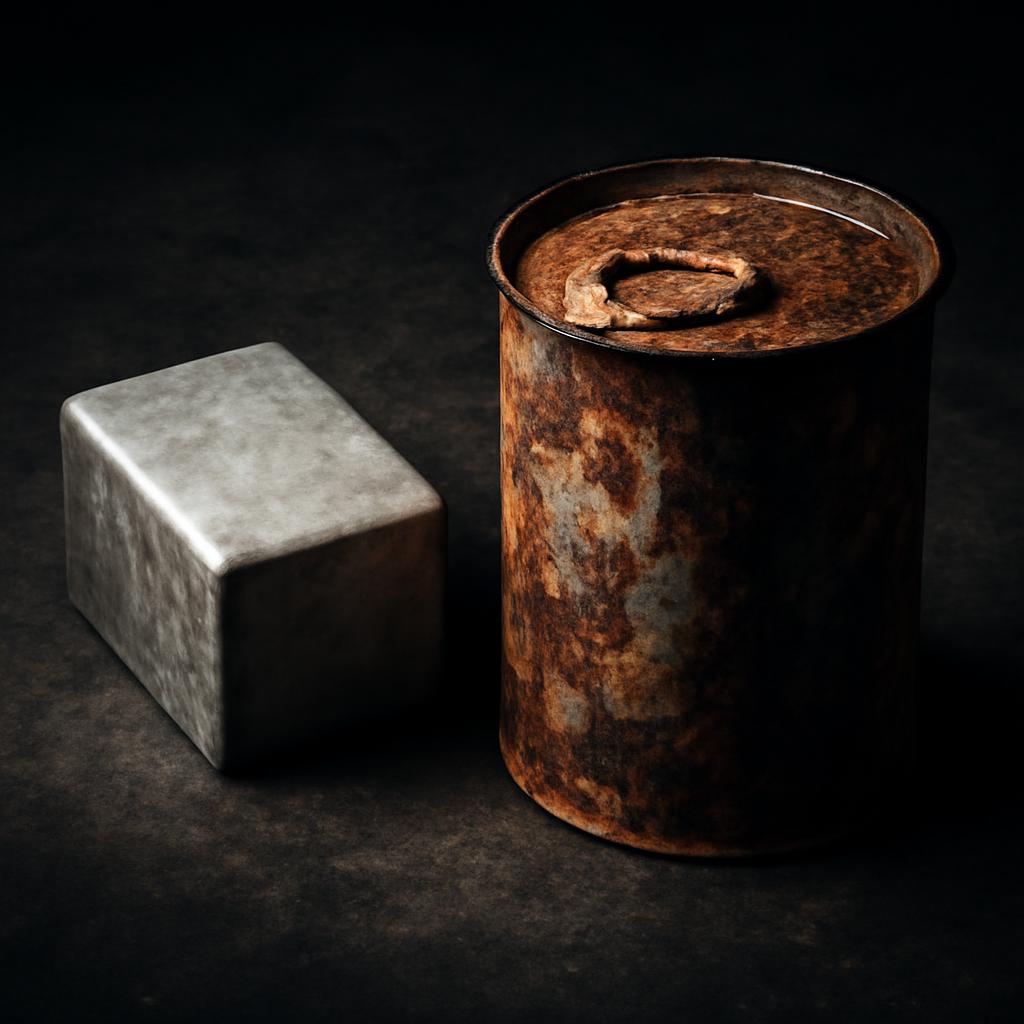
Tin doesn’t rust like iron — but many everyday “tin” items can still end up corroded.
If you searched “does tin rust”, the most accurate short answer is:
Pure tin does not rust in the strict chemical sense, but many everyday “tin” products can show rust because they are usually tin-plated steel, not solid tin. (Metal Supermarkets)
That distinction clears up most of the confusion. In chemistry, rust is not just any corrosion. It specifically refers to the iron-oxide products that form when iron or steel reacts with oxygen and water. Pure tin contains no iron, so it cannot form iron rust. But food cans, decorative tins, and other household “tin” items are often made from steel coated with a thin layer of tin. If that protective system is damaged, the underlying steel can rust. (Chumboon)
So when you see reddish-brown corrosion on a “tin can,” what has usually happened is not that tin rusted. It is that steel became exposed and rusted. (Chemistry Stack Exchange)
What Is Rust? Why Pure Tin Can’t Form It
Rust is a specific kind of corrosion, not a generic name for any metal surface damage.
In the strict sense, rust is the iron corrosion product formed when iron or steel reacts with oxygen and water. One simplified pathway given in the cited materials is:
4Fe + 3O2 + 6H2O → 4Fe(OH)3
which then dehydrates to forms commonly described as Fe2O3·nH2O. Those corrosion products are what people mean by rust. (Chumboon)
That matters because a metal can corrode without literally rusting. Metal Supermarkets makes this distinction plainly: aluminum, copper, brass, bronze, and other metals may oxidize or corrode, but they do not rust unless iron is involved.
Pure tin is the element Sn, atomic number 50. Because it contains no iron, it cannot produce iron oxide rust. (MISUMI)
What pure tin does instead is oxidize at the surface. The materials sources here describe tin as forming a protective oxide film, commonly discussed as SnO2, that helps inhibit further attack.
That is one of the key differences between iron and tin:
- Iron rust is described as porous and non-protective, so corrosion can keep spreading.
- Tin oxide is described as a denser, more protective surface film that slows additional corrosion.
So if the question is about pure tin, the answer is straightforward: it can oxidize and corrode under some conditions, but it does not rust in the iron-oxide sense.
Pure Tin Corrosion: Oxide Layer, Not Rust
Pure tin is not chemically inert. “Doesn’t rust” does not mean “cannot change at all.”
In ordinary air and light moisture, tin is generally treated as a corrosion-resistant metal because it develops a thin protective oxide film. The sources here repeatedly describe that film as the reason tin resists further attack better than bare iron does.
That means the usual appearance change on pure tin is not flaky red-brown rust. It is more of a dulling or oxide-film formation. Promisteel describes tin as developing a dull oxide layer when exposed to air.
Still, tin can be attacked in harsher environments. MISUMI says tin reacts slowly with dilute acids, and other materials in this set say tin is more vulnerable in acidic, alkaline, or salt-rich conditions than it is in ordinary indoor air. (Quora)
So the careful way to put it is:
- Pure tin is corrosion-resistant
- Pure tin is not immune to corrosion
- Its common corrosion behavior is oxide-film formation, not iron rust
There is also a separate phenomenon that sometimes gets mixed into rust discussions: tin pest. General reference material on tin notes that tin has white and gray allotropes, and chemistry discussion in this evidence set places the change associated with tin pest below about 13.2°C in very pure tin. That is a low-temperature structural change, not rust. The same discussion presents it as uncommon in ordinary alloyed household goods. (Wikipedia)
For practical household purposes, the important distinction is simple:
- Pure tin does not form iron rust
- Pure tin can still oxidize or corrode
- What you usually get is a protective oxide film, not the familiar red-brown rust of exposed steel
Tin Cans and Products: Mostly Tinplate Steel, Not Pure Tin
Most objects casually called “tin” are not made of solid tin.
Food cans, decorative tins, and many traditional “tinware” items are usually made from tinplate: low-carbon steel coated with tin by processes such as electroplating or hot-dip coating. (Tinmen)
That construction makes sense:
- Steel gives strength, stiffness, and shape retention
- Tin provides a corrosion-resistant surface and helps separate the steel from the contents or environment
Supplier material in this evidence set describes some electroplated tin coatings as being in the low-micron range, around 1-10 microns on some products. That should be read as a product-description detail, not a universal thickness for every can or tin item.
This is why the term “tin can” is a bit misleading. In most modern household use, the can is mainly steel with a tin surface, not a block of pure tin.
Modern food cans can also be more complex than bare tinplate. The Chemistry Stack Exchange discussion notes that cans may include plastic, polymer, or epoxy linings in addition to the metal coating, and Promisteel likewise notes that modern cans often use extra coatings, especially where acidic foods are involved. (Chemistry Stack Exchange)
That means a real can may have several layers working together:
- steel body
- tin coating
- interior lining
- seams and rims with different exposure conditions
A few practical identification cues follow from that:
- If the item is a common food can or decorative tin, it is usually safer to assume tinplate, not solid tin.
- If you see localized red-brown corrosion at seams, rims, or dents, that points more toward exposed steel rusting than pure tin changing uniformly.
- Once a can is opened, the cut rim becomes a fresh interruption in the protective system.
When Tinplate Rusts: Coating Damage Exposes Steel
Tinplate resists rust well only while the protective layers remain continuous.
The basic idea is simple. Tin acts mainly as a barrier coating. If the tin surface stays intact, it helps keep moisture and oxygen away from the steel underneath. (Indiana Galvanizing)
But if that barrier is broken — by a scratch, dent, worn spot, cut edge, pit, or seam defect — then moisture and oxygen can reach the steel, and the steel can rust.
That is why rust on tinplate often appears first in specific high-risk places:
- opened rims
- bottom edges
- side seams
- dented corners
- scratched spots on decorative tins
The pineapple-can example discussed on Chemistry Stack Exchange is useful because the rust showed up around the rim, seam, and localized spots, not as a uniform change across the whole can. That is exactly the pattern you would expect when isolated areas of steel become exposed.
There is also an important difference between tin and zinc as protective coatings. The sources here consistently say tin is not sacrificial like zinc. With galvanized steel, zinc can continue protecting nearby exposed steel after small scratches because zinc preferentially oxidizes. With tinplate, once the tin barrier is broken, protection is much less forgiving. (Indiana Galvanizing)
Some industry explanations in this set go a step further and describe an unfavorable galvanic relationship at damaged tinplate spots, where exposed steel may corrode more readily once the coating becomes discontinuous. Because that point is supported here mainly by industry explanation rather than neutral corrosion data, it is best treated as a plausible mechanism rather than a quantified household rule.
Harsh conditions make coating failure more likely. The cited sources repeatedly mention:
- acidic contents
- high humidity
- salt exposure
- long exposure after damage
So when a “tin” can shows red-brown rust, the best explanation is usually not “tin rusted.” It is steel rusting after the protective tin system was breached.
Factors Speeding Rust on Tinplate Items
Once you know that most “tin” items are really tin-coated steel, the common failure factors become much easier to understand.
1. Moisture and oxygen
Steel rust still needs the usual ingredients: water and oxygen.
That is why high humidity, direct wetting, and damp storage conditions are repeatedly identified as major accelerants for decorative tins and tin-plated steel.
2. Physical damage
A barrier coating only protects the places it still covers. Scratches, dents, abrasion, worn corners, and seam damage reduce that protection and can expose steel directly.
This is why decorative tins that are handled frequently or stored in rough conditions tend to fail first at edges and corners.
3. Acids, bases, and residues
Tin is relatively stable in ordinary conditions, but harsher chemistry changes the picture. MISUMI notes that tin reacts slowly with dilute acids, and other materials in the evidence set say acidic or alkaline environments can attack tin or contribute to localized coating failure.
The Chemistry Stack Exchange can discussion gives a practical example: acidic fruit contents may contribute to pitting or other localized attack when the protective system is imperfect.
So the risk is not simply “acid always destroys tin cans.” The more accurate point is that acid plus damaged or imperfect protection is a bad combination.
4. Salt, pollution, and harsh air
Salt and dirty outdoor air are particularly hard on damaged tinplate. Indiana Galvanizing points to salt spray and heavy air pollution as conditions that historically made tin roofs rust more readily, and Promisteel likewise flags harsh environments such as saltwater, acids, and high humidity.
That fits ordinary experience: a damp shed, coastal air, or wet outdoor storage is much tougher on tinplate than a dry pantry shelf.
5. Heat and opening damage
Opening a can creates a cut edge, and the Chemistry Stack Exchange example shows why that matters: the rim is one of the most common places for corrosion to start.
Heat can matter too. In that same discussion, heating a can is mentioned as a way an interior plastic lining may be damaged, which can expose steel that had previously been protected.
The common theme across all five factors is simple:
tinplate fails faster when you combine a breached coating with moisture and time.
Tin vs Other Coatings: Why Not as Good as Zinc
Tin is useful, but it is not the most forgiving anti-rust coating once damage occurs.
Its main strength is barrier protection. If the tin surface remains continuous, it keeps oxygen, moisture, and contents away from the steel beneath. That is why tinplate has been widely used for cans and other light-gauge products.
Its weakness is what happens after a scratch or break. Tin does not provide the same sacrificial protection that zinc does. Promisteel makes that point directly, and Metal Supermarkets explains the zinc side of the comparison: zinc on galvanized steel preferentially oxidizes and protects the steel underneath.
Indiana Galvanizing pushes that contrast even harder, arguing that galvanizing is better than tinning for long-term protection of structural steel because damaged tinplate is less tolerant of abrasion and exposure.
So, as a practical comparison:
- Tinplate works well where a clean, formable, corrosion-resistant surface is needed and the coating can stay largely intact.
- Galvanized steel is usually better where scratches and outdoor exposure are more likely, because zinc keeps helping after minor coating damage.
- Stainless steel can be more durable still because chromium in the alloy forms a protective chromium oxide layer.
That does not make tin “bad.” It makes tin specialized. It is well suited to packaging and light formed goods, but it is less damage-tolerant than zinc when the coating is breached.
Preventing Rust on Tin Cans and Decorative Tins
For household use, prevention is mostly about protecting the barrier system.
Keep items dry
Moisture is the main ingredient steel needs once protection is compromised. Store tins and cans in a dry place, away from repeated wetting, persistent humidity, or damp surfaces.
Avoid dents, scratches, and abrasion
Tinplate depends on a thin surface layer. Handle decorative tins carefully, and do not assume a dent is just cosmetic. Surface damage can become the starting point for rust.
Clean gently and dry promptly
Tinmen’s manufacturer guidance recommends keeping decorative tins clean and dry and notes that protective clear coatings can help preserve decorative finishes. For household care, the sensible version of that advice is simple: remove residue gently and do not leave the surface wet.
Inspect seams, rims, and bottoms
The highest-risk areas are usually the edges and joints. On food cans, the opened rim is a common weak spot. On decorative tins, failure often starts where the finish is thinned, chipped, or worn.
Be cautious with opened or badly damaged cans
This article is a corrosion explainer, not a regulatory food-safety standard. The sources cited here do not establish a precise official discard threshold. What they do show is that rims, seams, rust spots, and dents are the places where the protective system can fail. In practical household terms, a badly rusted, deeply dented, or seam-damaged can or decorative tin is a poor candidate for food use.
Thicker or alternative coatings can help
Tinmen also notes that thicker, more pore-free metallic coatings — or alternatives such as nickel in some designs — can improve resistance. That is best understood as a materials-design principle, not a guaranteed lifespan promise. Environment and handling still matter.
The basic rule is simple: keep tinplate dry, avoid damaging the surface, and pay attention to rims, seams, and worn spots early.
Common Myths About Tin Rusting
Myth: “Tin cans don’t rust.”
Too broad.
What is true is that tin itself does not form iron rust. What is false is the idea that everyday “tin cans” can never show rust. Most are steel with a tin coating, so once the steel is exposed, rust is possible.
Myth: “Pure tin is completely corrosion-proof.”
Also false.
Pure tin is corrosion-resistant, not immune. It forms a protective oxide film, but acids, alkalis, or salt-rich conditions can still attack it.
Myth: “Tin oxide looks just like rust.”
Not really.
The cited materials describe iron rust as the iron-oxide corrosion associated with exposed iron or steel, while tin is described as developing a dull protective oxide layer instead. In ordinary household terms, that means tin’s surface change is not the same thing as the familiar red-brown rust people look for on steel.
Myth: “If someone can ‘rust a tin can,’ that proves tin rusts.”
Usually it proves the opposite.
When a can is scratched, heated, chemically attacked, or left wet after opening, what often rusts is the steel under the tin, especially around seams and rims. That is fully consistent with the can-construction and failure explanations in the sources here.
The practical bottom line is stable all the way through:
Pure tin does not rust like iron. Tinplate products can rust when the steel under the tin becomes exposed.
FAQ
Do tin cans rust?
Yes — many objects called tin cans can rust because they are usually tin-plated steel, not solid tin. As long as the tin coating and any interior lining remain intact, the can resists rust well. But if the coating is scratched, dented, worn, pitted, or cut open at the rim, the underlying steel can rust.
Does pure tin ever corrode?
Yes. Pure tin is relatively corrosion-resistant, but it is not immune. In ordinary air it tends to form a protective oxide film rather than iron rust, which is why it usually dulls instead of turning red-brown and flaky. Stronger chemical exposure, including acidic or other harsh environments, can still attack it.
What does tin oxide look like vs iron rust?
The sources cited here describe tin as forming a dull oxide layer that inhibits further corrosion, while rust is the iron-oxide corrosion product associated with exposed iron or steel. In practical terms, iron rust is the familiar red-brown rust people recognize on steel, whereas tin’s surface change is more of a dull protective film than a flaky rust layer.
Is a rusted tin can safe for food?
The sources used here are materials and packaging explainers, not regulator-issued food-safety rules, so they do not establish a precise official safety line. What they do support is a cautious practical rule: if a can is badly rusted, deeply dented, or corroded at seams or rims, that indicates failure of the protective system, and it is sensible not to rely on it for food use.
How to tell if tinplate coating is failing?
Look for localized red rust spots, especially at rims, seams, bottom edges, scratches, dents, and worn corners. On food cans, the opened rim is a common failure point. On decorative tins, damage often begins where the surface has been rubbed, chipped, or stored damp. Those localized patterns are more consistent with steel exposure under tinplate than with any uniform change in pure tin.
Sources
- Third Party · Why does tin can not rust? - Chumboon Metal Packaging Group Co.,Ltd.
- Crowd-Sourced Q&A Forum · Does tin rust? - Quora
- Expert Q&A Forum · water - Why is a tin can that appears like galvanised steel rusting? - Chemistry Stack Exchange
- Third Party · Why is Galvanizing Better than Tinning? | Indiana Galvanizing
- Third Party · What Is Tin? Properties, Uses, and Applications in Industry
- Third Party · How can you prevent decorative tins from rusting? - Tinmen
- Third Party · Tin - Wikipedia
- Third Party · Does tin plated steel rust? - Blog
- Third Party · Metals That Don’t Rust - Metal Supermarkets