 StainList
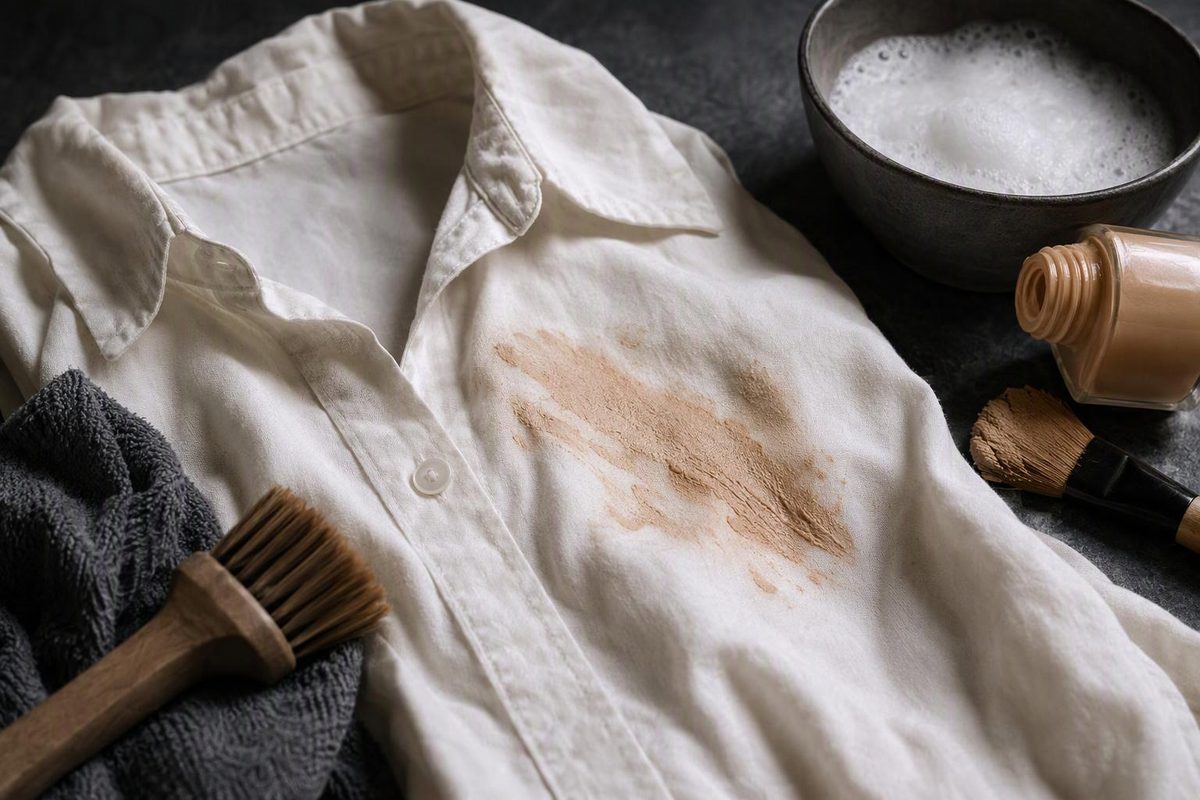
For a washable garment, lift off excess foundation, pretreat the mark with liquid laundry detergent, and wash at the warmest temperature the care label permits. Inspect the fabric while it is wet, and air-dry it if any discoloration remains. Do not use a dryer or iron until the stain is gone.
Choose the garment, foundation type, and stain condition to get the safest treatment sequence.
Foundation Stain Treatment Plan
Lift the deposit with a spoon, blot without rubbing, pretreat with liquid laundry detergent for its label-directed time, rinse from the back, and wash at the warmest temperature the care label permits. Inspect before air-drying.
The displayed plan is the default for a fresh liquid-foundation stain on a washable garment.
Source: Treatment sequence summarized from the American Cleaning Institute, University of Georgia Cooperative Extension and U.S. FTC care-label guidance cited in the article.
Foundation formulas differ. Liquid products may contain pigments in water and oil phases, along with solvents or silicones, so one spill can leave both visible color and a greasy outline. A formulation study illustrates this mixture while also noting that commercial foundations use varied technologies; it does not establish one ingredient list for every product (Journal of Cosmetic Dermatology).
That variation changes the first step. Loose powder should be removed while dry, whereas liquid, cream, stick and mousse foundation should be lifted and blotted before pretreatment. The garment’s care label then determines whether home washing is appropriate.
Remove Surface Foundation Before Adding Cleaner
Check the garment’s care label before applying water, detergent or another cleaner. If the label prohibits washing, stop after carefully removing the excess and take the item to a professional cleaner.
For liquid, cream, stick or mousse foundation, use the edge of a spoon or dull knife to lift the deposit. Work from the outside of the spot toward its center so the product is not pushed over a larger area. Keep the tool nearly parallel to the fabric rather than digging its edge into the fibers.
Once the thicker deposit is gone, blot remaining surface residue with a clean white cloth. Lift the cloth and move to a clean section as foundation transfers. Do not scrub back and forth or press the product through the garment.
For loose or pressed powder, keep the area dry at first. Shake off loose particles or brush them away gently without grinding them into the weave. A lint roller can pick up remaining particles; Tide recommends this approach for powdered blush and bronzer (Tide).
Do not pour water onto a pile of powder. Remove as much dry material as possible first, then treat any color left in the fabric as a washable cosmetic stain.
If the garment cannot be washed immediately, remove the surface product and keep it away from heat. Avoid rubbing the stain with a damp napkin, which can spread pigment and leave a larger area to treat later.
Pretreat Washable Cotton, Linen, Polyester and Blends
The following method is intended for an ordinary washable garment whose care label permits water washing. It is not a blanket method for silk, wool, acetate, velvet, embellished clothing or unstable dyes.
Test The Detergent On A Hidden Area
Apply a small amount of the intended detergent to an inconspicuous seam or inside allowance. Rinse that test area and check it for dye loss, texture change or another visible reaction before treating the stain.
University of Georgia textile-care guidance recommends following the care label and testing cleaning agents on an inconspicuous area for colorfastness (UGA Cooperative Extension). A successful test reduces uncertainty, but it does not override a dry-clean-only instruction.
Apply Liquid Laundry Detergent
Place a clean white towel behind the stained area. This separates the stain from another layer of the garment and gives loosened material somewhere to transfer.
Apply enough liquid laundry detergent to cover the mark. Work it in gently with a fingertip rather than scrubbing with a stiff brush. The American Cleaning Institute lists liquid laundry detergent or a prewash stain remover as treatments for cosmetic stains (American Cleaning Institute).
Leave the detergent in place for the pretreatment time printed on its label. There is no single contact time supplied by the sources for every detergent, so use the product’s directions rather than guessing a number. Do not allow a product to remain indefinitely merely because the stain is dark.
Rinse From The Back
Turn the stained section so the wrong side faces the running water. Rinse with cool or lukewarm water, directing the flow through the back of the fabric. This carries loosened foundation away from the direction in which it entered instead of driving it farther through the garment.
Rinse until the concentrated detergent and loosened residue have moved out. If substantial color remains, another gentle pretreatment is safer than forceful rubbing.
Wash According To The Care Label
Wash the garment with regular laundry detergent at the warmest water temperature the care label permits. That does not mean automatically selecting hot water. The label’s temperature and cycle restrictions take priority over a general stain-removal method.
Do not wash the garment with items that could be affected by transferred makeup if a large amount of foundation remains. If the label calls for a gentle cycle, use that cycle rather than increasing agitation in an attempt to remove the mark faster.
Inspect Before Applying Heat
Examine the stained area as soon as the wash finishes and while the fabric is still wet. Bright, even light makes a faint greasy outline or patch of pigment easier to see.
If any mark remains, repeat the detergent pretreatment and label-approved wash. The American Cleaning Institute advises keeping stained clothing out of the dryer until the stain has been removed because heat can make the residue more difficult to address.
Air-drying between attempts prevents dryer heat from being added while you assess the result. Do not iron the area, even from the reverse side, while foundation remains.
Use Dishwashing Liquid For A Greasy Outline
Foundation can leave an oily-looking border after most of its color has washed away. On an ordinary washable, colorfast fabric, put a small drop of clear hand-dishwashing liquid on that outline and work it in gently.
Rinse the dishwashing liquid out thoroughly. Then pretreat the area with liquid laundry detergent and wash it again according to the garment label. Clorox’s foundation guidance likewise suggests dish soap or detergent to loosen oils before washing (Clorox).
Use hand-dishwashing liquid, not detergent made for an automatic dishwasher. Do not use this step on silk, wool, acetate, embellished clothing or an item whose label prohibits washing. A clear product also avoids deliberately adding another visible color to the stained area.
Treat only the remaining mark rather than saturating a large section of the garment. If the spot-test produces dye transfer or a texture change, rinse the test area and stop the home treatment.
Address Pigment Only After The Oily Residue Is Gone
If the greasy outline has disappeared but foundation color remains, repeat the liquid laundry detergent treatment first. A fading stain is a reason to repeat the same controlled process, not to combine several cleaners.
For a washable, colorfast garment, an oxygen-bleach laundry product can be considered only when both the garment label and the bleach product’s label permit it. Spot-test the product and follow its own dilution, soaking and rinsing directions. The available guidance does not provide one universal dilution or soaking time for all oxygen-bleach products.
Do not assume chlorine bleach is safe because the garment appears white. Stitching, stretch fibers, trims and finishes may not respond like the visible fabric. Never substitute one type of bleach for another or use more than the product label directs.
If repeated treatment is not producing improvement, stop. Escalating to improvised solvents can affect the garment’s dye or finish while spreading the remaining pigment.
Re-Treat Dried Or Previously Washed Foundation
A dried stain needs another treatment cycle rather than harder scrubbing. Begin by lifting any crusted foundation with a spoon. Do not scrape aggressively enough to roughen the fabric.
Rinse the mark from the back with lukewarm water. Apply liquid laundry detergent and leave it for the pretreatment time specified on the detergent label. Rinse, wash according to the care label and inspect the garment before air-drying.
Repeat the cycle if the mark is becoming lighter. Gradual fading shows that material is still being removed; it does not justify adding harsher chemicals or dryer heat.
Foundation that has already been through a dryer or pressed under an iron may not come out completely. It is still reasonable to remove surface residue and repeat the label-safe detergent treatment, but the outcome is less certain. If there is no improvement, a professional cleaner is the lower-risk next step for a garment worth preserving.
Previously washed foundation can also have two distinct remnants: an oily boundary and pigment within it. Treat the greasy outline with the limited hand-dishwashing-liquid step only when the fabric qualifies, rinse thoroughly, and then return to laundry detergent for the complete stained area.
Send Dry-Clean-Only And Delicate Garments To A Cleaner
If the care label says dry-clean only, lift off excess foundation without rinsing or washing the spot. Place the garment where the stained area will not be crushed or rubbed, then take it to a professional cleaner.
Tell the cleaner that the stain is foundation. If known, identify it as liquid, cream, stick, mousse, loose powder or pressed powder. Also say whether the garment has been washed, heated or treated with another product. That history is more useful than presenting the cleaner with an unidentified damp spot.
Under the U.S. Federal Trade Commission Care Labeling Rule, “Dryclean Only” warns that washing will damage the garment, and manufacturers must have evidence supporting that warning (Federal Trade Commission). That U.S. rule explains the meaning of this wording within its jurisdiction; it does not replace the instructions printed on a particular garment.
Professional treatment is also the lower-risk choice for silk, wool, velvet, unstable dyes, structured jackets, beading and valuable garments. Even when one of these items appears washable, its construction, trim or finish may make spot treatment difficult to control.
Keep Heat And Improvised Solvents Away From The Stain
Do not rub fresh foundation with a napkin. Lift thicker product and blot what remains so the stain stays as contained as possible.
Do not wet loose or pressed powder before shaking, brushing or lifting off the dry particles. Adding liquid too early turns removable surface powder into a wet cosmetic stain.
Do not use bleach unless the garment label and the specific bleach-product label both permit it. A white-looking garment is not proof that every component is bleach-safe.
Do not improvise with hairspray, makeup wipes or nail-polish remover. These products may add oils, dyes or fabric-damaging solvents, creating another residue alongside the foundation.
Do not mix stain removers in an attempt to make them stronger. Rinse one permitted treatment out before moving to the next label-approved step.
Most importantly, do not tumble-dry or iron the garment while any shadow, oily ring or color remains. Repeat the controlled pretreatment if it is working, or stop and seek professional help if it is not.
Mascara contains a different balance of oils, waxes and colorants and should not automatically receive the foundation sequence. Use the separate mascara removal method for that stain.