 StainList
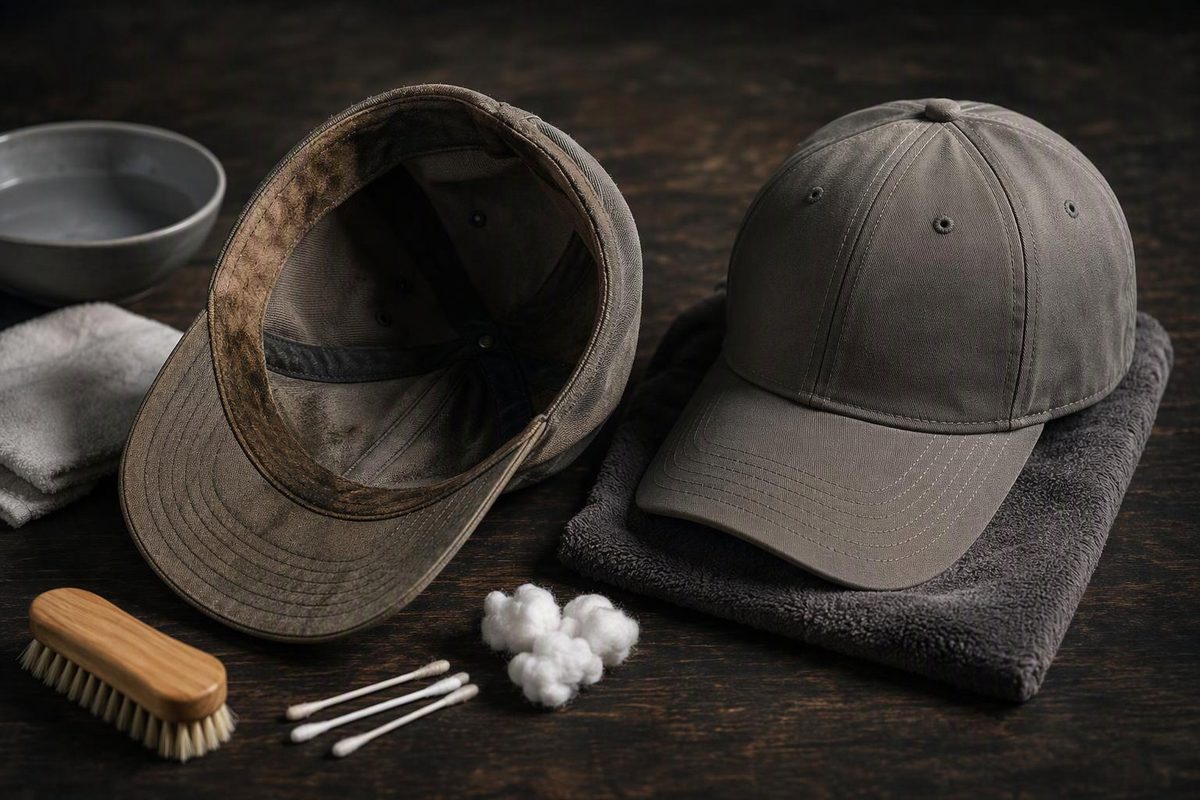
Start with a damp white cloth, then mild detergent—not a long soak. On a water-safe fabric cap, this lets you tackle the sweatband and visible marks while keeping the brim and crown as dry as possible. Soak the whole hat only when its care instructions allow it.
A pale, crusty line may be dried sweat residue: sweat contains water, sodium and chloride. A yellow or greasy-looking band may also need detergent to remove accumulated body oils. The appearance is a clue, not a certain diagnosis. (Cleveland Clinic, Nike’s hat-cleaning guide)
Check the hat before wetting it
Read the care label or look up the exact model. The fabric alone does not tell you whether the whole hat is washable.
- Washable cotton or polyester cap: Start with spot cleaning; hand-wash only if permitted.
- Structured cap, vintage cap, or unknown brim insert: Avoid immersion unless the maker confirms it is safe. Paper and cardboard brims must not be submerged, and structured crowns need particular care. Do not assume a brim is plastic just because the hat looks recent. (New Era, OxiClean)
- Wool, felt, leather, straw, or dry-clean-only hat: Do not use the general soak below. Follow material-specific instructions or ask a hat-care specialist. For example, Stetson advises against liquid cleanser on its fur-felt hats, while its straw-hat instructions allow mild soap cleaning. (Stetson care instructions)
If the sweatband is designed to detach, remove and clean it separately according to its instructions. Some spot-clean-only Tilley hats have hand-washable removable sweatbands. (Tilley)
Spot-test twice: Press a white cloth dampened with water against a hidden area, then test your diluted detergent there. Let the test patch dry and check for color transfer, a ring, or texture change. Stop home wet-cleaning if water transfers dye; if detergent changes the patch, do not continue with it. (OxiClean, Nike)
Remove the marks with minimal moisture
For a fabric hat whose label permits damp cleaning:
- Lift loose dust. Use a soft brush or dry cloth before applying water.
- Try water first. Dampen a white cloth with cool or lukewarm water, wring it out, and gently dab the pale line. Keep the brim from becoming saturated. If the residue lifts, finish with another clean, damp cloth.
- Add mild detergent if needed. Dilute a non-bleaching, non-whitening liquid detergent in water according to its hand-washing directions. Apply with a soft cloth or sponge rather than pouring it onto the hat.
- Clean the sweatband as well as the outside. If the band folds forward easily, expose it and gently work the solution into the dirty fabric. Do not pull at stitching. A soft toothbrush can help on sturdy fabric, but avoid vigorous scrubbing over embroidery or mesh.
- Remove the cleaner. Wipe repeatedly with a fresh cloth dampened with plain water. For a fully washable hat, rinse with cool water instead.
This follows the gentle detergent-and-sponge approach in New Era’s sweatband-cleaning instructions, with water-only cleaning as the least-aggressive first step.
Stop if dye transfers, threads begin to fuzz, or the brim or crown softens noticeably.
If the hat needs a full wash
Only proceed if the manufacturer permits immersion. Use cool or lukewarm water and the detergent’s labeled hand-washing dose. Nike’s basic hand-wash method uses about a 15-minute soak, followed by rinsing and towel-patting. Follow your hat’s label if it gives different directions. (Nike)
Do not automatically machine-wash every fabric cap. New Era advises against it, whereas some washable Tilley hats allow it. A dishwasher is not a substitute for an approved washing method. (New Era, Tilley)
For yellow marks that remain
Rinse out the detergent before trying another treatment. On a washable, colorfast hat whose maker permits oxygen bleach, a labeled oxygen-bleach soak is an option—not the default.
For example, OxiClean Versatile Stain Remover’s hat instructions specify scoop lines 2–4 per gallon of water, fully dissolved, and a soak starting at 15 minutes. Follow the current package for dose, temperature and maximum time; these measurements do not apply to other products. If the required temperature exceeds the hat’s care limit, skip the treatment. Test first, then rinse thoroughly. Do not use this product on wool, wool blends, silk, silk blends, leather or dry-clean-only fabrics. (OxiClean)
Skip this step when the hat maker prohibits bleach or whiteners. Tilley prohibits both, and New Era’s cotton-cap guidance says never to bleach. White fabric does not override those restrictions. (Tilley, New Era)
If the cleaned, dry area remains lighter without visible residue, it may be dye loss rather than removable soil. Stronger cleaning cannot replace missing dye.
Dry without distorting the hat
Pat away excess water; do not wring the cap. Gently reshape it and support the crown with a loosely bunched clean towel or a suitably sized bowl that does not stretch it. Air-dry away from direct sun and heat. Avoid the tumble dryer, radiator and hot hair dryer. (OxiClean, New Era Australia)
Judge the result only when the hat is completely dry. If a gentle treatment helped, repeat it once before escalating. If it did not help—or the hat is valuable, fragile or of unknown construction—stop and seek specialist care rather than repeatedly soaking or scrubbing it.