 StainList
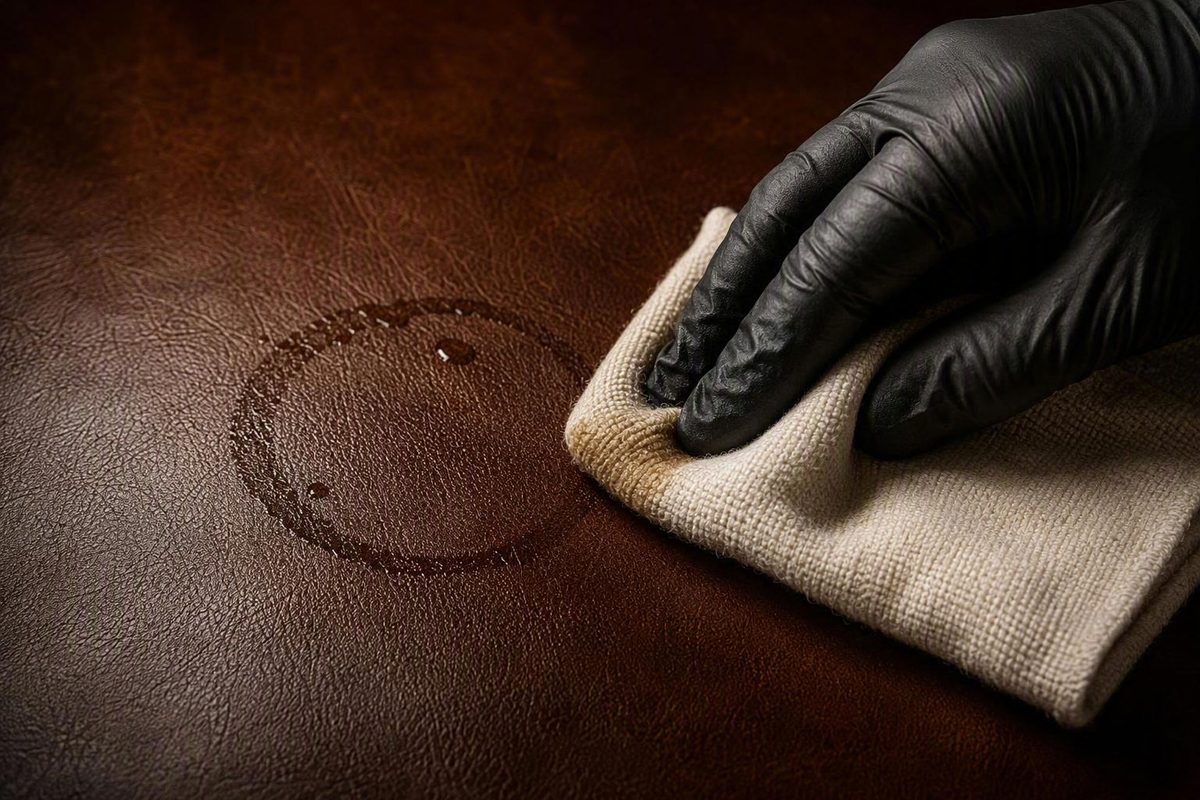
Treat a leather water mark without making the ring worse.
Water stains on leather require restraint. The safest response is not a universal mixture or vigorous cleaning routine: blot fresh moisture, identify the leather, test every product, and use only minimal moisture when the finish can tolerate it.
A water mark may fade, but complete removal is not guaranteed. Water exposure can leave discoloration, stiffness, a changed sheen, flattened nap, or distortion. Once the leather’s texture or shape has changed, stronger cleaning may compound the damage rather than reverse it.
Start Here: The Low-Risk Response to Wet Leather
If the spill is still fresh:
- Blot with a soft, dry, absorbent cloth. Use clean sections of the cloth as they become damp. Do not wipe, rub, scrub, or press hard enough to drive water farther into the leather.
- Support the item’s natural shape. Lightly fill a bag or shoe with clean, non-staining tissue, plain paper, or soft cloth. Do not overstuff it.
- Move it to a shaded, ventilated place at room temperature.
- Keep it away from forced heat. Do not use a hair dryer, heater, radiator, heat vent, direct sunlight, or drying machinery.
- Wait before adding any treatment. Do not immediately apply cleaner, vinegar, conditioner, saddle soap, or protectant. First identify the leather and patch-test anything you intend to use.
Commercial restoration guidance recommends blotting rather than rubbing, supporting shaped items while they dry, and allowing leather to air-dry away from heat and direct sunlight because rapid drying may contribute to stiffness, cracking, or warping (Fibrenew’s wet-leather guidance).
Blotting is different from wiping. Wiping can spread the wet boundary, while blotting lifts surface moisture without deliberately moving it across the item. If the leather is saturated, prioritize shape support and gradual drying rather than trying to wash out the affected area.
Do not assume that a dark patch visible while the leather is wet will remain. Let the item dry completely before deciding whether stain treatment is necessary.
Even careful first aid cannot promise a perfect result. Water exposure may leave a changed color, sheen, texture, or feel. Pigmented or otherwise protected finishes are generally more resistant than aniline and unfinished leather, although the exact response depends on the item and its finish (overview of finish-related water sensitivity).
Seek professional help before experimenting if the item is:
- Valuable, antique, vintage, rare, or highly sentimental
- Pale or unusually dye-sensitive
- Aniline, unfinished, vegetable-tanned, exotic, or of unknown construction
- Soaked through its lining, padding, or internal structure
- Cracked, swollen, warped, misshapen, or developing raised edges
- Bleeding dye onto the blotting cloth
- Affected by visible mold or a persistent musty odor
In these cases, preservation matters more than making the mark disappear quickly.
Identify the Leather and the Kind of Mark Before Cleaning
Begin with the care label, original packaging, receipt, product listing, or manufacturer’s instructions. Do not identify leather solely by its color, softness, grain, or price. Coatings and finishes can make different materials look similar.
For practical stain treatment, sort the item into one of these groups:
- Smooth finished or pigmented leather: Usually has a more protected surface and may tolerate cautious wiping when the manufacturer permits it.
- Smooth full-grain or top-grain leather: These terms describe how the hide was processed, not necessarily how absorbent its surface is. Some pieces have protective finishes; others mark readily.
- Suede or nubuck: Has a raised, velvety nap. Added water can produce matting, color variation, or another boundary.
- Patent leather: Has a glossy coated surface and generally should not be conditioned like absorbent smooth leather.
-
Aniline, unfinished, crust, or vegetable-tanned leather: Often absorbs moisture readily and may darken or move dye unpredictably.
-
Unidentified leather: Treat it as sensitive and consult the maker or a leather specialist before adding water or cleaner.
The supplied guidance does not provide a reliable home test that can identify every finish without risk. A hidden water-drop test can itself mark absorbent leather. If documentation is unavailable, uncertainty is a reason to do less—not to try increasingly aggressive experiments.
Examine the mark without treating its appearance as a diagnosis:
- A dark halo may involve moved dyes, oils, finishing material, or another contaminant.
- A white or pale residue may involve salt, limescale, or other material carried by water.
- A raised or palpable outline may indicate more than a surface color change.
- Stiffness, swelling, cracking, roughness, or distortion suggests material damage.
- A fuzzy or spreading patch accompanied by odor may not be an ordinary water mark.
Color alone cannot establish the cause. Milk, grease, sugary drinks, dye transfer, cleaner residue, road salt, and mold are not plain water stains and may require different treatment.
Use this decision path:
- Is the area still wet? Blot it and let it dry naturally before assessing the result.
- Is the surface smooth or napped? Reserve the damp-cloth method for compatible, patch-tested smooth leather. Use a dry-first process for suede or nubuck.
- Has the texture changed? A light, flat halo may be suitable for one conservative attempt. Stiffness, swelling, cracking, raised edges, finish loss, or distortion calls for professional assessment.
- Do you know the finish? If not, stop before applying water or chemicals.
- Was the spill really only water? If another substance was involved, follow guidance for that substance and leather type.
Patch-Test Water and Every Leather-Care Product
Choose a concealed test location made from the same material and finish as the stained area. Suitable locations may include the underside of a bag, an area behind a strap, the inside of a flap, or a covered edge that will not rub against clothing.
Test each substance separately:
- Distilled water
- Leather cleaner
- Conditioner or cream
- Protective spray
Do not combine several products in one test. If water, cleaner, conditioner, and protectant are applied together, you will not know which one caused darkening, tackiness, or dye movement.
Use the smallest practical amount. Lightly moisten a corner of a clean white or colorfast cloth rather than pouring water onto the leather. Apply cleaners and conditioners according to their labels, using no more than necessary. A white cloth makes dye transfer easier to see.
Let the test area dry naturally before judging it. There is no universal waiting time because drying varies with the amount applied, finish, leather thickness, lining, airflow, temperature, and humidity. An area that looks acceptable while damp may develop a boundary or altered sheen as it dries.
Compare the test area with untreated leather under the same lighting. Check for:
- Lasting darkening or fading
- Dye on the cloth
- A new ring or hard boundary
- Changed gloss or uneven sheen
- Tackiness, waxiness, or residue
- Swelling or puckering
- Roughness, stiffness, or loss of suppleness
- Finish lifting or abrasion
- Nap matting on suede or nubuck
Stop if the cloth picks up dye or the leather changes color, texture, finish, or feel. Leather-care guidance specifically recommends identifying the material, testing cleaners in an inconspicuous area, and avoiding treatment that makes the leather excessively wet (PICARD’s leather stain-care guidance).
A successful patch test lowers the risk; it does not guarantee that a large visible panel will respond identically.
A Conservative Method for Compatible Smooth Leather
Use this method only when the item is confirmed as compatible smooth leather, its texture remains normal, and a hidden test has dried without an adverse change.
For a fresh spill:
- Blot the surface moisture with a soft, dry cloth.
- Support the item and let it air-dry naturally.
- Reassess the area only when it is fully dry.
- Treat it only if a visible halo remains.
A temporary dark area may disappear during drying. Adding more water while the original moisture is still moving through the leather can enlarge the affected boundary.
For a light, dried halo:
- Prepare a clean, soft microfiber cloth and distilled water.
- Barely dampen the cloth. It should feel lightly moist, not wet enough to drip.
- Make gentle, even passes with minimal pressure.
- Blot away excess surface moisture if necessary.
- Stop after one conservative pass and let the area dry completely.
- Reassess before applying anything else.
Do not spray or pour water directly onto the item. Do not saturate the leather or repeatedly work the stain edge. A leather-goods care guide recommends distilled water on a lightly dampened microfiber cloth while warning that excess moisture and forceful rubbing may worsen a mark or affect the finish (Andar’s water-mark method and cautions).
Distilled water is a conservative choice where water is appropriate because it does not add the dissolved mineral content found in some tap water. It is not proven safe or superior for every leather. Water of any kind may mark absorbent, unfinished, aniline, vegetable-tanned, or pale leather.
When a wider, even pass may be safer than spot-wetting
Treating only the ring can create another wet-to-dry boundary. For that reason, one bag-care protocol recommends applying extremely light, even moisture across the affected full-grain panel rather than repeatedly wetting only the stain edge (Alazana’s full-grain bag protocol).
This is a limited moisture-balancing technique, not a universal leather treatment. Consider it only when:
- The item is confirmed as compatible smooth or full-grain leather.
- The leather has passed a water patch test.
- The mark is a flat, light halo rather than a raised, stiff, cracked, or distorted area.
- The visible section has a natural boundary, such as one bag panel.
- You can apply moisture evenly with a barely damp cloth.
The evidence supports this technique only in a narrow full-grain bag context. As a precaution, do not extend it to suede, nubuck, aniline, unfinished, vegetable-tanned, patent, faux, bonded, vintage, specialty, or unidentified leather without item-specific manufacturer or professional guidance. It also should not be generalized to furniture, vehicle upholstery, antiques, or composite constructions.
Whether treating a small area or an eligible panel, make one conservative pass and stop. If the mark spreads, remains darker after complete drying, transfers dye, develops a new ring, or shows no improvement, do not increase the water or pressure.
Once compatible smooth leather is fully dry, a thin layer of an approved conditioner may help restore some suppleness. Patch-test it separately, apply it sparingly, and remove excess as directed. Conditioner can darken leather or change its sheen.
Conditioning is aftercare—not a guaranteed stain remover. It does not rebuild cracked material, restore a lost finish, correct warping, or make leather waterproof.
Use a Different Process for Suede, Nubuck, and Sensitive Finishes
Suede and nubuck should not receive the damp-cloth process used for compatible smooth leather. Their visible nap can flatten, mat, or dry unevenly.
For fresh water on suede or nubuck:
- Blot gently with a dry, absorbent cloth.
- Do not rub the nap or add more water.
- Support the item’s shape if necessary.
- Allow it to dry completely in a shaded, ventilated place.
- Once dry, use a suitable suede brush gently to lift and align the nap.
- If a mark remains, consider a suede eraser or suede-specific cleaner only when its label confirms compatibility and a concealed test is successful.
Brush lightly. Stop if the surface becomes bare, shiny, rough, or noticeably different from the surrounding nap. Do not use ordinary smooth-leather cream on suede or nubuck unless its label expressly states that it is compatible. Restoration guidance distinguishes suede and nubuck from smooth leather and recommends blotting, passive drying, gentle brushing, and patch-tested leather-specific products (Fibrenew’s care guidance by leather type).
Patent leather has a coated surface that provides some moisture protection, but the coating has its own care requirements. Patent leather generally should not be conditioned as though it were absorbent full-grain or top-grain leather. Clean it only as the manufacturer directs, and stop if the coating becomes cloudy, sticky, or lifted.
Treat these materials as high risk:
- Aniline leather
- Unfinished leather
- Vegetable-tanned leather
- Pale or delicately dyed leather
- Vintage or antique items
- Unknown leather or unknown coatings
Moisture or cleaning products may produce lasting darkening, dye movement, or a visible edge on these finishes. Professional assessment is safer than improvising with water, vinegar, saddle soap, or household cleaner.
For faux, bonded, exotic, automotive, antique, or specialty upholstery materials, follow the manufacturer’s care code or consult a specialist familiar with that construction. A process intended for a natural-leather bag or smooth dress shoe should not be assumed safe for laminated surfaces, painted leather, seating, reptile skins, or historically significant objects.
Dry Bags and Shoes Without Losing Their Shape
Drying is part of the treatment. Support the item in its natural form and allow moisture to leave gradually rather than using concentrated heat.
Leather bags
Blot the exterior and empty the bag. If its lining is damp, open pockets and compartments so air can circulate. Support the bag with clean white tissue, plain non-staining paper, or soft colorfast cloth.
Use enough material to preserve the natural shape without stretching it. Avoid newspaper where ink could transfer to a lining or pale material. Replace the internal support whenever it becomes damp.
Set the bag in a stable position with air around it. If one side is drying much faster, reposition the bag occasionally. No fixed rotation schedule is necessary; respond to how the item is actually drying. Bag-care guidance supports non-newspaper paper, replacement of damp stuffing, and passive drying in a shaded, ventilated area.
Smooth leather shoes
Remove the laces so the tongue and eyelet area can ventilate. Insert suitable shoe trees or light, non-staining support without forcing the shoe wider than its normal shape.
Keep added water away from the insoles. Do not submerge the shoes or rinse them under running water. Leave them in a shaded, ventilated location—not on a radiator, in direct sunlight, near a heater, or in front of a hair dryer.
Lined, thick, padded, or heavily saturated items can take substantially longer to dry than a light surface mark. Judge readiness by complete dryness rather than a fixed number of hours. Check seams, linings, folds, and internal supports instead of relying only on the visible surface.
One workshop guide describes a full saddle-soap wash for certain smooth leather shoes, followed by natural drying with shoe trees and conditioning. The same guide excludes suede and nubuck and recommends different care for vegetable-tanned leather (Ken Kataoka’s smooth-shoe method and limitations).
Because that process is narrowly scoped and introduces substantially more moisture, do not extend it to bags, jackets, upholstery, suede, nubuck, vegetable-tanned leather, vintage items, or unidentified finishes. For an ordinary light halo, the lower-risk response remains blotting, passive drying, patch testing, and—only on compatible smooth leather—a minimal-moisture pass.
Skip Risky Shortcuts, Including Vinegar as a Default Remedy
Online vinegar advice is contradictory. Some commercial guides recommend diluted white vinegar for older water marks. Others warn that acidity may discolor leather, affect the finish, disturb oils, damage the item, or leave odor. One leather-goods guide specifically advises using vinegar sparingly because it may harm the material or bag structure (Andar’s discussion of vinegar and old water marks).
That disagreement matters because leather is not one standardized surface. A mixture tolerated by one coated item may mark another permanently. The supplied evidence does not establish vinegar as safe or effective across leather types.
Do not escalate from diluted to undiluted vinegar. If water is inappropriate or one conservative attempt fails, use a compatible leather-specific cleaner recommended by the item’s manufacturer—or seek professional advice—rather than strengthening a disputed household treatment.
Also avoid:
- Dish soap and hand soap
- General-purpose or multipurpose cleaners
- Alcohol and alcohol-based wipes or sprays
- Acetone or nail-polish remover
- Baby wipes
- Olive oil, baby oil, cooking oil, and improvised oil blends
- Toothbrush scrubbing or other forceful brushing
- Abrasive pads, powders, or sanding
- Repeated soaking or wetting
- Heat intended to speed drying
These products or methods may alter the finish, color, sheen, texture, or feel. Household oils may cause sticky or uneven darkening rather than controlled conditioning. Abrasion can replace a water ring with a worn patch. Commercial guidance for smooth leather shoes likewise warns against dish soap, vinegar, forced heat, direct sunlight, submersion, and forceful scrubbing (smooth-leather shoe-care cautions).
Saddle soap is not a universal cleaner. Its use in one shoe-care process does not establish suitability for thin upholstery, vehicle interiors, handbags, delicate coatings, or unknown leather. Product labels and item-specific instructions take priority.
Do not sand a stain or apply color merely to claim that it has been removed. Recoloring conceals persistent discoloration; it is a separate restoration process requiring compatible color and finish work.
Most supplied leather water-mark procedures come from retailers, product brands, workshops, or restoration businesses. Their articles generally do not cite controlled comparative testing. One PICARD guide identifies its contributor as a trained fine leather maker with long leather-processing experience, but the overall evidence base remains primarily commercial guidance rather than independent testing. Branded performance claims and guarantees should therefore be treated cautiously.
Know When to Stop and Call a Leather Specialist
More treatment is not necessarily more effective. Stop immediately if a patch test or visible-area treatment causes:
- Dye transfer to the cloth
- Spreading discoloration
- Marked or persistent darkening
- A new boundary ring
- Tackiness or residue
- Swelling or puckering
- Finish loss, clouding, or peeling
- Roughness or nap damage
- Stiffness, cracking, or distortion
A flat color difference and a physically altered area are not the same problem. If you can feel a raised outline, the area remains stiffer than the surrounding leather, or the grain has changed, the damage may extend beyond surface discoloration. A commercial restoration guide states that a palpable outline or lasting stiffness can indicate permanent alteration rather than a removable stain (Rub ’n Restore’s guide to water staining and altered leather).
Cleaning may reduce a mark. Conditioning may improve mild dryness or suppleness on compatible leather. Neither should be expected to reverse cracking, etched texture, removed finish, stretched components, warped panels, or structural deformation.
Refer the item to a leather specialist when you find:
- Visible mold
- Persistent odor after prolonged wetting
- Severe or through-and-through saturation
- Dye bleeding
- A damaged coating or finish
- Raised stain boundaries
- Lasting stiffness or brittleness
- Cracking, shrinking, swelling, or warping
- Distorted bag panels, handles, soles, or shoe uppers
- A mark that does not improve after one conservative attempt
Escalate sooner for valuable, sentimental, antique, pale, aniline, unfinished, vegetable-tanned, exotic, or specialty leather. Do not keep repeating the same treatment or move to stronger household chemicals.
Keep expectations realistic. Some halos disappear during natural drying. Some can be reduced with careful cleaning. Others may require professional color restoration, and physical changes may remain.
Reduce the Chance of the Next Water Mark
Blot rain or spills promptly instead of allowing moisture to sit on the surface. After damp use, ventilate the item before placing it in a closet, dust bag, box, or shoe rack.
Store leather in a cool, dry, ventilated location away from prolonged direct sunlight. Keep bags supported in their natural shape, and use suitable shoe trees after damp wear so shoes dry without collapsing.
Condition compatible smooth leather according to the item or product manufacturer’s directions. More is not better: excess conditioner may leave darkening, residue, or an uneven feel. Do not use smooth-leather conditioner on suede, nubuck, patent leather, or another finish unless the label expressly permits it.
A protective product may reduce future marking, but it should be:
- Labeled for the specific leather type
- Tested in a concealed area
- Applied to clean, fully dry leather
- Used according to its directions
- Reapplied only as directed
Prevention also has limits. Suede, nubuck, aniline, unfinished, pale, and highly absorbent leather may mark despite careful maintenance. Protective treatment can lower risk; it cannot eliminate it.
The safest action hierarchy is simple: blot first, identify the leather, patch-test, use minimal moisture only on compatible smooth leather, dry naturally, and condition only when appropriate. If dye transfers, the ring spreads, or the leather becomes stiff, raised, cracked, moldy, or distorted, repeated or stronger DIY treatment is not the answer. Stop and arrange professional assessment.
Frequently Asked Questions About Leather Water Stains
Can an old water stain be completely removed from leather?
Sometimes an old, flat halo can be reduced, particularly on compatible finished smooth leather when the texture has not changed. Complete removal cannot be promised.
Age is only one factor. The leather type, finish, color, previous products, degree of saturation, and presence of mineral or beverage residue can all affect the result. A stain with normal texture may respond to one careful, patch-tested attempt. A raised edge, altered grain, cracking, stiffness, or distortion suggests damage that cleaning cannot simply erase.
If one conservative attempt produces no improvement, stop. Professional cleaning or color restoration may reduce the visible difference, but recoloring is not the same as removing a stain.
Is distilled water safer than tap water for cleaning leather?
Distilled water is often the more conservative choice when water is appropriate because it avoids adding the dissolved mineral content found in some tap water. Leather-care guidance recommends distilled or boiled water to reduce the possibility of limescale marks.
That does not mean distilled water is safe for every leather or incapable of making a mark. Any water may darken aniline, unfinished, vegetable-tanned, pale, or otherwise absorbent leather. Patch-test it, use a barely damp cloth, and avoid water when the maker’s instructions prohibit it.
Should I use vinegar on a leather water stain?
Not as the default remedy. Commercial guidance conflicts: some sources recommend diluted vinegar, while others warn that it may affect color, finish, odor, oils, or the item’s material.
Do not use undiluted vinegar or make the mixture stronger when a stain resists. First identify the leather and consult its care instructions. If distilled water is unsuitable or ineffective, use a compatible leather-specific cleaner or seek professional advice.
How long should leather dry before I condition it?
Wait until it is completely dry, including seams, folds, linings, and supported interior areas. There is no reliable universal number of hours. Thickness, construction, saturation, airflow, temperature, and humidity all affect drying time.
Do not condition an item merely because the surface feels dry while the lining remains damp. Apply conditioner only to a finish that accepts it, patch-test it separately, and use a thin amount as directed. If the leather remains swollen, misshapen, unusually dark, or damp-smelling, continue passive drying or consult a specialist.
What should I do if a water stain leaves leather stiff or raised?
Stop cleaning. Do not continue wetting, massaging, scrubbing, oiling, or sanding the area.
A raised outline or lasting stiffness can indicate that the leather’s texture or structure has changed, not merely that color remains on the surface. A compatible conditioner may improve mild dryness in suitable smooth leather, but it should not be expected to reverse altered grain, cracking, finish loss, or deformation.
Have the item assessed by a leather-restoration professional, especially if it is valuable, pale, unfinished, vintage, cracked, or distorted.