 StainList
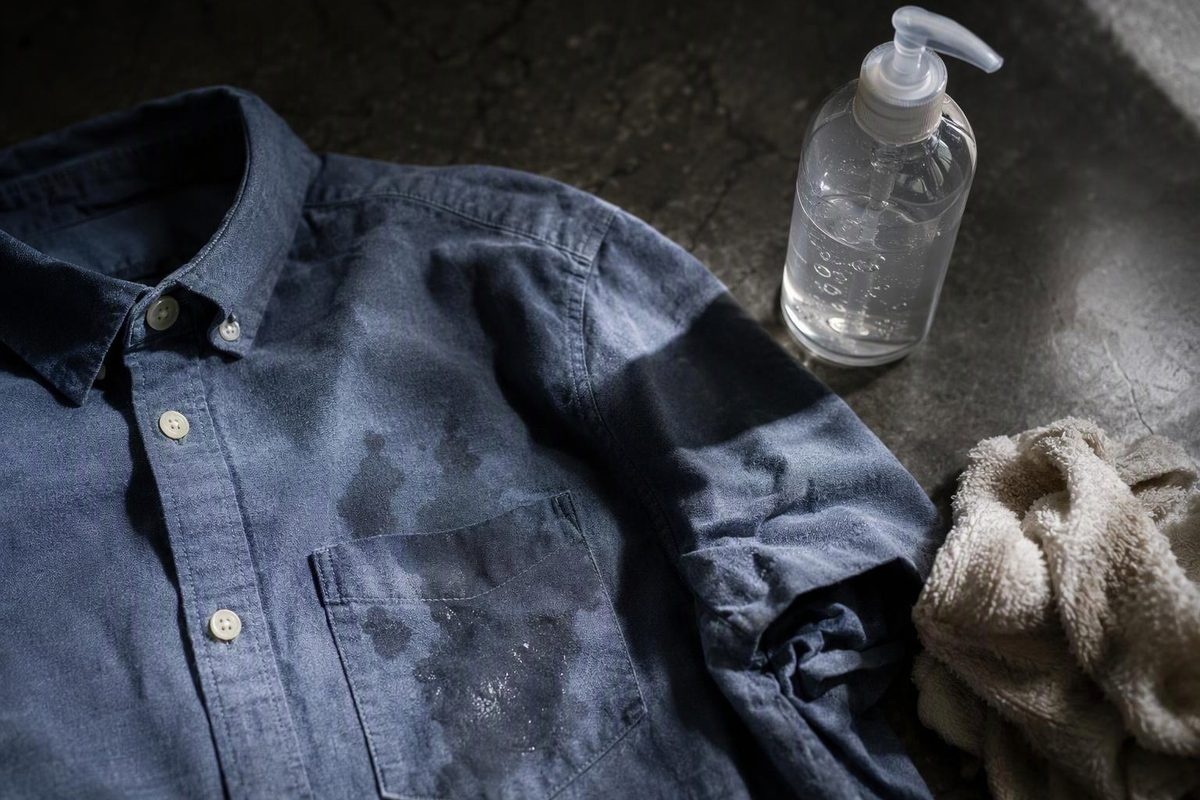
Yes—hand sanitizer can leave a visible mark on clothes, but not every mark is a removable stain. Leftover ingredients may wash out; a patch where alcohol has faded the fabric dye will not be fixed by stain removal. University of Georgia Extension warns that alcohol can fade some dyes and damage certain fibers. UGA textile-care guidance
For an ordinary washable garment, start by lifting excess sanitizer, spot-testing, then rinsing with cool water. Use liquid laundry detergent if residue remains. Do not add more sanitizer or rubbing alcohol to “dissolve” the mark.
Is it residue or lost color?
Hand sanitizer is not necessarily just alcohol and water. GOJO explains that its formulations evaporate while leaving moisturizers behind. A PURELL Healthcare gel label revised in December 2024 lists glycerin, isopropyl myristate and fragrance among its inactive ingredients. That makes leftover material a plausible cause of a mark—not proof that the fabric has faded. Check your own bottle because formulas vary. GOJO ingredient information · Example product label
Use the appearance as a clue, not a diagnosis:
| What you notice | What to do next |
|---|---|
| Sticky, stiff or crusty material; a whitish film | Try gentle rinsing on washable fabric before using detergent. |
| A darker or greasy-looking patch after drying | Pretreat with liquid laundry detergent, then wash as labeled. |
| A lighter patch that remains after rinsing, washing and drying | Suspect dye loss, especially if the texture feels normal. Stop escalating cleaners. |
| Dye transfers or the fabric changes color during a hidden-seam test | Stop and consult a professional cleaner. |
A wet patch can be misleading. Assess the final color only after the fabric has air-dried.
Gentle cleanup for washable clothes
-
Read the garment’s care label. This sequence is for clothing that permits washing. For dry-clean-only garments, silk, wool, valuable items or delicate trims, lift or blot excess and ask a professional cleaner before wet treatment. Tell them which sanitizer spilled.
-
Lift the excess without spreading it. Use a spoon edge for a blob of gel, or a clean white cloth for liquid. Blot rather than scrub: rubbing can abrade or tear fabric. Smithsonian stain-removal guidance
-
Spot-test water and detergent. Test a hidden seam with the treatment you intend to use, then blot with a white cloth and let the area dry. Stop if dye transfers, the color changes or the surface texture changes. Cornell Cooperative Extension recommends consulting a professional when a pretest causes color transfer or color change. Cornell precautions
-
Rinse the mark with cool water. Work from the back where practical. If the residue clears, a normal label-safe wash may be all that is needed.
-
Pretreat any remaining residue. Apply enough liquid laundry detergent to cover the small mark, gently distribute it without scrubbing, and follow the detergent’s pretreatment directions and dwell time. Then wash at the care-label temperature. Detergent pretreatment is the American Cleaning Institute’s first-line approach for light oily marks and several personal-care stains. ACI stain-removal guide
-
Air-dry and inspect. Keep the garment out of the tumble dryer until a removable stain is gone. If residue is clearly improving, repeat the gentle detergent treatment. If only an unchanged pale patch remains, further stain treatment is unlikely to help. ACI washing and drying guidance
When to stop
Do not jump to bleach, acetone or stronger alcohol for a pale patch: removing more color cannot replace missing dye. Avoid additional alcohol on acetate, triacetate, modacrylic or acrylic; UGA specifically identifies those fibers as vulnerable. UGA alcohol precautions
Keep a fresh alcohol-based spill away from flames and heat; sanitizer labels warn that the product is flammable. Product warning
If the patch is true color loss, the next decision is repair, professional recoloring or accepting the mark—not another stain remover.