 StainList
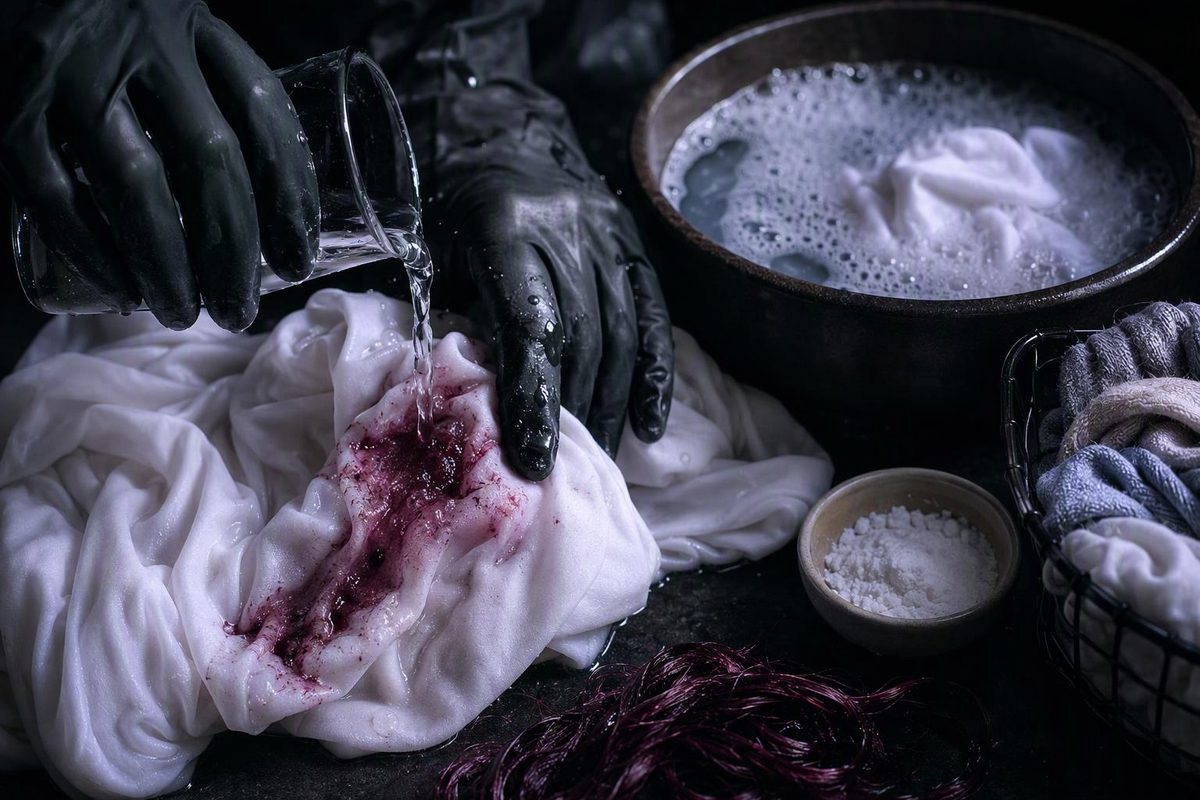
For washable clothes, remove excess hair dye, rinse, pretreat with liquid laundry detergent, and wash at the warmest care-label temperature. Keep the garment out of the dryer until the stain is gone. Concentrated hair dye may need repeated treatment, and complete removal is not assured. Clorox’s hair-dye guidance recommends air-drying between attempts.
These steps are for deposited hair color—not a patch where hair bleach has removed the garment’s own color.
Check the fabric before treating
- Ordinary washable cotton, polyester, or blends: Start with the detergent sequence below.
- Colored clothes or printed designs: Spot-test every treatment; do not assume “color-safe” means the garment cannot fade.
- Wool, silk, dry-clean-only, fragile, or valuable garments: Gently lift or blot excess dye without rubbing, then seek professional cleaning rather than trying bleach or solvent recipes. Bring the hair-color packaging and explain any treatments already used.
To spot-test, apply the intended product at its intended dilution to a hidden seam, following its stated contact time. Rinse if directed, let the test area dry, and check for fading or a changed finish before treating the visible stain. University of Georgia Extension advises checking the care label and pretesting each cleaning agent.
1. Remove excess dye and rinse
Take the garment off before applying cleaning products. Lift any blob of dye cream with a spoon edge; blot liquid with a white cloth. Do not scrub it across clean fabric.
Tide’s hair-dye instructions begin with removing excess dye and rinsing under running water. For washable fabric, start with cool water through the back of the stain, keeping the stained area away from the rest of the garment. This is a rinsing step, not a prolonged soak.
If the dye has already dried, skip scraping that pulls at the fibers and proceed to pretreatment.
2. Pretreat with liquid laundry detergent
Apply enough liquid laundry detergent to cover the mark and gently work it in with your fingertips. Use the detergent’s pretreatment directions; Tide’s hair-dye method specifies five minutes for Tide HE Turbo Clean Liquid.
Wash with the normal detergent dose at the hottest temperature the garment’s care label permits—not automatically hot water. Wash the stained item separately while it is releasing dye.
Inspect after washing, then air-dry to check the remaining color. If the mark has noticeably faded, repeat this sequence before escalating. Tide recommends repeating treatment before drying when dye remains.
3. Treat remaining color with a compatible laundry stain remover
For washable colored clothing, consider a liquid peroxide-based laundry stain remover labeled for pretreatment, provided both its instructions and the garment label allow it. This is also an option for compatible whites.
Contact times are product-specific. For example, Clorox’s hair-dye method uses Clorox 2 for Colors directly on the stain for 10 minutes, followed by washing with detergent at the hottest care-label temperature. It warns against letting the full-strength product dry on the fabric. Follow the bottle you have rather than applying that timing to every stain remover. Source: Clorox.
Do not substitute hair developer or hair-color remover for a fabric-labeled laundry product.
4. Reserve chlorine bleach for bleach-safe whites
For a white garment whose care label permits chlorine bleach, a short, correctly diluted presoak is an alternative to the peroxide treatment—not a product to layer over it. White does not automatically mean bleach-safe: Clorox excludes wool, silk, mohair, leather, and spandex—even a small spandex content.
For the Clorox Disinfecting Bleach specified in its instructions, the presoak is ¼ US cup (about 60 mL) per US gallon (about 3.8 L) of cool water, for no more than five minutes, followed by machine washing. Use your own bottle’s laundry directions if they differ. Never pour undiluted bleach onto the mark or increase the concentration to force a result; misuse can cause permanent yellowing. Clorox’s bleach precautions.
Do not combine stain treatments. Wash and rinse earlier treatments out thoroughly before changing products. Never mix chlorine bleach with vinegar, ammonia, or other cleaners; use laundry additives together only as their labels direct. Work with good ventilation and follow the product’s protective-equipment instructions. Poison Control warns that mixed cleaners can produce poisonous fumes.
When to stop
Stop if the garment’s own color fades, the print changes, or the fabric feels weakened. If properly used treatments no longer reduce the stain, stronger mixtures or longer exposure are not a sound next step. Seek professional assessment for a garment worth saving; old or dryer-exposed hair dye may remain visible.
For a spill on the floor as well, use the separate hair-dye removal guide for carpet—clothing bleach treatments are not a carpet method.