 StainList
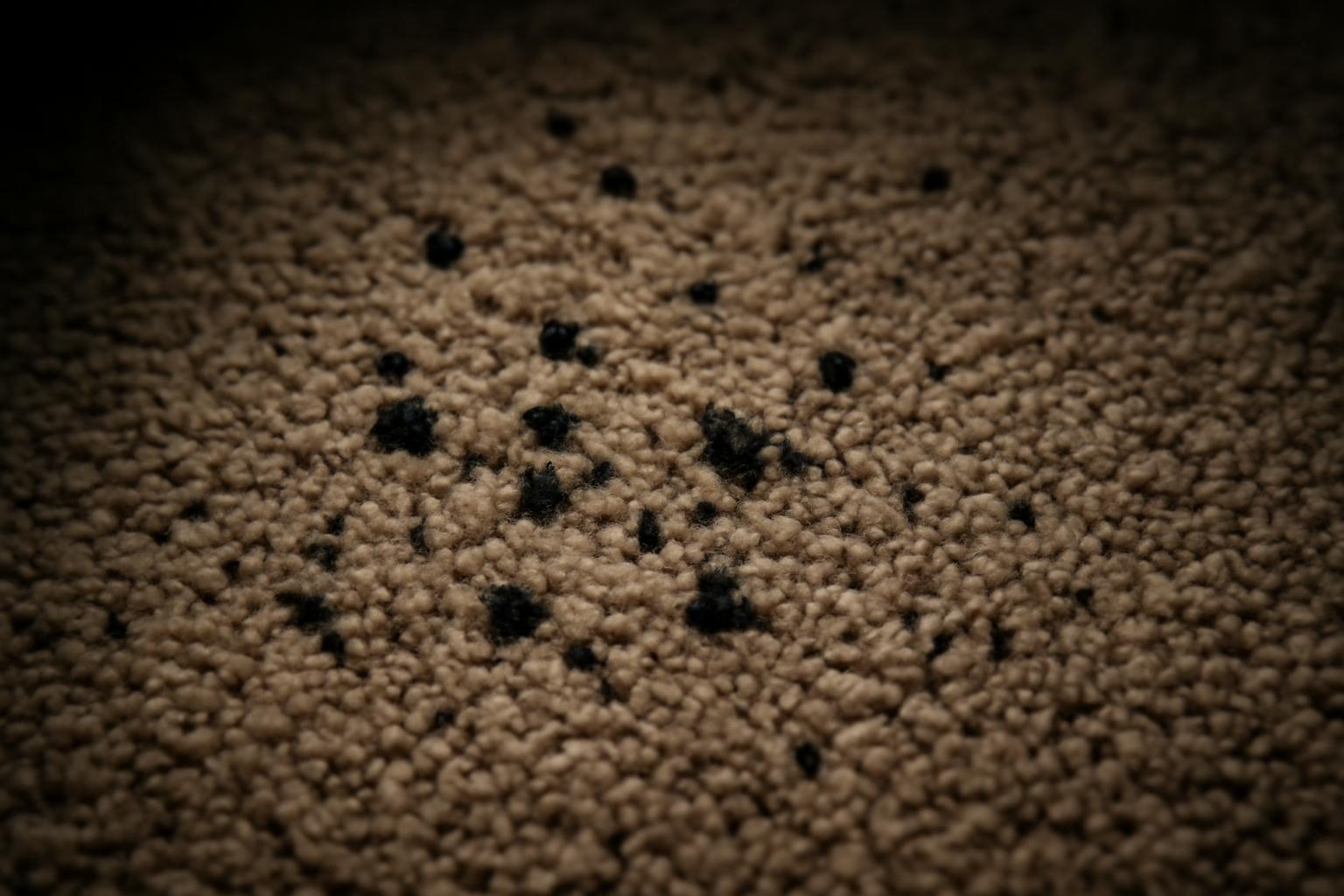
Black dots in carpet are a symptom, not a diagnosis. Color alone cannot tell you whether the marks are loose debris, insects, pest evidence, sticky residue, oil, wicking, filtration soiling, moisture-related discoloration, or contamination associated with newly installed carpet.
Do not automatically label dark specks as mold, carpet beetle droppings, beetle eggs, or grease. First examine their physical form, location, pattern, and timing. These clues can narrow the likely category and point to the safest next step, but they cannot provide a conclusive diagnosis by themselves.
Start Here: Are the Black Dots Objects or Stains?
Before vacuuming, scrubbing, or spraying anything, examine several dots under bright light. A flashlight held at a low angle can help distinguish raised particles or insects from flat discoloration.
Start with these questions:
- Do the dots move? Watch for crawling, especially after the area has been disturbed.
- Are they loose? Without crushing the material, determine whether an intact piece can be lifted.
- Do they vacuum up? Test only a small section if pest evidence is possible. Do not remove every example before you understand what it may be.
- Do they crumble? Dry pellets, fragments, soil, and cast material may break apart. Photograph their original form first.
- Do they smear? Smearing may indicate oil, soft residue, or fine deposited soil, but it does not identify the substance.
- Do they feel oily or sticky? Avoid unnecessary skin contact with unidentified material.
- Are they flat? A mark that remains part of the carpet’s color after gentle vacuuming is more likely to be a stain or discoloration than a loose object.
- Are they attached to fibers? Look for an oval body, bristles, a shed skin, or material caught around individual yarns.
Next, note the size, shape, concentration, and pattern:
- Isolated circles and gradually darkening spots suggest a different mechanism from scattered movable specks.
- Clusters beneath furniture may justify a pest inspection.
- Narrow straight streaks can be associated with installation-era oil or factory treatment.
- Reappearing spots may indicate resoiling or wicking.
- Broad gray-black bands at walls and doorways are more compatible with airflow-related filtration soiling.
Location matters as much as appearance:
- Along baseboards or beneath furniture: Inspect for insects, cast skins, lint, pet hair, and damage to natural-fiber materials.
- Near vents or floor gaps: Consider pest harborage as well as airflow patterns.
- Beside doorways or along room edges: Look for continuous bands rather than individual particles.
- Inside a previously cleaned area: Compare recurrence with the carpet’s drying period and subsequent foot traffic.
- Near a spill, pet area, plant, or adhesive tape: Consider soil-attracting residue.
- Across recently installed carpet: Look for straight lines, repeated bands, or marks recorded soon after installation.
- Near a leak or persistently damp area: Stop treating the appearance alone and obtain an assessment of the unresolved moisture.
Ask when the marks appeared. Did they follow a spill, spot treatment, wet cleaning, plumbing incident, leak, furniture move, or carpet installation? Timing is useful evidence, not proof. A spot noticed after cleaning may have existed previously, and a dark mark on new carpet is not automatically manufacturing-related.
Before cleaning, take:
- An overall photograph showing the marks in relation to walls, doors, vents, seams, and furniture.
- A close photograph that clearly shows their shape and relative size.
If the dots are loose objects, retain at least one intact representative sample when practical. Ask the pest professional, entomologist, installer, or other specialist who will examine it how the sample should be collected and submitted.
A compact decision path is:
- Loose, moving, oval, fuzzy, bristly, or pellet-like material: Preserve representative evidence and inspect for pest activity.
- Flat isolated spots that slowly darken: Investigate sugary, oily, adhesive, pet-related, or detergent residue.
- Spots returning gradually after the carpet is used: Consider residue-driven resoiling.
- Spots returning while wet carpet dries: Consider wicking or deeper contamination.
- Continuous edge bands: Investigate filtration soiling and airflow paths.
- Straight or repeating marks on new carpet: Document them and contact the installer or manufacturer before deep cleaning.
Black-Dot Identification Table: Pattern, Timing, and Likely Mechanism
Use this table to narrow the possibilities. It cannot conclusively identify a cause from a written description or photograph.
| Appearance or behavior | Common location | Timing | Corroborating clues | Plausible cause | Safest next step |
|---|---|---|---|---|---|
| Isolated flat dots that gradually become darker | Traffic lanes, eating areas, plant or pet areas, furniture, or former tape locations | Days or weeks after an unnoticed spill or treatment | Spot may feel slightly sticky or oily; dirt may be concentrated at yarn tips | Sugary drink, fruit juice, oil, grease, butter, adhesive, plant feed, pet saliva, urine, or detergent residue collecting soil | Check carpet-care instructions, avoid adding more detergent, and use only a compatible tested method |
| Spot disappears during cleaning but slowly returns | Previously spot-cleaned area | Days or weeks, often with continued foot traffic | Area may grow after repeated detergent treatment | Residue-driven resoiling from cleaner or original spill residue | Reconsider the cleaning method and obtain qualified help with residue removal if recurrence continues |
| Mark returns while carpet dries or within about 24 hours | Wet-cleaned, saturated, flooded, or repeatedly treated area | During drying or by roughly the following day | Discoloration may extend toward the yarn base; padding may have become wet | Wicking from residual stain or dirty moisture below the visible surface, a timing pattern described in carpet-cleaning trade guidance (Pelletier Rug) | Stop resaturating the area, assess drying and underlay moisture, and obtain advice on a compatible cleaning process |
| Black or gray band beside walls, doorways, floor gaps, or airflow paths | Room edges, beneath doors, around penetrations, or in aligned bands | Develops progressively | Continuous or repeated band rather than movable objects | Filtration soiling, also called draught marking | Photograph the pattern and investigate both cleaning options and relevant airflow paths |
| Tiny oval objects, fuzzy larvae, bristly skins, or salt-grain-sized pellets | Carpet edges, closets, beneath furniture, vents, lint accumulations, or stored textiles | May appear intermittently | Irregular holes, bare patches, damaged wool, cast skins, or visible larvae | Possible carpet beetle activity; larvae and associated evidence matter more than a few adults (UC Statewide IPM Program) | Preserve representative evidence, inspect susceptible materials, and seek identification |
| Delayed oily dots, narrow straight streaks, or repeated bands | Recently installed carpet | Immediately or over the following days or weeks | Marks run lengthwise or widthwise or repeat across the carpet | Machine oil, loom oil, excess lubricant, or uneven factory treatment | Document dimensions and timing; contact the installer or manufacturer before solvent use or deep cleaning |
| Damp, spreading, or irregular discoloration | Near plumbing, windows, basements, exterior walls, or a known water event | Associated with persistent moisture or repeated wetting | Carpet or underlay remains damp; odor may also be present | Unresolved moisture-related discoloration or contamination; appearance and odor do not establish mold | Stop adding liquid and obtain an appropriate moisture assessment |
| Material vacuums up cleanly without leaving discoloration | Scattered or concentrated in a traffic path | May appear suddenly | No smear, attachment, insect shape, or recurring stain | Ordinary loose soil or debris | Vacuum normally, then monitor for recurrence |
| Dark edge bands that do not vacuum away | Walls, doorways, and floor or skirting gaps | Gradual | Fine deposited material is embedded in the pile | Filtration soiling | Avoid aggressive scrubbing or overwetting and obtain fiber-appropriate cleaning advice |
Treat any match as a working hypothesis. Mechanisms can coexist. A detergent-treated area, for example, can collect new surface soil while excessive wetting also allows deeper contamination to move upward.
Sticky Residue, Oil, and Detergent: Why Clean Carpet Can Develop Dark Spots
A colorless spill can eventually create a black mark without depositing black pigment. The original liquid may dry clear or remain inconspicuous, but its residue can hold more tracked soil than the surrounding carpet. The black or gray material that later becomes visible may therefore be accumulated dirt, while the underlying cause is the residue retaining it.
Possible sources include:
- Sugary drinks and fruit juice
- Cooking oil, body oil, grease, or butter
- Adhesive or tape residue
- Plant feed
- Pet saliva or urine
- Detergent left after spot cleaning
A carpet-care product company lists lemonade, fruit juice, plant feed, pet saliva, oil, and fatty products as examples of residues that may collect dust and dirt. This is a plausible trade explanation, not a way to identify a particular spot without inspection (James).
It helps to distinguish the residue from the visible soil. Cleaning may remove the dark dirt and make the spot appear gone. If sugary, oily, adhesive, pet-related, or detergent residue remains, ordinary soil can collect there again. The returning dirt is newly deposited even though the underlying problem was never removed.
Repeated detergent treatment can intensify this cycle. Each application may remove some dark surface soil while leaving additional cleaner in the carpet. More product is not necessarily a better response when there is no compatible way to remove the residue afterward.
The recurrence clock is useful:
- Gradual darkening over days or weeks, especially in a walked-on area: More compatible with residue-driven resoiling.
- Reappearance while the carpet is drying: More compatible with wicking.
- A mark that never actually disappears: May represent embedded contamination, permanent discoloration, fiber damage, or an unsuitable cleaning method rather than recurrence.
If possible, inspect an individual yarn without pulling or cutting the pile. Soil concentrated near the yarn tips favors contamination deposited from above. Discoloration continuing toward the base raises the possibility of a deeper source.
Do not assume that an oily-feeling mark can be removed completely. If ordinary grease is ultimately confirmed, consult a surface-specific grease and oil stain guide only after checking the carpet manufacturer’s instructions; a method appropriate for washable fabric or one carpet construction may be unsuitable for another.
When Spots Return After Cleaning: Resoiling Versus Wicking
Resoiling occurs when new dirt adheres to material left in or on the carpet. That material may be residue from the original spill or from a cleaner. The dark soil is deposited after cleaning and generally becomes more noticeable as the area is used.
Wicking occurs when residual stain material or dirty moisture moves toward the visible surface while wet carpet dries. The mark then becomes visible near the surface even though it seemed to disappear when wet.
The timing often provides the clearest distinction:
- A spot that returns during drying or within roughly a day of wet cleaning may fit wicking.
- A spot that stays clean after drying but darkens gradually with traffic more strongly fits resoiling.
- A spot that returns at both intervals may involve more than one mechanism.
This timing distinction and the yarn-tip inspection are described in commercial carpet-cleaning guidance, which notes that wicking requires moisture at the carpet base and can become visible within 24 hours of wet cleaning (Pelletier Rug).
Ask whether the area was recently extracted, saturated during spot treatment, affected by a leak, or wet deeply enough to reach the backing or underlay.
The yarn inspection can add context:
- Dirt concentrated near the top: Surface resoiling becomes more plausible.
- Discoloration extending toward the yarn base: Wicking or another deeper source deserves consideration.
- No meaningful difference from top to base: The observation does not distinguish the mechanisms.
Do not assume every returning spot came from beneath the carpet. Conversely, do not keep adding detergent simply because each treatment briefly improves the appearance. First decide whether new soil is adhering from above or contamination is moving upward during drying.
Excess moisture can cause further wicking. Stop escalating treatment if each attempt requires more saturation or agitation.
Call a qualified carpet cleaner when:
- The same mark has returned more than once.
- Padding or underlay may have become wet.
- You do not know whether the carpet construction tolerates wet treatment.
- Discoloration reaches the base of the yarn.
- The spot cannot be treated without repeatedly saturating the area.
- The carpet is wool, a wool blend, valuable, unusually dyed, or otherwise specialized.
A professional should still diagnose the likely mechanism before choosing a process. “Recurring spot” does not automatically mean extraction, solvent treatment, or replacement.
Edge Lines, Airflow Patterns, and Moisture-Related Concerns
Continuous black or gray lines along walls differ from isolated black dots. Look for bands beside skirting boards, beneath doors, around floor penetrations, along floorboard gaps, or in repeated paths across a room.
This pattern may be filtration soiling, also called draught marking. It develops where air repeatedly moves through or around carpet and the pile captures fine contamination. The carpet effectively acts as a filter along those pathways.
Cooking emissions and proximity to heavy road traffic are among the possible pollution sources named by a carpet-cleaning company, but neither source can be assigned to a particular home from the mark alone. The same trade guidance warns that overwetting may cause additional staining and that scrubbing can damage carpet pile (Cheshire Cleaning).
Treatment may need to address both the deposited material and any cleaner residue. That does not make extraction or a specialty chemical universally appropriate: fiber type, dye stability, carpet construction, previous treatment, and the degree of soiling all affect the choice.
Source control and cosmetic restoration are separate tasks. Cleaning may improve the line without preventing its return. Reducing inappropriate airflow through relevant floor or skirting gaps may help, but alterations should be suitable for the building. Do not close necessary ventilation paths merely because a carpet edge is dark.
An aggressive attempt can create a more conspicuous patch than the original line.
Darkness near a damp area calls for a different response. If carpet or underlay remains wet, or there is an unresolved leak or spreading discoloration, stop repeated cosmetic treatment and obtain an appropriate moisture assessment.
Until the source of moisture is understood, adding more liquid may obscure the pattern or trigger further wicking.
Could the Dots Be Carpet Beetles or Their Pellets?
Small black or dark adult carpet beetles are one possible explanation for movable, insect-shaped objects. An unexplained black dot, however, is not enough to identify a beetle, its droppings, or its eggs.
Adult carpet beetles vary by species. They are generally oval or rounded and may be black, dark brown, or mottled with lighter colors. University of Kentucky guidance describes adults as approximately 1/16 to 1/8 inch long and larvae as approximately 1/8 to 1/4 inch long (University of Kentucky Entomology). UC IPM separately notes that adult black carpet beetles can reach approximately 3/16 inch.
Larvae are generally tan to brown, slow-moving, and fuzzy or bristly rather than smooth. They—not the adults—cause textile damage. A few adults near windows do not by themselves prove that larvae are actively feeding on carpet or belongings.
Stronger evidence includes:
- Fuzzy or bristly larvae
- Bristly cast skins
- Pellet-like material approximately the size of grains of salt
- Irregular holes
- Threadbare or bare patches
- Fine debris near damaged material
- Damage to susceptible textiles stored nearby
Pellet color alone is not a dependable identification rule. Although one commercial pest source describes pellets as brown or black, university guidance emphasizes their approximate size and the importance of larvae, cast skins, and damage. Generic black dots should not be identified as carpet beetle eggs.
Inspect dark, undisturbed locations rather than looking only at the exposed carpet surface:
- Carpet edges and undersides
- Baseboards and floor cracks
- Closets and stored textiles
- Beneath beds, sofas, cabinets, and other furniture
- Vents and ducts
- Lint and pet-hair accumulations
- Dead insects
- Bird or animal nests associated with the building
- Stored wool, silk, fur, feather, leather, or felt items
Larvae can feed on wool, silk, fur, feathers, leather, felt, and other animal-derived materials. Most synthetic carpet is not eaten, but synthetic flooring does not rule out nearby activity: larvae may be supported by pet hair, lint, dead insects, contaminated material, or natural-fiber possessions in the same area. Natural-fiber rugs and related animal-derived goods are also susceptible (Illinois Department of Public Health).
Once the pest has been identified, management should focus on the source:
- Locate the infested or food-bearing material.
- Vacuum carpet edges, furniture undersides, closets, vents, cracks, and lint accumulations thoroughly.
- Remove badly infested or unnecessary materials.
- Launder, heat-dry, dry-clean, or otherwise treat affected items only where the item’s care requirements permit.
- Store cleaned susceptible goods in suitable enclosed storage.
- Continue inspecting for larvae, cast skins, and fresh damage.
University entomology guidance supports detailed vacuuming, source removal, hot laundering, dryer heat, or dry-cleaning where suitable for the affected material (University of Kentucky Entomology).
Pesticides are supplemental rather than the primary response. Any pesticide must be labeled for the intended pest, surface, and setting and used according to its directions. Insecticides should not be applied to clothing or bedding (UC Statewide IPM Program). If identification is uncertain, ask a pest-management professional or entomologist how to submit a specimen rather than spraying unidentified dots.
Black Spots or Straight Streaks on Newly Installed Carpet
Consider manufacturing or installation-era contamination only when the carpet is newly installed or documentation connects the marks to that period. Do not extend the explanation casually to older carpet.
Timing and shape can distinguish several possibilities:
- Dark grease visible when the carpet is first unrolled: May reflect grease transferred during manufacturing or handling.
- Initially clear machine oil: May not become obvious until days or weeks later, after the oily area collects soil.
- Loom oil: May appear as narrow linear streaks running lengthwise or widthwise rather than random pest-like specks.
- Excess yarn lubricant: May contribute to rapid or widespread soiling.
- Overapplied soil retardant: May leave a sticky area that collects dirt.
- Uneven factory treatment: May produce repeating bands that soil faster than adjacent carpet.
A flooring-inspection article describes excess lubricant as especially associated with polypropylene or olefin carpet, but fiber type alone does not prove the cause. It also distinguishes immediately visible grease from delayed machine-oil spots and describes loom-oil contamination as narrow directional streaks (Carpets Wall to Wall).
Before applying solvent or arranging deep cleaning, record:
- Installation and discovery dates
- Whether the marks were visible when the carpet was unrolled
- Exact location and direction
- Length, width, and spacing
- Whether the pattern repeats
- Whether the marks are becoming darker
- Product, fiber, batch, and installer details, if available
Photograph the marks from several angles and retain installation paperwork and any photographs taken before furniture was placed.
Contact the installer or manufacturer before cleaning destroys the pattern or makes inspection more difficult. Do not assume that a solvent, water extraction, or another correction is universally suitable. Compatibility depends on the fiber, dyes, backing, manufacturer instructions, and actual contaminant.
A pattern consistent with installation-era contamination supports further inspection; it does not by itself establish the cause or determine the appropriate remedy.
A Conservative Response Plan—and When to Call a Specialist
The safest response is cause-first rather than cleaner-first.
1. Document before disturbing
Photograph the overall pattern and representative close views. Record the date, recent spills or treatments, installation timing, moisture events, and whether the marks are changing. Note their positions relative to walls, vents, furniture, seams, and traffic paths.
2. Retain loose evidence
If the dots are objects, keep at least one representative example intact when practical. Ask the professional who will identify it how it should be collected, stored, or submitted. Do not destroy all the material through vacuuming or chemical treatment before seeking identification.
3. Identify the carpet and its care requirements
Check the manufacturer, fiber, backing, care label, warranty documents, and permitted treatments. Wool, specialty dyes, natural-fiber rugs, glued-down carpet, and carpet with uncertain construction deserve extra caution.
4. Vacuum only genuinely loose debris
If the material is clearly ordinary loose soil, vacuum it. If it resembles insects, larvae, cast skins, or pellets, document representative evidence first and inspect nearby hidden areas. Vacuuming can still form part of pest management once the material has been assessed.
5. Reassess before applying liquid
For a flat unidentified spot, determine whether it is associated with unresolved moisture, new-carpet oil, or possible pest evidence.
Check the manufacturer’s instructions and test any permitted treatment in an inconspicuous area. A carpet-cleaning company specifically advises hidden-area testing because stain removers may alter or bleach carpet color (Cheshire Cleaning).
Plain cold water may be considered only as a cautious trial for a small spot that appears water-compatible and is not suspected to involve an insect specimen, manufacturing oil, or active moisture problem. Use minimal moisture and do not soak through to the backing.
James, a carpet-care product company, recommends using a wrung cotton towel with broad wiping strokes rather than dabbing. That is one company’s method, not a universal rule, and the carpet manufacturer’s instructions should take precedence (James).
For suspected grease or oil, use only a fiber-compatible method permitted by the carpet manufacturer or selected by a qualified carpet cleaner. The evidence does not establish a universal household solvent or chemical mixture that is safe for every carpet.
Avoid:
- Scrubbing or hard brushing
- Soaking the spot
- Combining unverified cleaning treatments
- Repeatedly adding detergent
- Extending product dwell time beyond its directions
- Applying a pesticide that is not labeled for the pest, surface, and setting
- Treating clothing or bedding with carpet insecticide
- Assuming that more product is safer or more effective
- Deep-cleaning patterned marks on new carpet before inspection
Match the specialist to the evidence:
- Pest professional or entomologist: Larvae, cast skins, pellets, adult insects, or continuing textile damage.
- Moisture specialist: Persistent dampness, an unresolved water source, wet underlay, or spreading moisture-related discoloration.
- Qualified carpet cleaner: Established surface contamination, residue-driven resoiling, filtration soiling, or suspected wicking after any water source has been controlled.
- Installer or manufacturer: Directional streaks, repeating bands, oily marks, or other documented patterns on recently installed carpet.
Stop home treatment if you find spreading dampness, an unresolved leak, repeated wicking, color transfer during a permitted hidden-area test, pile distortion, visible larvae, continuing fiber damage, or uncertainty involving valuable wool or specialty carpet.
Finally, separate source control from cosmetic cleaning. Soil-attracting residue must be removed rather than covered with more cleaner. Persistent moisture must be addressed before discoloration can be meaningfully evaluated. Carpet beetle food sources and infested materials must be located. Filtration-soiling recurrence may require appropriate attention to airflow paths. Cleaning the dark appearance without addressing its mechanism is why many marks return.
Frequently Asked Questions
Are black dots in carpet always carpet beetle droppings?
No. They may be ordinary debris, adult insects, cast material, accumulated soil on sticky residue, oil-related marks, wicking, filtration soiling, moisture-related discoloration, or contamination associated with newly installed carpet.
Carpet beetles become more plausible when the dots are accompanied by oval adults, fuzzy larvae, bristly cast skins, salt-grain-sized pellets, irregular holes, bare patches, or damage to wool and other susceptible materials. Dots alone are not enough to identify droppings, and generic black dots should not be labeled carpet beetle eggs.
Why do black carpet spots disappear after cleaning and then return?
Two leading mechanisms are resoiling and wicking.
With resoiling, cleaning removes visible dirt but leaves sugary, oily, adhesive, pet-related, or detergent residue that attracts new soil. The mark generally darkens gradually as the area is used.
With wicking, residual contamination or dirty moisture moves toward the surface while wet carpet dries. Repeated detergent application or saturation can complicate either problem, so reconsider the mechanism before treating the area again.
Do black dots and a musty smell mean there is mold under the carpet?
Not necessarily. Dark discoloration and odor do not establish the cause. If carpet or underlay remains damp, there is an unresolved leak, or discoloration is spreading, stop repeated spot cleaning and obtain an appropriate assessment of the moisture problem.
The moisture source should be addressed before cosmetic treatment continues.
What causes black lines around the edges of carpet?
Continuous dark lines along walls, skirting boards, doorways, floor gaps, or other airflow routes may be filtration soiling, also called draught marking. Fine airborne contamination is deposited where air repeatedly moves through or around the carpet.
Cleaning can be difficult and may not prevent recurrence. Appearance restoration and control of inappropriate airflow are separate tasks, and any treatment should be compatible with the carpet.
Can black spots on new carpet come from machine or loom oil?
Yes, when the timing and pattern are compatible. Clear machine oil may become visible after installation as it attracts soil. Loom oil is more likely to produce narrow directional streaks running lengthwise or widthwise than randomly scattered specks. Immediately visible dark grease, excess yarn lubricant, or uneven factory treatment can create other patterns.
Document the marks, dimensions, installation date, and changes over time. Contact the installer or manufacturer before solvent treatment or deep cleaning removes useful evidence.
Conclusion: Identify the Mechanism Before Cleaning
The safest way to address black dots in carpet is to identify their physical form and pattern before treating them. Loose insect-like material, flat recurring spots, wicking during drying, edge bands, damp discoloration, and straight marks on new carpet require different responses.
Begin with documentation and the least aggressive compatible action. If the surrounding evidence points to pests, unresolved moisture, recurring contamination, or an installation-era pattern, involve the appropriate pest professional, moisture specialist, carpet cleaner, installer, or manufacturer rather than applying a universal cleaner.