 StainList
The short answer from Reddit
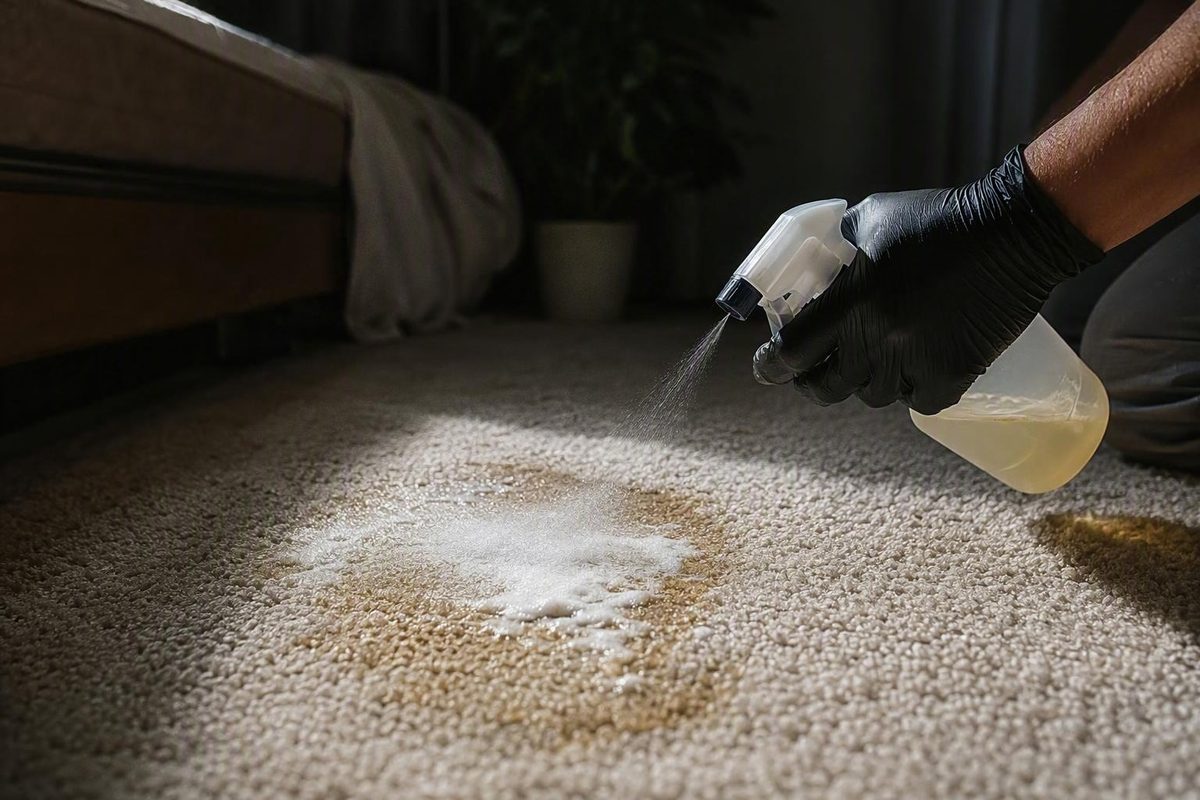
The recurring Reddit answer is straightforward: use a carpet-compatible enzymatic urine cleaner across the entire affected area, give it the contact time specified on the label, and let the carpet dry completely before judging the result. The most useful part of that advice is not a particular brand recommendation. It is the principle that the cleaner must reach the same layers the urine reached.
A light surface spray is unlikely to resolve urine that passed through the carpet fibers into the backing or padding.
In a r/CatAdvice discussion about urine beneath carpet, commenters repeatedly recommended enzyme cleaners, but they did not agree that treatment would always work. Some described success after deep application; another said a recommended approach had failed; others warned that contaminated padding or subfloor might require more extensive work. These are personal reports and community preferences—not comparative testing, proof of safety, or a guarantee.
A practical sequence is:
- Locate the full suspected area.
- Blot or extract fresh liquid without scrubbing.
- Check the carpet-care instructions and spot-test the cleaner.
- Apply one compatible urine cleaner exactly as its label directs.
- Keep people and pets away for the label-specified period.
- Let the area dry completely.
- If the odor returns, investigate the backing, padding, perimeter, and subfloor instead of repeatedly wetting the surface.
- Escalate to specialized remediation or material replacement when deep contamination cannot be treated adequately in place.
The depth-first rule applies whether the accident happened today or the odor was left by a previous resident. A fresh, isolated spot may be manageable from above.
First determine how far the urine traveled
A visible mark does not necessarily show the full affected area. Liquid can move downward and laterally, so the center of the stain may represent only part of the problem. Think of carpet as an assembly with several possible contamination levels:
- Face fibers: The visible pile.
- Backing: The structural underside of the carpet.
- Padding or underlay: The absorbent layer below it.
- Perimeter materials: Carpet edges, tack strips, baseboards, trim, or nearby lower wall surfaces.
- Subfloor: The material beneath the padding, commonly wood-based panels or concrete.
Suspect deeper or wider contamination when the area is large, has been used repeatedly, lies beside a wall, or still smells after surface treatment. Odor that disappears temporarily but returns after drying or during warm, humid conditions is another reason to stop assuming the source is confined to the fibers.
One r/HomeImprovement discussion about persistent cat-urine odor concerned an affected strip beside a wall after carpet machines, deodorizer, baking soda, and vinegar had failed. Commenters raised the possibility of contamination at the wall edge and beneath the carpet. One reported that odor in another home kept returning during warm, humid conditions until the carpet was removed. Those outcomes are anecdotal, but they illustrate why perimeter and below-carpet contamination may need investigation.
A black light can help map suspected old spots. Darken the room, scan the carpet, and mark the boundaries of suspicious fluorescence with removable tape before applying cleaner. Include any apparent spread toward carpet edges or lower wall materials.
Fluorescence is a clue, not conclusive proof of urine. Interpret what you see using the location, odor, known accident history, and results of prior treatment.
Doing so may require lifting carpet or removing trim. Homeowners who are not comfortable releasing and reinstalling carpet can ask a carpet installer or urine-remediation provider to inspect it.
Before applying liquid, check whether the carpet is glued down and whether its care instructions restrict wet cleaning. Products and methods suitable for one carpet may not be appropriate for another. Follow the carpet manufacturer’s care guidance and the cleaner’s label rather than assuming all fibers, dyes, backings, and installation methods tolerate the same treatment.
For a fresh accident, remove liquid before treating odor
Acting promptly reduces the liquid available to travel farther into the carpet assembly. Start with dry, absorbent white towels, paper towels, or an extraction tool suitable for the carpet. Press firmly, replace the absorbent material as it becomes wet, and continue until little additional moisture transfers.
Do not scrub. Scrubbing can enlarge the wet boundary, push liquid deeper, and distort the pile. Commercial BISSELL guidance on pet urine in carpet likewise advises blotting rather than scrubbing and recommends treating beyond the visible spot because urine can spread beneath the surface.
Work across the likely spread rather than treating only the darkest or wettest center.
Before broad application:
- Read the carpet-care instructions.
- Confirm that the cleaner is intended for carpet and pet urine.
- Test it in an inconspicuous location as directed.
- Allow the test area to dry before checking for color or texture changes.
- Review the label’s access restrictions for pets and children.
Apply the chosen cleaner according to its own instructions. Labels differ on how much product to apply, how long it needs contact, and whether the treated area should be blotted, rinsed, extracted, covered, or left to air-dry. Do not borrow a dwell time from a different product or an online comment.
There is no responsible universal instruction such as “wait ten minutes” or “leave it overnight.” Product formulation, soil level, carpet construction, and required post-treatment steps vary. Too little product may fail to reach the affected material, but treating more as automatically better can leave substantial moisture below the surface.
If you use an extraction machine, do not assume a whole-room shampoo pass is equivalent to targeted urine treatment. Extraction can recover liquid and residue, but success still depends on whether the process addresses the urine’s actual depth and spread.
For dried or recurring odor, use a label-first enzyme treatment
Enzymatic urine cleaners are the most repeated recommendation across the three supplied Reddit discussions. In a r/CleaningTips thread about odor that persisted after numerous products, commenters again recommended enzyme cleaners and emphasized treating the affected area thoroughly. Others suggested different products or professional cleaning, showing that there was no universally accepted solution.
The useful principle is simpler than the chemistry claims often made in comment sections: a cleaner cannot treat contaminated material it never contacts. Perfuming the face fibers will not resolve a source left in the backing or padding.
For an old, localized spot:
- Map the likely area, using a black light only as a screening aid.
- Prepare the surface as the product label directs.
- Confirm compatibility and spot-test the cleaner.
- Treat slightly beyond the suspected boundary.
- Apply enough product to reach the affected layer without indiscriminately flooding the floor.
- Maintain the contact conditions specified by the label.
- Blot, rinse, extract, or air-dry exactly as directed.
- Wait until the area is fully dry before reassessing.
There is no evidence-supported universal volume per square foot. A shallow accident in dense carpet and repeated contamination that reached thick padding do not call for the same amount. The target is adequate contact with the affected material—not an arbitrary number of sprays, a gallon by default, or standing liquid.
If shampoo, detergent, vinegar, peroxide, deodorizer, or another cleaner has already been used, do not assume the next product will be compatible or effective. The supplied evidence does not establish a universal rinsing or neutralizing sequence. Record what was applied, review the new cleaner’s label, and contact its manufacturer if the instructions do not address prior treatment.
A second application may be reasonable if the label permits retreatment and the first treatment has dried. Recurring odor after correct application is also a diagnostic clue, however: the untreated source may be deeper or wider than expected. Increasing the liquid indefinitely is a poor substitute for inspection.
What Reddit users bought—and what those mentions do not prove
Individual commenters in the r/CatAdvice thread mentioned:
- Nature’s Miracle
- Rocco & Roxie
- Simple Solution Urine Destroyer
- Kids & Pets
The r/CleaningTips discussion included mentions of:
- My Pet Peed
- Vital Oxide
- Nature’s Miracle
- Rocco & Roxie
These lists describe what individual users suggested or said they had tried. They do not establish which product is best, compare performance under controlled conditions, or prove compatibility with a particular carpet. Upvotes indicate that a comment resonated with some readers, not that its method was independently tested.
The reports also conflict. Some commenters associated deep enzyme application with success, while at least one user said a recommended approach did not work. The age and extent of contamination, affected materials, prior cleaners, application coverage, and drying conditions all differed.
Choose a product by process rather than popularity:
- Carpet compatibility: Is it approved for the carpet and its care code?
- Application method: Can you carry out the required contact, blotting, extraction, or drying steps?
- Likely depth: Is the problem confined to the pile, or might the backing and pad require attention?
- Fragrance: Will a strong scent make the room unpleasant or make odor assessment harder?
- Access restrictions: Can people and pets remain away for as long as the label requires?
- Prior treatment: Does the manufacturer address use after another cleaner?
- Patch-test result: Does the tested area remain unchanged after drying?
Do not select a gallon-size product solely because commenters recommend soaking. Conversely, do not expect a few surface sprays to resolve pad-level contamination. The appropriate amount depends on the affected depth and the product instructions, not the enthusiasm of a testimonial.
Avoid the common cycle of mixing and over-wetting
Persistent odor often produces a predictable cycle: shampoo, deodorizer, vinegar, baking soda, peroxide, detergent, and then another enzyme product. This makes troubleshooting harder by adding residues, fragrances, compatibility questions, and moisture without first establishing where the urine is.
The supplied commercial guides disagree about household treatments. Some recommend diluted vinegar, peroxide, or baking soda under particular conditions; others question whether those materials reliably address urine odor. They should not be presented as one proven sequence.
If the instructions are unclear, ask the product manufacturer rather than improvising.
Never mix vinegar with bleach. The combination can produce dangerous chlorine gas. Commercial ServiceMaster guidance also warns against that mixture and advises avoiding bleach and ammonia-based cleaners for cat-urine cleanup. Do not combine cleaners in a machine, bottle, or treated area unless their manufacturers expressly authorize it.
Hydrogen peroxide may discolor carpet. A Zerorez carpet-cleaning guide advises following the peroxide product’s dilution directions and testing an inconspicuous area for bleaching or discoloration. A successful patch test does not establish compatibility with an enzyme cleaner or every carpet construction.
Ordinary fragrances and powdered deodorizers may temporarily change what you smell, but they cannot address urine that remains untreated in the backing or pad.
Reddit advice frequently says to “soak” the area. There is a valid principle behind that recommendation: treatment must reach the urine. The mistake is turning it into indiscriminate flooding. Heavy application may be difficult to remove and dry, particularly when absorbent padding is involved. Apply the product only as directed; if proper treatment would require uncontrolled saturation of inaccessible layers, move to inspection or specialized remediation.
Dry fully before deciding that treatment failed
A treated area is not ready for evaluation while it remains damp. User reports describe urine odor becoming more noticeable immediately after wet cleaning, but those anecdotes do not prove one universal mechanism.
Use complete drying as the decision checkpoint:
- Keep people and pets away as directed.
- Follow the cleaner and carpet manufacturer’s drying instructions.
- Do not shorten required contact time in an attempt to accelerate drying.
- Do not cover the area longer than the product permits.
- Remember that dry-feeling pile does not confirm that the padding is dry.
- Reassess only after the treated carpet assembly has had a reasonable opportunity to dry.
There is no universal drying time. Carpet pile, padding, ventilation, climate, product quantity, treatment method, and floor construction all vary.
As noted in the r/HomeImprovement account above, one commenter reported that odor returned during warm or humid conditions until the carpet was removed. That is one person’s experience, not proof of a particular chemical or structural explanation. Nevertheless, recurrence after apparent improvement is a practical reason to investigate unresolved contamination rather than add fragrance.
Clear water in an extraction tank is not proof that urine has been eliminated from the backing, padding, perimeter, or subfloor. It describes what the machine recovered during that pass; it cannot verify inaccessible layers.
After the area dries, use this stopping rule:
- No odor: Continue monitoring, particularly if the location was repeatedly used.
- Improved but still detectable: Check whether the label permits retreatment and whether the original coverage was adequate.
- Odor returns strongly or extends beyond the treated boundary: Investigate deeper or wider contamination.
- The carpet or underlying area does not dry as expected: Stop adding liquid and request an assessment of the carpet assembly and drying conditions.
Repeatedly applying larger quantities without learning where the source is turns treatment into guesswork. Dry, reassess, and change the investigation—not merely the brand or dose.
Know when to call a specialist or replace materials
Stop treating indefinitely when odor persists after a compatible product was applied correctly and the area dried completely. At that point, inspect the carpet assembly or request professional evaluation.
Routine carpet cleaning and pet-urine remediation are not necessarily the same service. Urine remediation should begin by locating affected areas and determining whether the backing, padding, edges, lower wall materials, or subfloor need attention.
Ask a prospective provider:
- How do you locate and map suspected urine contamination?
- Can you inspect carpet edges and padding when authorized?
- How do you distinguish surface contamination from a deeper source?
- How will you control the amount of liquid applied?
- How will you determine whether the carpet and padding have dried?
- Can you inspect affected perimeter or lower wall materials?
- What is the plan if the odor returns?
- Will any proposed work comply with the carpet manufacturer’s requirements?
- If removal is necessary, will the company handle it or coordinate with an installer?
Professional treatment is an escalation option, not an assured solution. The supplied anecdotes include both successful remediation and cleaning that failed until materials were removed. The depth and extent of contamination—and the process the provider offers—matter more than the word “professional.”
If inspection finds contamination concentrated in the padding, selective pad replacement may be reasonable. Padding replacement alone is not guaranteed to solve the problem because the carpet backing, perimeter, or subfloor may also be affected. Conversely, finding contamination in one layer does not automatically mean every layer must be discarded.
Severe, extensive, or old contamination may require one or more of the following:
- Lifting or removing carpet
- Replacing affected padding
- Treating or replacing contaminated carpet
- Inspecting carpet edges and adjacent porous materials
- Treating the subfloor with a method appropriate to that material
- Replacing subfloor sections that cannot be remediated adequately
- Repairing affected trim or lower wall materials
The response should be proportionate to what inspection finds. Do not assume routine extraction will solve every deep problem, but do not authorize extensive removal solely because one surface treatment failed.
Protect a rental—and address why the accident happened
For renters, the following are general documentation precautions rather than legal advice. Lease terms and local rules vary:
- Photograph the affected carpet and surrounding trim or wall.
- Note when the odor was detected and whether it appeared to be present at move-in.
- Notify the landlord or property manager in writing.
- Preserve receipts for cleaners, equipment rentals, and assessments.
- Record each treatment and the result after drying.
- Request a written plan if the problem appears to involve installed padding, walls, or subfloor.
This creates a clear record of what work was authorized; it does not determine responsibility under a particular lease or jurisdiction.
If the odor appears pre-existing, report that promptly and retain move-in photographs or correspondence. If your cat caused the accident, a treatment log can still help the property owner distinguish targeted urine remediation from repeated general carpet cleaning.
Cleanup does not establish why a cat urinated outside the litter box. The supplied cleaning discussions cannot diagnose a medical or behavioral cause.
You can also document practical observations to discuss with the veterinarian or household members:
- How clean the litter box is kept
- Whether the cat can reach it easily
- Where the box is placed
- Whether another animal appears to obstruct access
- Recent changes in the household or routine
- Whether the event looked like spraying or full urination
- Whether the pattern is isolated or recurring
One commenter in the r/CatAdvice discussion raised spay or neuter status as a possible marking consideration. That anecdote does not show that altering a cat will stop the behavior in an individual case. Cleaning, veterinary guidance, and observation of litter-box conditions should be treated as separate parts of the response.
Frequently asked questions
Will an enzyme cleaner definitely remove cat urine smell from carpet?
No. Enzyme cleaners are the most common recommendation in the reviewed Reddit threads, but the reports are anecdotal. Results depend on carpet compatibility, coverage, contamination depth, label-directed contact, and drying.
If odor returns after a correctly applied treatment has dried, investigate deeper layers rather than assuming a larger dose must work.
How much enzyme cleaner should I put on the carpet?
Use the amount specified by the product label for the full affected area and application method. There is no universal number of sprays, ounces, or volume per square foot.
The cleaner must reach the contaminated material, but uncontrolled flooding is not a substitute for inspecting padding or other inaccessible layers.
Why does cat urine smell come back after the carpet dries or when it gets humid?
A returning odor is a practical clue that contamination may remain outside the treated area or below the fibers. Possible locations include the backing, padding, carpet edge, nearby porous material, or subfloor.
Warm- or humid-weather recurrence appears in user reports, but it does not prove which layer is affected. Expand the inspection before repeating treatment.
Can I use vinegar, baking soda, or hydrogen peroxide with an enzyme cleaner?
Not as a universal sequence. The supplied commercial guides conflict about these household treatments and do not establish compatibility with every enzyme cleaner.
Follow the applicable labels. Peroxide may discolor carpet and requires a patch test when its use is permitted. Never mix vinegar with bleach, and do not combine cleaning chemicals unless their manufacturers explicitly authorize it.
When does cat urine contamination require replacing the carpet or padding?
Consider replacement when authorized inspection finds extensive contamination that cannot be reached or remediated adequately in place, or when odor persists after correctly applied treatment and complete drying.
Padding replacement may help when the pad holds the source, but it is not automatically sufficient. The backing, edges, nearby porous materials, or subfloor may also require attention. Renters should obtain written approval before destructive inspection or removal.
The durable strategy is depth-first: blot a fresh accident, map the probable spread, use one compatible enzymatic urine cleaner exactly as labeled, and wait for complete drying. If the odor returns, stop chasing it with fragrance or progressively heavier soaking and investigate the backing, padding, edges, and subfloor. Renters should document the condition before altering installed materials, and recurring accidents should be discussed with a veterinarian without assuming a diagnosis.