 StainList
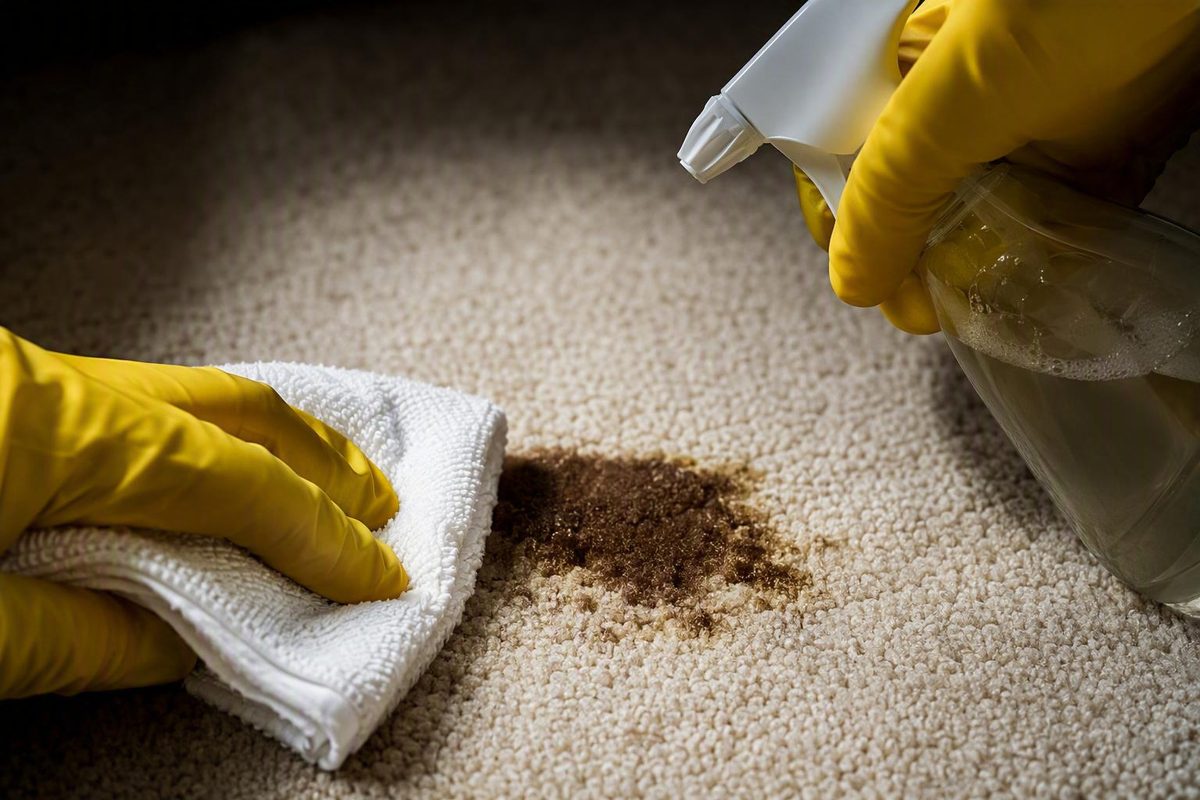
The safest answer to how to get faeces stains out of carpet is not to begin with the strongest cleaner available. For a small, superficial accident, first lift the solid material without pressing it into the pile. Then blot the remaining mark with a weak detergent solution, rinse with very little water, extract the moisture, and dry the carpet thoroughly.
That controlled sequence reduces three common problems: spreading the contamination, leaving sticky detergent behind, and driving liquid into the backing or underlay. If residue or odour remains after the carpet has dried, a carpet-compatible enzyme cleaner may be appropriate—but only as directed on its label.
Visible stain removal, cleaning, deodorising, and disinfection are separate outcomes. A carpet can look clean but retain an odour, and an enzyme cleaner that acts on organic residue should not automatically be treated as a disinfectant.
This household method is limited to a small surface incident where the carpet is compatible with water-based spot cleaning and there is no reason to suspect infectious illness. It is not a health-safety protocol for extensive human faecal contamination, diarrhoeal waste, or material that may have reached the carpet backing or underlay. In those situations, seek current public-health advice and professional carpet assessment rather than relying on appearance or smell.
What to do immediately
Act promptly, but do not panic-scrub. Speed helps contain the affected area; rubbing can spread wet material and disturb the carpet pile.
Use this immediate checklist:
- Keep children and animals away while you work.
- Put on disposable gloves.
- Gather paper towels, a disposable bag or dull scraper, clean white cloths, a waste bag, mild clear washing-up liquid, and clean water.
- Lift solid material before applying liquid.
- Blot loose or wet material rather than wiping it.
- Place the waste and disposable cleaning materials in a bag.
- Avoid using an ordinary dry-only vacuum on the affected area.
Gloves, paper towels, disposable scraping tools, and prompt bagging are commonly specified in carpet-cleaning guidance for these accidents. The safest practical choice is to use disposable pickup tools rather than returning a contaminated kitchen utensil to normal use. Pogi’s carpet-cleaning guide likewise recommends gloves and disposable materials for lifting the waste.
To remove solids, use folded paper towels, an inside-out bag, or a disposable dull scraper. Start at the outer edge and work towards the centre. Lift upwards rather than pushing down. The aim is to reduce the amount that must later be dissolved or blotted from between the fibres.
For loose or wet faeces, place folded paper towels or a white cloth over the material and press lightly. Lift straight up, move to an unused section, and repeat. Do not wipe from side to side. The University of Georgia Extension’s stain guidance advises scraping gently without forcing the stain farther into the carpet pile.
Do not run an ordinary dry-only vacuum over wet material. It is not intended to extract liquid contamination. Because the supplied evidence does not establish that an ordinary domestic vacuum is appropriate for dried human faecal particles, disposable manual pickup is the more cautious option for remaining crumbs as well. A wet/dry extractor is different, but use one only when its instructions, the carpet instructions, and the chosen cleaning product all permit it.
The low-risk method for a fresh faeces stain
Before treating the visible mark, check the carpet or rug care instructions. If the manufacturer prohibits household detergent, requires professional cleaning, or specifies a particular product, follow that direction.
Patch-test the proposed solution in a concealed area. Apply a small amount, blot it, let the test patch dry, and then check for dye transfer, lightening, texture change, or pile distortion. A wet patch can look acceptable before drying, so do not judge compatibility immediately.
For an ordinary colourfast carpet whose instructions permit water-based spot cleaning, use:
- ¼ teaspoon mild, clear, bleach-free washing-up liquid
- 1 cup lukewarm water
This is a conservative published recipe, not a proven universal optimum. Published concentrations vary, but increasing the detergent does not necessarily improve removal. A Carpet and Rug Institute representative quoted in Reader’s Digest’s carpet-cleaning method cautions that excess dish soap is difficult to rinse and can leave residue.
Follow this sequence:
- Lift and blot first. Remove as much physical material as possible before introducing cleaner.
- Dampen a clean white cloth with the solution. Do not pour the mixture directly onto the carpet.
- Blot from the outside towards the centre. Apply light pressure, lift the cloth, and move to a clean section.
- Repeat sparingly. Continue only while visible material transfers to the cloth.
- Stop when transfer stops. Do not automatically move to a stronger chemical because a faint shadow remains.
- Rinse with minimal water. Use another white cloth lightly dampened with clean water and blot until suds no longer transfer.
- Extract moisture. Press firmly with dry white towels, replacing them as they become damp.
- Dry completely. Increase ventilation or direct a fan across the treated area.
White cloths make transferred residue visible and reduce the chance of cloth dye moving onto the carpet. Change cloth sections frequently so that material already lifted is not deposited back into the pile.
Applying cleaner through a dampened cloth gives more control than pouring it onto the mark. Most of the work should take place in the upper pile. Flooding can carry dissolved residue and detergent into the backing or underlay, where ordinary surface blotting cannot readily reach them.
Rinsing remains important even when the visible stain has gone. Detergent left in the carpet can create a sticky patch that catches soil. A restrained blot-rinse removes that residue without creating a second problem through saturation.
When drying, press rather than rub. A thick folded towel can be placed over the damp patch and pressed briefly, then replaced when damp. Continue airflow until the area no longer feels damp. Do not cover it with furniture, cushions, blankets, or another rug while it dries.
How to treat dried or embedded residue
Dried faeces requires more mechanical removal before wet treatment.
If the residue cannot be lifted, place a lightly dampened white cloth over it briefly. The purpose is to soften the deposit, not soak the carpet. Remove the cloth and loosen the material gently with a disposable dull scraper, working from the outer edge towards the centre.
Collect the loosened particles manually with paper towels. Do not use an ordinary domestic vacuum for residual faecal particles where human waste or infectious illness may be involved. Even when the accident concerns a pet, follow the vacuum manufacturer’s instructions and avoid putting contaminated or damp material into a dry-only machine. Flooring guidance specifically says a dry-only vacuum should not be used until the affected carpet is dry.
Once the dry material has been removed, return to the numbered fresh-stain method:
- Apply the weak detergent solution through a white cloth.
- Blot from the perimeter towards the centre.
- Use only enough liquid to dampen the pile.
- Blot-rinse with clean water.
- Extract moisture with dry towels.
- Provide airflow until the area is thoroughly dry.
Embedded residue may require a second careful pass, but let the carpet dry before deciding.
If a mark or organic odour remains after the basic treatment and complete drying, a carpet-compatible enzyme cleaner is an optional next step. Confirm that it is suitable for the carpet fibre and backing, patch-test it, and follow its label for the amount, contact time, rinsing or extraction, and drying.
Do not use this surface method as a definitive response to extensive diarrhoeal contamination or a substantial volume of liquid. Surface blotting cannot determine what remains below. Seek professional assessment instead.
Dish detergent, enzyme cleaner, or stronger treatment?
Cleaner choice should depend on what remains—not on the assumption that stronger is always better.
| Treatment | Primary purpose | When to use it | Contact time | Rinsing | Principal risk |
|---|---|---|---|---|---|
| Diluted mild washing-up liquid | Lifts surface soil and removable residue | First-line treatment on a compatible, colourfast carpet | Brief blotting; repeat only while material transfers | Blot-rinse until suds stop transferring | Sticky residue or over-wetting |
| Carpet-compatible enzyme cleaner | Acts on persistent organic residue and odour | After physical removal and initial cleaning, if residue or odour remains | Product-specific | Product-specific | Incompatibility, residue, incorrect dwell time, or prolonged dampness |
| Oxidising cleaner containing peroxide | May alter persistent coloured compounds | Only when both carpet and product instructions permit it | Product-specific | Product-specific | Bleaching or lightening |
| Professional treatment | Assesses contamination beyond a controlled surface spot | Deep penetration, extensive contamination, delicate fibres, recurring odour, or failed DIY treatment | Determined after inspection | Determined by the process used | Cost and possible access to deeper layers |
Diluted washing-up liquid
A weak solution of mild, clear, bleach-free washing-up liquid is the conservative first-line option for removable surface soil. It can be applied through a cloth and rinsed with relatively little water.
Published recipes vary, so there is no universal concentration for every carpet. Beginning with ¼ teaspoon per cup avoids introducing an unnecessarily large soap load. More detergent can produce more foam without improving removal, and every additional amount must later be rinsed out.
Enzyme cleaner
An enzyme cleaner becomes more relevant when the visible surface soil has been removed but organic residue or odour persists. Proteases in some enzyme formulations act on protein-containing waste. The cleaner still has to reach the residue and remain there for the period specified by the manufacturer.
Instructions vary substantially. One commercial faeces-cleaning guide gives a product-specific dwell time of about five minutes, with a longer period for dried material; those instructions apply to the named product rather than to enzyme cleaners generally. The Stain Guide provides that specific example.
By contrast, Rover’s general discussion describes approximately 15–20 minutes of contact followed by thorough air-drying, often overnight, while repeatedly emphasising that individual product directions differ. Its explanation of how enzymatic cleaners act on organic waste also notes that repeat treatment may sometimes be necessary.
That variation is why the label—not a generic online recipe—must govern application amount, dwell time, rinsing, extraction, and drying. “No rinse” on one bottle does not establish a no-rinse rule for the entire category.
Oxidising products
Oxidising cleaners, including products containing hydrogen peroxide, work differently from detergents and enzymes. They may alter coloured stain compounds, but they can also alter carpet dye and leave a pale patch that cannot be rinsed away.
Consumer Reports tested enzyme, oxidising, and surfactant products on dog urine and onion odour, not faeces. Those results therefore do not establish which cleaner will perform best on faecal staining, as the Consumer Reports test description confirms.
Peroxide should not be a routine escalation on dark or coloured carpet. If the carpet and cleaner manufacturers permit it, conduct a concealed patch test and let it dry fully. Stop if the test area lightens or changes texture.
Ammonia and improvised mixtures
Do not use ammonia as a general next step. It may damage or discolour wool and silk; the University of Georgia Extension guidance specifically cautions that ammonia damages those fibres.
Rinse one treatment away before considering another. The cited flooring guide applies an ammonia mix, then a vinegar mix, and then rinses the carpet How to Remove Excrement or Feces Stain from Carpet or a Rug | Wolfe Flooring Inc.. Such combinations are not an evidence-supported carpet-cleaning sequence and may damage fibres, alter colour, or interfere with the products.
Branded cleaners appearing in commercial guides are examples, not proof of superiority. Choose according to carpet compatibility, label directions, and the remaining problem.
Removing odour is not the same as disinfecting
If the mark has gone but the carpet still smells, first check whether detergent remains and whether the area has dried completely.
Blot-rinse again if suds transfer or the pile feels slippery or sticky. Extract moisture with dry towels and allow the area to dry before reassessing.
If a distinct organic odour remains after drying, apply a carpet-compatible enzyme cleaner exactly as its label directs. Some enzyme products break organic waste into smaller components and may require repeat treatment. Let the carpet dry between applications rather than repeatedly saturating the same area.
Baking soda is commonly suggested only after the carpet is completely dry. Commercial household guidance typically recommends leaving it for several hours and then vacuuming it thoroughly. It should not replace physical residue removal, rinsing, drying, or an appropriate enzyme treatment.
Keep the outcomes separate:
- Stain removal reduces or removes the visible mark.
- Cleaning physically removes unwanted material.
- Deodorising reduces the detectable smell.
Achieving one does not prove the others. In particular, enzyme cleaners should not be assumed to remove viruses or disinfect faecal contamination. Rover’s expert-reviewed discussion expressly states that enzyme cleaners do not remove viruses from faeces or vomit.
Do not improvise a carpet-disinfection recipe. The evidence supplied for this article does not establish a validated household procedure for disinfecting carpet after human faecal contamination. If infectious gastrointestinal illness is suspected, do not rely on ordinary stain removal; obtain current guidance from the relevant public-health authority and advice from a professional carpet cleaner.
Carpet compatibility and chemical safety
A treatment accepted by one carpet may damage another.
| Carpet or rug type | Safer starting position | Main supported concerns | When to stop |
|---|---|---|---|
| Ordinary synthetic carpet | Check the care instructions, patch-test, and use weak detergent with minimal moisture | Dye change, detergent residue, pile change, or backing saturation | Colour transfers, the area lightens, the pile changes, or dampness persists |
| Wool or silk | Prefer manufacturer-approved products or specialist advice | Ammonia damage, colour transfer, and uncertain product compatibility | Any colour or texture change |
| Sisal, jute, or another moisture-sensitive natural-fibre rug | Remove solids with minimal disturbance and obtain fibre-specific guidance | Compatibility with water-based treatment is uncertain; saturation should be avoided | Before treating a valuable or unidentified rug, or if drying cannot be controlled |
| Antique, handmade, or valuable rug | Consult a specialist before visible-area treatment | Unknown dyes, fibres, construction, or previous treatment | Before experimentation |
For every carpet type, the care label and manufacturer’s instructions take priority. Patch-test products marketed as “natural,” “pet-safe,” or “carpet-safe” as well as ordinary household cleaners. Stop if dye transfers to the cloth, the area lightens, the pile feels different, or the fibres change shape.
Avoid ammonia on wool and silk. Do not assume dilution makes an otherwise unsuitable cleaner safe.
Hydrogen peroxide and other oxidisers may bleach or lighten dark and coloured carpet.
Vinegar is not universally suitable. Some commercial guidance uses it on ordinary carpet, while other supplied guidance cautions against it on wool or delicate rugs. That disagreement is a reason to defer to the carpet’s care instructions rather than treating vinegar as a harmless default.
For sisal, jute, valuable natural-fibre rugs, and carpets of unknown composition, the available evidence is not strong enough to support a universal household wet-cleaning procedure. Minimal disturbance and specialist advice are safer than experimenting with a visible area.
Guidance addressing bleach and vinegar warns that the combination can produce toxic fumes; follow the cleaner’s safety label and obtain poison-control or emergency advice if an accidental mixture causes concern.
Ventilate as directed by the product label. Keep cleaning products, mixed solutions, damp cloths, and waste bags away from children and animals, and store or dispose of products according to their instructions.
Rinsing, drying, and troubleshooting a returning stain
Rinsing removes detergent that would otherwise remain between the fibres. A soap-laden patch may feel stiff or sticky after drying and can collect soil more quickly than the surrounding carpet.
To rinse without flooding:
- Dampen a clean white cloth with plain water.
- Wring it out so it is wet but not dripping.
- Dab the treated pile without pouring water onto it.
- Press with a dry towel.
- Move to a clean cloth section and repeat only until suds stop transferring.
- Finish by pressing with fresh dry towels.
Excess liquid can travel into the backing or underlay, which dry more slowly than the visible pile. Supplied carpet-cleaning guidance warns that excess moisture can contribute to mould or mildew, so use restrained rinsing and thorough extraction rather than soaking the area.
A returning mark may be caused by wick-back. As the carpet dries, moisture and dissolved material from deeper in the pile or backing can move towards the visible surface. The residue then reappears near the fibre tips. Flooring guidance notes that faeces stains can wick back during drying.
Use good ventilation or a fan to move air across the surface. Keep furniture, cushions, blankets, and rugs off the area until it has dried. A surface that appears dry while the area remains cool or damp needs more drying time, but surface feel alone cannot determine whether the underlay is affected.
Once dry, use clean fingers to lift the pile gently. If the carpet normally permits vacuuming and no faecal particles or damp contamination remain, ordinary vacuuming may help reset the fibres.
If the mark returns once, repeat only the minimum surface procedure: a weak detergent treatment if material still transfers, a restrained rinse, towel extraction, and complete drying. Do not repeatedly flood the patch. Recurring wick-back, persistent dampness, or returning odour is a warning sign that professional inspection may be needed; it is not proof by itself that the underlay is contaminated.
A pale patch is not necessarily remaining faeces. If the area is lighter than the surrounding carpet and no material transfers to a cloth, the accident or a cleaning chemical may have altered the dye. Further stain treatment will not restore lost colour and may enlarge the damage.
When to stop DIY cleaning and call a professional
Stop home treatment if:
- Carpet dye transfers to the cloth.
- The treated area becomes lighter.
- The pile roughens, mats, or distorts.
- Moisture persists despite extraction and ventilation.
- Odour returns after the area dries.
- The stain repeatedly wicks back.
- A substantial volume of liquid entered the carpet.
- You cannot identify the fibre or confirm dye stability.
- The carpet or rug is valuable, antique, handmade, or moisture-sensitive.
Professional assessment is appropriate when liquid may have reached the backing or underlay, the affected area is extensive, or diarrhoeal waste may have penetrated below the accessible pile. Do not continue adding products to an already wet area.
Wool, silk, sisal, jute, antiques, and valuable rugs merit specialist care when their cleaning requirements are unknown. Even a mild household solution can create irreversible colour or texture changes if it is incompatible with the rug.
Escalate rather than relying on this article when human faeces may be associated with infectious illness. The supplied carpet-cleaning evidence primarily addresses visible household stains and does not establish a validated health-safety or disinfection protocol for that circumstance.
There is no responsible universal replacement threshold based only on the surface diameter of the mark.
Set realistic expectations. An old, heat-exposed, chemically altered, or deeply penetrated stain may remain visible despite careful treatment. Stopping before the carpet changes colour or texture can be a better result than pursuing complete removal at any cost.
The controlled sequence remains the safest general approach for a small surface incident: lift, blot, lightly treat, rinse, and dry. Use stronger or specialised products only when they are compatible and label-directed. Treat odour and disinfection as separate questions, and stop DIY work if the carpet changes colour, stays damp, smells after drying, or appears to have a deeper problem.
Should I use cold, lukewarm, or hot water on a faeces stain?
Use lukewarm water unless the carpet care instructions or cleaner label specifies otherwise. Avoid unnecessary heat and saturation.
The evidence does not establish that hot water sets every faeces stain on every carpet. The more reliable rule is to follow the carpet and product instructions, use little water, blot instead of rubbing, and extract the moisture thoroughly.
Is an enzyme cleaner better than washing-up liquid for faeces on carpet?
They serve different purposes. Diluted washing-up liquid is a conservative first step for lifting removable surface soil. A carpet-compatible enzyme cleaner may be more useful for persistent organic residue or odour after the physical material has been removed.
Neither is automatically suitable for every carpet. Start with the low-risk detergent method where permitted, then consider an enzyme cleaner only after rinsing and drying. Follow its label rather than borrowing the dwell time or rinsing rules from another product.
Can I use hydrogen peroxide or vinegar on coloured carpet?
Neither is a universal option. Hydrogen peroxide may bleach or lighten coloured carpet. Vinegar is accepted by some carpet-cleaning guides but discouraged for certain wool and delicate rugs.
Check the carpet and product instructions and conduct a concealed patch test that is allowed to dry completely. If colour transfers, the carpet lightens, or the texture changes, do not use the treatment on the visible area.
Does removing the stain also disinfect the carpet?
No. Removing the visible mark does not prove disinfection, and removing an odour does not show that microorganisms have been reduced to a specified level.
Enzyme cleaners may act on organic residue, but they should not be assumed to remove viruses or disinfect faecal contamination. If infectious illness is suspected, obtain current public-health guidance and professional carpet advice rather than relying on appearance or smell.
How can I tell whether the mess has reached the carpet underlay?
Substantial liquid exposure, persistent dampness, returning odour, or repeated wick-back are warning signs that deeper assessment may be needed, but they are not diagnostic tests.
Do not pour in more cleaner in an attempt to reach deeper material. A professional may need to inspect the carpet, assess moisture below the pile, or determine whether controlled extraction, access to deeper layers, or replacement is appropriate.