 StainList
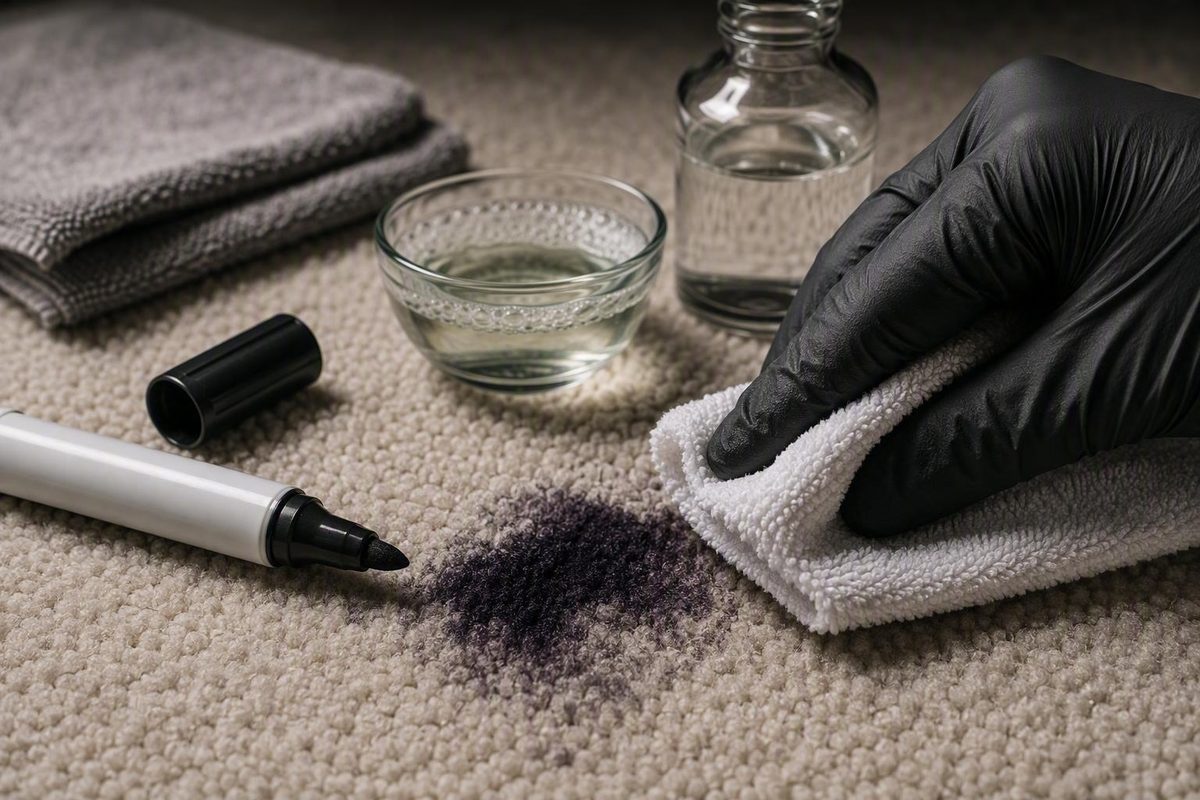
To get marker out of carpet, identify the marker if possible, patch-test the cleaner, and blot rather than scrub. Use diluted clear dish soap for washable marker. For permanent marker, apply rubbing alcohol sparingly through a white cloth—never pour it onto the carpet. Work from the stain’s edge toward its center, rinse lightly when appropriate, press dry, and reassess only after the carpet has air-dried completely.
Quick answer: identify, test, blot, treat, rinse, and dry
Use this six-step sequence:
- Identify the marker. Check its barrel or packaging for terms such as “washable,” “water-based,” “permanent,” or “dry-erase.”
- Patch-test the cleaner. Apply a small amount through a white cloth in a hidden area. Stop if carpet dye transfers or the color or texture changes.
- Blot loose ink. If the ink is wet, press a clean white absorbent cloth or paper towel straight down, then lift. Do not rub.
- Apply the appropriate treatment through a cloth. Use diluted clear dish soap for washable marker or a small amount of rubbing alcohol for permanent marker.
- Rinse lightly. When the product’s directions permit rinsing, blot with a separate cloth lightly dampened with clean water.
- Dry and reassess. Press dry towels onto the area, let it air-dry, and inspect it before repeating treatment or allowing foot traffic.
Gather several clean white cloths or plain white paper towels, clean water, and clear mild dish soap. Add rubbing alcohol only if the marker appears permanent and both the carpet and alcohol product directions permit its use.
Always work from the outside edge toward the center. Rotate the cloth as soon as it picks up ink so dissolved color is not redeposited. Carpet-specific guidance recommends applying cleaner to a cloth rather than directly to the carpet and using repeated small applications instead of soaking the pile or backing (Stain Kings’ ink and felt-tip carpet guide).
Do not mix cleaners. If one treatment does not work, follow its label directions for removal or rinsing before considering another.
Choose the method by marker type and carpet risk
The marker label is the best starting point. If it is unavailable, the ink’s behavior can provide a clue, but it cannot definitively identify the chemistry.
| Marker type | Safest first treatment | Application method | Main risk |
|---|---|---|---|
| Washable or water-based | Lukewarm water with a few drops of clear mild dish soap | Dampen a white cloth and dab edge to center | Spreading ink or leaving soap residue |
| Permanent | Rubbing or isopropyl alcohol after a patch test | Dampen a swab or white cloth; never pour | Dye loss or excess liquid reaching deeper layers |
| Unknown | Water-dampened white cloth | Blot briefly and inspect for transfer | Misidentifying water-resistant ink |
| Dry-erase | Blot first; check manufacturer guidance | Avoid experimental combinations | Smearing or damage from an unsuitable remedy |
If an unknown mark transfers easily to a water-dampened white cloth, it may be water-soluble. Treat that only as a clue. Start with the washable-marker method rather than escalating immediately to a solvent.
The available guidance does not establish a broadly reliable, carpet-safe household method for dry-erase marker. Vinegar-and-baking-soda procedures appear in some commercial cleaning advice, but the instructions and support are inconsistent. Do not give that combination equal standing with diluted detergent for washable ink or carefully controlled alcohol application for permanent marker.
Check the carpet label and manufacturer instructions whenever possible. Fiber, dye method, protective treatments, backing, and construction can all affect cleaning tolerance. Wool is absorbent and slow to dry, while unsuitable chemicals can affect the dye or protective treatment on some nylon carpets (HydraMaster’s carpet-fiber cleaning overview). Seek professional advice before applying solvent to wool, another delicate natural fiber, an antique carpet, a valuable rug, or any carpet whose fiber cannot be identified.
How to remove washable marker with dish soap and water
- Prepare a mild solution. Add only a few drops of clear mild dish soap to lukewarm water. Heavy suds are unnecessary.
- Patch-test it. Dampen a white cloth with the solution and dab a hidden carpet area. Stop if dye transfers or the carpet changes color or texture.
- Blot wet ink first. Press a dry white cloth straight down, lift it, and move to a clean section after each transfer.
- Dampen the treatment cloth. It should be moist, not dripping. Do not pour the solution onto the stain.
- Dab from edge to center. Follow each application with a dry section of cloth so the loosened ink transfers out of the pile.
- Repeat cautiously. Continue only while ink transfers and the carpet remains stable. Do not scrub.
- Rinse lightly. Blot the treated fibers with a separate white cloth lightly dampened with clean water.
- Dry completely. Press dry towels over the area and let it air-dry before judging the result or allowing foot traffic.
Commercial carpet-care guidance likewise recommends mild dish soap and water for washable marker, followed by a clean-water rinse and blot drying (COIT’s marker-stain carpet guide).
How to treat permanent marker with controlled alcohol application
Rubbing or isopropyl alcohol is the household treatment most often recommended for permanent marker in the supplied carpet-specific guidance, but it is not universally safe or effective.
Follow the alcohol product’s label and work in a space appropriate for its use.
- Patch-test first. Dampen a white cloth with a small amount of alcohol and dab a hidden area. Stop if carpet color appears on the cloth or the tested area changes color or texture.
- Choose a small applicator. Use an alcohol-dampened cotton swab for a tiny mark or a white cloth for a larger stain.
- Never pour alcohol onto carpet. Direct pouring makes it harder to keep solvent out of the backing and padding.
- Dab inward. Start at the stain’s outer edge and move toward the center.
- Lift the dissolved ink. Press a clean white cloth or paper towel straight down, then lift. Do not wipe sideways.
- Rotate frequently. Move to a clean cloth section whenever ink transfers. Continued transfer—not a fixed amount of alcohol or a preset number of cycles—is the useful sign of progress.
- Repeat lightly. Alternate small alcohol applications with dry blotting. Stop if the mark spreads, the carpet reacts, or the backing becomes wet.
- Rinse and dry. If the carpet and alcohol product directions permit, blot lightly with a clean water-dampened cloth. Press with dry towels and air-dry without a hair dryer, iron, or other heat source.
Repeated light applications are preferable to one heavy soak. Excess liquid can reach the backing or padding, while scrubbing can spread ink or damage the pile; alcohol may also affect some carpet dyes or backing materials (Stain Removal Guides’ permanent-marker carpet method).
Crayola reports successfully testing a rubbing-alcohol-and-blotting method for marker on carpet, but it also says results vary and removal is not guaranteed (Crayola’s marker-on-carpet instructions). Treat this as a practical option, not proof that alcohol suits every marker-and-carpet combination.
What to do with dried, recurring, or previously treated stains
For dried permanent marker, begin with the same hidden-area test. If the test passes, briefly hold an alcohol-dampened cloth against the affected fibers, without soaking them, and then blot straight down with clean absorbent material.
Repeat only while ink continues to transfer and the carpet remains colorfast, correctly textured, and no more than lightly damp. Rinse only when the relevant product and carpet directions permit it, then let the area dry completely.
If another product has already been used, identify it before doing anything else. Check its label or manufacturer instructions for removal, rinsing, and incompatible products. Do not automatically add water, alcohol, peroxide, vinegar, or another cleaner on top of it.
A spot can return as moisture or residue migrates upward from the backing during drying, a process often called wicking. A persistent mark can also be discoloration caused by chemical alteration of the carpet rather than removable ink.
Stop before the treatment causes more damage
Avoid:
- Rubbing, scrubbing, or aggressive brushing
- Flooding the carpet or pouring cleaner directly onto it
- Hot water
- Hair dryers, irons, steam, or other heated drying
- Mixing cleaning products
- Applying a new cleaner before following the previous product’s removal or rinsing directions
- Treating hydrogen peroxide as a routine fallback, especially on dark or non-colorfast carpet
- Treating acetone as a routine carpet solvent
- Assuming hairspray is interchangeable with rubbing alcohol
- Giving vinegar and baking soda, toothpaste, or similar remedies equal standing with the primary methods
Hydrogen peroxide may lighten dark or non-colorfast carpet. Stronger products such as acetone or peroxide can affect carpet color, texture, or fiber integrity, and their compatibility with a particular carpet’s fibers and construction cannot be assumed.
Stop DIY treatment if:
- Carpet dye appears on the test cloth
- The carpet lightens or changes color
- The texture changes or fibers begin to fray
- The ink spreads beyond its original boundary
- The backing or padding becomes wet
- Strong fumes develop
- Careful blotting produces no further improvement
Seek professional evaluation for wool or other delicate natural fibers, valuable or antique rugs, failed patch tests, large or deeply saturated marks, unidentified chemicals from an earlier treatment, or discoloration that remains after complete drying.
The decision rule is straightforward: use diluted clear dish soap for washable marker and carefully controlled rubbing alcohol for permanent marker, but only after a hidden-area test. Keep liquid out of the backing, blot rather than scrub, rinse only as appropriate, and judge the result after full air-drying. Complete removal cannot be guaranteed.
Can I use hairspray instead of rubbing alcohol on marker?
Hairspray is not the preferred substitute. Although some formulas contain alcohol, they may also contain oils, silicones, polymers, fragrance, and other ingredients that can leave residue. If rubbing alcohol is unavailable, unsuitable, or unsuccessful, pause and consult the carpet manufacturer, the product label, or a carpet-care professional rather than assuming hairspray will behave the same way.
Why did the marker spot come back after the carpet dried?
Ink, moisture, or cleaning residue may have entered deeper carpet layers and then migrated upward during drying. Blot any resurfaced material with a clean white cloth without adding more cleaner. Repeated recurrence or a wet backing is a reason to seek professional evaluation.
Does a remaining shadow mean I should use a stronger cleaner?
No. Let the carpet dry fully first. A shadow may be residual ink, cleaning residue, changed pile direction, or carpet-dye damage. If nothing transfers to a white cloth and careful treatment no longer improves the area, a stronger chemical may damage the carpet without removing the mark.