 StainList
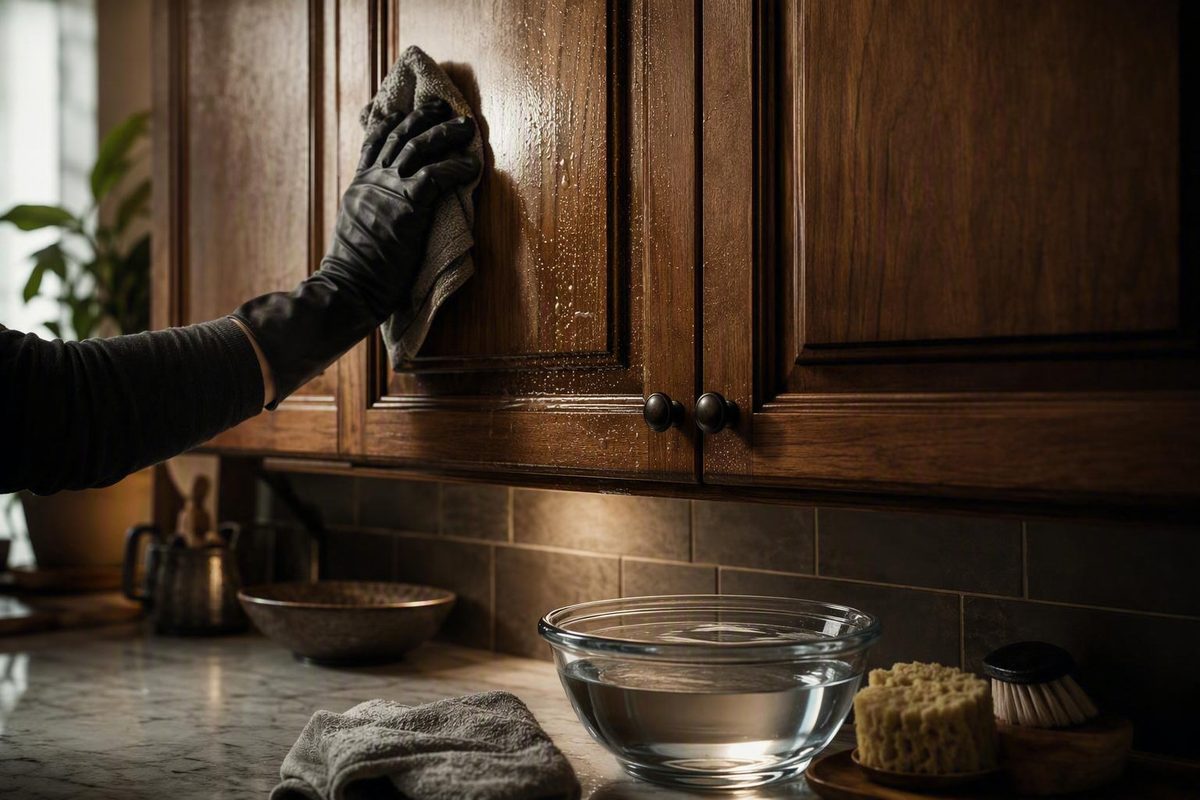
TSP can be an optional heavy-duty degreaser when greasy kitchen cabinets are being prepared for paint. It is not the default choice for routine care, an unidentified finish, or cabinets that will be re-stained. Before using it, identify the cabinet surface and exact cleaner formulation, then follow the cabinet, cleaner, and coating manufacturers’ instructions. Control moisture, remove the cleaner as directed, and complete any sanding or stripping required by the new finish.
First decide what you are trying to do
| Your goal | Best starting point | What cleaning will not do |
|---|---|---|
| Routine maintenance | Use the cabinet maker’s approved mild cleaner with minimal moisture. | It should not unnecessarily alter, dull, or remove an intact finish. |
| Degreasing before painting | Consider TSP only for substantial grease and only if the cabinet, cleaner, primer, and paint instructions permit it. | Degreasing does not automatically replace sanding or other surface preparation. |
| Complete refinishing or re-staining | Remove any finish or coating that prevents stain from reaching bare wood, using the method appropriate for that system. | Washing alone does not expose wood evenly for stain absorption. |
For ordinary cleaning, start gently—particularly when the finish is glossy, delicate, intact, or unidentified. Check the cabinet manufacturer’s care and warranty instructions before introducing a heavy-duty cleaner. A product may remove grease effectively but still be unsuitable for a particular finish or inconsistent with its care requirements.
Heavy grease before painting is the situation in which TSP is most relevant. Even then, determine whether the cabinets are painted wood, clear-coated wood, veneer, laminate, melamine, or another material. Check the condition of the existing finish, the exact cleaner instructions, and the preparation requirements for the planned primer or paint. Savogran markets genuine powdered TSP as a heavy-duty cleaner for greasy grime on woodwork, but its general product information does not specifically approve every kitchen-cabinet material or finish (Savogran’s heavy-duty cleaner information).
Re-staining is a different project. Stain needs reasonably even access to exposed wood. Paint, lacquer, varnish, toner, sealer, or another film-forming finish can block or disrupt absorption. Cleaning removes surface grease and dirt; it does not reliably remove those coatings in the controlled, even manner needed for staining.
If you cannot identify the surface, use the cabinet maker’s approved mild-cleaning method or obtain finish-specific advice rather than experimenting across the kitchen.
Check whether the product is real TSP or a substitute
“TSP” on the front of a package does not necessarily mean that every similarly named product has the same composition or directions. Genuine powder, phosphate-free substitutes, and ready-to-use cleaners must be treated as separate products.
| Product category | What it is | Why the distinction matters |
|---|---|---|
| Genuine powdered TSP | A trisodium phosphate compound mixed with water according to its container directions | Its concentration, handling, rinsing, and restrictions cannot be inferred from substitute directions. |
| Phosphate-free TSP substitute | A different formulation marketed for similar heavy-duty cleaning tasks | Its ratios and precautions apply only to that formulation and product. |
| Ready-to-use cleaner using TSP terminology | A premixed product with its own formulation and application directions | It may require no dilution and may specify a particular wiping or rinsing procedure. |
Savogran identifies its powdered TSP as a trisodium phosphate compound, while TSP-PF is explicitly phosphate-free. The manufacturer describes TSP-PF as having cleaning power equivalent to TSP, but that is a marketing claim rather than an independent comparison. Its manufacturer product sheet provides formulation-specific directions and warnings (Savogran TSP-PF product sheet).
Do not use a powdered-product recipe for a spray cleaner or apply a substitute’s dilution to genuine TSP. Do not assume that all products require the same removal procedure. Locate the exact current container label and safety information before mixing or applying the cleaner. If the container is damaged, illegible, or unidentified, do not substitute instructions copied from another package or an online project.
Use gentle cleaning for ordinary cabinet care
If you are not repainting, stripping, or otherwise refinishing the cabinets, a cabinet-manufacturer-approved mild cleaner is the better-supported starting point. The goal is to remove ordinary soil without needlessly challenging the finish or driving liquid into vulnerable joints.
For its own cabinetry, Columbia Cabinets recommends mixing 1/4–1/2 teaspoon of mild dish soap with 1 quart or 1 liter of warm water for occasional deeper cleaning. It directs owners to apply the solution to a cloth rather than spray it onto the cabinet, follow with a clean damp cloth, and dry immediately (Columbia Cabinets’ care and warranty guide).
Keep the cloth damp rather than dripping. Minimize moisture around:
- seams and joints;
- door and panel edges;
- shelf-pin holes;
- screw holes and hardware penetrations;
- chips or worn areas where the substrate is exposed.
Liquid can enter through these openings, so wipe and dry them promptly rather than leaving visible moisture to evaporate.
These directions apply to Columbia cabinetry; they do not prove compatibility with every brand, material, or finish. Other manufacturers may specify different products or prohibit certain degreasers. When the cabinet material or finish is unknown, locate the original care and warranty instructions before selecting a cleaner.
A cautious pre-paint degreasing workflow
Treat cleaning kitchen cabinets with TSP as one controlled step in a larger coating-preparation process.
-
Identify the cabinet material and finish. Determine whether the surface is painted wood, clear-coated wood, veneer, laminate, melamine, or another material. Look for swollen edges, loose veneer, damaged finish, or exposed substrate before introducing water.
-
Review the cabinet and coating instructions. Check whether the cabinet-care guidance restricts the proposed cleaner. Read the primer and paint instructions for required cleaning, abrasion, repair, drying, and recoating conditions.
-
Read the exact cleaner label. Confirm whether the product is genuine TSP, a phosphate-free substitute, or a ready-to-use cleaner. Follow only that product’s stated concentration, application method, precautions, and removal directions.
-
Protect nearby surfaces. Move food, utensils, small appliances, and textiles out of the work area. Protect counters, floors, walls, glass, and adjacent finishes as appropriate for the product being used.
-
Test an inconspicuous area. Apply and remove the cleaner exactly as planned, then inspect the area after it dries. A successful spot test is only an initial compatibility screen. It does not prove that longer contact, repeated wiping, or widespread use will be harmless.
Remove doors when practical, or open and support them securely so that you can reach grease without flooding hinges, seams, and edges. Label doors and hardware if their original positions will matter during reassembly.
Mix only the amount needed and only at the concentration stated on the exact product label. Apply the solution with a controlled, damp sponge or cloth rather than saturating the surface. Focus on grease-prone areas around pulls, handles, corners, lower edges, and cooking zones. Stop if wiping begins to change the finish’s color, gloss, or texture.
If the product directs rinsing or a clean-water wipe, remove the cleaner accordingly rather than allowing residue to dry. Let the cabinets dry completely. Then sand, degloss, repair, prime, or otherwise prepare them as required by the selected coating system, and remove sanding dust before applying primer or paint.
Those instructions depend on the cleaner, cabinet surface, existing finish, and planned coating system.
Use the dilution printed on your product
Use the amount printed on the exact product’s current container for the relevant task and permitted surface.
The following measurements apply only to Savogran TSP-PF, a phosphate-free substitute, according to its manufacturer product sheet (Savogran TSP-PF directions):
| Task listed for TSP-PF | Product amount | Warm water |
|---|---|---|
| Household cleaning | 1/8 cup | 2 gallons |
| Heavy-duty cleaning | 1/4 cup | 2 gallons |
These are not directions for genuine trisodium phosphate, other substitute brands, or ready-to-use cleaners. They also do not establish that TSP-PF is compatible with a particular cabinet finish.
Separately, one DIY author reported using 1/2 cup of powdered TSP in 2 gallons of warm water on oak kitchen cabinets before sanding and painting. The author removed the doors, concentrated on dirty areas near handles and corners, and followed the cleaning step with a clean-water wipe (Weekend Craft’s oak-cabinet project).
That mixture is an anecdotal project example, not an authoritative recommendation for routine care, unknown finishes, or other TSP products. The difference between it and the TSP-PF measurements illustrates why product names and tasks cannot be treated as interchangeable.
Cleaning does not replace sanding or stripping
TSP is discussed primarily as a cleaner and degreaser, not as a reliable finish stripper. Do not assume it will uniformly strip, soften, or degloss an existing coating. If a cleaner changes the sheen in one area, that is not evidence that it has created a consistent surface for the next finish.
In a woodworking discussion concerning clear-lacquered cabinets, contributors generally treated TSP as a cleaning step and recommended sanding or chemical stripping when the existing coating had to be removed. They disagreed about whether strong TSP solutions might affect some finishes, reinforcing why accidental cleaner damage should not be used as a refinishing method (Sawmill Creek’s cabinet-preparation discussion).
The required preparation depends on what will be applied next:
- Paint: The surface must be free of grease and prepared for adhesion according to the primer or paint instructions. The system may require repair, sanding, deglossing, or a particular primer.
- Stain: Any coating that prevents stain from reaching the wood generally must be removed. Remaining patches of finish can cause uneven penetration and color.
- Clear finish: Cleaning alone does not establish compatibility or adhesion. Follow the new finish manufacturer’s requirements for cleaning, abrasion, and recoating.
Degreasing is one checkpoint, not the whole preparation process. The requirements for the selected primer, paint, stain, or clear finish should determine what follows.
Manage chemical hazards, residue, and disposal uncertainty
Savogran’s TSP-PF product sheet warns that this phosphate-free product can irritate skin and eyes, may cause burns, is harmful if swallowed, and must be kept away from children. These warnings apply specifically to TSP-PF. Consult the current container label and safety information for the protective equipment, ventilation, first aid, spill response, and disposal measures required for the exact formulation.
The same TSP-PF sheet includes a bleach-containing recipe for mildewed decks and siding. Do not transfer that exterior recipe to kitchen cabinets. A mixture specified for a particular outdoor task is not a cabinet-cleaning direction.
Moisture presents a separate risk from cleaner compatibility. Excess liquid can enter seams, cut edges, shelf-pin holes, hinge recesses, and hardware penetrations. Apply only a controlled amount, prevent drips from collecting, and dry vulnerable areas promptly.
In one personal DIY account, the author misread the directions for a spray-on TSP cleaner and omitted the specified clean-water wipe. Primer and paint later chipped at cabinet corners and edges (the reported cabinet-paint failure).
That account was not a controlled test. It does not establish that cleaner residue alone caused the failure because the exact formulation, original finish, and complete application conditions were not documented. It does, however, support a practical rule: if the cleaner requires rinsing, or if a film remains, do not prime. Remove the product as its label directs and allow the surface to dry. Stop if residue, softening, swelling, gloss changes, or adhesion concerns remain.
Do not guess how to discard leftover cleaner or wash water. Use the disposal instructions on the exact product label and ask the appropriate local waste or wastewater authority if the instructions do not resolve the question.
The practical choice is straightforward: reserve TSP for substantial pre-paint grease when the cabinet, cleaner, and coating instructions permit it. For routine cleaning or an unidentified finish, begin with the cabinet maker’s mild-cleaning method. Cleaning still does not replace the sanding, stripping, repair, or other preparation required for the new finish.