 StainList
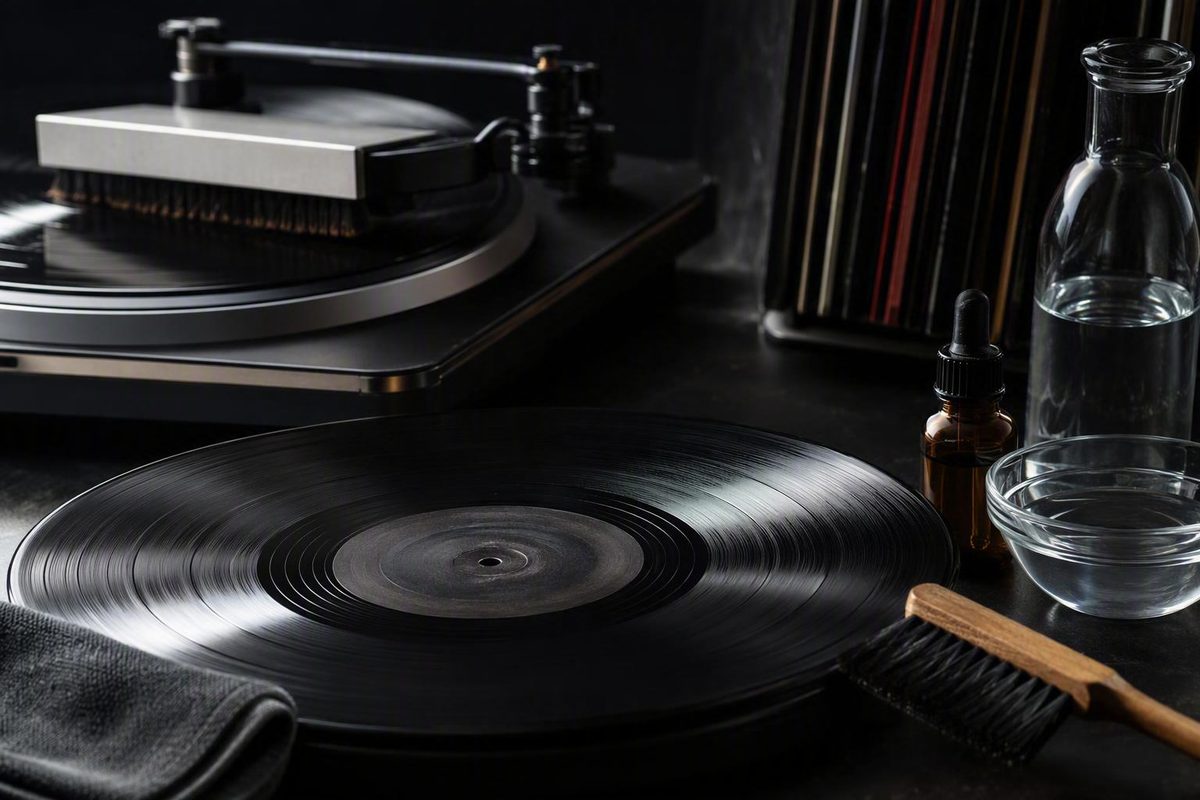
For a known vinyl LP or single, a conservative, low-guesswork option is distilled water paired with a record-specific ready-to-use fluid or a concentrate approved for the cleaning system. Measure it exactly as directed, rinse when the product requires it, and let the record dry completely before playback.
That is a decision rule based on documented product and equipment instructions—not proof that one formula is universally safest or most effective.
The short answer: identify the record before choosing a solution
Start with the record material rather than a favorite homemade recipe. Similar-looking records may require different treatments. An archived Keith Monks machine manual gives separate instructions for vinyl, shellac, lacquer, and Victrolac and warns that unsuitable treatment can destroy irreplaceable recordings.
| Record or situation | Conservative solution choice | Avoid | Next step |
|---|---|---|---|
| Known vinyl LP or single | Distilled water with a vinyl-specific fluid compatible with the cleaning method | Guessing at dilution or substituting another solvent | Follow the fluid and equipment instructions |
| Shellac 78 | Only a current product whose instructions explicitly include shellac | Applying an alcohol-based vinyl formula by default | Treat compatibility as a manufacturer claim, not independent proof |
| Lacquer, Victrolac, or acetate | No general-purpose vinyl formula | Alcohol or detergent experiments | Obtain material-specific guidance |
| Picture disc or unidentified record | No wet treatment until identified | Assuming the playing surface is ordinary vinyl | Check release information or seek expert assessment |
| Rare, fragile, or valuable record | Minimal handling and professional advice | Testing an improvised mixture on the recording | Consult an audio-media conservator |
A concentrate may suit batch cleaning if its required dilution, rinse process, and equipment are practical for the collection.
Basin-washer doses are system-specific. Spin-Clean, for example, uses a proprietary concentrate in a basin filled to its stated level. Its capful measurements cannot be transferred to another cleaner because neither cap volume nor equivalent concentration is established across products.
For shellac, use only the exact current product covered by the manufacturer’s instructions. Spin-Clean describes its non-alcoholic fluid as compatible with shellac 78s, but this remains a manufacturer claim rather than independent conservation evidence. Its FAQ also explains its distilled-water preference and material claims.
Wet cleaning may remove loose dust, fingerprints, and some other removable deposits, depending on the fluid and process. It cannot reverse scratches, groove wear, pressing defects, or other physical damage.
Compare the documented solution types
“Alcohol-based” and “alcohol-free” describe ingredients, not overall safety or performance. Meaningful comparison also requires the solvent concentration, surfactants, preservatives, record material, rinse requirement, and cleaning equipment.
| Solution type | Documented composition or dilution | Intended use and rinse | Evidence limitation |
|---|---|---|---|
| Historical ethanol formula | Approximately 85% ethanol diluted with an equal volume of triple-distilled water | Vinyl in the specified Keith Monks machine; use that manual’s process | Historical, machine-specific instruction rather than a general DIY recommendation |
| Historical Photo-Flo mixture | Kodak Photo-Flo 200 diluted with distilled water | Standard mixture in the archived machine manual; some material-specific treatments require rinsing | Current formulation and long-term record compatibility are not independently established |
| Alcohol-free proprietary concentrate | Spin-Clean concentrate diluted in its basin | Spin-Clean system; use bottle-dependent capful directions | Ingredients, cap volume, and concentration are not disclosed |
| Alcohol-free ready-made fluid | Water with named surfactant and chelating ingredients | Big Fudge 4-in-1 cleaning kit; use its directions | Exact ingredient concentrations and preservatives are undisclosed |
| Separate isopropanol product | Water, isopropanol, and preservative | Big Fudge Record Friend product | Not the same formula as the company’s alcohol-free kit fluid |
The archived Keith Monks manual’s vinyl formula uses equal parts approximately 85% ethanol and triple-distilled water. It expressly rejects isopropyl alcohol for that particular formula. This does not establish that isopropanol is always unsafe for vinyl; it establishes only that different alcohols should not be treated as interchangeable within that machine-specific procedure.
The same manual documents a separate standard mixture of one part Kodak Photo-Flo 200 to 200 parts distilled water. It does not establish that current Photo-Flo has the same formulation or that its long-term use on records has been independently validated.
Big Fudge discloses that its alcohol-free cleaning-kit fluid contains water, small amounts of polyoxyethylene lauryl ether and disodium edetate dihydrate, and unspecified preservatives. Its separately named Record Friend solution is listed as 90% water, 9.7% isopropanol, and 0.3% preservative. These are distinct products, as shown in the manufacturer’s formula disclosures.
An alcohol-free label does not prove that a product is safer, more effective, or residue-free. Conversely, the presence of alcohol does not by itself establish compatibility or incompatibility.
Measured examples—and why they are not interchangeable
The following figures explain ratios found in the documented instructions. They are not general mixing recommendations.
Archived ethanol formula
The Keith Monks manual describes an equal-volume mixture of approximately 85% ethanol and triple-distilled water for vinyl in its specified machine. Arithmetically, two equal 250 mL portions would total 500 mL, but this article does not provide an operational ethanol-mixing procedure. The available evidence does not supply adequate current guidance on ignition control, ventilation, exposure, storage, labeling, or disposal.
Archived Photo-Flo calculation
If 1:200 means one part concentrate added to 200 parts water, the arithmetic for 250 mL of water is:
250 mL ÷ 200 = 1.25 mL concentrate
That corresponds to 1.25 mL of concentrate per 250 mL of water, producing approximately 251.25 mL in total. The same manual describes adding two to three drops—or more if needed—of mild, non-abrasive dish detergent to 250 mL of standard Photo-Flo solution for unusually dirty records, with only trace foam as the target. It also sets a maximum fluid-contact time of two minutes for its process and calls for less time in warm conditions. These are historical, machine-specific instructions, not a general record-cleaning recipe or universal dwell limit. The archived manual documents these ratios and limits.
The manual contains an apparent conversion error: one cubic centimeter equals one milliliter, not ten milliliters. Any product requiring a small liquid measurement should be measured with suitable graduated equipment rather than by relying on that statement.
Spin-Clean uses a different dosing system: two capfuls from its 4-, 8-, or 16-ounce fluid bottles, or one capful from its 32-ounce bottle, in a basin holding 24 ounces of water. Do not convert those capfuls to milliliters without a stated cap volume, and do not apply the dose to another concentrate.
A ratio belongs to a particular product, material, and cleaning process. It cannot be transferred safely merely because another fluid is also described as a record cleaner.
Use the solution without leaving dirt or cleaner behind
A conservative wet-cleaning sequence is:
- Identify the material. Stop if the record is shellac, lacquer, acetate, Victrolac, a picture disc, unidentified, rare, or valuable and the product does not explicitly cover it.
- Remove loose debris. Gently lift heavy particles before wet cleaning so they are not dragged across the grooves.
- Prepare the compatible fluid. Use distilled water where directed and follow the product’s stated dose.
- Use clean, dedicated tools. Brushes, cloths, and vacuum pickup parts can transfer dirt or residual cleaner between records and fluids.
- Control the application. Use enough liquid for the specified process without adding unnecessary cleaner.
- Rinse when required. Complete every labeled rinse stage. If visible film remains, stop adding detergent and follow the product’s rinse instructions.
- Dry completely. Do not play or sleeve a damp record.
- Use a clean inner sleeve. A dirty sleeve can return debris to the cleaned surface.
Contact time must come from the exact product or machine instructions. The historical two-minute limit described above applies to the Keith Monks procedure, not automatically to sprays, basin washers, vacuum machines, or other fluids.
Residue is a practical concern. In a limited Discogs side-by-side test, an equal-parts mixture of isopropyl alcohol and distilled water containing one to two drops of dish soap left a shiny film and required rinsing. The test was editorial rather than laboratory research: it did not report replicated trials, objective audio measurements, or long-term material testing.
Spin-Clean permits tap water when distilled water is unavailable but warns that minerals or impurities may remain in grooves or contaminate brushes. The company also says records must be completely dry before playback because residual moisture can cause audible surface noise.
Avoid saturating labels and follow the instructions for the exact equipment in use. The available documentation does not establish one label-protection technique as safe for every record construction.
Match the fluid to the cleaning system and collection size
Choose the cleaning method before buying fluid in volume. Suitability depends on the equipment, workload, rinse stages, record material, and ability to keep tools clean—not bottle price alone.
| Method | Best fit | Fluid and process | Main control point |
|---|---|---|---|
| Manual spray | Occasional cleaning or isolated fingerprints | Apply a controlled amount with a clean applicator; rinse when instructed or when visible residue remains | Avoid excess fluid and reused dirty cloths |
| Basin washing | Batches of compatible records | Use the basin’s specified water volume and proprietary dose | Replace contaminated solution |
| Vacuum cleaning | Regular cleaning with active fluid removal | Use a machine-compatible one- or two-stage process | Keep brushes and pickup tubes clean and fluid-specific |
| Multi-step product | Processes requiring separate wash and rinse stages | Complete each labeled stage in order | Do not omit the rinse or combine products |
For Spin-Clean, the documented setup is 24 ounces of distilled water plus the bottle-dependent concentrate dose: two capfuls from a 4-, 8-, or 16-ounce bottle or one capful from a 32-ounce bottle. The record is rotated three times clockwise and three times counterclockwise before complete drying. These are instructions for that basin and concentrate, not for other manual washers. See the official system instructions.
Vacuum systems may use a one-step fluid or separate cleaning and rinse products. During product comparisons, use separate applicator brushes and pickup tubes for each fluid.
A Galen Carol Audio evaluation illustrates several useful comparison controls: new LPs, an untreated control, a vacuum machine, separate applicators and pickup tubes, and manufacturer directions for each cleaner. The author reported using approximately 3–5 mL per side and calculated costs using 3 mL per side plus estimated application losses. Those figures are examples from one evaluation, not universal consumption rates.
The evaluation should not be used here to declare a winner. It involved one recording on five new pressings, and the two-step Mobile Fidelity treatment was not directly equivalent to the one-step products.
For a large collection, concentrate may be convenient or economical, but only under the right assumptions. Compare:
- Final diluted volume
- Expected fluid use per side
- Required wash and rinse stages
- Distilled-water consumption
- Brushes, cloths, or pickup tubes required
- Equipment compatibility
- Frequency of bath replacement
A concentrate that requires a separate rinse and dedicated hardware may demand more time and equipment than a ready-to-use spray. A small spray bottle may be convenient for occasional use but impractical for batch cleaning. Bottle format alone does not establish value.
Troubleshoot noise, film, spots, and a dirty cleaning bath
If a record looks or sounds worse after cleaning, inspect the process before reaching for stronger chemistry.
| Symptom | Check first | Corrective action |
|---|---|---|
| Increased surface noise | Whether the record is still damp; excess concentrate; dirty bath; contaminated tools; unsuitable cloth; dried cleaner | Dry fully, clean the tools, and follow the product’s rinse directions |
| Shiny film | Whether too much detergent or cleaner remains | Stop adding detergent and complete the specified rinse |
| Spots after drying | Water quality, residual cleaner, or contaminated drying equipment | Use distilled water where directed and clean or replace the drying tools |
| Persistent foam | Incorrect concentrate dose or excess detergent | Replace or correct the mixture; detergent should produce only trace foam where expressly allowed |
| Debris returns | Dirty bath, brushes, applicator, vacuum tube, or inner sleeve | Replace the bath, service the tools, and use a clean sleeve |
| Noise remains after cleaning | Remaining contamination, residual moisture, scratches, groove wear, or another physical defect | Confirm complete drying and inspect the record before considering another compatible cycle |
For a Spin-Clean bath, the manufacturer advises changing the water at about 50 records or sooner when it becomes visibly dirty. A covered prepared bath may be retained for up to one week if the brushes are removed. The brushes should be rinsed thoroughly with warm water, pressed to remove excess liquid, and air-dried rather than left soaking. These are product-specific maintenance instructions, and visible contamination is a reason to replace the bath sooner regardless of record count or storage time.
Film after a soap-containing cleaner is a reason to stop adding detergent and perform the specified rinse.
Do not use repeated cycles as a reason to escalate to improvised solvents. If a compatible repeat produces no improvement, the remaining noise may come from scratches, worn grooves, or a pressing defect that cleaning fluid cannot repair.
The final rule is straightforward: identify the record material, choose a record-specific fluid compatible with the cleaning system, measure it exactly, rinse as directed or when residue appears, and dry the record completely before playback. Do not improvise with alcohol or transfer a vinyl formula to shellac, lacquer, acetate, picture discs, unidentified pressings, or valuable records. Refer high-risk material to a qualified audio-media conservator.