 StainList
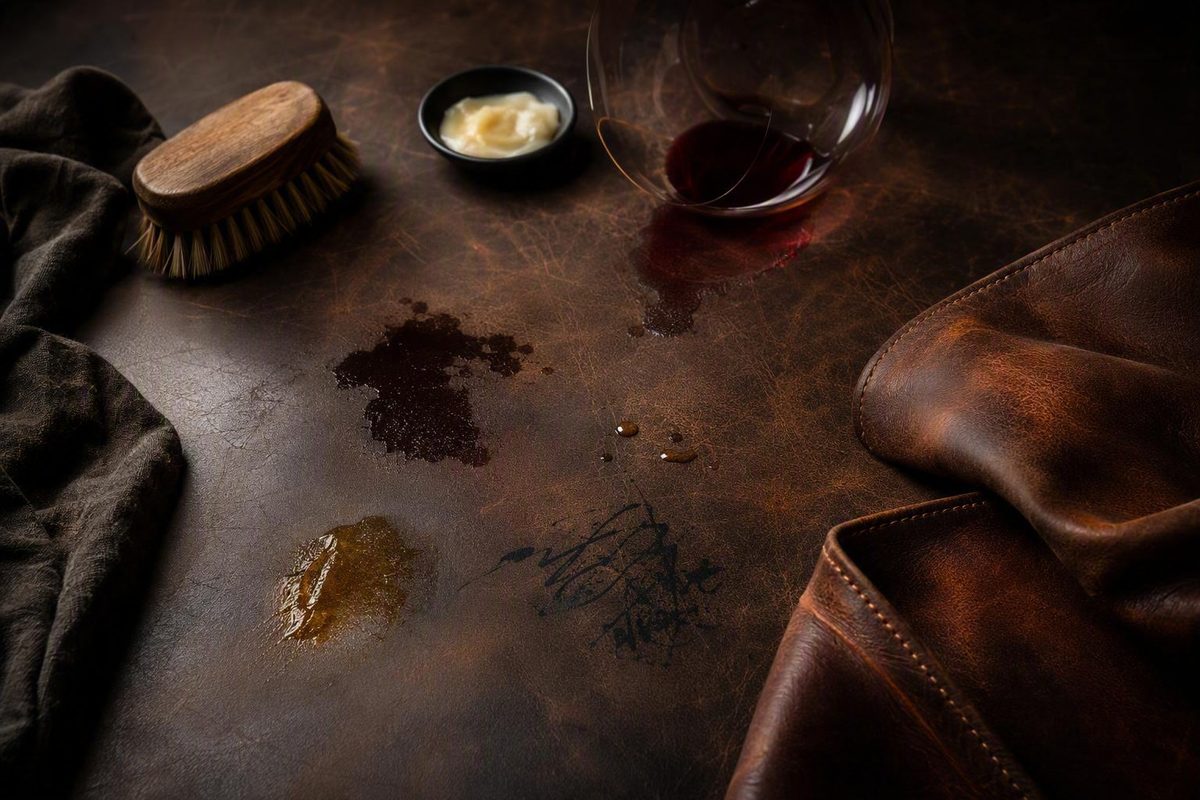
Crazy horse leather in one minute: what the name does and does not mean
Crazy horse leather is generally not horsehide. In current commercial usage, the name usually refers to cowhide with a wax- or oil-rich finish that changes tone when the surface is bent, pressed, rubbed, or lightly scratched. Galen Leather describes it as cowhide but also acknowledges that “crazy horse” identifies a finish rather than guaranteeing a quality grade (Galen Leather’s material overview).
That visible color response is called pull-up. When waxed or oiled leather bends around a finger, material in the finish shifts or becomes less concentrated across the stretched area. The bend consequently appears lighter or differently toned. Pressing or rubbing the surface may move the finish again and alter the mark.
This response produces the distressed, two-tone appearance associated with crazy horse leather. It also explains why a new bag or wallet can begin displaying folds, pressure points, scuffs, and handling patterns almost immediately.
The essential qualification is that crazy horse is a working market description, not a universal technical specification. Commercial sources commonly use the term for waxed or oiled pull-up cowhide, but the label alone does not prove:
- The animal species
- The retained hide layer or degree of surface correction
- Whether the leather is full-grain
- Whether it is chrome-tanned, vegetable-tanned, or combination-tanned
- A particular thickness or temper
- A specific wax, oil, pigment, or coating formulation
- A defined level of quality, strength, or durability
Many sellers describe their own crazy horse products as full-grain cowhide. That may accurately describe those products, but it is not a universal definition. Galen Leather expressly warns that thinner or corrected-grain hides may also be sold under the same name.
Terminology in brief
- Animal source identifies the hide: cow, calf, buffalo, horse, goat, or another animal.
- Hide layer and surface description indicate which part of the hide is used and how its outer surface has been retained or altered. Terms include full-grain, corrected-grain, split, and top-grain, although trade usage is not always consistent.
- Tanning describes how the raw hide was stabilized and converted into leather, such as chrome tanning or vegetable tanning.
- Finish describes surface treatments such as waxes, oils, pigments, protective coatings, and pull-up effects.
One piece of leather can therefore carry a description from every category. A product might be cowhide by source, full-grain by surface description, chrome-tanned by process, and crazy horse by finish. Calling it crazy horse leather tells you something useful about its intended appearance, but it does not answer every material question.
Stories about the name are less secure. Retailers variously attribute it to saddles, horse tack, toughness, or a “wild” appearance. The supplied material does not document a definitive historical origin, so none of those explanations should be treated as established history.
How the pull-up finish creates lighter marks, tonal variation, and patina
Crazy horse leather is commonly described as containing enough wax or oil in its finish for surface stress to create a visible color response. The effect may be dramatic or subtle depending on the base color, finish formulation, substrate, and amount of previous handling.
Consider three typical examples:
- A messenger bag may develop lighter lines where its flap repeatedly folds.
- A wallet may become darker or shinier where fingers and pockets continually rub it.
- A light scrape across a briefcase may leave a pale streak even when the leather has not been deeply abraded.
These changes are commonly called pull-up. Yukon Bags defines the effect as a color change caused when wax or oil shifts as leather is stretched, folded, or scratched (Yukon Bags’ explanation of leather grades and finishes).
As these marks accumulate, sellers and owners often describe the changing surface as patina. Patina is not one isolated scratch. In this context, it means the combined appearance created by handling, flexing, friction, exposure, maintenance, and time. On a frequently carried bag, high-contact areas may become smoother or darker while folds and lightly abraded areas remain paler.
Expected pull-up should not be confused with physical failure.
| Appearance | What it may indicate |
|---|---|
| A pale line that softens with very gentle rubbing | Movement in the waxy or oily finish |
| Color change along a clean fold | Normal pull-up behavior |
| Greater sheen on handles or wallet corners | Repeated handling and surface polishing |
| A rough area with visible fibers | Abrasion or loss of surface material |
| A cut with separated edges | Physical damage rather than patina |
| A lifting or flaking surface | Possible coating or material failure |
| Cracks that remain open after the leather relaxes | Dryness, stress, finish failure, or structural deterioration |
| Loose stitching or an opening seam | Construction failure rather than a finish effect |
Natural hide features are a separate consideration. Wrinkles, healed marks, vein patterns, and other variations may remain visible when the substrate and finish retain them. One seller’s description of its own full-grain material mentions wrinkles, healed scrapes, insect marks, and veins among its visible irregularities (Crazy Horse Craft’s material description).
Their presence will vary with the hide, cutting position, surface treatment, pigmentation, and finish. Conversely, a corrected or embossed surface can be made to look irregular.
Patina is also an aesthetic preference, not an objective improvement. Some owners enjoy seeing a bag record every trip and touch. Others regard the same marks as untidy or poorly maintained. The practical question is whether you want a surface designed to display change rather than preserve visual uniformity.
Full-grain, chrome-tanned, vegetable-tanned, or waxed? Untangling the labels
Confusion arises when sellers present independent leather characteristics as competing categories. “Full-grain,” “vegetable-tanned,” and “crazy horse” do not necessarily describe alternatives.
A coherent description could read:
- Cowhide by animal source
- Full-grain by retained surface
- Chrome-tanned or vegetable-tanned by tanning process
- Crazy horse by finish or presentation
All four descriptions could apply to the same hide. Alternatively, a corrected surface with a heavy pull-up-style treatment might still be marketed as crazy horse leather, even though it would not match sellers that reserve the term for full-grain material.
Does crazy horse mean full-grain?
Many sellers define their own crazy horse leather as full-grain cowhide with a wax finish. The problem is not necessarily the individual product claim; it is the assumption that every other seller applies the term in the same way.
Consider a product full-grain only when the seller or maker documents that characteristic separately. The crazy horse label supports an expectation of a mark-rich pull-up appearance, but it is not sufficient proof of the substrate.
Visible grain may be consistent with a seller’s description, but it cannot conclusively authenticate it.
Terms such as top-grain also require care. Trade usage varies, and a short label may not explain how much the surface was altered. When the distinction matters, ask the seller for a plain description of the hide layer, surface preparation, and coating.
Does crazy horse mean vegetable-tanned?
No universal vegetable-tanning requirement is established by the supplied evidence. Some seller guides describe their crazy horse products as vegetable-tanned. By contrast, Montana Leather’s displayed range categorizes six crazy horse cowhide products as chrome-tanned (Montana Leather’s crazy horse listings).
That listing does not show that most crazy horse leather is chrome-tanned. It demonstrates the narrower point that products marketed under the name can be chrome-tanned, so the label cannot guarantee vegetable tanning.
Neither process should be ranked categorically from the name alone. Suitability depends on the actual leather, finish, thickness, construction, and intended use. Someone selecting a belt blank may need different properties from someone choosing a soft backpack or structured briefcase.
Is it simply waxed leather?
In common commercial usage, crazy horse leather is a waxed or oiled pull-up presentation. But the supplied evidence does not establish a minimum wax content, pull-up measurement, coating thickness, or other standardized threshold that separates every crazy horse product from every generic waxed leather.
The most reliable interpretation is therefore functional: expect a surface intended to show tonal movement and wear, then verify the animal source, surface description, tanning method, thickness, and care requirements separately.
The practical advantages, drawbacks, and best uses
The central appeal of crazy horse leather is visual and tactile. It commonly offers:
- A rugged, two-tone appearance
- Visible color movement at bends and pressure points
- A surface that records handling and wear
- Tonal variation between panels
- A distressed look from the beginning rather than a uniformly polished surface
Common applications include bags, backpacks, wallets, belts, footwear, notebook covers, pen cases, sleeves, pouches, and leathercraft projects. Sellers also offer hides for boots, book covers, jackets, décor, and other goods. Suitability still depends on thickness, temper, finish, and construction.
Handling-heavy products display pull-up especially clearly. Wallets are folded and gripped repeatedly. Bags flex at their flaps, bases, handles, and strap attachments. Footwear bends across the forefoot and encounters friction. These repeated movements create visible differences between high-contact areas and protected panels.
When it is a good fit
Crazy horse leather may suit you if you:
- Like distressed or vintage-looking goods
- Welcome visible scuffs and color variation
- Prefer an evolving surface to stable uniformity
- Do not expect every panel to match exactly
- Accept that maintenance may alter color or sheen
- Want frequent handling to become visible
When another finish may be better
Consider a more uniform finish if you:
- Want a consistently polished or formal appearance
- Find visible scratches distracting
- Need closely matched panels to retain their color
- Expect an item to look pristine with little intervention
- Require predictable performance around frequent moisture
- Would be unhappy if conditioner darkened the surface
- Prefer wear to remain inconspicuous
Commercial descriptions generally characterize the wax-rich finish as water-resistant rather than waterproof. Brief contact may not have the same effect as soaking, but uneven or prolonged moisture can still leave visible spots. Care products can also alter color, shine, softness, or pull-up contrast, so compatibility cannot be assumed from the category name alone.
It is equally important to separate the character of the leather from the durability of the finished product. An attractive pull-up hide cannot compensate for weak seams, poor hardware, thin material in stressed areas, brittle edge coating, inadequate reinforcement, unsuitable adhesives, or a failing lining.
For a bag, inspect the handles, strap anchors, zipper installation, corners, and stitching around loaded panels. For a wallet, examine the fold, card-slot edges, thread placement, and assembly of layered sections.
The name does not establish that an item is unusually strong, lightweight, premium, crack-proof, or capable of lasting for decades. Those conclusions require evidence about the specific leather, design, manufacturing, use, and maintenance.
A buyer’s checklist: how to look beyond the marketing label
Treat “crazy horse” as the beginning of your questions, not the end.
Ask for a complete material description
Look for separate disclosures covering:
- Animal species: Is it cowhide, calfskin, buffalo, horsehide, or something else?
- Hide layer and surface: Is it full-grain, corrected-grain, split, or otherwise described?
- Tanning method: Is it chrome-tanned, vegetable-tanned, combination-tanned, or undisclosed?
- Thickness: Is a measurement or weight range provided?
- Finish: Is it waxed, oiled, pigmented, coated, or expressly described as pull-up?
- Care requirements: What does the maker permit, prohibit, and recommend?
Ask whether the seller uses “crazy horse” strictly for the finish or also intends it as a documented claim about full-grain leather. If full-grain construction matters to you, obtain that statement explicitly rather than inferring it from photographs.
Examine the advertised pull-up response
If you can handle the item—or request a demonstration—observe a gentle bend in an inconspicuous area. A product sold for its pull-up behavior would ordinarily be expected to show some tonal change where the surface stretches. Gentle rubbing may change the contrast again.
This is a behavior check, not an authenticity test. It may help establish whether the product performs as advertised, but it cannot conclusively identify the hide layer or surface treatment.
Natural-looking variation is similarly inconclusive. That does not automatically make the product unsuitable, but the seller should be able to describe what lies beneath it.
There is no home visual test in the supplied evidence that reliably distinguishes every full-grain, corrected-grain, split, and heavily coated material.
Inspect construction independently
For finished goods, examine:
- Stitch length and consistency
- Reinforcement at stressed points
- Strap anchors and handle attachments
- Rivets, buckles, snaps, zippers, and other hardware
- Lining attachment and pocket construction
- Raw, burnished, folded, painted, or bound edges
- Closure alignment
- Adhesive residue or separating layers
- Access to replaceable hardware
- Whether damaged components can be repaired
Material thickness should make sense for the job. Thick leather is not automatically better; it may make small folded goods bulky or add unnecessary weight to a bag. The relevant question is whether the material selection fits the product’s structure and stress level.
Get care instructions before buying
Ask for product-specific instructions, especially if the seller recommends its own cleaner, balm, wax, soap, or waterproofing spray. Clarify:
- Whether a damp cloth is permitted
- Whether soap or a specialist cleaner is recommended
- Which conditioner is compatible
- Whether care is expected to darken or shine the finish
- Whether waterproofing spray is permitted
- Whether color, oil, or wax transfer is possible
- What to do after rain
- Whether a treatment affects the warranty
Finally, perform an honest preference check. Will a pale scratch annoy you? Would water spotting diminish your enjoyment of the item? Are you comfortable with mismatched tonal areas? Would you accept darkening after care? Do you want the product to become increasingly distressed?
Retailer prices, ratings, warranties, and promotional terms are shopping information. They do not prove hide grade, construction quality, or long-term performance.
Routine care: use the least invasive method first
Begin with the maker’s instructions. Products sold as crazy horse leather can differ in substrate, tanning, dyes, waxes, oils, pigments, and coatings. Because the supplied evidence is retailer-authored and does not validate one universal chemical protocol, the safest general framework is to use minimal intervention and defer to product-specific guidance.
1. Remove loose dust dry
Start with a clean, soft, dry cloth. Wipe lightly rather than polishing aggressively, especially if you want to preserve a matte finish. Pay attention to seams and folds where grit can collect.
A soft brush may be suitable if the manufacturer permits it. Avoid assuming that stiff brushing is harmless to every finish.
2. Introduce minimal moisture only when allowed
For dirt that does not lift dry, use a barely damp cloth only if the maker’s instructions allow it. Galen Leather recommends a dry or lightly damp soft cloth for its material and warns that prolonged water contact may leave a stain (Galen Leather’s cleaning guidance).
Do not treat “water-resistant” as permission for routine wet washing. The supplied sources do not establish how much water any particular item can tolerate, and the appearance should be reassessed only after it has dried.
3. Dry naturally
If the leather becomes wet:
- Blot visible moisture with a clean, absorbent cloth rather than scrubbing.
- Empty a bag or case and gently restore its shape if necessary.
- Leave it where air can circulate.
- Keep it away from radiators, hairdryers, other direct heat, and strong sunlight.
- Wait until it is fully dry before judging any remaining tonal change.
Eiken’s retailer care guidance similarly recommends absorbing moisture and allowing the leather to dry naturally away from direct heat (Eiken’s crazy horse leather guide).
These are conservative retailer-derived steps, not a tested drying protocol for every product carrying the label. If the maker gives different instructions, follow those instructions.
4. Treat cleaners as product-specific
Seller recommendations conflict. Depending on the source, readers are told to use hand soap, dish soap, saddle soap, specialist leather cleaner, or no soap.
Thread & Maple, for example, recommends saddle-soap lather for its products but states that its care kit is not intended for suede and is not recommended for one of its colored leathers (Thread & Maple’s product-specific method).
That limited recommendation should not be converted into a universal rule. A cleaner may change color, sheen, feel, or pull-up behavior, and even a product labeled “leather cleaner” is not proven compatible with every crazy horse finish.
Before applying cleaner, conditioner, balm, wax, or waterproofing spray:
- Confirm that the maker permits it.
- Test it in a hidden area.
- Use the smallest practical amount.
- Let the test area dry completely.
- Compare its color, sheen, texture, and pull-up response with the untreated area.
5. Condition for condition, not the calendar
Retailer schedules range from every few months to once or twice a year, and the supplied evidence provides no independently validated interval. Consider the item’s actual condition, climate, frequency of use, exposure, cleaning history, and maker guidance.
If an approved conditioner is needed, apply it sparingly. Woosir warns that excessive conditioner can leave a greasy texture and advises using only a small amount, although its frequency recommendations vary within the same guide (Woosir’s care guide).
A hidden patch test matters because conditioning may make the surface darker, shinier, softer, tackier, or less strongly contrasted. Wait until the test area is fully dry before deciding whether the result is acceptable.
Do not condition leather while it is still wet merely because damp areas look dark or uneven. Allow it to dry and then follow the maker’s instructions.
6. Store it dry and ventilated
Store the item only when it is fully dry. Seller guidance commonly recommends a cool, dry, ventilated location away from direct heat and sunlight. Support bags lightly so they retain their shape without being overstuffed.
Where the maker agrees, use breathable storage rather than sealing the item in plastic. This is retailer guidance rather than a universal conservation standard, so product-specific instructions should take priority.
Scratches, rain, stains, and dryness: a conservative troubleshooting guide
First identify what happened. A pale pull-up streak, a deep cut, and an oily stain may all be called a “mark,” but they are not the same condition.
The table below gives limited first responses drawn from the cited retailer guidance. It is not a universal treatment protocol, and unfamiliar or valuable items warrant advice from their maker or an experienced leather-care professional.
| Condition | Conservative first response | Avoid | Escalate when |
|---|---|---|---|
| Loose dirt | Wipe lightly with a soft, dry cloth | Grinding grit into the surface | Dirt is embedded or the finish transfers |
| Superficial pull-up mark | Rub very gently with a clean finger or buff lightly with a soft cloth | Assuming every scratch can be erased | Fibers are exposed or the mark has physical depth |
| Rain droplets | Blot promptly and allow natural air-drying | Scrubbing wet spots or applying direct heat | Spots remain after complete drying |
| Substantial wetting | Blot, empty, reshape, and follow the maker’s drying instructions | Hairdryers, radiators, direct sun, or treatment while wet | Dye moves, shape is lost, layers separate, or saturation persists |
| Unidentified stain | Blot removable residue and consult the maker | Using alcohol, acetone, detergent, spray cleaner, or concentrated soap as an untested first step | The stain is widespread, old, odorous, chemically unknown, or on a valuable item |
| Dryness or stiffness | Confirm the finish and patch-test a maker-approved conditioner | Saturating the leather with oil, balm, or wax | Cracking, distortion, or persistent stiffness is present |
| Cuts or cracking | Stop rubbing and reduce stress on the area | Calling physical damage patina or trying to polish it away | Fibers, seams, or load-bearing areas are affected |
Superficial scratches and pull-up marks
For a faint scuff, very gentle finger rubbing or light buffing with a clean, soft cloth may redistribute surface wax and reduce the contrast. Commercial care guidance limits this method to minor surface marks; it is not a repair for cuts, exposed fibers, deep abrasion, cracking, delamination, or failed seams.
Stop if rubbing produces unwanted shine, warmth, tackiness, or discoloration. Do not use household heat tools unless the item’s manufacturer provides a controlled procedure for that specific product. The supplied sources do not establish heat as universally safe.
Rain and spills
Blot visible moisture rather than rubbing it across the surface, then follow the maker’s drying instructions and reassess only when the item is fully dry. Woosir’s comparison describes the wax finish as offering some water resistance while still allowing water stains (Woosir’s water-resistance comparison).
That distinction matters: crazy horse leather should not be assumed waterproof. Uneven droplets or prolonged exposure may leave tonal changes. Do not add cleaner or conditioner to still-wet leather solely because its color looks uneven.
Unidentified stains
Do not immediately apply alcohol, acetone, household spray cleaner, detergent, or concentrated soap. No supplied evidence validates those treatments across all crazy horse finishes, and the seller sources repeatedly acknowledge that cleaning products can change appearance.
Blot removable liquid without spreading it, identify the staining material if possible, and consult the maker. Use an experienced leather-care professional for a valuable item, unknown finish, widespread stain, mildew, dye movement, deep cut, cracking, or structural damage.
Stain List publishes a separate article about removing pen ink from finished leather. Its listing says aniline, suede, or valuable items may require professional care, but it does not specifically classify crazy horse finishes. It should therefore not be read as a universal ink-removal protocol for this category.
Do not transfer formulas intended for fabric, carpet, concrete, or other hard surfaces to waxed leather. The supplied evidence does not validate general recipes for ink, oil, mildew, or set water marks on every crazy horse product.
Dryness, cuts, and cracking
A compatible conditioner may improve the feel or appearance of mildly dry or stiff leather.
If the affected area carries weight—such as a handle base, shoulder-strap anchor, belt hole, shoe flex point, or closing tab—reduce stress on it and seek product-specific assessment. Surface treatment is not a substitute for repairing weakened material, loose stitching, or failed hardware.
What the evidence can—and cannot—tell us
The supplied sources support a practical market definition, but they do not establish a universal manufacturing or performance standard. In the table below, reasonably consistent means consistent across the supplied commercial descriptions—not independently proven for every item sold under the name.
| Reasonably consistent across supplied descriptions | Variable by product | Not established here |
|---|---|---|
| The term commonly refers to cowhide rather than horsehide | Animal source when not explicitly disclosed | A definitive historical origin for the name |
| The finish is commonly described as wax- or oil-rich | Retained hide layer and degree of surface correction | Universal decades-long service life |
| Bending, pressure, rubbing, and light abrasion can create tonal pull-up | Tanning method | “Strongest” or “highest-quality” status |
| The surface changes visibly with handling and wear | Thickness and temper | Crack-proof or failure-proof performance |
| Bags, wallets, belts, footwear, covers, cases, and craft hides are common applications | Exact cleaner compatibility | Chemical-free production |
| The finish is generally marketed as water-resistant rather than waterproof | Conditioning frequency | Environmental superiority |
| Visible variation and patina are central to its appeal | Degree of scratch blending or recovery | Guaranteed resistance to staining, fading, mildew, or transfer |
| Minor finish marks may respond to gentle buffing | Water-spot behavior and colorfastness | Guaranteed durability of the finished product |
Repeated agreement among retailers is meaningful in a limited way. It shows how a commercial term is commonly used and what general appearance buyers are being promised. It cannot prove that every product has the same species, surface construction, tanning process, composition, or performance.
The evidence supplied for this article is overwhelmingly retailer-authored. It provides no independent, standardized comparisons of abrasion resistance, flex endurance, water resistance, colorfastness, finish recovery, wax transfer, or longevity. It also does not establish one universally safe cleaner, conditioner, waterproofing product, drying method, or maintenance interval.
The practical implication is straightforward: evaluate the individual product and its documentation. Do not buy, clean, condition, or waterproof an item solely because its product page calls it crazy horse leather.
Frequently asked questions
Is crazy horse leather made from horses?
Usually, no. The supplied commercial sources generally use the term for cowhide with a waxed or oiled pull-up finish. The name describes the presentation rather than guaranteeing an animal species.
Verify the species when sourcing matters. Because crazy horse is not a dependable technical standard, the label should not replace an explicit statement such as “cowhide.”
Is crazy horse leather always full-grain cowhide?
No universal requirement has been demonstrated. Many sellers describe their own crazy horse leather as full-grain cowhide, but Galen Leather acknowledges that thinner or corrected-grain hides may carry the same label.
Treat “full-grain” as a separate product claim requiring clear documentation. Tonal pull-up and natural-looking marks may be consistent with it, but visual inspection cannot conclusively verify the substrate.
Is crazy horse leather waterproof?
No. The supplied commercial descriptions characterize it as water-resistant rather than waterproof. The wax- or oil-rich finish may offer some resistance to brief exposure, but uneven or prolonged wetting can still leave spots or alter the appearance.
For a wet item, follow its maker’s instructions. The conservative retailer-derived approach is to blot rather than scrub and let the leather dry naturally away from direct heat before reassessing it.
Can scratches in crazy horse leather be removed by rubbing?
Some faint surface marks may become less conspicuous when very gentle rubbing redistributes wax in the finish. That is limited blending, not structural repair.
Rubbing cannot replace missing material or repair deep abrasion, cuts, cracks, exposed fibers, delamination, or failed construction. Stop if it creates unwanted shine, color change, warmth, or tackiness.
How often should crazy horse leather be conditioned?
There is no universal schedule supported by the supplied evidence. Base the decision on the item’s instructions, condition, feel, frequency of use, climate, exposure, and cleaning history.
Do not condition solely because a calendar reminder appears. If treatment is appropriate, use a maker-approved product, test it out of sight, let the test dry completely, and apply sparingly. Conditioning may darken the leather, add shine, soften it, or reduce the contrast of its pull-up effect.
Ultimately, reduce the buying and care decision to three questions: Does the seller clearly disclose the substrate and finish? Do you genuinely welcome visible marks and tonal change? Are product-specific care instructions available?
Crazy horse leather can be an appealing choice when you want a rugged, evolving surface. The name alone cannot establish grade, construction quality, waterproofing, or longevity. Preserve the finish by starting with the least invasive care, using little moisture, allowing natural drying, testing treatments out of sight, and seeking specialist help when a mark is more than superficial wax displacement.