 StainList
The short answer: brass can turn skin green, but it does not always happen
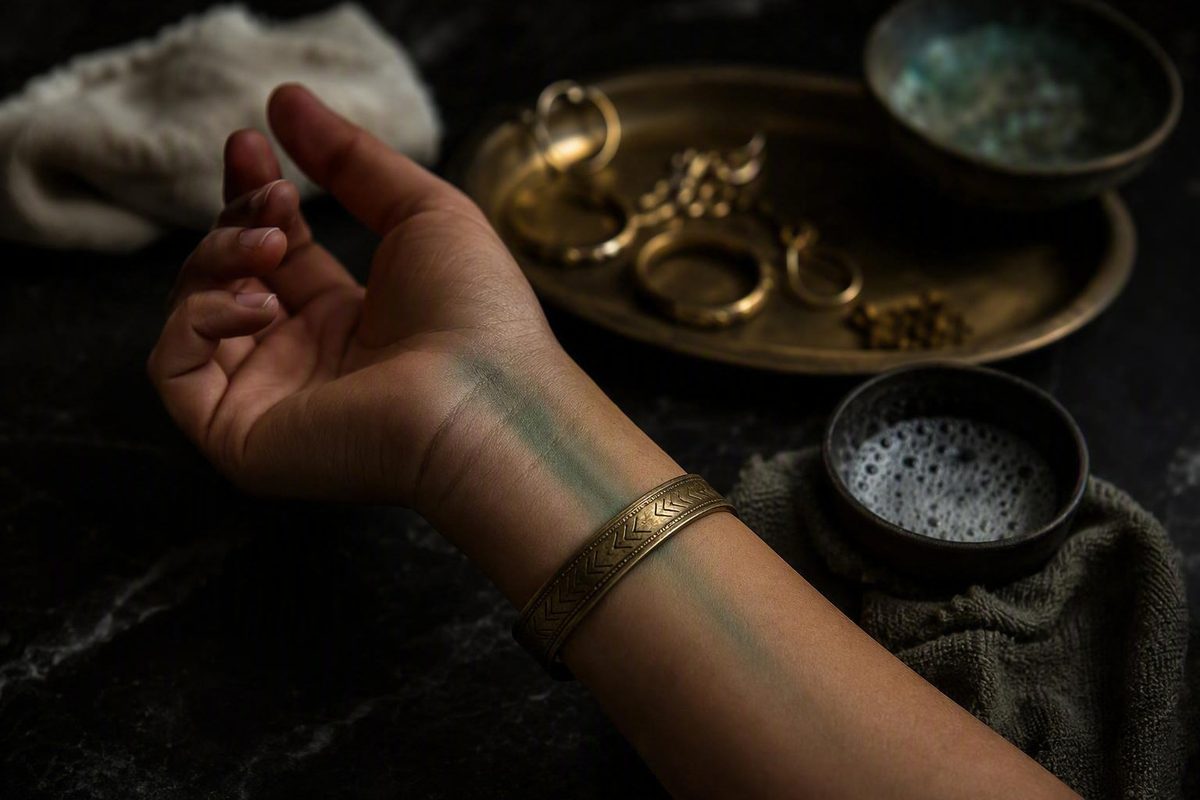
Yes, brass jewelry can leave a green or gray-green mark on your skin. It will not necessarily happen with every piece, wearer, or occasion. Moisture, perspiration, personal-care products, wear time, fit, and the condition of any coating can all affect whether a mark appears.
The color is generally residue deposited on the skin rather than a permanent change in skin color. If the area is comfortable and the mark is simply a flat patch of color, remove the jewelry and wash gently with mild soap and warm water. The residue commonly washes off or fades, although there is no reliable timetable that applies to everyone (Bryn Mawr Jewelry’s guide to green jewelry marks).
A green mark by itself does not prove that the jewelry is fake, defective, or low quality. Genuine brass can cause discoloration because brass contains copper.
The important distinction is between color alone and color accompanied by irritation:
- Flat green or gray-green color without discomfort: More consistent with transferred surface residue.
- Redness, itching, swelling, pain, bumps, blistering, or persistent irritation: Stop wearing the piece and treat the problem as a possible skin reaction rather than an ordinary cosmetic stain (James Michelle’s comparison of green residue and irritation).
Color and symptoms cannot identify a specific allergy, alloy component, coating, product, or other cause. The cited sources in this article are commercial jewelry guides rather than independent clinical or materials-science references, so the chemistry is best understood as a qualitative explanation and the symptom guidance as a conservative decision aid—not a diagnosis.
Why copper in brass creates green residue
Brass is an alloy containing copper and zinc. Formulations vary, but the relevant shared feature is copper. That is why even genuine solid brass may leave a green mark.
During wear, exposed brass may come into contact with:
- Oxygen
- Water and humidity
- Perspiration
- Substances in sweat
- Skin oils
- Soap residue
- Lotion, sunscreen, perfume, and cosmetics
Under these conditions, copper at the surface can react and produce copper-containing material that collects on the jewelry. Some of that material may then transfer to the skin, creating a green or gray-green film. Brass and copper jewelry can both produce this effect because both contain copper (AJLuxe’s comparison of copper and brass jewelry).
It helps to distinguish two related effects:
- Tarnish or corrosion develops on the metal.
- The skin mark appears when material from the jewelry’s surface transfers to the wearer.
The two effects are connected, but they are not identical.
The process is often summarized as oxidation, but actual wear conditions are variable. Moisture, air, perspiration, oils, product residue, contact time, alloy formulation, and surface condition can all play a part. It is therefore more accurate to say that copper can react, residue may form, and that residue may transfer than to imply that every piece undergoes one identical reaction.
A green mark also does not reveal exactly which copper-containing substances are present. Appearance alone is not a chemical analysis.
Why one ring stains today when it did not stain yesterday
A brass ring may leave no mark for weeks and then suddenly create a green band. That does not necessarily mean the jewelry’s composition or the wearer’s health changed. The conditions of wear may simply have changed.
The most useful variables fall into four categories: environment, wear pattern, products, and jewelry condition.
Environment: heat, sweat, humidity, and water
Hot or humid weather can leave more moisture between jewelry and skin. Exercise adds perspiration, while swimming, showering, handwashing, and other water exposure can keep a piece wet.
These conditions do not guarantee staining. They give exposed copper more opportunity to react. Jewelry-care guidance identifies humidity, sweat, swimming, showering, and similar water exposure as factors that may increase discoloration (Blake Brothers’ guide to metals that turn skin green).
Wear pattern: duration and contact
Long wear gives residue more time to form and transfer. A ring worn through a workout, overnight, or for several consecutive days has much more continuous exposure than a necklace worn for a short evening and removed afterward.
Fit can matter, especially for rings. Close contact may retain moisture and make a mark more concentrated or sharply defined. That does not mean close fit is the sole cause, and deliberately choosing an excessively loose ring can create a risk of losing it. The practical goal is a secure, comfortable fit rather than either extreme.
Breaks between long periods of wear allow the skin and jewelry to dry. They also make it easier to notice developing residue or changes in the jewelry’s finish.
Products: lotion, sunscreen, perfume, and soap residue
Hand cream beneath a ring, sunscreen beneath a bracelet, or perfume around a necklace can change conditions at the metal surface. Products may introduce additional substances, retain moisture, or collect in recessed parts of the jewelry.
Possible contributors include:
- Hand and body lotions
- Sunscreen
- Perfume and fragranced sprays
- Makeup
- Soap or cleanser residue
- Hand sanitizer residue
- Natural skin oils
Allowing products to dry before putting on jewelry may reduce direct contact, but it cannot guarantee stain-free wear.
Jewelry condition: worn coatings and exposed metal
Some brass jewelry is bare. Other pieces are plated, lacquered, waxed, or otherwise coated. An intact finish may reduce direct contact between brass and skin. Scratches and ordinary wear can expose the underlying metal, allowing marks to begin where none appeared before.
Inspect high-contact areas such as:
- The inside and underside of a ring
- The back of a pendant
- Bracelet edges
- Clasp areas
- Earring surfaces that touch the skin
Consider a ring that first stains during a hot week after the wearer starts using a new hand lotion. Increased perspiration, retained moisture, and product contact offer a more useful working explanation than assuming the wearer has developed an illness. Similarly, if staining begins only where a finish has visibly worn, exposed base metal is an important clue.
Individual differences may affect the result, but the available evidence does not establish skin pH as the single or primary cause. Environment, contact time, products, fit, and finish condition all deserve consideration.
Green residue versus an irritated skin reaction
A flat green patch and an irritated rash call for different responses. Symptoms cannot diagnose the cause, but they can help determine whether it is appropriate to continue treating the problem as removable residue.
| What you notice | More consistent with ordinary residue | Reason to stop wearing the item |
|---|---|---|
| Flat green or gray-green color | Yes | Not by itself |
| Color lifts or fades with gentle washing | Yes | Not by itself |
| No itching, pain, swelling, or other irritation | Yes | Not by itself |
| Redness | No | Yes |
| Itching | No | Yes |
| Pain or swelling | No | Yes |
| Raised bumps | No | Yes |
| Blistering | No | Yes |
| Irritation that persists after removal | No | Yes |
Ordinary residue is primarily cosmetic: the skin is discolored but otherwise feels normal, and the color commonly comes off or fades with gentle washing. Do not scrub aggressively.
If redness, itching, swelling, pain, bumps, blistering, or persistent irritation occurs, remove the jewelry. Seek appropriate medical advice if symptoms are severe, spreading, painful, markedly swollen, blistering, or do not resolve after the item is removed. Commercial jewelry guidance distinguishes these inflammatory symptoms from an ordinary washable mark, but it cannot determine their medical cause (Dea Dia’s guidance on irritation during brass wear).
Do not automatically label every jewelry-related rash a nickel allergy. More than one factor may be involved, and appearance alone cannot identify the responsible substance.
Likewise, “nickel-free” does not mean “incapable of causing discoloration or irritation.” The label addresses nickel, not every component or coating, and it does not remove the copper from brass.
How to remove a green brass mark from skin
For a comfortable, flat green mark, begin with the least aggressive method:
- Remove the jewelry. This stops further transfer and allows you to inspect the skin and the piece.
- Wash gently with mild soap and warm water. Use your fingertips or a soft cloth rather than an abrasive brush.
- Rinse thoroughly. Soap left behind may become trapped if the jewelry is put on again.
- Pat the area dry. Avoid forceful rubbing.
- Leave the jewelry off temporarily. This allows the area to dry and shows whether the color fades without further exposure.
Soap and warm water are commonly recommended for removing green residue, but the available evidence does not establish an exact disappearance time for every wearer (By Bonnie Jewelry’s removal and prevention guide).
Stop treating the problem as a cosmetic stain if redness, itching, pain, swelling, bumps, blistering, or persistent irritation appears. Remove the item and seek appropriate medical advice for severe, spreading, painful, markedly swollen, blistering, or unresolved symptoms (AJLuxe’s discussion of brass staining and skin reactions).
Cleaning the skin removes transferred residue; it does not change the underlying brass. If the same exposed surface is worn again under similar conditions, another mark may form.
How to reduce future staining from brass jewelry
No method can guarantee that exposed brass will never react. Prevention is best approached in stages, beginning with moisture control and wearing habits before moving to a temporary barrier.
First tier: wipe, dry, and store carefully
After wearing brass jewelry:
- Wipe skin-contact surfaces with a soft, clean cloth.
- Remove visible perspiration, oil, and product buildup.
- Allow the piece to dry completely.
- Store it away from humid areas.
- Keep coated pieces from rubbing against other jewelry when friction could damage the finish.
This routine does not make bare brass inert. It reduces the time that moisture and residue remain on the surface.
Follow the maker’s cleaning instructions. If the construction is unclear or the item is valuable, consult the maker or a qualified jeweler rather than experimenting with a homemade cleaner.
Second tier: change when and how you wear it
Remove brass jewelry before:
- Swimming
- Showering or bathing
- Strenuous exercise
- Sleeping
- Washing dishes or doing wet cleaning
- Applying lotion, sunscreen, perfume, or similar products
If you apply a personal-care product first, let it dry or absorb before putting on the jewelry. After handwashing, dry both your hands and the ring rather than leaving moisture trapped underneath.
For rings, a comfortable fit and breaks between long periods of wear may reduce retained moisture and continuous contact. These measures reduce exposure but cannot guarantee prevention.
Third tier: consider a compatible barrier
A coating, lacquer, wax, or plating can create a physical layer between brass and skin. It does not change the underlying alloy. Once the barrier scratches, thins, or wears through, exposed brass can begin reacting again.
Before adding a barrier:
- Determine whether the item is bare, plated, lacquered, stone-set, or glued.
- Check the maker’s care instructions.
- Use only a product intended for jewelry and compatible with the existing finish.
- Ask the maker or a qualified jeweler for advice if the construction is delicate or uncertain.
Temporary barriers require inspection and renewal because they can wear away (Sara Golden Jewelry’s discussion of temporary brass barriers).
Do not assume a household clear coating is suitable for every item or wearer. Avoid unverified acidic or abrasive cleaning recipes when the item’s construction and finish are uncertain.
Solid brass, plated brass, and what the green mark says about quality
Genuine solid brass can leave green residue precisely because it contains copper.
Other labels answer narrower questions than shoppers sometimes assume:
- Lead-free addresses lead, not copper.
- Nickel-free addresses nickel, not copper.
Solid brass and nickel-free brass can therefore still leave green residue. Removing nickel from an alloy does not remove the copper responsible for copper-related discoloration.
Plated or coated brass is more dependent on surface condition. An intact outer layer may reduce direct contact with the brass. Once friction or scratching exposes the base, staining may begin in those areas.
Worn gold-plated jewelry may expose a copper- or brass-containing base, but a green mark cannot identify that base metal by itself. Product documentation is more reliable than inference from skin color.
Price does not settle the question. A lower-priced item is not proven fake by a green mark, and an expensive item is not guaranteed to be compatible with every wearer.
If composition matters because staining recurs or irritation develops, ask the maker or seller:
- Is the piece solid or plated?
- What is the base metal?
- Is there a lacquer or protective coating?
- Are potential sensitizers disclosed?
- Which cleaning methods suit the finish?
- Can the item be recoated or replated?
Specific material and construction information is more useful than relying on appearance, price, or marketing terms.
A practical troubleshooting guide for the next green mark
Use what you see and feel to choose a conservative next step. This sequence is intended for risk reduction, not self-diagnosis.
Scenario 1: Green color only
If the mark is flat, comfortable, and not inflamed:
- Remove the item.
- Wash the skin gently with mild soap and warm water.
- Rinse and pat dry.
- Wipe the jewelry and let it dry completely.
- Consider recent conditions such as heat, exercise, water, lotion, long wear, or close contact.
- Adjust those conditions before trying the piece again.
Avoid aggressive scrubbing. The aim is to remove residue without irritating otherwise comfortable skin.
Scenario 2: Recurring color without irritation
If the mark repeatedly returns without inflammatory symptoms:
- Shorten wearing periods.
- Remove the piece during exercise and water exposure.
- Keep the jewelry and skin dry.
- Limit product residue beneath the item.
- Wipe the contact surface after wear.
- Inspect plating or coatings for worn areas.
- Consider a renewable, jewelry-compatible barrier if the maker confirms that it is suitable.
- Ask about professional refinishing if the piece is valuable or delicate.
These measures may reduce the frequency or intensity of staining. They do not permanently stop exposed brass from reacting.
Scenario 3: The mark begins after a finish wears
If a previously trouble-free piece starts marking the skin where its finish is visibly scratched or thin, exposed base metal is a reasonable working explanation.
If documentation identifies the item as brass or brass-based, the exposed area may be treated as the likely contact surface. If the composition is undisclosed, do not assume a green mark proves that the base is brass. Contact the maker, seller, or a qualified jeweler for material and refinishing information.
Scenario 4: Redness, itching, pain, swelling, bumps, or blistering
Stop wearing the piece and gently wash away any surface residue. Do not repeatedly test the jewelry against irritated skin.
Seek appropriate medical advice if symptoms are severe, spreading, painful, markedly swollen, blistering, persistent, or do not resolve after removal. A green color does not rule out a simultaneous adverse reaction, and appearance alone cannot show whether the cause is an alloy component, coating, trapped moisture, friction, or another exposure (Blake Brothers’ guidance on staining versus possible allergy symptoms).
The concise answer is: yes, brass can turn your skin green. Moisture control, gentle cleaning, shorter wear, reduced product contact, and maintenance of any protective finish can make the effect less likely, but no method guarantees that exposed brass will never react.
Frequently asked questions
Does all brass turn your skin green?
No. Brass can leave green residue, but the result is not inevitable. Pieces differ in alloy formulation, finish, coating condition, shape, and contact with skin. Wearers also differ in their exposure to perspiration, humidity, water, products, and prolonged contact.
Even one item can behave differently from day to day. A ring may leave no trace during short wear in cool, dry conditions but create a mark after exercise, handwashing, lotion use, or a humid day.
Can solid or genuine brass still leave a green mark?
Yes. Brass is a copper-zinc alloy, so solid or genuine brass can leave green residue because copper is part of the material. “Solid” does not mean that the copper has been removed.
The mark may therefore be consistent with genuine brass. It is not an authenticity test by itself.
Does green skin mean brass jewelry is fake or low quality?
No. A green mark alone does not establish authenticity, workmanship, safety, price level, or overall quality. Genuine brass can stain, while coated jewelry may remain mark-free until its finish wears.
Use product documentation to evaluate composition. The base metal, plating, coating, and care instructions are more informative than price or the appearance of a skin mark.
Can nickel-free brass still turn skin green?
Yes. Nickel-free labeling addresses nickel, not copper. Because brass still contains copper, nickel-free brass can leave a cosmetic green mark.
The label is also not a universal promise against irritation. If redness, itching, swelling, pain, bumps, blistering, or persistent irritation occurs, stop wearing the item.
When should I stop wearing brass jewelry and seek medical advice?
Stop wearing the jewelry if the area becomes red, itchy, painful, swollen, bumpy, blistered, or persistently irritated. Seek appropriate medical advice if symptoms are severe, spreading, painful, markedly swollen, blistering, or do not resolve after the item is removed. These signs should not be treated as an ordinary cosmetic stain (Bryn Mawr Jewelry’s symptom guidance).
For green color alone, remove the piece, wash the skin gently, clean and dry the jewelry, and reduce moisture and product exposure before wearing it again.
In summary: Brass can leave temporary green residue because its copper content reacts under certain wearing conditions. The effect is not inevitable and does not by itself prove that the jewelry is fake or poor quality. For a comfortable patch of color, remove the piece, wash gently, and keep the jewelry clean and dry. Treat coatings as renewable barriers, not permanent fixes. If the area is red, itchy, painful, swollen, bumpy, blistered, or persistently irritated, stop wearing the item and seek appropriate medical advice rather than assuming it is an ordinary brass mark.