 StainList
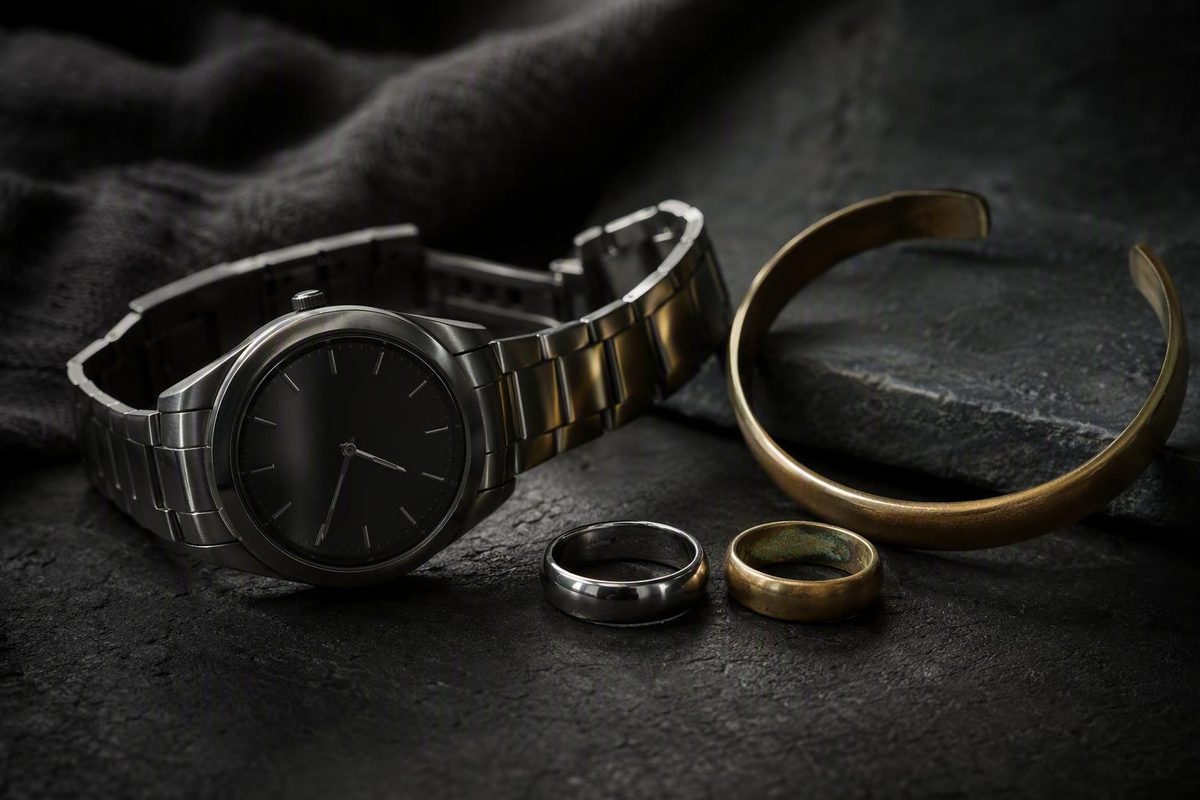
The short answer: stainless steel is unlikely to leave a green mark
Solid stainless steel is unlikely—but not guaranteed—to leave the classic green residue commonly associated with copper-containing jewelry during ordinary wear. Stainless steel is corrosion resistant, not corrosion proof. More importantly, an item marketed as “stainless steel” may also include coatings, underlayers, solder, clasps, charms, adhesives, or decorative parts made from other materials. One commercial jewelry guide describes 316L stainless steel as much less likely than copper-rich metals to leave green marks while acknowledging that no material behaves identically for every wearer (EXCITÀRE’s jewelry guide).
Related: What Decides Whether Brass Turns Your Skin Green.
This article relies on commercial jewelry publications because the supplied evidence does not include independent laboratory studies, metallurgy standards, or clinical dermatology guidance. Accordingly, technical and skin-related points below are practical, non-diagnostic guidance rather than proof of what happened in any individual case.
The product label may describe only the main body. A stainless-steel watch might have a coated back, non-steel buckle, soldered joint, adhesive, or decorative insert. A bracelet may use steel links with a different clasp. A ring may have a steel core beneath a colored coating—or a steel-colored finish over an unidentified base.
A green mark alone does not prove that jewelry is fake, toxic, poor quality, or unsafe. It does not identify nickel or diagnose an allergy. It indicates only that colored material was produced or transferred at the contact area.
Start with four questions:
- What changed? Is there a green film that wipes or washes away, or is the skin itself red or inflamed?
- Where is the mark? Is it beneath the whole band, only under a clasp, beside a joint, or along a worn edge?
- What touched that location? Consider every component, not only the advertised main metal.
- Are there skin symptoms? Itching, burning, swelling, scaling, pain, bumps, or blisters require a more cautious response than a painless surface stain.
The practical question is therefore not simply, “Does stainless steel turn skin green?” It is, “What part of this finished item contacted the marked area, and was the result residue, skin irritation, or both?”
Why jewelry leaves green residue
The supplied commercial sources most often associate familiar green jewelry marks with copper-containing materials. Their simplified explanation is that exposure to moisture, sweat, salts, oils, cosmetics, or other substances can produce colored copper residue that transfers to the skin. The color is consistent with copper-containing residue, but it cannot establish the exact chemical process in a particular case.
Materials commonly identified as more likely to leave green marks include:
- Copper
- Brass, an alloy of copper and zinc
- Bronze, which also contains copper
- Sterling silver, commonly described as 92.5% silver and 7.5% other metals, often copper (Blake Brothers’ overview of jewelry metals)
- Plated jewelry with a copper- or brass-containing base or intermediate layer
A piece’s color does not reveal its construction. Gold-colored or silver-colored jewelry may have a thin decorative finish over a different base. When that finish becomes scratched, porous, or worn, an underlying copper-containing material may contact the skin.
Conditions that commercial jewelry sources associate with residue formation or transfer include:
- Sweat and prolonged dampness
- Water and high humidity
- Salt from perspiration or seawater
- Chlorinated water
- Skin oils
- Lotions, sunscreen, perfume, soap, and cosmetics
- Household cleaners
- Tight contact that traps moisture
- Long, uninterrupted wear
Several factors can operate at once. A ring worn during hand washing can trap soap and water beneath its band. A watch worn during exercise can hold sweat against its back, buckle, and pins. Lotion can collect inside engraving or around a clasp.
Two people may also have different experiences with similar jewelry. Their exposure to moisture and personal-care products may differ, their pieces may have different amounts of finish wear, and one design may trap more residue than another. Commercial sources often call this difference “skin chemistry,” but practical variables—dampness, product buildup, fit, construction, and surface condition—also deserve attention.
Color alone cannot identify a compound or certify the jewelry’s composition.
How stainless-steel-labeled jewelry can still cause a green mark
Investigate the finished product as a collection of materials rather than assuming that every part matches the listing.
Possible explanations include:
- Coating or plating: The visible surface may not be bare stainless steel.
- Copper-containing underlayer: A decorative finish may cover an intermediate layer that becomes exposed as the surface wears.
- Solder or joining material: A seam, joint, or repair may differ from the surrounding metal.
- Clasp, buckle, or pin: Small functional components may not use the same metal as the main body.
- Charm or decoration: Inlays, bezels, rivets, chain extenders, and ornaments may contain another material.
- Mixed-metal construction: “Stainless steel” may refer only to the primary component.
- Manufacturing residue: Polish, adhesive, or other material may remain on the surface.
- Environmental contamination: Metal dust, cosmetics, cleaners, or contact with another corroding object may leave transferable residue.
- Finish wear: Scratches and abrasion may reveal another layer.
- Incomplete or inaccurate labeling: The description may not cover the whole item—or may not accurately identify its main material.
The mark’s location is often the most useful clue. A thin line along a ring’s inner edge may correspond to worn plating. A watch mark confined to the buckle area points away from the watch back. A necklace stain at the nape may align with the clasp or extension chain rather than the main chain.
After removing the piece, inspect it under bright light. Look for:
- A shift from silver color to yellow, red, or brown
- Flaking, bubbling, or peeling
- Scratches along raised or high-friction edges
- Uneven color inside a band
- Darkened seams
- Green or blue-green deposits in crevices
- Buildup around stones, hinges, or links
- Components that visibly differ from the main body
Then review recent use. Did the problem begin after swimming, bathing, exercise, hot weather, frequent hand washing, household cleaning, or prolonged damp wear? Was lotion, sunscreen, perfume, or another product applied beneath the jewelry? Was the item stored while damp? A change in exposure can explain why an older piece starts leaving marks.
These observations can identify a pattern, but they cannot certify an alloy or establish the residue’s chemistry. A steel-colored surface is not proof of stainless steel, and a visible copper tone does not reveal every layer underneath.
When contacting the seller, ask:
- Is the piece solid stainless steel, plated stainless steel, or a plated base metal?
- Which stated steel grade applies to the main body?
- Are all skin-contact components made from that grade?
- What are the clasp, pin, solder, extension chain, watch back, and decorations made from?
- Is there a PVD coating, conventional plating, lacquer, or another finish?
- Are copper- or brass-containing underlayers used?
- Is there a supplier declaration, composition report, or test record, and exactly which finished components does it cover?
A document identifying only the nominal material of the main body does not necessarily establish the composition of the completed piece. Specific construction information is more useful than broad claims such as “waterproof,” “surgical,” or “hypoallergenic.”
What 304, 316L, “surgical steel,” and “hypoallergenic” do—and do not—tell you
The supplied commercial material attributes stainless steel’s corrosion resistance to a chromium-supported protective surface film. It also cautions that stainless steel remains vulnerable to unsuitable chemical exposure, surface damage, contamination, and crevices where salts and moisture collect. Because the evidence pack includes no independent technical standard or corrosion reference, these points should be treated as a commercial explanation rather than a verified performance specification.
One retailer describes solid, clean, uncoated, correctly identified 304 and 316L stainless steel as unlikely to produce classic copper-associated green staining. The same source says 316L generally has better resistance than 304 to localized corrosion in chloride-containing conditions and attributes that difference to molybdenum (Oahlan’s comparison of stainless-steel jewelry grades).
That is provisional commercial guidance, not a guarantee that every 316L product will outperform every 304 product. The behavior of finished jewelry also depends on its coatings, other components, fabrication, surface condition, exposure, and maintenance. A 316L ring with a worn copper-containing layer could leave residue even if the underlying steel remains unaffected. An uncoated 304 component may leave no green mark in ordinary wear.
A grade also describes only the component to which the designation genuinely applies. “316L stainless-steel necklace” does not necessarily mean its clasp, jump rings, solder, stones, coating, or extension chain are all 316L.
The labels “surgical steel” and “hypoallergenic” are even less informative when unsupported by documentation. Do not interpret either term as automatic proof of:
- A verified alloy composition
- No nickel
- No coatings or mixed-metal parts
- No nickel release
- No corrosion or staining
- No possibility of irritation or allergy
The supplied commercial evidence says 316L can contain chromium, nickel, and molybdenum and notes that nickel may matter to people with a confirmed sensitivity. It therefore should not be described as nickel-free or universally suitable for every wearer.
If composition matters because of recurring staining or known sensitivity, request records identifying the stated alloy and the finished components covered.
Green surface stain versus irritation or possible allergy
A removable green deposit and an inflammatory skin reaction are different observations, although both may occur at the same time.
A surface stain is more consistent with a mark that:
- Is green or blue-green
- Transfers to a cloth
- Washes away or fades with gentle cleaning
- Matches a specific jewelry contact point
- Causes no discomfort or change in skin texture
Irritation or a possible allergic reaction is more concerning when there is:
- Redness
- Itching
- Burning or tenderness
- Swelling
- Scaling, cracking, or weeping
- Raised bumps
- Pain
- Blisters
- A rash extending beyond the contact area
This comparison is not diagnostic. A retailer guide similarly distinguishes removable green transfer from itching, swelling, blistering, pain, or persistent irritation, while noting that such symptoms may indicate a skin reaction rather than simple staining (EXCITÀRE’s discussion of green residue and irritation).
Green staining and nickel sensitivity are separate questions. A copper-containing surface may leave a green film without inflammation. Conversely, stainless steel that contains nickel may leave no green mark even if a susceptible wearer experiences symptoms.
A green mark therefore cannot:
- Identify nickel
- Prove nickel allergy
- Diagnose allergic contact dermatitis
- Establish that stainless steel itself caused a reaction
- Show that a product is toxic
Do not assume every green mark is harmless. Residue can appear alongside irritated or broken skin. If the area is severely painful, markedly swollen, blistered, spreading, or otherwise concerning, remove the jewelry and seek qualified medical guidance. Persistent symptoms also warrant professional advice rather than further wear. These are conservative safety steps, not a diagnosis.
What to do when you notice a green mark
Use the least aggressive response first:
- Remove the jewelry.
- Wash the skin gently with mild soap and warm water.
- Rinse thoroughly so soap does not remain under a tight contact area.
- Pat the skin dry rather than scrubbing it.
- Check what remains: note any redness, itching, burning, swelling, pain, scaling, bumps, or blisters.
Commercial jewelry guidance says ordinary green residue often washes away with mild soap and warm water (By Bonnie Jewelry’s cleaning guidance). Do not use acids, bleach, strong solvents, abrasive powders, or aggressive scrubbing on skin.
How—or whether—you clean the jewelry depends on its construction.
For confirmed bare, uncomplicated stainless steel, the supplied commercial guidance supports mild soap and water followed by thorough rinsing and drying. Use a soft cloth rather than an abrasive pad, and remove moisture from crevices.
For plated, coated, glued, painted, stone-set, antiqued, or mixed-material jewelry, follow the maker’s care instructions. If you do not know the construction, avoid soaking, abrasive cleaning, or experimenting with strong products. Ask the seller or a reputable jeweler what method is appropriate for that particular piece.
After cleaning, inspect the exact area corresponding to the stain. Look for deposits and visible finish wear. Do not deliberately wear the item again merely to provoke another mark, especially if the skin was irritated or the composition is uncertain.
If staining repeatedly returns during normal use, discontinue wear while requesting construction details or obtaining a professional assessment. Cleaning and visual inspection may reveal patterns, but they cannot verify an alloy.
How to reduce the chance of another green stain
Prevention focuses on limiting moisture, chemicals, residue buildup, and contact with exposed reactive layers.
Useful habits include:
- Keep the jewelry and skin clean and dry.
- Dry the item thoroughly after accidental moisture exposure.
- Remove it before swimming or bathing.
- Take off rings before prolonged hand washing or washing dishes.
- Avoid wearing close-fitting pieces during heavy exercise if sweat remains trapped beneath them.
- Remove jewelry before using household cleaning chemicals.
- Let lotion, sunscreen, perfume, and cosmetics dry before putting jewelry on.
- Avoid applying products directly under bands, watch backs, clasps, or close-fitting chains.
- Store jewelry only after it is dry.
- Inspect high-friction edges, clasps, and seams periodically for visible wear.
Commercial jewelry sources repeatedly associate sweat, humidity, water, lotions, and perfume with green transfer from copper-rich materials. These precautions may reduce residue, but they cannot correct inaccurate labeling, exposed copper-containing layers, or mixed-metal construction.
Clear nail polish, polymer barriers, and jewelry sealants are sometimes suggested as temporary workarounds. The supplied sources do not establish them as universally safe or durable.
Use a barrier only if the maker approves it for the specific item, and stop if it peels, cracks, changes the finish, or appears to affect the skin. Do not assume a household coating is appropriate for every material or wearer.
For recurring problems, prioritize verified composition and whole-item construction over color, price, or marketing language. Ask about every component that touches the skin rather than relying on “waterproof,” “surgical steel,” or “hypoallergenic.”
A step-by-step troubleshooting checklist
Step 1: Determine whether the mark is residue or a skin change.
Gently wash with mild soap and warm water. A removable green film without discomfort is more consistent with surface transfer. Redness, itching, burning, swelling, pain, scaling, bumps, or blisters raise a separate skin-safety concern.
Step 2: Map the mark to the exact contact point.
Compare the shape and position of the mark with the:
- Main band or chain
- Inner or outer edge
- Clasp or buckle
- Soldered joint
- Chain extender
- Charm
- Watch back
- Strap hardware
- Stone setting
- Decorative component
A photograph of the mark and the item’s position may help with comparison after cleaning.
Step 3: Inspect the corresponding part.
Under bright light, check for:
- Worn plating
- Scratches or flaking
- Uneven color
- Green deposits
- Trapped product residue
- Dark seams
- A different underlying metal color
Do not scrape, file, or deliberately damage the surface. Destructive testing can ruin the item and expose additional layers.
Step 4: Review recent exposure.
Consider whether the mark followed:
- Heavy sweating
- Hot or humid weather
- Pool or seawater exposure
- Bathing
- Frequent hand washing
- Lotion, sunscreen, perfume, or cosmetics
- Soap trapped under a band
- Household cleaning
- Damp storage
- Longer wear than usual
Step 5: Clean only as the construction allows.
Mild soap, water, rinsing, and thorough drying may suit confirmed bare stainless steel. For plated, coated, glued, painted, stone-set, or mixed-material pieces, follow the maker’s instructions. If the construction is uncertain, avoid soaking and aggressive cleaning.
Step 6: Do not deliberately test-wear an uncertain item.
Instead, inspect the cleaned piece for deposits or damage and ask the seller or a jeweler to assess the suspect component. Never put it back on irritated, broken, or previously reactive skin merely to see what happens.
Step 7: Request specific product records.
Ask for:
- The stated alloy
- Whether the piece is solid or plated
- The composition of every skin-contact component
- The coating or finish type
- Whether copper- or brass-containing underlayers are used
- Any supplier declarations or test records
- A clear statement of which finished components those records cover
Save the original listing and seller correspondence if a specific material claim was made.
Step 8: Escalate appropriately.
For recurring residue without inflammation, ask the seller or a reputable jeweler to assess finish wear and mixed-metal construction. Stop wearing the item and seek qualified medical guidance for severe, spreading, blistering, painful, or persistent symptoms.
This process may identify patterns, but it cannot diagnose a skin condition, certify a metal, or determine the exact composition of transferred residue.
Does a green mark mean my stainless-steel jewelry is fake?
No. The main body may be stainless steel while a coating, underlayer, clasp, soldered joint, charm, pin, or decorative part contains another material. Residue or environmental contamination is also possible.
Repeated staining from the main body—particularly where a finish is visibly worn—justifies asking for detailed construction and composition information. Appearance alone still cannot prove what the piece contains.
Can nickel in stainless steel turn skin green?
A green mark does not reliably identify nickel. The supplied commercial sources more often associate classic green residue with copper-containing materials. They discuss nickel mainly in relation to possible inflammatory symptoms in susceptible wearers.
Nickel-containing stainless steel may be present without leaving green residue, while a copper-containing surface may leave a green film without proving nickel sensitivity. Stain color cannot diagnose an allergy.
Is 316L stainless steel less likely to leave green marks than 304?
The supplied commercial guidance describes both solid, clean, uncoated, correctly identified 304 and 316L stainless steel as unlikely to produce classic copper-associated green marks. One retailer says 316L generally has better localized-corrosion resistance in chloride-containing conditions, but the evidence pack does not include an independent standard or technical study establishing how that comparison applies to every finished jewelry product.
The printed grade also does not establish the composition of coatings, solder, clasps, charms, or underlayers. Whole-item construction may matter more than the grade in the listing.
How do I remove a green jewelry mark from my skin?
Remove the jewelry, wash gently with mild soap and warm water, rinse well, and pat the area dry. Do not use harsh acids, solvents, abrasives, or aggressive scrubbing.
If the green color washes away but redness, itching, burning, pain, swelling, scaling, bumps, or blisters remain, stop treating the issue as a simple stain. Do not put the jewelry back on while the skin is irritated.
When should I stop wearing the jewelry and seek medical advice?
Stop wearing it if contact is followed by itching, burning, pain, swelling, blistering, broken skin, or a spreading rash. Seek qualified medical guidance when symptoms are severe, spreading, blistering, painful, persistent, or otherwise concerning. Commercial jewelry guidance also distinguishes redness, itching, and swelling from simple removable transfer (WatchClick’s overview of jewelry marks and skin symptoms).
The practical rule is simple: verified solid stainless steel is not the usual source of a classic green mark, so examine the entire piece and its recent exposures rather than judging it by the label alone. Wash removable residue away gently, keep the jewelry clean and dry, and investigate coatings, clasps, solder, edges, and other contact points if the stain returns. Treat itching, redness, burning, swelling, bumps, or blisters as a separate skin-safety issue: stop wearing the item and seek qualified advice.