 StainList
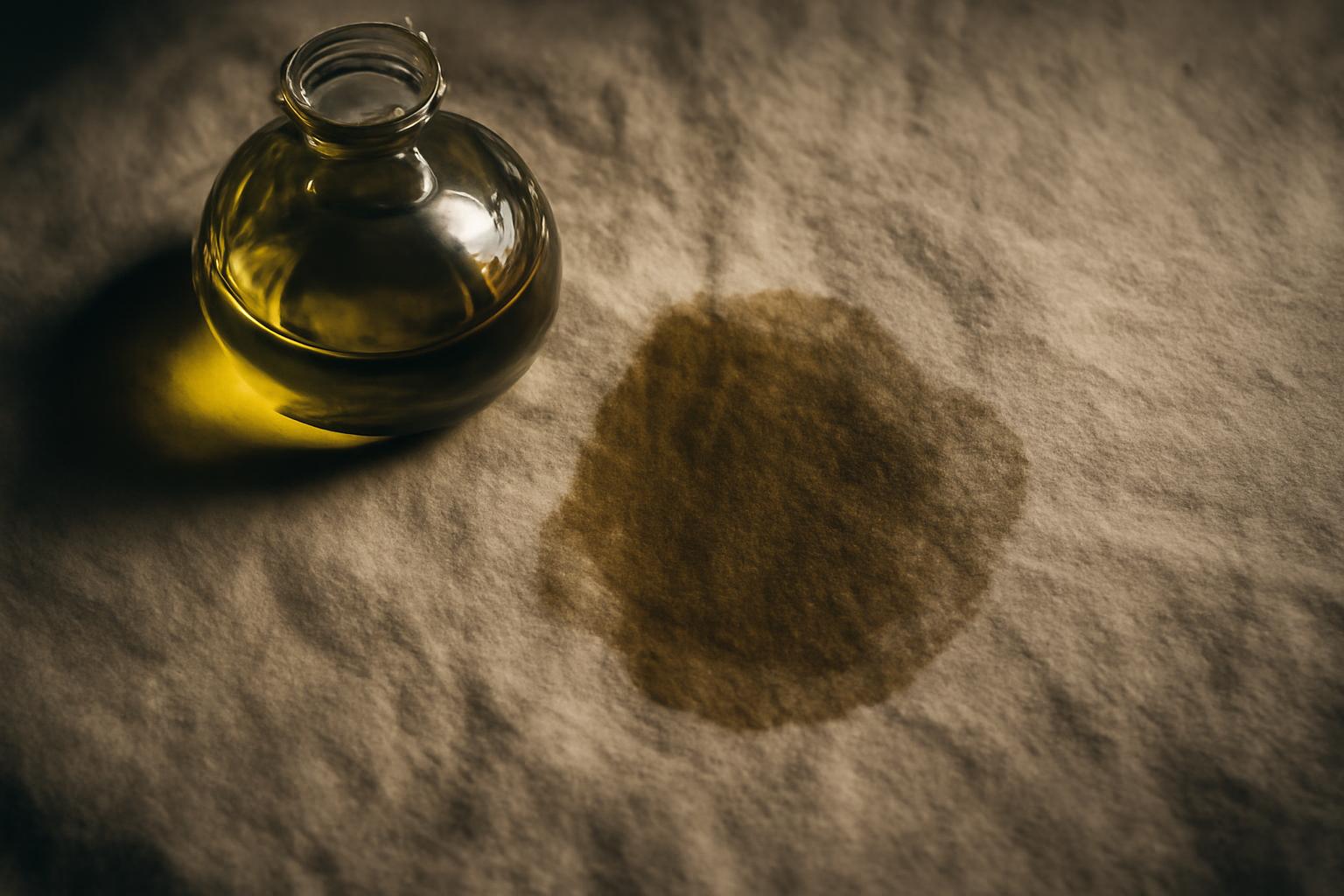
Yes, olive oil can leave a stain on clothes
Yes, olive oil can stain clothes. A spill may leave a darker patch, a translucent outline, or a greasy area that becomes more noticeable after the fabric dries.
Olive oil is a lipid and does not dissolve readily in water. A simple rinse may therefore leave oil among the fibers, and laundering without pretreatment can leave a visible shadow. Olive Oils from Spain describes olive oil as a hydrophobic lipid that does not dissolve easily in water, although its removal advice is commercial guidance rather than controlled textile research.
A visible mark is not necessarily permanent. Manufacturer guidance and an informal first-person test report successful removal after grease-focused pretreatment and laundering. The practical response is to treat the garment before assuming it is ruined.
Prompt treatment is preferable because it lets you blot away surface oil before washing or dryer exposure.
The result can depend on:
- Stain age: A fresh drop generally gives you more opportunity to remove surface oil than a mark that has been through several wear and wash cycles.
- Amount of oil: A small splash differs from a spill that has soaked through multiple layers.
- Fabric: Washable cotton may respond differently from a delicate knit, lined garment, or specialty material.
- Colorfastness: A treatment that leaves one fabric unchanged may affect another garment’s dye.
- Previous washing: Washing may remove some oil while leaving a faint patch that becomes obvious only after drying.
- Dryer exposure: Heat may make residual oil harder to remove, but it does not prove that the garment is permanently ruined.
- Prior treatment: Product residue or damage from repeated treatment can sometimes resemble or accompany the original stain.
For an ordinary machine-washable garment, a practical starting point is restrained: blot away excess oil, apply a small amount of grease-cutting pretreatment, rinse it out, wash as the label permits, and inspect after air-drying.
The quick method for an ordinary washable garment
This method is intended for an ordinary washable cotton, polyester, or common blend whose care label permits normal laundering. It is commonly recommended guidance, not a scientifically proven protocol for every fabric.
What you need:
- A clean white cloth or plain paper towel
- Liquid hand-dishwashing detergent
- Your usual laundry detergent
- Clean rinse water
- A drying rack or hanger
Then follow these steps:
-
Read the care label. Confirm that the garment is washable and note its permitted wash cycle, temperature, bleach restrictions, and drying instructions. Stop if the label says dry-clean only.
-
Blot away surface oil. Press a clean, dry cloth or paper towel against the spill. Move to a clean section as oil transfers. Do not rub the mark from side to side.
-
Keep the stained area dry initially. Lay the garment flat. If the oil has soaked through, place a clean towel behind the spot to prevent transfer to another layer.
-
Apply a few drops of liquid hand-dishwashing detergent. Cover the oily area without saturating a broad section of fabric. More product is not necessarily more effective and may be harder to rinse away.
-
Work it in gently. Use a fingertip to distribute the detergent over the mark. Avoid vigorous rubbing or aggressive brushing.
-
Allow about five minutes of contact time. This is the dwell time used in one manufacturer’s olive-oil procedure; it is a practical starting point rather than a proven optimum for every garment. Clorox recommends treating dry fabric with a few drops of dishwashing detergent, waiting five minutes, and rinsing thoroughly.
-
Rinse thoroughly. Remove the hand-dishwashing detergent before putting the garment in the washer. These products can generate excessive foam, so use them for localized pretreatment rather than pouring them into the machine.
-
Wash with laundry detergent. Choose a cycle and water temperature allowed by the garment’s care label. Do not automatically select the hottest or coldest setting.
-
Air-dry completely. Keep the garment out of the machine dryer. Once the material is fully dry, inspect the treated area in good light.
-
Repeat if necessary. If a dark or translucent outline remains, repeat the procedure on dry fabric.
This sequence gives the two detergents separate jobs: dishwashing liquid is applied locally to the greasy mark and rinsed out, while laundry detergent is used in the washer as intended. A commercial laundry stain spray may be added if its label permits, but it is not essential to the core method.
If the oil has soaked through a shirt, inspect the back of the fabric and any second layer before washing. Keep the treatment focused on the mark and its immediate edge rather than coating a broad area “just in case.”
Why the care label settles the water-temperature debate
Published instructions conflict about the right water temperature for olive oil stains. Some begin with a cold rinse, some use warm water, and others recommend hot water. The available guidance does not identify one optimal temperature for every fiber, garment construction, finish, and dye.
The conservative rule is:
After pretreatment, use the warmest wash temperature permitted by the garment’s care label.
That does not mean hotter is always better. The label accounts for garment characteristics that a generic stain guide cannot assess. If the permitted temperature is cold, use cold. If warm washing is allowed, warm is reasonable. Use hot water only when the label permits it.
For example, Truly Free Home begins its commercial procedure with a cold rinse and later recommends a warm wash after checking the care label. Its olive-oil instructions illustrate the cold-rinse approach. By contrast, the primary method above applies dishwashing detergent to dry fabric before rinsing. Neither sequence has been shown to be universally superior in a controlled comparison.
Do not let general temperature advice override the garment’s restrictions. Wool, silk, stretch fibers, unstable colors, embellishments, bonded layers, and specialty finishes may require different handling. If the label is missing or unreadable, use a cautious setting and consider professional care when the item is delicate, structured, valuable, or difficult to replace.
Air-dry, inspect, and treat again if necessary
Air-drying is also an inspection step. A garment that appears uniform while wet may reveal a darker olive oil patch when fully dry.
After washing:
- Hang or lay the garment flat as its label directs.
- Let the entire item dry, including seams, cuffs, linings, and layered areas.
- Examine it in bright, even light.
- Compare the treated spot with the surrounding material from more than one angle.
- Look for a darker patch, translucent outline, changed appearance, or greasy feel.
Do not machine-dry the garment until no mark remains. Commercial olive-oil guidance commonly recommends air-drying, inspecting, and retreating before using dryer heat because heat may make remaining oil more difficult to remove. This is a cautious warning, not proof that every heat-exposed mark becomes permanent.
If you still see a stain, repeat the core method on dry fabric: apply a small amount of dishwashing detergent, allow brief contact, rinse thoroughly, wash according to the care label, and air-dry again.
Needing more than one treatment cycle does not necessarily mean the garment is ruined. Repeating a mild, label-compatible process is preferable to immediately escalating to concentrated bleach or forceful scrubbing.
Also distinguish residual oil from detergent residue.
Baking soda, cornstarch, vinegar, and stain sprays: what is optional
Baking soda and cornstarch are optional absorbents, not required ingredients. They may be worth trying when a fresh, substantial spill has left visible oil on the fabric.
To use an absorbent cautiously:
- Blot away as much surface oil as possible.
- Keep the area dry.
- Place baking soda or cornstarch over the mark.
- Let it sit undisturbed.
- Lift, shake, or brush the powder away gently and completely.
- Continue with the dishwashing-detergent method.
- Rinse, wash according to the care label, and air-dry.
Suggested dwell times vary widely, and the supplied evidence does not establish a scientifically optimal period. Whirlpool’s general oil-stain guide presents baking soda as an optional step, followed by a small amount of dishwashing liquid, care-label-compatible washing, and line drying. See Whirlpool’s oil and grease stain instructions.
Evidence that baking soda or cornstarch improves results over dishwashing detergent alone is limited. Recommendations are based mainly on consumer guidance and personal experience rather than controlled comparisons.
One informal comparison tested four treatments on a new white cotton T-shirt stained with extra-virgin olive oil. Baking soda followed by vinegar and water, dish soap, and a specialty soap spray each removed the tested marks after washing; chalk did not. The methods were not completed under identical one-cycle conditions, and the publisher disclosed that the article contained affiliate links. Apartment Therapy describes the shirt, methods, and results of that first-person test.
That one-shirt trial does not establish how the treatments will perform on colored cotton, polyester, stretch blends, silk, wool, delicate knits, or dry-clean-only garments. It also does not prove that vinegar was responsible for removing the oil or that vinegar has a special olive-oil-lifting mechanism.
Commercial stain sprays are optional as well. If you use one:
- Confirm that its label permits use on the garment’s fiber and color.
- Follow its application amount and maximum dwell time.
- Spot-test when colorfastness is uncertain.
- Do not combine it with other treatments unless the product directions allow that use.
- Rinse before laundering when directed.
A branded spray is not established as necessary or superior to every generic alternative. For most ordinary washable garments, a few drops of suitable liquid hand-dishwashing detergent provide a simpler first treatment.
For related guidance beyond clothing, Stain List also has a separate overview of grease and oil stains on fabric, carpet, and hard surfaces.
Adjust the treatment for color, fiber, and garment value
No olive oil treatment is automatically suitable for every garment. Identify the material and read the care label before applying a product.
Washable cotton, polyester, and ordinary blends: Use the core method only when the care label permits normal washing. Check for printed decoration, coatings, elastic components, or contrast trim that may impose additional restrictions.
Brightly colored or potentially non-colorfast clothing: Spot-test the treatment on an inconspicuous seam or hem. Use a small amount, rinse as directed, and let the test area dry before assessing it. Commercial oil-stain guidance likewise recommends care-label checks, gentle handling, and spot-testing when fabric response is uncertain. Charlie’s Soap discusses these precautions in its general cooking-oil guidance.
Spandex-containing garments: Do not use chlorine bleach simply because the stain is oily or the main fabric appears white. Stretch fibers may be present in fitted shirts, underwear, athletic clothing, socks, and denim.
White clothing: White does not automatically mean bleach-safe. Fiber content, trim, thread, prints, finishes, stretch content, and care instructions still matter. Chlorine bleach is only a conditional option when the garment is white, the label permits bleaching, the fibers are compatible, and the bleach product’s directions allow the proposed use.
Bleach should not be used on wool, silk, mohair, leather, spandex, non-fast colors, or any garment whose label prohibits it. The manufacturer’s olive-oil instructions make bleach conditional on garment color, fiber content, colorfastness, and care-label requirements rather than recommending it for every white item. Review the stated bleach restrictions before considering that option.
Silk, wool, and cashmere: Do not assume that instructions for ordinary washable cotton also apply to these materials. Blot gently and follow the label. If the garment is valuable or designated dry-clean only, tell a professional cleaner that the stain is olive oil.
Leather and suede: Follow the item’s specific care instructions rather than applying the ordinary machine-washable garment method. Blot surface oil without spreading it, avoid bleach, and consider a cleaner experienced with the material.
Dry-clean-only, structured, lined, embellished, antique, or valuable clothing: Blot carefully and stop. Avoid improvised heat, bleach, soaking, and repeated experiments. Professional treatment may be the safer option.
Whatever the fabric, greater force is not necessarily more effective. Use a small amount of product, work locally, rinse thoroughly, and stop if the treatment visibly affects the garment’s color or condition.
What to try for an old, washed, or dryer-exposed stain
First determine the stain’s history:
- Air-dried but never machine-dried: The stain has aged without dryer exposure.
- Washed and air-dried: Some oil may have been removed, leaving a faint residual patch.
- Machine-dried: The remaining oil has been exposed to heat, making the result less certain.
- Treated repeatedly: The visible area may contain oil, treatment residue, garment damage, or a combination of these problems.
Each condition may still justify retreatment, but complete removal cannot be guaranteed.
For robust, washable fabric, begin with the same restrained procedure used for a fresh mark. Apply a few drops of dishwashing detergent to dry fabric, work it in gently, allow a brief contact period, rinse thoroughly, wash as the care label permits, and air-dry for inspection.
Allow for more than one mild treatment cycle rather than immediately turning to bleach, harsh products, or aggressive scrubbing. Stop if the treated area begins to lose color or otherwise shows visible damage.
One personal laundry blog reports improvement in old oil and grease stains—including some that had been through a dryer—after an overnight treatment with a paste made from dish soap, baking soda, and water. The report is anecdotal, addresses oil and grease generally rather than olive oil specifically, and does not identify all tested fabrics. The author describes the old-stain method and its personal-experience basis in the original tutorial.
If you choose to try an extended paste treatment, spot-test first and reserve it for robust, washable fabric. Do not assume that a method used on an everyday item is suitable for wool, silk, cashmere, leather, unstable dye, special finishes, or dry-clean-only clothing.
Prior dryer exposure is a reason for caution, not an automatic reason to discard the garment. The stain may improve, remain visible, or fail to respond. Seek professional cleaning when the item is valuable, delicate, dry-clean-only, dye-unstable, or beginning to show damage from repeated home treatment.
Mistakes that can spread the stain or damage the garment
Avoid these common errors:
- Rubbing the fresh spill: Blot to lift surface oil rather than spreading the mark through side-to-side rubbing.
- Using too much dishwashing detergent: A few drops are easier to distribute and rinse. Excess product may leave residue.
- Pouring hand-dishwashing liquid into the washer: Use it only as a localized pretreatment and rinse it out before laundering to limit excessive sudsing.
- Ignoring the care label: Do not select a hotter wash, stronger cycle, bleach treatment, or drying method than the label permits.
- Judging the stain while the fabric is wet: Damp material may conceal residual oil. Air-dry completely and inspect in good light.
- Using the dryer too soon: Delay machine drying while a darker or translucent patch remains.
- Assuming every white fabric tolerates chlorine bleach: White garments can still contain bleach-sensitive fibers, stretch components, trim, thread, or finishes.
- Scrubbing aggressively: Forceful rubbing can spread the affected area and is inconsistent with the gentle handling recommended by the available guidance.
- Layering multiple products: Repeatedly adding dish soap, baking soda, vinegar, bleach, and stain spray can leave residue and make the result harder to assess.
- Treating vinegar as essential: The informal one-shirt comparison does not establish a unique role for vinegar.
- Relying on chalk: It failed in the supplied comparison and should not be presented as dependable.
- Assuming a branded spray guarantees removal: Treat stain sprays as optional and follow their labels.
- Continuing after visible damage appears: Stop if the garment loses color or its condition visibly changes.
The evidence base should remain in perspective. Much of the available olive oil guidance comes from detergent manufacturers, appliance companies, commercial blogs, and personal experience. The only supplied comparative test was an informal trial involving one white cotton shirt, not a controlled textile study across multiple fibers and dyes. No method can promise complete removal from every garment.
The practical takeaway
Olive oil can leave a dark, greasy mark, but it does not automatically ruin clothing. For an ordinary washable garment, use a simple sequence:
Blot excess oil, pretreat the dry mark gently with a few drops of liquid dishwashing detergent, rinse it out, wash according to the care label, air-dry, inspect, and repeat if needed.
Keep the garment out of the machine dryer until the mark is gone. For delicate, valuable, dye-unstable, leather, suede, or dry-clean-only items, follow the care label and consider professional cleaning rather than repeated home experiments.
Frequently asked questions
Will olive oil come out in the washing machine without pretreatment?
It might, especially if the spill is very small, but washing alone is less dependable because olive oil does not rinse readily with water. The garment may look clean while wet and reveal a darker patch after drying.
For an ordinary washable garment, blotting and localized pretreatment give the dishwashing detergent direct contact with the greasy area before the regular wash. If the item has already been washed, air-dry it, inspect it, and use the core treatment if a mark remains.
Can I use Dawn or another liquid dish soap on an olive oil stain?
A small amount of liquid hand-dishwashing detergent can be used as localized pretreatment on an ordinary washable garment, provided the care label and any necessary spot test do not reveal a problem.
Dawn is not established as necessary or universally superior. Another suitable liquid hand-dishwashing detergent may be used. Apply only a few drops, work them in gently, allow brief contact, and rinse thoroughly before machine washing. Do not pour hand-dishwashing detergent into the washer.
Use additional caution with strong dyes, special finishes, silk, wool, leather, suede, and dry-clean-only clothing.
Does baking soda remove olive oil from clothes?
Baking soda may absorb some surface oil from a fresh spill, but it is optional. Its added benefit over dishwashing detergent alone has not been established through controlled comparisons.
If you use it, blot first, apply the powder to the dry spot, let it sit, and remove it completely before proceeding with dishwashing detergent and laundering.
An informal test reported successful removal from one white cotton shirt using a multistep baking-soda, vinegar, and water treatment. That result does not show that baking soda is necessary, that vinegar caused the result, or that the method will be safe and effective on other fabrics.
Can I remove an olive oil stain after the clothes have been through the dryer?
You can try. Dryer exposure may make residual oil harder to remove, but it does not prove that the garment is permanently ruined.
For robust, washable material, repeat the core pretreatment on dry fabric, rinse thoroughly, wash as the care label permits, and air-dry for inspection. More than one mild cycle may be appropriate, but complete removal is uncertain.
Stop home treatment and consult a professional if the garment is valuable, delicate, dry-clean-only, unstable in color, or showing damage.
Can bleach be used on an olive oil stain on a white shirt?
Only conditionally. A white appearance does not automatically make a shirt bleach-safe. Check the care label, fiber content, trim, stretch content, colorfastness, and bleach product directions first.
Do not use chlorine bleach on wool, silk, mohair, leather, spandex, non-fast colors, or any garment whose label prohibits it. Even when bleach is permitted, begin with the simpler dishwashing-detergent pretreatment. Bleach is an optional escalation for compatible white clothing, not a required olive oil treatment.