 StainList
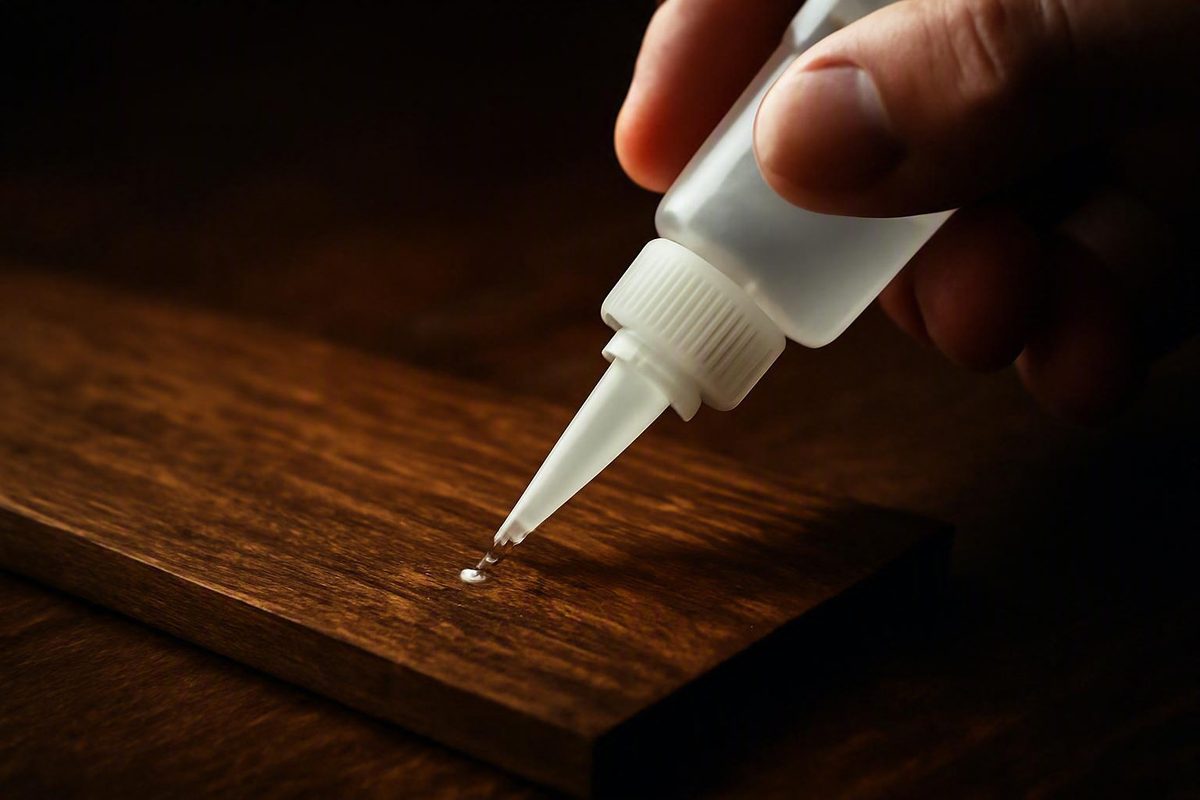
The short answer: yes, within clear limits
Yes, super glue works on wood. The adhesive commonly called super glue is cyanoacrylate, usually shortened to CA glue. It can form an effective bond when the wood is clean and dry, the broken surfaces fit closely, and the pieces remain still while the adhesive sets.
Its best role is a small, precise, non-structural repair where rapid initial grab is more useful than a long working time. Suitable examples include:
- Reattaching a clean splinter
- Securing a small chip that fits neatly back into place
- Tacking down a lifting veneer edge
- Fixing a tiny inlay or carving detail
- Joining miniature components
- Holding a small part that would be awkward to clamp
The central limitation is equally important: generic super glue should not be the sole adhesive for major furniture joints, load-bearing assemblies, exterior structures, or repairs whose failure could injure someone. Such work requires an adhesive and joint design specifically suited to the expected load and service conditions.
Super glue’s speed can also be misleading. A piece that feels fixed after several seconds has reached an initial set, not necessarily full cure or maximum strength. It may be ready for cautious handling before it is safe to load.
Whether a CA repair lasts depends on more than the word “super” on the package. Relevant variables include:
- The particular CA formulation and viscosity
- Joint size and geometry
- Long-grain or end-grain orientation
- How closely the broken surfaces meet
- Surface cleanliness and moisture
- Impact, vibration, or repeated loading
- Seasonal wood movement
- Heat, humidity, and water exposure
- Compatibility with an existing or planned finish
The qualified answer to “does super glue work on wood?” is therefore yes—but primarily for small, close-fitting repairs where speed matters and failure would not create a structural or safety problem.
Choose the adhesive by the job, not by a universal strength claim
No adhesive is universally “strongest” on wood. A tightly fitted long-grain joint, a broken end-grain ornament, and a loose outdoor joint present different bonding problems. Results can change with the formulation, preparation, grain direction, joint fit, cure conditions, and type of load.
A useful choice starts with what the joint must do:
| Consideration | Cyanoacrylate or super glue | PVA wood glue | Epoxy |
|---|---|---|---|
| Typical repair size | Small, localized repairs and details | Medium to large wood-to-wood joints | Localized or larger repairs, depending on product |
| Working time | Very short; alignment may lock within seconds | Longer, allowing assembly and adjustment | Usually longer than CA, but product-dependent |
| Best joint fit | Closely fitting surfaces | Well-fitted woodworking joints | May suit some imperfectly fitting repairs |
| Gap tolerance | Limited; thick or gel grades may handle minor imperfections | Intended for fitted joints, not major voids | Often considered for gaps, subject to product directions |
| Clamping | Brief hand pressure may be enough for a tiny repair | Usually benefits from sustained, even clamping | Often needs support or clamping during cure |
| Typical load | Light-duty, noncritical use | Ordinary furniture and wood-to-wood assemblies | Depends heavily on formulation and joint design |
| Movement tolerance | Hard, rapid bond; not the default for movement-prone joints | Usual choice for conventional indoor joinery | Product-specific |
| Moisture exposure | Varies; never assume waterproof | Varies by PVA type and rating | Varies by formulation |
| Finishing concern | Can soak into visible wood and affect stain absorption | Squeeze-out can interfere with finish but is generally easier to manage before cure | Residue and squeeze-out can be difficult to remove |
| Best reason to choose it | Speed, precision, and hard-to-clamp parts | General wood-to-wood joinery and alignment time | Mixed materials, imperfect fit, or a requirement covered by a specific product rating |
Choose CA for speed and precision. A loose veneer corner or tiny broken carving detail may need only a minute quantity of adhesive and immediate pressure. A gel can also be easier to control on a vertical edge.
Choose PVA wood glue as the usual default for substantial wood-to-wood work. Even an independent experiment that reported good results from some CA products retained PVA as the general-purpose choice for ordinary wood joints (Wood By Wright’s comparative adhesive experiment).
**** That does not mean epoxy will always outperform CA or PVA. Epoxy products differ substantially, so the choice depends on the particular product’s material compatibility, gap-filling directions, environmental rating, cure schedule, and load requirements.
For structural or exterior work, move beyond broad adhesive categories. Use a product expressly rated for the application, and seek manufacturer or qualified professional guidance when the item is load-bearing, valuable, or difficult to replace.
Repairs that suit super glue—and repairs that do not
The easiest way to decide whether super glue is suitable is to sort the job into green-light, caution, and red-light categories.
Green light: small, well-fitted, noncritical repairs
CA is a practical candidate for:
- A clean splinter that returns exactly to its original position
- A small chip with matching mating surfaces
- A lifting veneer edge
- A loose decorative inlay
- A tiny carving or molding detail
- A miniature or model component
- Another localized repair that carries little load and is difficult to clamp
These repairs play to CA’s strengths: a small bonding area, accurate fit, little need for repositioning, and a benefit from rapid initial hold.
Close contact matters. Super glue is not improved simply by pouring more into the joint. Excess adhesive can spread onto visible grain, while uneven mating surfaces and substantial voids reduce effective contact. Manufacturer guidance similarly warns that excess glue, gaps, and uneven surfaces can delay bonding or cause failure.
Caution: end grain, minor gaps, and loose joints
A thick or gel CA may be easier to keep where the surfaces meet and may accommodate a minor imperfection. That does not turn it into a validated structural gap filler.
Treat these situations cautiously:
- A small end-grain decorative break
- A minor void between otherwise matching pieces
- A slightly loose joint that carries no meaningful load
- Porous wood that rapidly absorbs thin CA
- A vertical repair where liquid adhesive would run
- A finished surface where squeeze-out would be conspicuous
If a joint is loose because wood is missing, the parts have worn away, or the original joinery has failed, filling the space with adhesive may conceal rather than correct the problem. Rebuilding the joint or replacing missing wood may provide a more appropriate repair.
CA mixed with fine wood dust is sometimes used to fill a small cosmetic defect. Treat the result as a surface or appearance repair, not proof that the damaged part has regained structural capacity. The filled area may also accept stain differently from the surrounding wood.
Red light: structural, load-bearing, exterior, or safety-critical repairs
Do not rely on generic super glue alone for chairs, railings, bed frames, ladders, steps, major furniture joints, exterior structures, components that carry a person, or any repair whose sudden failure could cause injury or significant property damage. Commercial woodworking guidance likewise advises against CA for load-bearing joints and major structural work (woodworking CA use and limitations).
A hard, rigid CA bond may be less suitable for repeated shock, vibration, or seasonal movement than an adhesive-and-joint system selected for those conditions. However, the available evidence does not establish a universal long-term comparison across every CA and PVA formulation. The narrower conclusion is more defensible: a CA product can perform strongly in a particular test and still be the wrong design choice for a moving or safety-critical assembly.
Thin, thick, or gel: match the formula to the joint
Products sold as super glue do not all behave alike. Viscosity, additives, cure behavior, material compatibility, moisture resistance, and application instructions vary. The exact product label therefore takes priority over a general rule.
Thin CA flows readily and suits a very tight joint where penetration is useful. That same mobility creates risks: porous wood can absorb it rapidly, and the liquid can travel farther than expected across end grain or an unfinished surface.
Thin CA also gives you little placement control. Use it only when the pieces already fit, the repair can be aligned immediately, and nearby visible wood has been protected.
Thick CA stays nearer to where it is placed. Its thickness should not be interpreted as permission to bridge an unrestricted gap.
Gel CA provides the most placement control of these three broad categories. It is useful for vertical work, tiny components, or repairs where runoff would be difficult to contain.
One independent woodworking experiment tested 32 adhesives in four scenarios—long grain to long grain, long grain to end grain, gap filling, and exterior conditions—with 10 repetitions per adhesive using a calibrated load cell. The author reported particularly strong results from some thick and gel CA products in the end-grain and gap tests. Thin CA was less successful in those situations, and activator generally offered little benefit; in one thick-gel test, activator was associated with lower strength (details of the Wood By Wright glue test).
Those findings are useful but bounded. The experiment was not peer reviewed, the supplied account does not reproduce the numerical results, and it covered a limited set of products, specimens, preparation methods, and test conditions. It did not establish long-term CA durability or a maximum gap that generic thick or gel super glue can safely bridge.
Do not assume activator automatically creates a stronger bond. An activator may be useful when a specific product calls for faster setting, but faster curing and greater joint strength are different outcomes. Follow the directions for the particular adhesive-and-activator system rather than mixing brands or improvising.
How to super glue a small wood repair
Use this process only for a small, close-fitting, non-structural repair.
-
Decide whether failure would be dangerous. Stop if the part carries a person, stabilizes a structure, supports a substantial load, or could create a safety hazard if it releases. Commercial CA guidance recommends wood glue rather than super glue for larger, structural, or weight-bearing wood joints (Adhesive Guru’s wood-application guidance).
-
Inspect the fit. Put the broken surfaces together without adhesive. They should meet closely without forcing the wood into an unnatural position. If wood is missing, the joint is worn, or a large void remains, choose another repair method.
-
Clean and dry the surfaces. Remove dust, grease, loose fibers, and detached finish. Lightly prepare rough contamination where appropriate, but do not sand away intact mating features or round over edges that previously fitted together.
-
Dry-fit and rehearse the movement. Decide where your fingers, supports, and tools will go. Practice bringing the pieces directly into final alignment. Once CA touches both surfaces, repositioning time may be measured in seconds.
-
Protect the surrounding wood. Mask adjacent areas where practical, especially on unfinished, stain-grade, painted, or high-gloss surfaces. Leave enough room for the pieces to meet without trapping tape in the joint.
-
Select the viscosity. Use thin CA for a very tight fit where controlled wicking is desirable. Choose thick or gel CA when you need better placement control, are working vertically, or want to reduce rapid absorption into porous end grain.
-
Apply a very small amount. Wet the necessary contact area without flooding it. More adhesive does not automatically create a stronger joint and increases the chance of squeeze-out, staining, or accidental skin contact.
-
Bring the pieces together without sliding. Press them directly into final alignment. Sliding can spread adhesive beyond the repair and shift a precisely matched splinter or chip.
-
Hold for the label-specified period. As one product-specific example, Gorilla recommends about one drop per square inch, holding closely fitted pieces for 10 to 45 seconds, avoiding stress during the first few minutes, and allowing up to 24 hours for full strength. Those figures apply to the cited guidance, not every CA formulation (Gorilla’s super-glue instructions for wood).
-
Distinguish set from cure. Initial grab means the pieces no longer move freely. Safe handling means the item can be moved cautiously under the product’s directions. Full cure is the later point at which the manufacturer says the adhesive has developed its intended properties. Do not load the repair merely because it feels fixed.
-
Inspect before use. Look for misalignment, an open bond line, movement, or adhesive that failed to cure properly. If the repair is questionable, do not keep adding glue around the outside and assume that restores strength.
Application quantity, working temperature, pressure time, cure time, and moisture resistance vary. Read the exact label before starting, not after the joint has locked.
Using super glue as an instant clamp for wood glue
CA and PVA wood glue can be used together as a temporary holding technique, but CA should not automatically replace the primary wood adhesive.
The method keeps the two adhesives in separate areas:
- Dry-fit the pieces and confirm their final alignment.
- Apply separated blobs or short lines of wood glue over most of the joint.
- Leave spaces between those areas.
- Place small drops of CA in the open spaces.
- Do not stir or blend CA into the wood glue.
- Press the pieces together in their final position.
- Allow the CA spots to grab while the wood glue follows its own drying and curing schedule.
Loctite documents this layout as a way to work without conventional clamps. Its example calls for holding the pieces together for 15 to 30 seconds, after which the CA maintains the immediate hold while the wood adhesive dries and cures. Loctite also directs users to follow the wood-glue manufacturer’s precise cure instructions (Loctite’s wood-glue and super-glue clamping method).
The practical benefit is straightforward: a small or awkward assembly may stay in place without a metal clamp. The trade-off is that the CA can lock an alignment error before you can correct it. This technique is best reserved for joints that can be positioned accurately in one motion.
Keep the CA spots small and separated, with the PVA covering most of the intended bond area.
Other temporary holding options include masking tape, rope, straps, weights, or a simple support jig. These alternatives may be preferable when you need time to check squareness or adjust the assembly.
Do not extend the instant-clamp method to a structural or safety-critical joint merely because it feels solid immediately. The documented technique provides no engineering data or load ratings for those applications.
Strength, moisture, and durability: what the evidence can and cannot establish
The available evidence supports a limited but useful conclusion: CA can form a strong bond on wood, and some thick or gel products can perform impressively in particular joints. It does not show that every super glue is stronger than every PVA, epoxy, or purpose-made construction adhesive.
Short-term break strength answers only one question: how much force did a particular specimen withstand under a particular test? It does not by itself establish resistance to:
- Years of humidity cycling
- Sustained load and creep
- Repeated vibration
- Sudden impact
- Joint movement
- Heat and cold cycles
- Water exposure
- UV exposure
- Changes in the surrounding wood
Concerns about CA being hard or brittle appear frequently in woodworking discussions, particularly where joints experience movement or impact. Those concerns are anecdotal rather than universal proof of eventual failure, just as a strong short-term result does not prove decades of durability (Woodcarving Illustrated forum discussion).
Water resistance is product-specific. The generic term “super glue” does not establish that a product is waterproof, weatherproof, or suitable for exterior exposure. Check the package and technical documentation for the exact formulation.
Before using any adhesive in a damp, outdoor, hot, cold, or chemically exposed location, look for explicit ratings covering:
- Waterproof or water-resistant performance
- Interior or exterior use
- Service-temperature range
- Compatible materials and coatings
- Required cure conditions
- Gap limitations
- Load or impact suitability
For ordinary indoor furniture assemblies and broad wood-to-wood contact areas, PVA wood glue remains the practical default. If an item is valuable, antique, structural, exterior, or safety-critical, consult the product manufacturer or a repair professional familiar with that type of object before choosing an adhesive.
Prevent stains, residue, and accidental damage
CA can soak into porous wood beyond the visible joint. Once adhesive enters the pores, that area may accept stain, dye, oil, paint, or clear finish differently from the surrounding wood. A colorless spill may therefore become conspicuous only during finishing, a concern also reported in practical woodworking discussions (MRH forum discussion of CA and wood finishing).
Prevention is more reliable than cleanup:
- Test the adhesive and intended finish on scrap from the same wood when possible.
- If scrap is unavailable, test in an inconspicuous area.
- Mask around the repair without obstructing the mating surfaces.
- Use the smallest practical amount of adhesive.
- Keep the nozzle close to the joint to reduce drips.
- Orient the visible face to discourage runoff.
- Do not wipe liquid CA broadly across unfinished grain.
- Let the repair cure before applying a finish.
Sanding may reduce a surface mark, but it cannot be assumed to remove adhesive that has penetrated deeply. Aggressive sanding can also create a hollow, soften crisp details, or sand through veneer.
Acetone or a dedicated CA remover may soften or dissolve super-glue residue. The danger is that acetone can also damage paint, lacquer, varnish, and other finishes. Check both the finish manufacturer’s directions and the remover label, then test in a hidden location before treating a visible area (guidance on removing glue from wood).
Approach a misaligned bond conservatively. Do not twist or pry apart a valuable, thin, veneered, or delicate piece merely because solvent cleanup is inconvenient. The wood fibers, veneer, carving detail, or finish may fail before the adhesive releases.
Follow the exact adhesive label for ventilation and personal protection. Avoid skin and eye contact, keep CA away from children, and use the protective measures specified by the manufacturer. If accidental exposure occurs, follow the product’s first-aid directions rather than improvising with an unverified solvent or removal method.
How long does super glue take to dry on wood?
Initial grab may occur within seconds, but “dry” can refer to three different stages: initial set, cautious handling, and full cure. Timing varies with the formulation, temperature, humidity, application quantity, joint fit, and wood porosity.
Some products require only brief pressure but considerably longer before full strength is reached. Follow the exact package directions and do not load a repair simply because the pieces no longer move.
Is super glue waterproof on wood?
Not necessarily. “Super glue” describes an adhesive family, not a universal water-resistance rating. Moisture performance varies by formulation.
Use CA in wet or exterior conditions only if the label or technical documentation specifically supports that environment.
Can super glue hold a chair or another load-bearing wood joint?
It may make the pieces feel firmly attached, but generic super glue should not be relied on as the sole adhesive for a chair or another load-bearing joint. Chairs experience changing loads, leverage, impact, and movement, and a failed joint can cause injury.
A failed chair joint may also contain worn joinery or missing wood that adhesive alone cannot correct. Use a repair method appropriate to the joint and service conditions, or seek professional furniture-repair guidance. Woodworking discussions broadly favor conventional wood glue over CA for primary, substantial wood joints, while recognizing CA’s usefulness for small chips and noncritical repairs (woodcarving adhesive discussion).
Does super glue work on both hardwood and softwood?
Commercial woodworking guidance presents CA as capable of bonding both hardwood and softwood, but that broad classification does not predict the quality of a particular joint (woodworking CA preparation guidance).
Porosity, moisture, extractives, surface coatings, grain orientation, and fit can all affect the result. A porous softwood or end-grain surface may absorb thin CA rapidly, while a dense, oily, sealed, or finished surface may require product-specific preparation. Test first when the species, coating, or treatment is uncertain.
Can acetone remove super glue from wood?
Acetone may soften or dissolve CA residue, but it can also damage or discolor the existing finish. Paint, lacquer, varnish, and other coatings may soften, smear, or lose gloss.
Check the remover and finish labels, test in a hidden area, and use the smallest controlled amount if the materials are compatible. Do not force apart a delicate or valuable piece; professional help may cause less damage than aggressive solvent or mechanical removal.
Ultimately, super glue is a practical choice for a small, precise, close-fitting wood repair when speed matters. It is not a blanket substitute for wood glue. Choose according to joint size, fit, load, movement, moisture, working time, and finishing needs; follow the exact adhesive label; and obtain product-specific guidance for valuable, structural, exterior, or safety-critical work.