 StainList
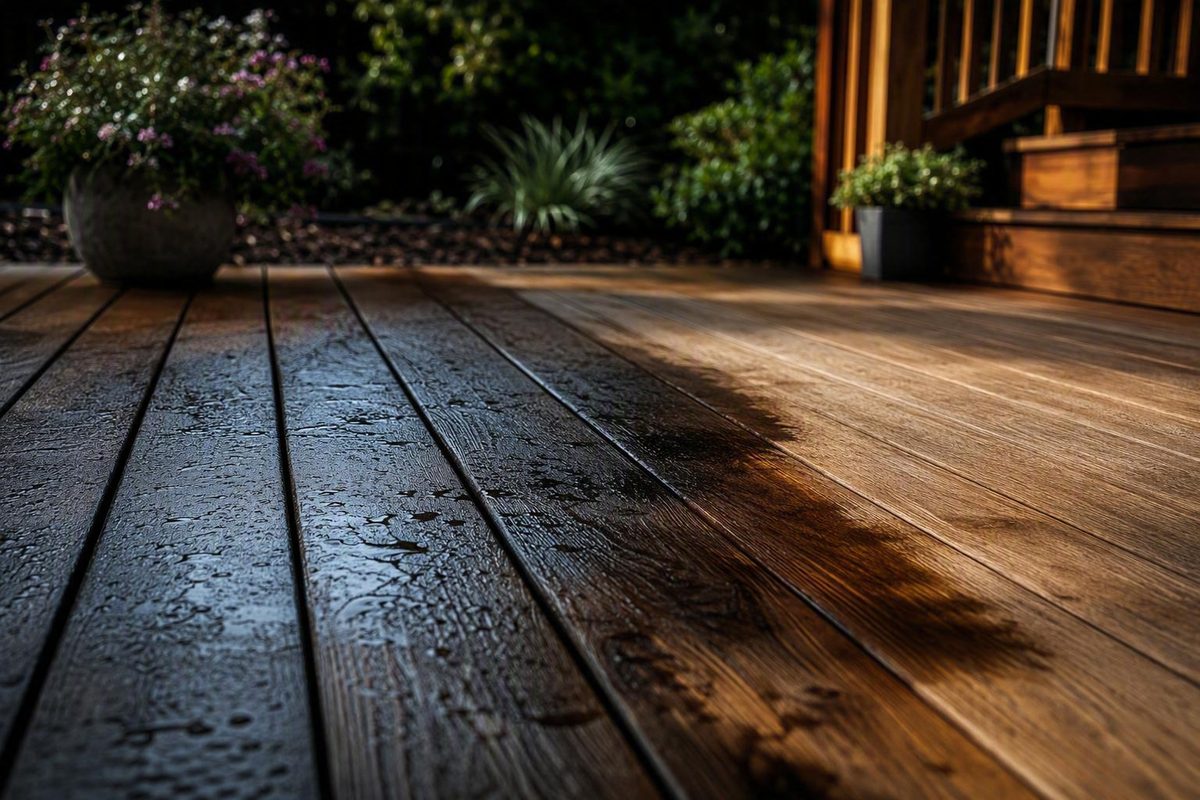
The short answer: allow 24–48 hours before ordinary deck use
Deck stain may feel dry within roughly 1–24 hours, but that does not mean it is ready for rain, shoes, furniture, or heavy activity. As a practical starting point, allow 24–48 hours before ordinary use and 48–72 hours or longer before replacing furniture or allowing concentrated activity. These are planning ranges, not product specifications. DeckStainHelp distinguishes touch-dry, rain-safe, traffic-safe, and furniture-safe intervals by stain type.
Most importantly, the instructions on the stain container or technical data sheet override every general estimate in this article. The exact formula determines its rain-ready, recoat, traffic, furniture, and cure intervals.
| Readiness milestone | Water-based stain | Oil-based stain |
|---|---|---|
| Touch-dry | About 1–4 hours | About 4–24 hours |
| Rain-safe | About 4–8 hours | About 12–24 hours |
| Light foot traffic | About 8–12 hours | About 24–48 hours |
| Furniture | About 24–48 hours | About 48–72 hours |
| Full cure | Often about 24–72 hours | Often several days; certain products may take longer |
The touch-dry, rain-safe, traffic, and furniture entries synthesize nonstandardized trade and commercial guidance rather than independent controlled testing. They should be used for preliminary scheduling only.
Published full-cure estimates are particularly inconsistent. Guidance for water-based exterior stain commonly places curing somewhere around 24–72 hours, while oil-based formulas may require several days. Some sources publish shorter or longer figures, which is why a category-wide cure time should never be treated as a guarantee. Flowyline’s exterior-stain guidance reports a 24–72-hour water-based cure range and a 48–72-hour oil-based estimate.
If you cannot find the product instructions, use a conservative fallback:
- Keep the deck unused for 24–48 hours.
- Postpone parties, repeated traffic, and concentrated loads for about 72 hours.
- Reserve at least 24–48 hours of dry weather after application.
- Add time for cool temperatures, high humidity, shade, weak airflow, damp wood, or a heavy application.
This fallback is intentionally cautious rather than predictive. Lowe’s recommends allowing stain and sealer to dry completely for at least 24–48 hours, withholding deck use and furniture during that period, and planning for at least two dry days, while still directing users to the manufacturer’s instructions. Review Lowe’s deck-staining guidance.
Dry to the touch is not the same as fully cured
Dry to the touch means the surface no longer feels wet when it is cautiously tested after the product’s minimum drying interval. It should not pull at your finger, transfer color, or retain a distinct fingerprint.
Curing is the longer process in which the stain hardens, bonds, or settles sufficiently for its intended use. A deck can pass a light surface test while the finish below remains vulnerable to pressure, abrasion, or moisture. A.G. Williams Painting Company describes drying as becoming dry to the touch and curing as fully hardening and bonding with the wood. Read its explanation of deck-stain drying and curing.
It helps to separate five practical milestones:
- Touch-dry: The surface no longer appears or feels wet.
- Rain-safe: The finish has reached the product’s stated resistance to rain or moisture.
- Walkable: The deck can tolerate the specified level of foot traffic without marking.
- Furniture-safe: The finish can bear furniture legs and other sustained contact.
- Fully cured: The stain has completed the manufacturer’s stated curing process.
These milestones do not necessarily occur together. A touch-dry surface can still be soft enough for shoes to leave marks. A deck that tolerates a few cautious steps may not be ready for a table leg pressing on one small area for hours. A finish that withstands a brief shower may still be far from fully cured.
Two common scheduling mistakes illustrate the problem:
- Assuming touch-dry means rain-safe. Surface moisture may have evaporated while the finish remains susceptible to spotting, streaking, or movement.
- Replacing furniture as soon as walking is possible. A brief step distributes and removes pressure differently from a chair, grill, planter, or table leg left in place.
Elapsed time and a finger test can identify an obviously wet or tacky surface, but neither can prove complete curing below the surface. The useful answer to “how long does it take for deck stain to dry?” therefore depends on what you intend to do next.
Water-based versus oil-based deck stain drying times
Water-based deck stains generally become touch-dry sooner than oil-based stains.
Under favorable conditions, a water-based stain may be:
- Touch-dry in approximately 1–4 hours
- Rain-safe in approximately 4–8 hours
- Ready for cautious light traffic in approximately 8–12 hours
- Ready for furniture in approximately 24–48 hours
- Fully cured in roughly 24–72 hours, depending on the formula and conditions
Some commercial guidance permits light foot traffic on water-based stain after 4–6 hours. Treat that as a product- and condition-dependent possibility, not universal permission. If the label does not expressly allow such early access, the more conservative interval gives the finish additional protection.
An oil-based stain commonly follows a longer schedule:
- Touch-dry in approximately 4–24 hours
- Rain-safe in approximately 12–24 hours
- Ready for light traffic in approximately 24–48 hours
- Ready for furniture in approximately 48–72 hours
- Fully cured after several days in some cases
These approximate exterior-stain schedules are consistent with published commercial guidance, but that guidance also warns that dry-to-touch, traffic, and full-cure times are separate and that the product label should govern. Review the exterior water- and oil-based timelines.
Oil-based cure estimates vary substantially. Do not interpret 72 hours as a universal maximum.
Opacity can also matter. Solid-color or highly pigmented products may form heavier surface coverage than thin penetrating formulas and may require a different traffic or cure schedule. This is a reason to check the instructions for the exact opacity and product line rather than relying only on the words “water-based” or “oil-based.”
Fast-dry claims require similar caution. Olympic says one named exterior sealant can dry in as little as one hour, while certain other formulas normally dry in about 24 hours. Those are manufacturer claims for particular products, not representative drying times for deck stain as a category. See Olympic’s product-specific drying examples.
A fast touch-dry claim also does not automatically establish when the deck can face rain, support furniture, accept another coat, or return to heavy use.
The practical conclusion is selection-neutral: do not choose or schedule a deck stain solely from average water-based or oil-based drying times. Find the exact container instructions or technical data sheet and verify:
- Acceptable application temperature
- Maximum wood moisture, if specified
- Rain-ready interval
- Recoat window
- Foot-traffic interval
- Furniture interval
- Full-cure time
Weather, wood, and application can extend the timeline
The headline ranges assume that stain was applied correctly to properly prepared wood in suitable weather. Temperature, humidity, wood condition, airflow, and coat thickness can all change how quickly the same product dries.
Temperature: Cool conditions can slow evaporation and curing. A broad project-planning range is approximately 50–90°F, but the product may specify a narrower range. Conditions after application matter too, so consider the forecast for the entire required drying period rather than only the temperature at the start of the job.
Humidity: High humidity can prolong drying because moisture leaves the stain and wood less readily. Guidance commonly treats humidity above approximately 70% as a reason to expect a longer interval.
Direct sun and excessive heat: Hot boards and strong sunlight are not reliable shortcuts. They can cause the surface to flash-dry before the stain penetrates or levels evenly, contributing to blotches, visible overlaps, or lap marks.
Mr. Handyman recommends planning around approximately 50–90°F, low or moderate humidity, shade or cloud cover, and no imminent rain. Its guidance also identifies humidity above 70% and temperatures above 90°F as conditions that can interfere with the expected result. See its deck-staining weather guidance.
Shade and airflow: Shaded boards stay cooler and may dry more slowly than boards in an open area. One deck may therefore contain both ready and unready areas.
Overnight moisture: Rain is not the only possible moisture exposure. Dew can reach the surface before the finish has met its stated moisture-resistant interval. When comparing the forecast with the product instructions, account for possible overnight moisture rather than considering only daytime rain.
Wood moisture: Damp wood can interfere with stain absorption and drying. A deck recently washed, rained on, or built from pressure-treated lumber may appear dry at the surface while retaining moisture internally.
Wood density and previous treatment: Dense hardwood can absorb a penetrating product differently from softer lumber. Old coating, dirt, failed stain, or residual cleaner may also prevent even penetration. Follow the product’s preparation instructions for the wood species and existing finish.
Application thickness: More stain is not necessarily better. Thick coats, puddles, and unwiped excess can leave material sitting on the surface instead of penetrating the wood. Those areas may remain glossy, gummy, or tacky beyond the expected drying time.
Postpone staining when:
- The deck is damp from rain, washing, or dew.
- Temperatures may fall outside the label’s permitted range.
- Humidity makes the stated drying interval doubtful.
- Intense direct sun cannot be avoided.
- The forecast does not provide the required moisture-free period.
- The wood has not completed the required preparation and drying period.
- You cannot prevent traffic during the applicable drying window.
Choosing a more suitable weather window reduces the risk of having to diagnose a blotchy, sticky, or partially washed finish later.
How long deck stain should dry before rain
Rain-safe time is not necessarily the same as touch-dry time. A surface can stop feeling wet while remaining vulnerable to rain, dew, irrigation, or water dripping from railings and nearby roofs.
As a general planning estimate, allow approximately:
- 4–8 hours before rain for water-based stain
- 12–24 hours before rain for oil-based stain
Some labels require longer, while specific quick-dry products may permit shorter intervals. Neither category estimate overrides the product’s rain-ready instruction.
If exact product guidance is unavailable, secure a conservative 24–48-hour dry-weather window. This cannot guarantee a perfect result, but it offers more protection than scheduling around the shortest published estimate.
Use this decision process before starting:
- Find the label’s rain-ready or moisture-resistant interval.
- Identify the earliest possible rain, drizzle, irrigation, or heavy dew.
- Measure the available interval from the time you expect to finish, not the time you begin.
- Allow additional time when conditions are cool, humid, shaded, or poorly ventilated.
- Postpone the job if the available window is close or uncertain.
Rain risk depends on more than elapsed time. Rain intensity, stain formula, wood moisture, coat thickness, temperature, humidity, and airflow can all affect the result.
A practical risk sequence is:
- During the first 30 minutes: Wet stain faces the greatest risk of movement, wash-off, streaking, and pronounced water spotting.
- Within 1–3 hours: Blotching and uneven absorption may occur, particularly where the application remains visibly wet.
- Around 4–6 hours: Some thin applications may tolerate light rain under favorable conditions, but spotting or tackiness can still develop.
- After 24 dry hours: The finish is generally more resilient than it was initially, although it may remain uncured.
These intervals are risk bands, not promises. The outcome still depends on the product and drying conditions. The Deck People provides the underlying rain-exposure timeline and emphasizes that no interval guarantees a damage-free result.
Possible signs of premature rain exposure include:
- Blotchy or washed-out color
- White or milky areas
- Water rings
- Streaking
- Glossy or tacky patches
- Bubbling
- Peeling or flaking
- Areas where the stain appears to have moved
No fixed number of hours makes every stain immune to rain. If the weather window is marginal, postponement is safer than assuming a warm afternoon will offset an overnight shower.
When you can walk on the deck and replace furniture
“Ready to use” should be divided into cautious walking, normal traffic, furniture placement, and heavy or concentrated use. Each exposes the finish to a different amount and duration of pressure.
For water-based stain, 8–12 hours is a conservative general estimate before limited light traffic. Some products or commercial guidance may permit walking after 4–6 hours under favorable conditions, but use that shorter interval only when it agrees with the product instructions and the finish is clearly not tacky.
For oil-based stain, a general wait of 24–48 hours before light foot traffic is more appropriate. Cool, shaded, or humid conditions can extend that period.
“Light traffic” means limited, careful access. It does not mean children running, pets turning sharply, workers carrying equipment, or repeated trips along the same boards.
Furniture usually needs a longer wait because legs and feet concentrate weight:
- Water-based stain: generally 24–48 hours
- Oil-based stain: generally 48–72 hours
When conditions are less than ideal, wait about 72 hours—or follow a longer label interval—before parties, repeated traffic, energetic pets, or other concentrated use. The Ultimate Deck Shop similarly advises progressively longer waits for light traffic, furniture, and heavy activity under warm, dry conditions. See its post-application use guidance.
Use additional caution with:
- Grills
- Large planters
- Umbrella stands
- Storage boxes
- Outdoor kitchens
- Rugs and mats
- Furniture with narrow metal feet
- Anything that blocks airflow or traps moisture
The available guidance does not establish one universal return time for these objects. If the label provides only a general furniture interval, extending it for heavy or moisture-trapping objects is prudent.
Using the deck too early can result in:
- Footprints or scuffs
- Smudged or uneven color
- Color transfer to shoes or furniture
- Furniture sticking to the finish
- Compressed marks beneath legs
- Peeling or cracking
- Uneven gloss or texture
Walking barefoot is not a guarantee against damage.
How to check whether the stain is ready
Start with the clock, but do not rely on the clock alone. Wait until the product’s stated minimum interval has passed before testing. Pressing or walking on the surface prematurely can mark a finish that might otherwise have dried correctly.
Choose an inconspicuous location, such as an edge, a section near a step, or an area that will later sit beneath furniture. Do not begin in the center of the deck.
Use a cautious finger-press test:
- Press lightly without dragging your finger.
- Lift your finger straight up.
- Examine both the surface and your fingertip.
The stain is not ready if it:
- Feels tacky or gummy
- Pulls as your finger lifts
- Retains a fingerprint
- Transfers color
- Smears or shifts under light pressure
Inspect the surface visually as well. Glossy pools, soft-looking patches, uneven wet areas, or markedly darker sections may indicate stain remaining on the surface. Check shaded boards, stairs, board gaps, rail details, corners, and areas beneath overhanging plants.
Before allowing the intended activity, confirm that:
- The full label-specified interval has elapsed.
- The finish does not feel tacky.
- A light press leaves no fingerprint.
- No color transfers.
- No glossy or pooled excess remains.
- Shaded and slow-drying sections have also been checked.
- Rain, irrigation, frost, or heavy dew is not imminent.
- The relevant rain, traffic, furniture, or cure milestone has passed.
A successful test shows only that the tested spot is no longer obviously wet or tacky. It cannot prove complete curing underneath, and it says nothing about another board that received a heavier coat or remained shaded.
Do not replace furniture merely because one sun-exposed board passes. Check representative locations and use the slowest-drying area to set the schedule for the entire deck.
Preparation, recoating, and problems that delay drying
Pre-application wood drying and post-application stain drying are separate timelines.
A deck cleaned with water, pressure-washed, or soaked by rain commonly needs at least 24–48 hours to dry before staining. Shade, humidity, cool weather, weak airflow, and absorbent wood can require a longer wait. Sherwin-Williams advises allowing a cleaned deck to dry for 24–48 hours and separately directs users to the selected product for drying and walk-on times. See Sherwin-Williams’ deck-staining project sequence.
New pressure-treated lumber may need several weeks or longer before it accepts stain properly. There is no universal waiting period because retained moisture varies with the lumber, treatment, storage, climate, exposure, and stain requirements. Verify readiness using the stain manufacturer’s preparation guidance instead of staining automatically on a fixed date.
Previous treatments can also affect absorption. Old film-forming coating, failed stain, dirt, or residual cleaner may require cleaning, sanding, stripping, or another label-approved preparation method before staining begins.
For another coat, first answer three questions:
- Does the exact product permit or require another coat?
- What are its minimum and maximum recoat intervals?
- Must the first coat be dry, tack-free, or still wet when the next coat is applied?
Sherwin-Williams’ general project guidance recommends approximately 24 hours between coats, but this is not a universal recoat rule. Some products specify a different window, use a wet-on-wet method, or call for only one coat. Applying an unnecessary second coat can leave excess material on the surface.
If the deck remains sticky beyond the expected interval, first consider whether the conditions have simply slowed drying. Cool temperatures, high humidity, shade, poor airflow, or damp wood may justify more time.
Persistent tackiness can also indicate excess product. A penetrating stain that was applied too heavily may remain on the surface instead of being absorbed. In that situation, additional waiting may not correct the problem, and label-directed removal may be necessary. Ready Seal’s general guidance identifies high humidity, low temperatures, and overapplication as factors that can prolong drying or leave a sticky finish. Review its discussion of drying conditions and overapplication.
Do not improvise with solvents or aggressive cleaning. Follow the selected product’s label and safety data sheet for correcting excess stain, cleaning tools, and handling stain-contaminated materials.
If rain reaches fresh stain:
- Stop work and do not apply more product to wet wood.
- Allow the entire deck to dry completely.
- Inspect it in consistent daylight.
- Check for discoloration, rings, tackiness, bubbling, peeling, or washed-off sections.
- Consult the product’s repair and recoating instructions before sanding or touching up.
Minor marks may sometimes be addressed with light sanding and a thin touch-up coat. Widespread peeling, severe tackiness, bubbling, or substantial wash-off may require more extensive sanding, stripping, or refinishing. There is no universal threshold between a touch-up and a restart, so follow the manufacturer’s repair instructions or seek professional assessment when the failure is widespread.
Frequently asked questions
Can I walk on my deck 12 hours after staining it?
Possibly, if it is a water-based stain, the label permits traffic by then, the weather has been favorable, and the finish is not tacky or transferring color. Keep access limited even if the product allows it.
For many oil-based stains, that point will still be too early. Do not use a surface test to override a longer label-specified traffic interval, and continue to withhold furniture and heavy activity after cautious walking becomes possible.
What happens if it rains 24 hours after staining a deck?
After 24 dry hours, the finish is generally more resilient than it was during the first few hours, but it may not be fully cured. The outcome depends on the stain formula, rain intensity, application thickness, wood moisture, temperature, and humidity. Review the rain-exposure guidance.
Once the deck dries, inspect it for blotches, white or milky marks, rings, tackiness, bubbling, peeling, flaking, or washed-out color. Do not assume either that damage occurred or that the elapsed time guaranteed protection. The label’s rain-ready interval remains controlling.
Why is my deck stain still sticky after two days?
Cool temperatures, high humidity, shade, weak airflow, or damp wood may have slowed drying. If the finish is becoming progressively less tacky, additional time under suitable conditions may be appropriate.
If it remains glossy, gummy, or unchanged, consider whether too much penetrating stain was applied or whether the wood failed to absorb it. Elapsed time alone cannot diagnose the cause. Consult the label for correction instructions rather than adding another coat.
How long should a pressure-washed deck dry before staining?
Allow at least 24–48 hours as a general starting point, and longer in shaded, humid, cool, or poorly ventilated conditions. Mr. Handyman recommends at least 48 hours after cleaning and up to 72 hours in shaded or humid conditions. Review its preparation and weather recommendations.
This pre-application wait is separate from the drying time required after stain is applied. Before beginning, confirm that the wood meets any moisture requirement specified by the stain manufacturer.
How long should deck stain dry before applying another coat?
Sherwin-Williams’ general project guide recommends approximately 24 hours between coats, but the exact label must govern. Some stains have a specific recoat window, some use a wet-on-wet process, and others are intended for one coat. See the manufacturer’s project guidance.
Do not apply another coat merely because the first feels dry. Confirm that the product calls for it, that the permitted recoat window remains open, and that no tacky or unabsorbed stain is sitting on the surface.
The final rule is milestone-based rather than tied to one number: check the label first, then wait for the applicable rain, traffic, furniture, recoat, or full-cure interval. Under favorable conditions, ordinary use often resumes after 24–48 hours, while oil-based products, heavy objects, cool weather, high humidity, and shaded areas may require 48–72 hours or several days.
If the finish remains tacky, takes a fingerprint, transfers color, contains pooled product, or faces uncertain weather, extend the wait and investigate the application conditions. The passage of time alone does not make every stained deck ready.