 StainList
Dry Cleaning Fees and Pricing Explained
Overview
Dry cleaning is typically priced per item, with the fee driven by garment type, fabric, condition, the work required, and the cleaner’s service level. One consumer price guide from Alterations Express reports that customers usually spend around $25 to $50 per visit for 3 to 5 items, while Homeaglow’s price guide puts most everyday garments at $4–$18 and outerwear and household items at $18–$45.
Treat those figures as illustrative examples from individual sources, not as guaranteed local rates. Prices vary by market and provider, and the trade publication American Drycleaner explains why: each step in the cleaning process takes time, effort, and additional cost, so cleaners with different procedures and service levels charge different prices.
The practical upshot for a first-time customer is simple. Expect a base per-item price, expect that price to move up or down based on the garment and the work involved, and plan to ask a few specific questions before approving service. The rest of this article explains the fee categories, the work behind them, and how to compare quotes without surprises.
Typical dry cleaning price ranges by item type
The most useful way to estimate a dry cleaning bill is by item category, because everyday garments, outerwear, household textiles, and formalwear are generally priced in different tiers. Homeaglow’s guide reports that most everyday garments cost $4–$18, while outerwear and household items usually run $18–$45, with gowns and wedding attire sitting above those tiers. Alterations Express frames the same idea at the visit level: roughly $25 to $50 for a typical trip of 3 to 5 items.
The table below summarizes those source-reported tiers. These are approximate ranges from two consumer-facing guides with unknown publication freshness — your local cleaner’s price list may sit above or below them.
| Item category | Reported approximate range | Source |
|---|---|---|
| Everyday garments (shirts, blouses, pants, and similar) | $4–$18 per item | Homeaglow price guide |
| Outerwear and household items (coats, comforters, and similar) | $18–$45 per item | Homeaglow price guide |
| Gowns and wedding attire | Above the everyday and outerwear tiers; quote-dependent | Homeaglow price guide |
| Typical multi-item visit (3–5 garments) | $25–$50 per visit | Alterations Express |
A quick sanity check shows the two sources are roughly consistent: at Homeaglow’s everyday-garment range of $4–$18, a 3-item order works out to $12–$54 ($4 × 3 to $18 × 3), which overlaps the $25–$50 visit range Alterations Express reports.
Use these tiers to spot outliers rather than to predict an exact bill. If a quote for an ordinary shirt lands far above the everyday tier, ask what specifically about the garment or service explains the difference. If a quote for a structured coat lands in the everyday tier, ask whether it covers the same cleaning and finishing steps you would get elsewhere.
Household textiles and specialty items
Coats, comforters, wedding dresses, and preservation work should be budgeted differently from everyday garments, because size, construction, fabric, and specialty handling can each push the item into a higher tier. Homeaglow’s guide groups outerwear and household items together at $18–$45 — noticeably above its $4–$18 everyday range — and places gowns and wedding attire higher still.
The reasoning follows the pattern American Drycleaner describes: larger or more complex items involve more handling steps, and each step adds time, effort, and cost. A comforter takes more machine capacity and drying attention than a blouse; a structured coat needs more careful pressing; a wedding dress may involve delicate fabric, embellishments, and — where the cleaner offers it — preservation packaging as a separate service.
For any of these items, ask for a quote on the specific piece rather than relying on a posted category price, and ask whether specialty steps such as preservation are included or billed separately.
Base prices, add-ons, and surcharges
Most dry cleaning bills can be understood through a small vocabulary: a base per-item price, add-on charges for extra work, surcharges for garments that are harder to handle, and optional services you choose separately. Competitor price guides list per-item ranges but rarely define these categories, so it helps to name them before you compare quotes.
The base price is what the cleaner charges to clean and finish a standard version of an item — a plain cotton shirt, an unlined pair of trousers. On top of that, cleaners may add charges when the garment requires work beyond the standard process. American Drycleaner’s explanation of pricing structure supports the underlying logic: steps in the process each add time, effort, and cost, so garments requiring more steps reasonably cost more.
In practice, the extra charges you may encounter fall into a few conceptual groups:
- Add-on work: extra treatment the garment needs, such as intensive stain spotting or hand finishing on delicate fabric.
- Surcharges: upcharges tied to the garment itself — special materials, linings, beading, pleats, or unusual size or length that slow handling.
- Optional services: things you elect, where offered, such as rush turnaround, preservation boxing, or pickup and delivery.
Not every cleaner uses these labels, and not every cleaner charges for every category — the supplied sources support the general relationship between extra work and extra cost, not a universal fee schedule. The practical move is to ask two questions when you drop off an item: what does the base price include, and what about this specific garment could add to it?
Related services that may be priced differently
Not everything a dry cleaner does is dry cleaning, and the related services are often quoted on different terms. Shirt laundering — machine washing and pressing dress shirts — is a distinct process from solvent-based dry cleaning, and pressing-only service skips cleaning entirely. Wash-and-fold is typically an everyday-laundry service, and alterations are tailoring work priced by the job rather than by cleaning.
This matters because a low advertised “shirt price” may refer to laundering rather than dry cleaning, and comparing that number against another shop’s dry cleaning price is comparing two different services. American Drycleaner’s core point applies here: the price reflects the procedures performed, so different procedures naturally carry different prices.
Before comparing quotes, confirm which service is actually being quoted for each item. Ask the counter staff whether your shirts will be laundered or dry cleaned, and whether pressing is included in the figure they gave you.
What dry cleaning fees usually pay for
A dry cleaning fee is not just paying for a machine cycle — it covers a sequence of labor steps, and that sequence is why prices differ between shops. American Drycleaner, a trade publication writing for cleaners themselves, makes this explicit: each step in the process takes time and effort as well as additional cost, and differences in prices between dry cleaners come down to their procedures and service level.
Mapping the customer-facing charge to the work performed makes a quote much easier to evaluate. The table below connects the typical stages of a dry cleaning workflow to what you are paying for at each stage. The stages reflect the process-cost framing in the American Drycleaner source; individual shops may combine, skip, or add steps depending on their service level.
| Stage of work | What it involves | How it shows up in your fee |
|---|---|---|
| Intake inspection and tagging | Checking the garment’s fabric, condition, and existing damage; tagging it for tracking | Built into the base price; flags issues that may trigger add-on charges |
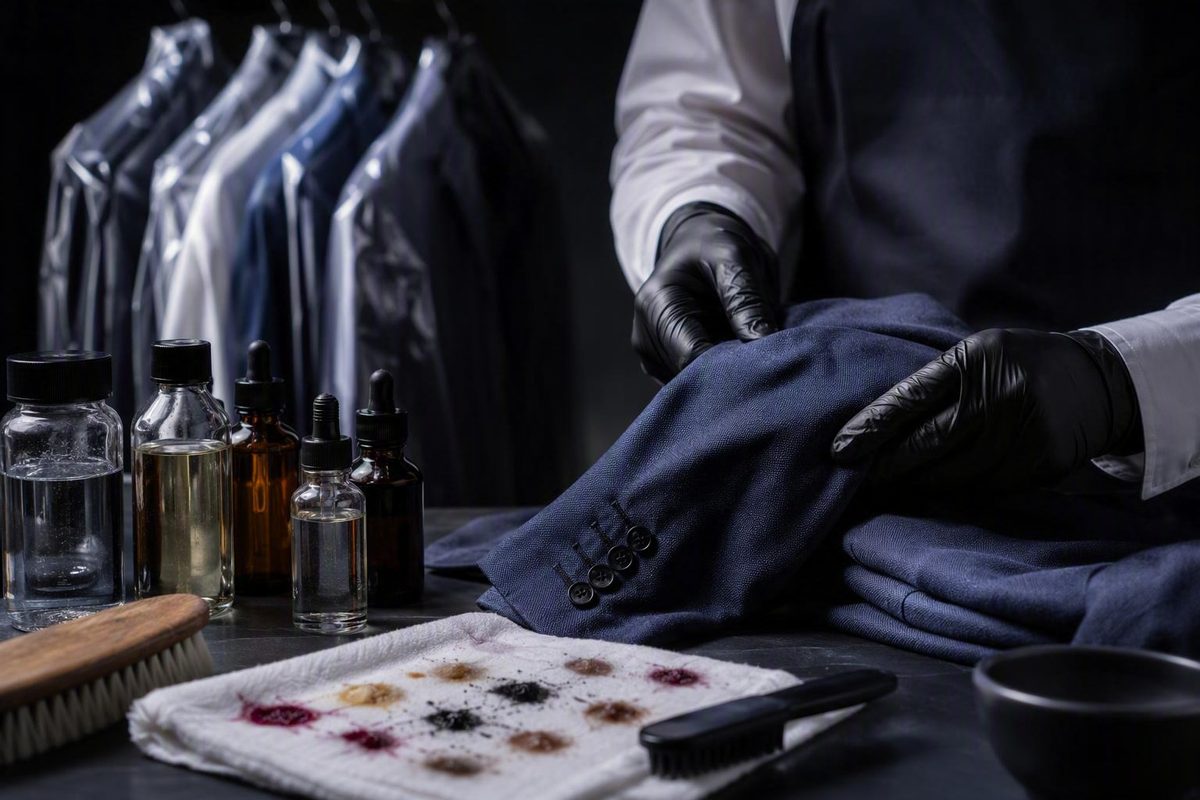
| Stain spotting and pre-treatment | Identifying stains and treating them before cleaning | May be included for light spots; heavier stain work may be quoted as add-on treatment |
| Cleaning | Running the garment through the solvent-based cleaning process | The core of the base price |
| Pressing and finishing | Machine pressing, and hand finishing where the garment requires it | Included at a standard level; delicate or structured pieces may need more finishing time |
| Final inspection | Checking cleaning results and presentation before release | Part of the shop’s service level — more rigorous inspection generally means higher operating cost |
| Packaging | Bagging, boxing, or — where offered — preservation packaging | Standard packaging is typically included; preservation is usually a separate optional service |
Two takeaways follow from this mapping. First, a cheaper price is not automatically a worse deal — but it may mean fewer or faster steps, so it is fair to ask what the price includes. Second, when a cleaner quotes extra for a stained silk blouse or a beaded gown, the charge usually corresponds to real additional labor at the spotting, finishing, or inspection stages, not an arbitrary markup. If a line item on your bill is unclear, ask which stage of work it reflects — a reputable shop should be able to answer.
Why the final bill can differ from a posted price
A posted price list describes a standard garment in standard condition, so the final bill can change once the cleaner actually inspects your item. This is the single most common source of pricing surprise, and it follows directly from how fees work: the price reflects the work required, and the work required is not fully known until intake.
Several garment variables can move a price after inspection. Fabric matters — silk, delicate knits, or fabrics with uncertain colorfastness may need slower handling. Construction matters — linings, structured shoulders, pleats, or unusual length add pressing and finishing time. Detailing matters — beading, sequins, or embellishments may require hand work or protective handling to avoid damage. And condition matters most of all: set-in stains, odors, or existing damage can require pre-treatment, extra passes, or a conversation about risk before the cleaner will proceed. Both the Alterations Express guide’s garment-by-garment cost framing and American Drycleaner’s step-cost explanation support this pattern, even though neither source publishes a universal surcharge schedule.
Special requests work the same way. Rush turnaround, where offered, compresses the shop’s workflow; preservation adds packaging and handling steps. Each is legitimate added work, and each may carry an added charge.
Consider two qualitative scenarios. A plain suit dropped off in good condition will usually be billed near the posted suit price. The same suit with a prominent oil stain on the lapel may come back with a stain-treatment charge on top — not because the price list was wrong, but because the garment needed work the list price never covered. Similarly, a down coat quoted by phone as “a coat” may be re-quoted at the counter once its size and fill are visible.
The protective habit is simple: point out stains, delicate details, and deadlines at drop-off, and ask the cleaner to flag any charge beyond the posted price before starting work.
How to compare dry cleaning quotes
The best way to compare cleaners is to give each one the same specific information and ask each one the same specific questions — a vague “how much for a suit?” produces quotes you cannot meaningfully compare. Because prices vary by market and by each shop’s procedures and service level, as American Drycleaner’s pricing-structure discussion makes clear, the comparison should focus on what each quote actually includes rather than on the headline number alone.
Use this checklist when calling or visiting local cleaners:
- Count and describe your items. State exactly what you have — for example, three shirts, one lined blazer, one comforter — so quotes cover the same order. Alterations Express’s $25–$50 typical visit figure assumes 3 to 5 items, so per-visit comparisons only work when item counts match.
- Name the garment types and fabrics. A silk blouse and a cotton blouse may be priced differently; say which you have.
- Mention detailing and construction. Linings, beading, pleats, or unusual length can add cost, so surface them up front rather than at the counter.
- Disclose stains and condition issues. Ask whether stain treatment is included in the base price or quoted separately after inspection.
- Confirm which service is being quoted. Dry cleaning, shirt laundering, and pressing-only are different processes at different prices.
- Ask what finishing is included. Does the price cover pressing and standard packaging, or are those separate?
- State your turnaround need. Ask whether your deadline requires a rush charge, where rush service is offered.
- Ask about optional extras. Preservation, pickup and delivery, or garment protection may be available at some shops and not others; confirm whether any apply to your order and what they cost.
Once you have two or three quotes built on the same inputs, compare them on included work as well as price. A quote that is a few dollars higher but includes stain treatment and hand finishing may be the better value for a delicate garment; a lower quote may be entirely sufficient for durable everyday items. Local variation is normal — the goal is not to find a universal “right” price but to understand what each shop is charging you to do.
When a higher price may be justified
Paying more can be rational when your garment genuinely needs more work or lower risk tolerance — and unnecessary when it does not. The trade-side explanation is the guide here: American Drycleaner attributes price differences between cleaners to their procedures and service level, which means a higher price can reflect more careful steps rather than simple markup.
A higher quote is more likely to be worth it when the item is fragile or high-stakes: delicate fabrics such as silk, structured garments like tailored suits and coats, heavily stained pieces that need skilled spotting, or a wedding dress heading into preservation. In those cases, thorough inspection, hand finishing, and careful packaging are exactly what you are paying for, and the cost of getting it wrong — a damaged or discolored garment — outweighs the savings from a cheaper shop.
Conversely, for durable everyday garments in good condition, a lower-cost cleaner performing standard steps may serve you perfectly well. The Alterations Express and Homeaglow ranges suggest everyday items sit in the lowest pricing tier precisely because they need the least specialized work.
The deciding question to ask any higher-priced cleaner is concrete: what do you do for this garment that a cheaper shop would not? If the answer names specific steps — extra spotting, hand pressing, closer inspection — the premium has a basis. If it does not, keep comparing.