 StainList
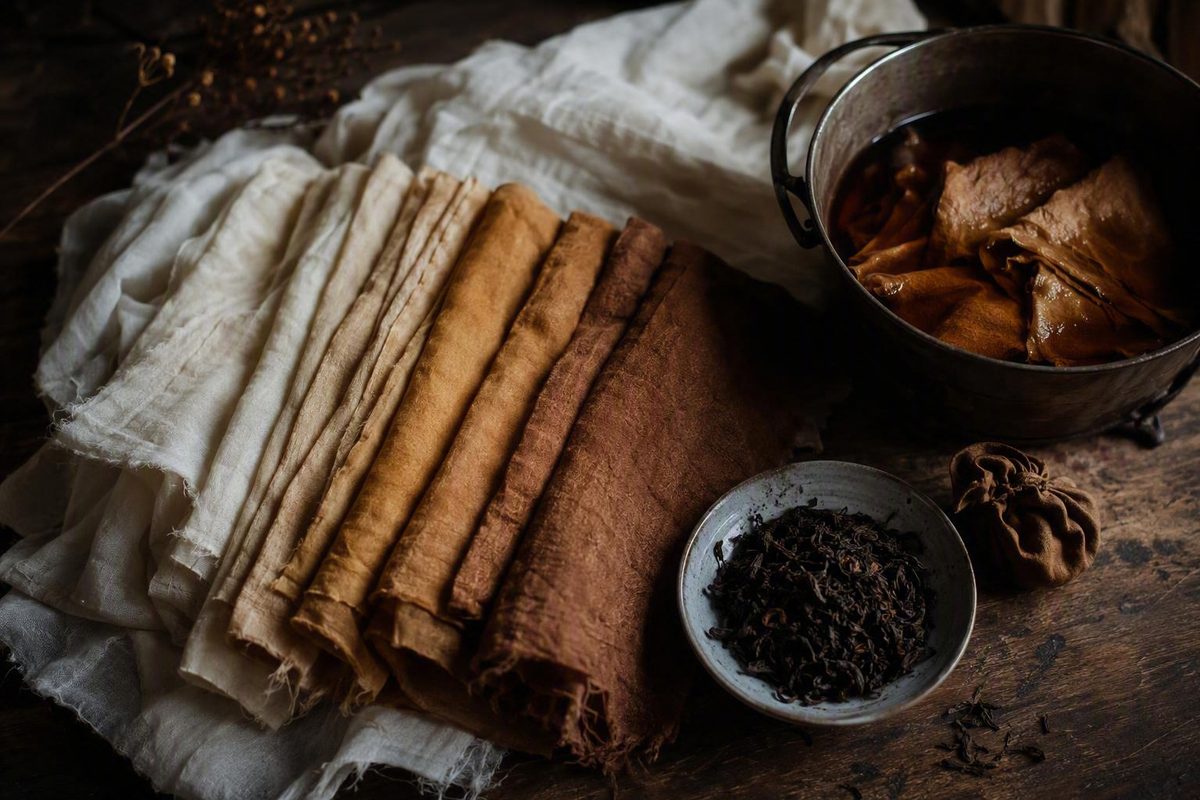
Fabric dyeing with tea is best understood as intentional tonal staining. It can soften a bright white, warm a pale color, or give cloth an aged beige-to-brown cast. It is not a dependable route to vivid, opaque, precisely matched, or permanently washfast color.
The most cautious home method is straightforward: check the care label, prewash the item, test matching fabric, wet it thoroughly, brew and strain strong black tea, immerse the fabric in a roomy bath, move it frequently, rinse in cold water, and judge the color only after it is completely dry. Tea, water, fiber, fabric finish, temperature, and laundering can all affect the result, so treat every recipe as a trial rather than a formula.
What tea dyeing can—and cannot—do
Tea generally adjusts a fabric’s tone rather than replacing its color. On white or pale cloth, it can create warm ivory, beige, tan, reddish-brown, or antique-looking shades. On colored fabric, it usually warms, dulls, or mutes the existing color.
That subtlety is the main reason to use tea. It can make a stark white background look creamier, soften a bright garment, or give new linens a less pristine appearance. In a personal sewing demonstration, tea subtly changed a white floral cotton dress and toned down a bright green linen dress without replacing their underlying colors or patterns. The pale cotton showed the change more clearly than the green linen, illustrating why starting color matters in the dress-dyeing project.
Do not assume that an overall brown tint will conceal an existing stain. A mark may remain visible, accept more tea than the surrounding cloth, or become darker. Tea may make minor discoloration less conspicuous when the intended finish is deliberately uneven or aged, but it is not a reliable stain-covering method.
The principal limitations are:
- Exact shade matching: Tea brand, blend, water, temperature, fabric, and processing can change the result.
- Saturation: Expect a tint rather than a strong replacement color.
- Uniformity: Seams, finishes, worn areas, mixed fibers, folds, and crowding can produce variation.
- Repeatability: Two items may not match even when treated in the same bath.
- Durability: Some color usually leaves during rinsing and laundering, and continued fading should be expected.
Tea is better suited to forgiving projects where gradual fading and small irregularities complement the design.
These expectations come primarily from household tutorials and personal demonstrations, not controlled textile testing. Some published methods also adapt earlier tutorials, so apparent agreement does not necessarily represent independent validation. This article therefore treats fiber behavior, additives, durability, and recipes as reported craft experience rather than established textile-science conclusions. A project-specific swatch is more useful than any promise that tea will produce a particular shade.
Choose the fabric and run a useful swatch test
Cotton and linen have the clearest practical support across the available demonstrations. They are sensible starting points for a beginner, particularly when the cloth is white, cream, or another pale color. Different weaves, finishes, sewing threads, linings, and prior treatments can still produce different results.
Treat wool and silk separately rather than applying one “natural fiber” procedure to everything. Both appear in household tea-dyeing methods, but the supplied evidence does not establish one safe temperature or agitation level for every wool or silk textile. Follow the care label rather than applying a hot cotton method by default. If the label requires dry cleaning or prohibits soaking, tea immersion is not an appropriate household experiment.
Evidence for synthetic fibers is much thinner. One personal tutorial gave particular nylon bra-making materials a pale ivory tint after about an hour. The materials became lighter after drying, and insufficient stirring left paler patches in that nylon-specific demonstration. This is an isolated result for a particular construction, not proof that every nylon fabric, elastic, lace, or finish will behave the same way.
The supplied demonstrations do not establish dependable results for polyester, rayon, lyocell, or mixed-fiber fabrics. A fiber label such as “cotton blend” also does not tell you whether each component, the sewing thread, and any applied finish will change equally. Avoid predicting the result; test representative material through the complete process instead.
Build a representative swatch
The best swatch is not simply a random piece of white cotton. Use scrap that matches the final item as closely as possible in:
- Fiber percentages
- Weave or knit construction
- Starting color and print
- Surface finish
- Thickness
- Prior laundering history
- Age and wear
If the item was sewn at home, test a leftover cutting. On a purchased garment, an inside seam allowance may provide a limited color test, although it cannot show whether the entire garment will dye evenly. Treat a hidden test as a clue, not a guarantee.
Test dimensional and surface changes along with color. Measure or mark the swatch before treatment, then compare its length, width, texture, drape, and appearance after it has dried. Note any shrinkage, puckering, loss of stretch, print bleeding, or other unwanted change.
Keep a simple project record:
| Variable | What to record |
|---|---|
| Fabric | Fiber content, construction, starting color, and prior washing |
| Tea | Type, brand or blend, and number or weight of bags |
| Bath | Water volume and approximate temperature |
| Treatment | Immersion time and how often the swatch was moved |
| Initial result | Shade while wet |
| Rinsed result | Shade after the cold rinse |
| Dry result | Shade after complete drying |
| Washed result | Shade and dimensions after one wash permitted by the care label |
Photograph each color stage in the same lighting if matching matters. Wet fabric can look convincingly dark and then become much paler after rinsing and drying.
Antiques, heirlooms, fragile textiles, upholstery, and anything irreplaceable warrant professional textile-care or conservation advice. Such items may contain unidentified materials, weakened areas, linings, padding, trims, embroidery, or finishes that a surface inspection or small hidden test will not fully represent.
Supplies, workspace, and bath planning
For a basic immersion project, gather:
- Plain black tea bags
- Water
- A large nonreactive pot or heat-safe container
- A long stirring utensil
- A strainer or fine sieve
- Gloves, if desired
- Towels or another protective covering for the work area
- A separate container for pre-wetting, if needed
- A timer, measuring jug, and notebook for repeatable testing
Blends can shift warmer, redder, yellower, or more golden, so plain black tea provides the simplest baseline. Do not assume that two brands labeled “black tea” will make identical baths.
Vessel capacity matters more than finding a universal recipe. Once wet, the item must fit loosely beneath the liquid, unfold fully, and move without being compressed against itself. If it must be wedged into the pot, the bath is too small.
There is no validated tea-to-water or tea-to-fabric-weight formula in the supplied evidence. As an experiential starting trial, one household tutorial uses 6–10 black tea bags covered with boiling water for a small natural-fiber project. The same tutorial advises removing the bags for a more even effect and avoiding brass, copper, and iron vessels, although that container advice is source-specific rather than a comprehensive materials standard in the household craft method.
Reported recipes vary sharply:
- A clothing project used about 10 bags in 2–3 gallons of water in a personal tea-staining method.
- A retailer’s demonstration used 30–40 bags in a bucket filled about two-thirds with hot water in its concentrated-bath instructions.
- A cotton-towel project used 40 bags, but did not state the water volume in its household demonstration.
- A family craft project used 100 bags in a 15-quart pot and steeped them for 15 minutes in the Woodlark Blog method.
These figures cannot be converted into one dependable scale because the projects used different quantities of fabric, concentrations, temperatures, steeping times, fibers, vessels, and target colors.
Plan the liquid around coverage and movement. If the first batch does not fully cover the fabric, brew more tea separately, strain it, and mix it thoroughly into the bath before continuing. Do not force a large item into too little liquid.
Protect the work area and avoid dyeing directly in a sink or bathtub finish that you are unwilling to stain. Use a dedicated or easily cleaned container where practical.
Step-by-step: the cautious immersion method
This workflow is designed for a subtle, reasonably even tint. It deliberately omits vinegar and salt because the available demonstrations do not establish either additive as a universal requirement.
1. Read the care label and prewash
Confirm that the item can be immersed and identify the permitted washing temperature. Wash it with detergent according to the label to remove dirt, body oils, sizing, softener residue, and manufacturing finishes that may interfere with even uptake.
Do not use a hotter preparation wash than the label permits. Remove the item promptly so it does not dry in tight folds.
2. Test color, dimensions, and construction
Run the complete process on matching scrap before treating the full item. Rinse, dry, and wash the swatch once according to its care instructions. A successful wet swatch is not enough; the useful result is its dry, laundered color and its post-treatment dimensions.
Stop if the swatch shrinks, distorts, loses stretch, changes texture, or develops unacceptable blotches.
3. Wet the fabric completely
For an even immersion effect, soak the fabric in clean water until it is uniformly wet. Open the folds and gently press out trapped air. Avoid twisting fabric that requires gentle handling.
Pre-wetting helps the bath reach the item more uniformly. This differs from certain squeeze-bottle pattern methods, where dry cloth is used to keep tea concentrated in selected areas.
4. Brew a strong black-tea bath
Heat enough water to cover the item while leaving room for it to move. Add the tea bags and steep them, stirring occasionally so the bath becomes reasonably uniform.
Household demonstrations commonly use a steep of about 10–15 minutes, although their tea quantities and water volumes differ considerably as illustrated by this cotton-towel method. Treat that duration as a practical example, not a validated optimum.
Remove strings, labels, or staples beforehand when practical.
5. Remove and strain the tea
Lift out the bags, then strain the bath if any have broken. Remove loose leaves, strings, and fragments.
Tea debris pressed against cloth can create concentrated dark marks. If evenness is the goal, do not leave bags floating among the fabric. Retain them only when deliberate mottling is desired.
6. Bring the bath to a permitted temperature
Allow the tea to reach a temperature compatible with the care label and your test swatch. Some household authors report richer results from hotter baths, but the supplied evidence also warns that hot-water dyeing can shrink fabric. It does not establish a universally safe hot temperature for every textile.
The hottest bath is not automatically the best bath. A paler intact item is generally preferable to a deeper shade accompanied by permanent dimensional change.
7. Immerse the item all at once
Lower the fabric smoothly into the bath rather than feeding it in section by section. Unfold it immediately, confirm that every part is covered, and press out visible air pockets with the stirring utensil.
Check hems, pockets, sleeves, waistbands, multilayer seams, and gathers. These areas can trap air or remain folded against themselves.
8. Keep it loose and moving
Move the fabric frequently throughout treatment. Lift and redistribute folds, turn the item, separate layers, and prevent one area from floating or resting continuously against the vessel.
Movement need not be harsh. Use slow repositioning for items that require gentle handling. The objective is to renew contact between the bath and every surface without exceeding the care instructions.
9. Check the color periodically
Do not rely on a universal immersion time. Published household treatments range from a few minutes in a concentrated hot bath to an hour or an overnight soak under different conditions.
Lift a representative section, let excess liquid drain, and compare it with your swatch. Return it promptly if more color is needed, and continue moving the rest of the item while checking.
10. Remove and cold-rinse
Remove the item when its wet color is somewhat darker than the desired dry shade. One clothing project suggests aiming one or two shades darker because rinsing reduces the apparent depth, but the amount of lightening is not predictable from that individual demonstration.
Rinse in cold water until the runoff is substantially clearer. Press out excess water in a manner permitted by the care label rather than wringing indiscriminately.
11. Dry completely before deciding
Air-dry the fabric, or use another drying method only if the care label permits it. Support heavy wet items so their weight does not distort them.
Assess the completely dry color in ordinary lighting. If it is too pale, repeat the treatment in a refreshed bath rather than modifying it while damp. Record the final conditions so you can approximate the process later, while accepting that an exact match is unlikely.
Control the shade without relying on the clock alone
Final color depends on several interacting variables:
- Tea type and blend
- Tea concentration
- Water volume and composition
- Fabric fiber and finish
- Original fabric color
- Bath temperature
- Immersion time
- Movement
- Rinsing and laundering
Time alone is therefore a poor predictor. A short treatment in a concentrated, hot bath can differ greatly from a long treatment in weak, cooled tea. Two items left for the same period may also emerge in different shades because their starting colors, constructions, finishes, or positions in the bath differ.
One concentrated demonstration reported light, medium, and darker results at approximately 3, 5, and 10 minutes, respectively. That same guide characterizes tea staining as semi-permanent and subject to gradual fading rather than presenting those times as a universal color schedule. Other household methods use at least an hour or an overnight soak. These timings are illustrative, not interchangeable recipes.
A stronger bath, warmer permitted temperature, longer exposure, or repeat treatment may deepen the shade. The change has not been shown to be linear, however. An indefinite soak does not guarantee proportionally darker color, and the bath may cool or produce diminishing visible change.
For a light tint, begin checking early. Rinse when the wet swatch is only slightly darker than the intended dry color. A pale result is easier to deepen than an overly dark or uneven result is to reverse.
For a deeper tint, first let the fabric dry so you know what the existing treatment produced. Then refresh or strengthen the bath and repeat the process. This gives you more checkpoints than leaving the item in an aging bath indefinitely.
Tea variety can change the undertone. In one informal dressmaking test, chai appeared more brown-yellow while basic black tea showed redder undertones. The same author found that a reused, lukewarm bath gave a weaker and less even result on a second dress in the scrap and garment comparison. These are personal observations, not a standardized color chart.
A used bath may still tint another item, but the result is less predictable because the remaining color, temperature, and amount previously absorbed are unknown. Do not use a secondhand bath when the next item must match the first.
Evaluate the shade at four stages: directly from the bath, after rinsing, after complete drying, and after one permitted wash. A color that appears ideal while saturated with tea may be considerably lighter at the final stage.
Prevent and troubleshoot blotches, weak color, and over-darkening
Uneven results commonly reflect preparation, bath size, debris, folds, trapped air, or insufficient movement. Differences within the textile itself may also remain visible despite careful handling.
| Symptom | Likely cause | Cautious correction |
|---|---|---|
| Pale isolated patches | Incomplete pre-wetting, trapped air, floating sections, tight folds, or too little movement | Wet the item completely, release air, unfold it, keep it submerged, and redistribute it frequently |
| Dark dots or contact marks | Broken tea leaves, bags touching the cloth, concentrated debris, or fabric resting against itself | Strain the bath and keep the layers separated and moving |
| Broad streaks or splotches | Crowding, an undersized bath, insufficient movement, uneven finishes, or differently behaving textile components | Use a larger vessel and more liquid; test whether the contrast originates in the fabric |
| Weak color after drying | Wet cloth looked darker, or the bath was too weak or cool for the desired effect | Test a refreshed or stronger bath and repeat only after assessing the dry result |
| Color is too dark | The bath was stronger or hotter than expected, or the fabric changed quickly | Rinse immediately in cold water; a care-label-approved gentle wash may remove more color, but not necessarily evenly |
| Completed item remains blotchy | Existing sections continue to accept or release tea differently | Redye after full pre-wetting in a roomy, strained bath, while accepting that old marks may remain |
| Shrinkage or distortion | The treatment exceeded the item’s tolerance for water, temperature, or handling | Stop and follow the care label; do not apply more heat in an attempt to set the color |
| Uneven seams or panels | Different fibers, finishes, interfacings, or fabric thicknesses | Accept the contrast or test an appropriate commercial dye on representative material |
If an item is too dark, prompt cold rinsing offers the simplest opportunity to remove loosely held color. A mild wash permitted by the label may lighten it further, but there is no demonstrated household procedure for restoring the original shade uniformly. Do not improvise with an untested removal treatment.
It cannot be assumed to erase the original pattern of pale and dark areas; those areas may simply become darker versions of the same patches.
Unevenness can also be intentional. Reduce movement, arrange folds, permit localized contact with concentrated tea, or apply it selectively to create mottling. The less you control circulation and coverage, the less repeatable the result becomes.
Large curtains, bedding, tablecloths, and yardage are especially difficult because a vessel that technically holds the textile may still be too small for it to unfold and circulate. If a large item cannot move freely, use a more suitable vessel or choose a commercial process when uniformity matters.
Do vinegar, salt, or a mordant set tea dye?
The terminology around additives is often blurred:
- A mordant is an additive used in a dyeing process to help establish an association between a colorant and a fiber.
- A pH modifier changes the acidity or alkalinity of a process and may alter its outcome.
- A household fixative claim is an assertion that an ingredient makes color stay. The assertion itself is not evidence of improved washfastness, lightfastness, or permanence.
The supplied tutorials conflict. Some call vinegar a mordant or color setter. Others recommend salt for plant-based fibers and vinegar for protein fibers. A Woodlark Blog tutorial initially described a vinegar treatment as mordanting, but the author later clarified in a comment that she was using vinegar as a pH modifier rather than claiming that black tea required a mordant in that household method.
Other tutorials continue to describe salt as helping to set tea color as in this derivative household guide, while a separate craft author uses a vinegar soak and says it sets the dye in a personal fabric experiment. None of these supplied demonstrations includes a controlled comparison showing that salt or vinegar improves tea color’s washfastness, lightfastness, or permanence.
A recipe can include an additive without proving that the additive caused better retention. If cloth treated with tea, salt, and vinegar turns brown, that result shows only that the complete process produced an initial color. Testing the additive requires otherwise identical material treated with and without it, followed by the same rinsing, washing, drying, and light exposure.
Curious readers can compare three matched swatches:
- Tea with no additive
- Tea with the recipe’s measured amount of salt
- Tea with the recipe’s measured amount of vinegar
Keep tea concentration, water volume, temperature, exposure time, movement, rinsing, and drying as consistent as possible. Compare the swatches when dry and again after the same care-label-approved wash. Record both color and fabric condition.
This home comparison will not establish a universal rule, but it may show whether an additive makes a useful difference in one particular project. The main beginner workflow remains additive-neutral. Salt or vinegar may be retained when reproducing a specific author’s recipe, but neither should be presented as a universally required or proven permanence treatment.
Alternative effects: mottling, painting, spraying, and tea tie-dye
Even immersion and decorative patterning are different projects. Pre-wetting and frequent movement encourage a more even tint, while folds, restricted flow, and localized application preserve variation.
For mottling, reduce agitation, hold or tie folds in place, or permit controlled contact between concentrated tea and selected areas. Tea bags or leaf debris can create dark contact marks, although their shape and intensity are difficult to duplicate.
Tea may also be applied with brushes, stamps, sponges, or spray bottles. These methods suit decorative aging, costume distressing, samples, and cloth that does not require a uniform wash. A household tutorial presents stamps, paintbrushes, and spraying as optional pattern methods and recommends removing tea bags for even color or retaining them for mottling in its decorative tea-dyeing guide.
Test localized methods for spreading and edge halos. Several light applications may provide more control than one saturated pass, but the supplied evidence does not establish repeatability or laundering durability.
For a squeeze-bottle tea tie-dye effect, one reported process is:
- Prewash white cotton.
- Allow it to dry.
- Fold, twist, or bunch the fabric and secure it with rubber bands.
- Apply concentrated tea from squeeze bottles.
- Place the saturated bundle in a sealed bag.
- Leave it for at least 8 hours.
- Remove the ties and rinse thoroughly in cold water.
- Air-dry.
Unlike the even-immersion workflow, this process begins with clean, dry cotton to preserve localized application. The tea-company demonstration used about 9–12 ounces of concentrate for one shirt and left it sealed for a full day, although its stated minimum was eight hours in the squeeze-bottle project. That single-shirt quantity is not a scalable formula for other sizes, constructions, or patterns.
Black tea produced the strongest and most consistent result in that author’s account. Other tea or botanical colors were described as lighter and less durable after rinsing. Because the project included no standardized washfastness testing, treat those comparisons as anecdotal.
Localized techniques make unevenness part of the design rather than a defect, but they remain difficult to duplicate. Make coordinated pieces in one session if visual similarity matters, and expect the pattern to soften with rinsing and laundering.
Rinsing, laundering, fading, and deciding when tea is the wrong dye
Begin with a thorough cold rinse and allow the item to dry completely before judging the shade. Rinsing, drying, and laundering commonly lighten tea-treated fabric. Do not decide that an item is too dark while it is still saturated with liquid.
Wash the item separately at first. The supplied demonstrations do not quantify later bleeding or color transfer, so separation is a precaution rather than a guarantee that additional color will be released.
For washable items:
- Use cold water unless the care label directs otherwise.
- Choose a mild detergent.
- Use gentle handling appropriate to the item.
- Avoid unnecessary soaking.
- Air-dry when practical and permitted.
- Keep the item separate from other textiles until you know how it behaves in washing.
These practices may reduce stress on the textile and slow visible color loss, but they cannot prevent fading. Household demonstrations commonly describe tea color as fade-prone or semi-permanent. One cotton-towel project specifically reports that rinsing and washing reduce color intensity, without quantifying long-term retention.
Neither delaying the first wash nor heat-setting has been established by the supplied evidence as a reliable way to improve retention. Drying recommendations vary from air-drying to machine drying, but the tutorials do not provide controlled comparisons. Do not exceed the temperature allowed by the care label in an attempt to set the color.
How much fading matters depends on use. A decorative textile that is rarely washed may maintain an acceptable aged appearance longer than clothing, bedding, towels, or napkins. Frequently laundered items are poor candidates when preserving a particular shade is important.
Choose a commercial fiber-specific dye instead when the project requires:
- Strong or saturated color
- Close shade matching
-
Uniform yardage or multiple matching items
-
Frequent machine washing
- Better repeatability
- Dependable long-term appearance
Seek professional care rather than household tea dyeing for valuable, antique, fragile, upholstered, structurally complex, or irreplaceable textiles.
Proceed with tea when:
- You want a subtle warm, muted, or aged effect.
- Representative material has been tested successfully.
- Some variation is acceptable.
- Gradual fading will not ruin the project.
- The item can be safely immersed according to its label.
- The vessel is large enough for free movement.
Choose another method when:
- The textile is valuable or irreplaceable.
- You need an exact match or strong color.
- The item will be washed frequently.
- The care label conflicts with soaking or the proposed temperature.
- A large item would be crowded in the available vessel.
- Existing stains, prints, or colors must be completely concealed.
- Dependable long-term durability is essential.
Frequently asked questions
How many tea bags do I need to dye fabric?
There is no universal number. Published household methods range from a handful of bags in a small container to more than 100 bags in a multi-gallon bath. Those quantities cannot be scaled directly because fabric amount, water volume, tea strength, temperature, fiber, and target shade differ.
For a small cotton trial, 6–10 black tea bags in enough water for the item to remain covered and move freely is one experiential starting point reported in a household tutorial. Record the water volume and test matching fabric. For a larger item, prioritize complete coverage and free movement rather than multiplying the bag count without considering vessel size.
Do I need vinegar, salt, or a mordant when dyeing fabric with tea?
Not for this cautious beginner method. Household tutorials disagree about whether vinegar or salt functions as a mordant, pH modifier, or fixative, and the supplied demonstrations do not contain controlled evidence that either additive universally improves washfastness, lightfastness, or permanence.
To investigate a particular recipe, compare identical swatches treated with no additive, salt, and vinegar. Keep every other variable the same, then compare them dry and after the same wash. Do not assume an additive worked merely because the fabric acquired color.
Can tea dye colored, patterned, or stained fabric?
Tea can tint colored and patterned fabric, but it generally warms or mutes what is already present rather than replacing it. Pale backgrounds show the change most clearly, while dark colors may show little visible difference. Prints normally remain visible.
Existing stains may also remain visible or become darker if they accept tea differently from the surrounding cloth. Test representative material and do not rely on tea when complete stain coverage is required.
Is tea dye permanent, and can the fabric be machine-washed?
Tea staining should be considered fade-prone or semi-permanent rather than permanent. Some color commonly leaves during rinsing, drying, and later washing.
A machine-washable item can be washed by machine if its care label allows it. Cold water, mild detergent, a gentle cycle, and washing separately at first are cautious choices. Air-drying may also be appropriate. None of these measures guarantees color retention, and neither delayed washing nor high-heat drying is established as a dependable setting method.
Will tea dye synthetic fabric or a fabric blend?
Results are uncertain. Cotton and linen have the clearest practical support in the supplied demonstrations. One personal project produced pale ivory on specific nylon bra-making materials, but that result does not prove that every nylon textile will accept tea.
The available evidence does not establish dependable outcomes for polyester, rayon, lyocell, or mixed-fiber constructions. Read the fiber and care labels, then test matching material through the complete process, including washing. If predictable color on a synthetic or blend matters, use a commercial dye explicitly formulated for its fiber composition.
The most dependable home approach is test-first: identify the fiber, read the care label, prewash, test representative fabric for color and dimensional change, use a roomy strained bath, keep the item moving, rinse cold, and assess it only when fully dry. Tea is useful precisely because it creates a subtle, variable vintage tint. When precision, permanence, or textile value makes that variability a liability, choose a suitable commercial dye or professional care.