 StainList
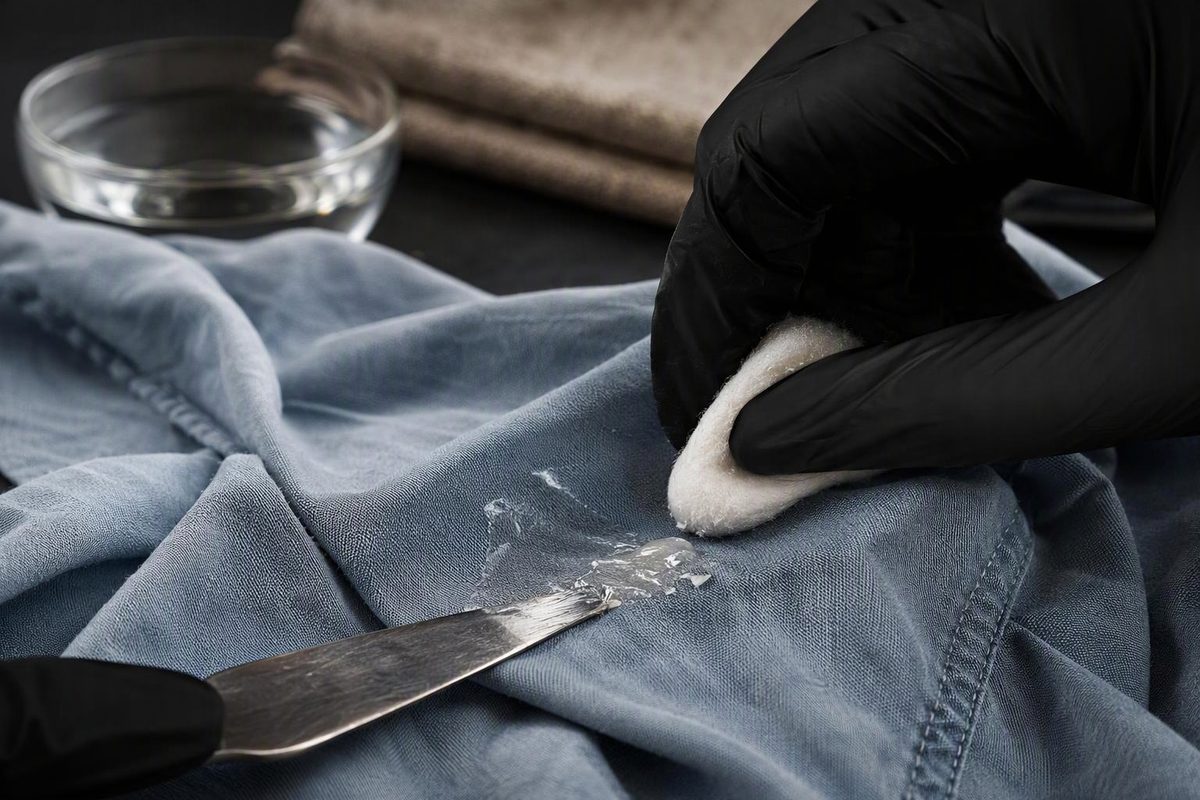
For a small, fully hardened super-glue spot on washable fabric, use this sequence: gently lift the brittle surface deposit, spot-test acetone, dab the remaining glue from the back, then wash and air-dry. Do not use acetone on acetate, triacetate or modacrylic. Refer delicate, structured and dry-clean-only items to a professional cleaner.
Super glue is cyanoacrylate, an adhesive that cures rapidly in the presence of moisture (Poison Control). A cured deposit generally needs mechanical removal followed by a compatible solvent; ordinary laundering alone may not release it.
If the spill is fresh, hot, smoking or against skin
Handle the burn risk before the stain. Cyanoacrylate can release intense heat when it contacts fabric, especially cotton or wool. Serious burns through clothing have been documented, including cases requiring skin grafts (ANSES; Journal of Burn Care & Research abstract).
- Immediately apply cold, soapy water to the affected clothing, as advised by ANSES, and seek medical advice.
- Do not pull away fabric that has bonded to skin.
- Do not mop up a fresh spill with cotton, wool, tissues or another cloth. A Henkel cyanoacrylate safety sheet warns that contact with fabric or paper goods can cause rapid curing, smoke, irritating vapor and thermal burns (Henkel safety data sheet).
- For a burn, eye exposure or skin that will not separate, contact a poison center or medical professional. In the US, Poison Control is available at 1-800-222-1222 and advises against pulling bonded skin apart (Poison Control). Elsewhere, contact the local poison or emergency service.
Do not begin the stain-removal steps below until the garment is off the body, the area is cool and the adhesive is completely hard.
Check the fabric before using acetone
Read both the fiber-content label and care label. The glue manufacturer Bostik directs users to patch-test acetone, work from the reverse side and avoid acetone on acetate, triacetate and modacrylic (Bostik). University of Georgia textile-care guidance gives the same three exclusions and stresses checking the care label and testing for colorfastness (UGA Cooperative Extension).
After a hidden-area test, plain acetone may be suitable for many washable cotton, linen, polyester, nylon and acrylic items. Do not use it when:
- the fabric is acetate, triacetate or modacrylic;
- the care label prohibits solvent treatment;
- the test causes color transfer, dullness, tackiness or a texture change;
- the glue is on a print, coating, bonded layer or embellishment that the solvent could damage.
Take silk, wool, rayon, vintage textiles, structured garments and dry-clean-only items to a professional. The value of removing a small glue mark rarely justifies risking dye loss, distortion or finish damage on these materials.
Removal sequence for washable fabric
1. Let a small, cool spill harden
If the glue is no longer producing heat, is not against skin and is not smoking, leave it undisturbed until it is hard and non-tacky. Rubbing liquid glue can spread it through the weave. Do not use an iron, hair dryer or clothes dryer to speed the process.
2. Lift only what releases easily
Lay the fabric flat. Use the edge of a spoon, dull table knife or plastic card to flake away raised, brittle glue. Keep the edge nearly parallel to the cloth so it skims the deposit rather than digging into the yarns.
Stop if the fabric pills, yarns begin to pull or the glue is embedded rather than sitting on the surface. Aggressive scraping can replace a small glue spot with a hole or fuzzy patch.
3. Patch-test plain acetone
Work with good ventilation, away from flames, sparks and heat. Apply a drop of plain acetone to an inconspicuous seam allowance, blot with a white cloth and let the test area dry fully.
Do not continue if color transfers or the fabric changes in sheen, feel or shape. Nail-polish remover is less predictable because products may contain dyes, oils or conditioners; UGA notes that these added ingredients can worsen a stain.
4. Dab the residue from the back
Once the glue is fully hard and the fabric has passed the test:
- Place the stain face down on folded white paper towels or a clean white absorbent cloth.
- Apply a small amount of acetone to the back of the spot with a glass dropper or the corner of a clean white cloth.
- Blot without scrubbing. Move the stain to a clean part of the absorbent material as residue transfers.
- Turn the garment over and gently lift any loosened fragments with the spoon edge.
- Repeat with small amounts until no more glue transfers or the treatment stops making progress.
Loctite lists acetone as one option for cured adhesive but warns that it can damage surfaces and is highly flammable (Loctite). Keep it off plastic worktops and painted or varnished furniture, and close the container promptly.
5. Rinse, pretreat and wash
Rinse the treated area thoroughly with cool water. Apply a small amount of liquid laundry detergent for the pretreatment time stated on its label, then wash according to the garment’s care label.
Air-dry and inspect in good light. If a thin film remains and the fabric shows no damage, one more careful acetone treatment may help. Air-drying keeps the item available for retreatment and avoids exposing a remaining mark or weakened area to dryer heat.
When to stop
Stop home treatment if the acetone changes the color or texture, the glue joins multiple fabric layers, scraping distorts the weave, or a second careful treatment makes no progress. A cured cyanoacrylate mass can bind fibers tightly enough that complete removal would leave stiffness, discoloration or a weakened area.
Acetone is not a general answer for every sticky mark. If the residue came from a label rather than cyanoacrylate, use the sticker-residue guide instead.