 StainList
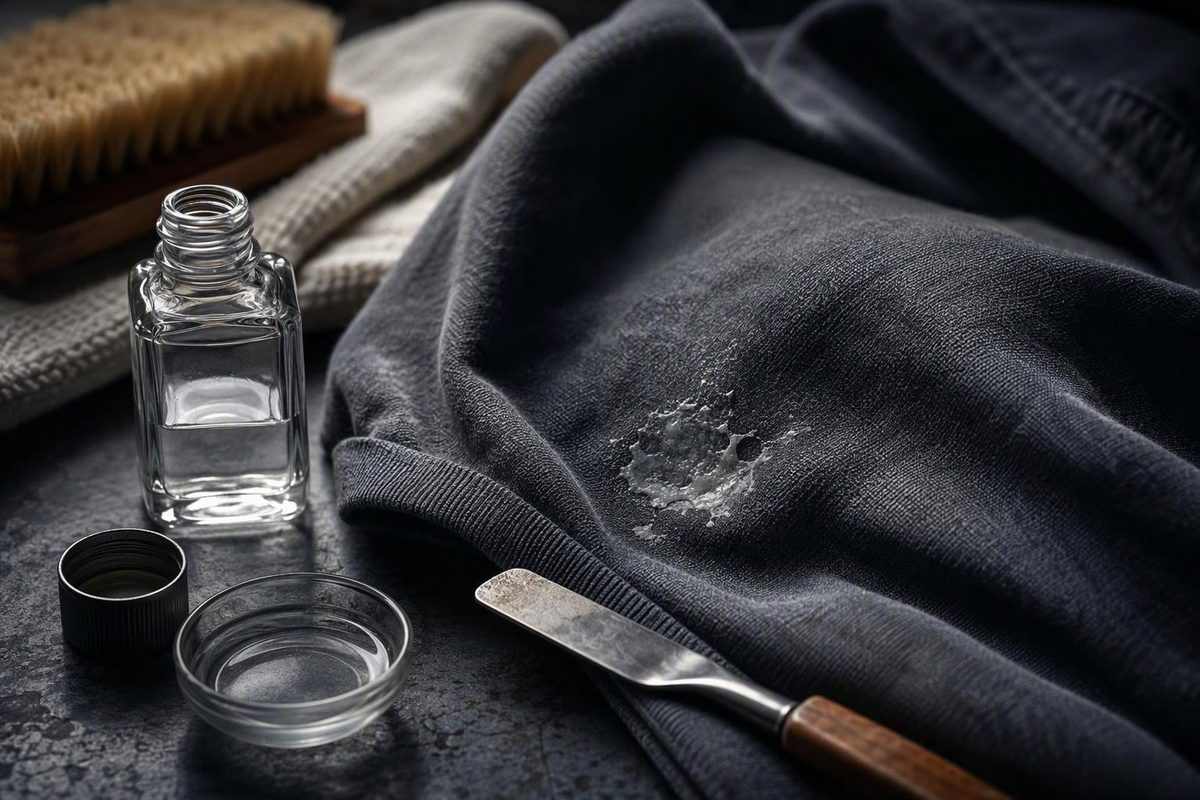
For a small super-glue spot on ordinary washable clothing, let the glue harden, lift off as much as possible with a blunt edge, then use acetone sparingly only if the care label, fiber content and a hidden-area test allow it. Follow with liquid laundry detergent, wash as labeled and air-dry until the glue is gone. Do not use acetone on acetate, triacetate or modacrylic.
Choose the spill and garment conditions to see whether to treat it, avoid acetone or call a professional.
Super-Glue Treatment Check
Base the choice on the current spill, care label and every affected fabric layer.
Lift the hardened glue with a blunt edge. Patch-test one drop of acetone on a hidden area, then use small applications only if the dried test shows no change.
- Blot from the back onto a clean white pad.
- Rinse, pretreat with liquid detergent and wash as labeled.
- Air-dry and inspect; do not use high heat while glue remains.
Source basis: Journal of Surgical Case Reports safety guidance; Drycleaning & Laundry Institute, Bostik, Loctite and UGA textile-care guidance cited in the article.
Cool a Hot Spill Before Treating the Garment
Super glue is usually a cyanoacrylate adhesive. When it contacts cotton or another cellulose-containing material, curing can generate enough heat to cause a serious burn. Published medical reports describe full-thickness burns from this reaction and note that cold water with soap can reduce the temperature and help detach the glue (Journal of Surgical Case Reports).
Treat the situation as a skin-exposure problem, not a stain-removal job, if glue on a worn garment feels hot, smokes or has bonded cloth to skin:
- Apply plenty of cool, soapy water promptly.
- Do not pull or tear the garment away from the skin.
- Get medical help for a burn, persistent pain, eye exposure, a large spill or clothing that will not release.
- Contact your local poison-control service if you need exposure advice.
Do not apply acetone while the clothing is being worn or while the adhesive is producing heat. Saving the garment is secondary to stopping the reaction and protecting the person. Begin fabric treatment only after the garment is off the body, the deposit is cool and there is no continuing skin exposure.
The guidance does not provide a measured spill-size cutoff for safe home treatment. The method below is intended for a small, localized deposit. Glue spread across a broad area or through several layers calls for professional assessment rather than progressively larger amounts of solvent.
Check Every Fabric Layer Before Using Acetone
Read both the care label and the fiber-content label. Check the outer fabric, lining, trim and printed or coated decoration rather than assuming that the main fabric represents the entire garment.
Do not use acetone on acetate, triacetate or modacrylic. Acetone readily dissolves acetate fibers and can remove some fabric dyes; acetate is also used in many garment linings (Drycleaning & Laundry Institute). Bostik’s fabric guidance likewise excludes acetate, triacetate and modacrylic from its acetone method (Bostik).
Skip home solvent treatment and consult a professional cleaner when:
- the garment contains acetate, triacetate or modacrylic;
- the label says dry-clean-only;
- the item is silk, wool, leather, coated, sequined or otherwise delicate;
- glue has bonded several fabric layers or covers a large area;
- the fiber content cannot be established;
- the item is valuable and cannot be safely patch-tested.
An unknown fiber is not the same as an acetone-compatible fiber. If the content label is missing or unreadable, scraping away a raised, hardened deposit may still be possible, but the solvent step should wait for a professional evaluation.
A washable label also does not establish that every component is solvent-safe. A contrasting lining, transfer print, surface coating or decorative trim can react differently from the base cloth. Keep acetone away from those areas unless each affected material passes a hidden test.
Let a Small, Cool Deposit Harden
Once the garment is off the body and the glue is cool, place it on a protected surface and allow the spot to cure naturally. Do not rub, wipe or smear wet adhesive. Rubbing enlarges the affected area and pushes the uncured glue through more of the textile structure.
Waiting applies only to a cool deposit that is not attached to skin. It does not override the need for immediate cool, soapy water when the adhesive is heating on cotton or another cellulose-containing fabric.
After the glue has hardened, lay the garment flat and flex the fabric gently. Use the edge of a spoon or another blunt tool to skim raised adhesive from the surface. Work from the outside of the deposit instead of forcing the tool beneath sound fabric.
Stop scraping if yarns begin to fuzz, stretch, snag or lift. A shallow drop may release without solvent, while glue that has penetrated between yarns may leave a stiff area. Loctite also advises allowing super glue to dry and removing as much as possible with a dull edge before trying acetone (Loctite).
Do not substitute a sharp knife or aggressive picking. Removing the glue is not a successful result if the process cuts threads, raises the fabric surface or distorts the weave.
Patch-Test Acetone Before Touching the Stain
Use acetone only after the garment has passed the label and fiber checks. Work in good ventilation and away from smoking, flames, pilot lights, sparks, hot appliances and other ignition sources. Follow every precaution on the solvent’s own label.
Put one drop on a hidden seam allowance or another inconspicuous part made from the same material as the stained area. Blot with a white cloth, then let the test area dry before judging it. A wet test alone can hide a change that becomes apparent after evaporation.
Do not continue if:
- color transfers to the white cloth;
- the tested material becomes tacky;
- the color turns pale or uneven;
- the surface becomes rough;
- the area becomes misshapen.
A successful hidden test reduces uncertainty but does not guarantee that prolonged soaking will be harmless. The stain treatment should still use small, controlled applications.
Acetone evaporates rapidly and is flammable. The University of Georgia textile-care reference also warns that nail-polish removers may contain other ingredients that worsen a stain (UGA Cooperative Extension). Do not treat nail-polish remover as an interchangeable substitute merely because acetone appears among its ingredients.
Soften the Remaining Glue From the Back
Place the stained area face-down on a clean white cloth or a folded stack of white paper towels. The absorbent material gives softened adhesive somewhere to transfer and makes color transfer easier to see.
Using a cotton swab, apply a small amount of acetone to the back of the spot. Begin at the edge of the residue and blot rather than rub. Move the garment and stained pad to a clean section as material transfers so that dissolved residue is not pressed back into the cloth.
Pause after each small application. Turn the fabric over if necessary and use the spoon to lift glue that has softened. Repeat only while two conditions remain true: the adhesive is responding, and the textile shows no change.
Do not soak the garment. More solvent is not automatically more effective, particularly when glue has penetrated the yarns. Stop immediately if dye appears on the pad or if the fabric becomes tacky, pale, rough or distorted.
Do not combine acetone with another stain remover or cleaner. Keep the open solvent, treated garment and solvent-damp pads away from the washing machine, dryer and all ignition sources until the acetone has completely evaporated.
Rinse, Pretreat and Wash as Labeled
Once no more glue can be lifted safely, rinse the treated area. Apply a small amount of heavy-duty liquid laundry detergent and leave it in place only for the pretreatment time printed on that detergent’s label.
Wash the garment according to its care label. Do not choose a hotter cycle or more aggressive process in an attempt to compensate for residue. Loctite’s sequence similarly calls for acetone, heavy-duty detergent and laundering after the glue has been lifted (Loctite).
The detergent and wash step follows mechanical lifting and, where safe, acetone treatment. Washing first is not a substitute for removing the hardened deposit. A thick piece of cured adhesive may remain attached even after the surrounding cloth has been cleaned.
Keep solvent handling separate from laundering. The garment should not go into the washer until the acetone has evaporated fully, and solvent-soaked pads should remain away from the washer, dryer, flames and heat.
Air-Dry Before Deciding Whether to Repeat
Air-dry the garment after washing. Inspect the area in good light and feel it for a remaining hard or stiff patch. Do not iron or tumble-dry the item while adhesive remains; the adhesive manufacturer also advises complete removal before high-heat drying (Loctite).
Air-drying preserves the chance to reassess the spot without introducing high heat. If a smaller residue remains and the first treatment caused no color or surface change, another careful pass may be reasonable for the same washable, acetone-compatible garment.
Repeat the controlled sequence rather than scraping harder or soaking longer: lift what is raised, use a small amount of acetone from the back, blot onto a clean white pad, rinse, pretreat, wash and air-dry.
Stop When the Fabric Changes or Treatment Stalls
Stop immediately if dye transfers or the textile becomes pale, rough, tacky, stretched or misshapen. Stop scraping when threads begin to lift, even if visible glue remains.
Another careful treatment is not worthwhile when it produces no improvement. Cured glue may have penetrated the yarns, and forceful scraping can damage the fabric while removing the deposit. Complete removal is not certain, particularly if the garment has already been ironed or tumble-dried.
A professional cleaner may be able to reduce the remaining deposit, but the cleaner should be told that the stain is cyanoacrylate or super glue, whether acetone has already been used and whether the garment has been exposed to heat. For dry-clean-only, delicate, mixed-material or valuable clothing, professional treatment is the first option rather than the fallback after an unsafe solvent test.