 StainList
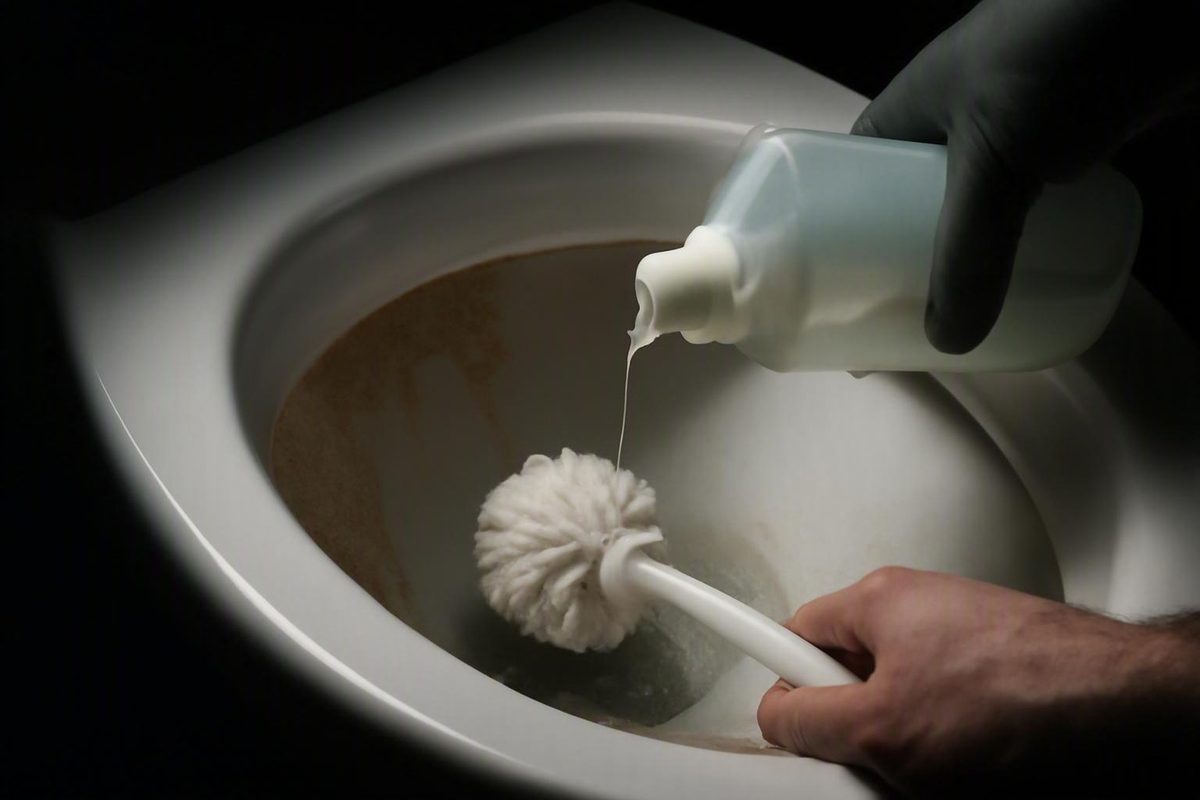
A conservative household-first approach to toilet limescale is to expose the deposit, apply one compatible acidic treatment, allow enough contact time, brush gently, rinse, and repeat if necessary. This avoids immediately resorting to aggressive scraping or hazardous chemicals.
First, make sure no incompatible cleaner remains in the toilet. Lower the bowl water so the treatment can reach deposits below the normal waterline. White vinegar provides a practical starting method, while citric acid and toilet-specific commercial descalers are alternatives.
No method is guaranteed to remove every mark. Old mineral deposits, iron staining, other residue, and damaged glaze can look similar but respond differently.
Before You Start: Never Mix Toilet Cleaners
Warning: Never combine bleach with vinegar, citric acid, an acidic toilet-bowl cleaner, or another descaler. Bleach reacting with acids can release chlorine gas. Do not mix bleach with ammonia; because urine may introduce ammonia into a toilet, flush before cleaning. These combinations and their respiratory hazards are explained in Family Handyman’s expert-reviewed cleaner-mixing guidance.
Use only one cleaner during a treatment, and never add a second product because the first seems to be working slowly.
Before applying vinegar, citric acid, or a commercial descaler:
- Put on household cleaning gloves.
- Open a window or run the bathroom exhaust fan.
- Keep children and pets out of the room.
- Flush away urine and visible cleaning residue.
- Use one cleaner at a time.
- Protect nearby finishes from drips and splashes.
- Avoid leaning directly over the bowl while pouring or brushing.
If another toilet product was used earlier, flush and rinse the bowl thoroughly before beginning. There is no universal number of flushes suitable for every toilet and formulation. The objective is to remove the previous product so that residues do not meet. If you do not know what was used, postpone treatment until the bowl has been thoroughly rinsed.
For a commercial descaler, read the complete label before opening the container. The label must override generic advice about dosage, contact time, ventilation, protective equipment, suitable materials, application, and rinsing. Products sold for the same purpose can have different formulations.
Also protect the area around the toilet. Cover vulnerable surfaces where practical, pour carefully, and clean splashes promptly according to the affected material’s care instructions. The Bathroom Showroom specifically cautions about using acidic limescale treatments around stone, grout, and certain metal finishes.
If incompatible products are accidentally combined, do not remain in the bathroom or attempt to neutralize the mixture. Leave for fresh air, keep other people and animals away, contact the appropriate poison-control service for your location, and follow its directions. Seek emergency help for breathing difficulty or other significant symptoms. These exposure-response steps are supported by the same expert-reviewed cleaner-safety guidance.
Check Whether the Deposit Is Actually Limescale
Limescale is a hard, rough mineral deposit associated with hard water. It consists primarily of calcium carbonate left behind as mineral-bearing water sits or evaporates. Repeated wetting can turn a thin deposit into a firmly attached ring or crust.
Common clues include:
- A raised or chalky ring at the normal waterline
- A rough layer at the bottom of the bowl
- Crust beneath the rim
- Narrow streaks along regular water paths
- Deposits that resist ordinary toilet cleaning
- Visible mineral crust near rim openings, sometimes accompanied by weak water flow
Lysol’s toilet-limescale guide describes limescale as primarily calcium carbonate and identifies waterline rings, bowl-base deposits, and obstructed jets as possible signs. However, not every mark in these locations is limescale.
Mineral scale often feels raised, rough, or crusty rather than merely discolored. It is frequently white or chalky, but pink, brown, or reddish discoloration may appear with or around it.
Color alone cannot identify limescale. Reddish-brown marks may involve iron or rust, while dark or pink residue may have another component.
Use three practical clues:
- Texture: Does the mark feel raised or rough?
- Location: Is it concentrated at the waterline, bowl base, beneath the rim, or along regular water paths?
- Response: Does a compatible acidic soak soften or reduce it?
These clues can guide a cleaning decision, but they are not a definitive home diagnostic test. Do not keep applying stronger products merely because an uncertain mark has not changed color.
Stop and consider professional assessment if the porcelain appears cracked, pitted, scratched, or dull. Do the same when a smooth mark does not soften or diminish after suitable treatment. Aggressive abrasion could make the surface damage worse.
Prepare the Toilet and Expose the Scale
Gather everything before lowering the bowl water:
- Household cleaning gloves
- An ordinary or soft toilet brush
- One chosen treatment: white vinegar, citric acid, or a toilet-labeled descaler
- A measuring cup or spoon reserved for cleaning
- Protective covering for vulnerable nearby surfaces
- Any application material expressly permitted by the fixture manufacturer
- Eye protection if required by the product label
Do not place several possible cleaners beside the toilet. Bringing only the product you intend to use reduces the chance of an accidental combination.
To expose deposits below the waterline:
- Locate the water-supply valve, usually on the wall or floor behind the toilet.
- Turn it clockwise until it closes, without forcing it.
- Flush the toilet.
- Let the tank empty and the bowl level fall.
- Confirm that as much of the deposit as possible is exposed.
Culligan San Diego’s toilet-limescale procedure uses this shutoff-and-flush method before vinegar treatment. It is a controlled way to lower the water while preventing the bowl from immediately refilling.
If the supply valve cannot be operated safely, you can use the toilet brush to push bowl water slowly over the trap and down the drain. Take care to avoid splashing. The shutoff-and-flush method is generally clearer and easier to control.
Lowering the water serves two purposes. It lets the treatment touch a submerged ring directly, and it reduces dilution. Pouring a small amount of vinegar into a full bowl may leave the most stubborn scale under water in a much weaker solution.
Do not dismantle the toilet or pour acid blindly into hidden rim passages. Scale inside concealed channels is difficult to assess, and the liquid may contact materials you cannot see. Treat only visible, accessible deposits unless the toilet manufacturer supplies specific instructions.
After treatment, turn the supply valve counterclockwise to reopen it. Let the tank and bowl refill, then confirm that the toilet flushes normally and that the valve and supply connection are not leaking.
The Main Method: Soak, Brush, Flush, and Repeat
White vinegar is the primary household-first option here because the available guidance provides a usable amount and contact time—not because independent comparison has proved vinegar universally safer or more effective than citric acid or a commercial descaler.
Step 1: Lower the bowl water
Close the supply valve and flush as described above. Expose the waterline ring and as much buildup at the bowl base as the toilet’s design permits.
Step 2: Apply white vinegar
Pour approximately 1–2 cups of white vinegar directly onto and around the exposed deposits. Leave it in contact for approximately 3–4 hours. For severe buildup, overnight contact may be considered only if the toilet manufacturer permits prolonged acidic treatment. These quantities and times come from Culligan San Diego’s commercially published toilet-limescale method.
Pour carefully so the vinegar does not splash flooring, grout, stone, metal, or decorative finishes. If it runs into the remaining bowl water, use the toilet brush to redistribute it over the exposed ring. Do not add another cleaner to make it cling.
During the dwell period, keep the room ventilated and inaccessible to children and pets. Closing the toilet lid does not replace restricting access.
Step 3: Brush gently
Use an ordinary or soft toilet brush. Concentrate on:
- The normal waterline
- The bowl base
- Visible streaks
- Accessible areas beneath the rim
Work repeatedly over the softened deposit rather than applying maximum force. Acidic treatment helps break down alkaline calcium-carbonate scale; brushing removes material after it loosens.
Step 4: Restore the water and flush
Reopen the water-supply valve, allow the toilet to refill, and flush thoroughly. Inspect the bowl after loose material has washed away. A thick ring may become thinner or patchy rather than disappearing after one treatment.
Step 5: Repeat before escalating
If the deposit has clearly softened or reduced, repeat the same process. Heavy buildup may require two or three treatment rounds, according to the Culligan guidance cited above. Repeating one compatible treatment is preferable to immediately switching products, scraping harder, or introducing another chemical while residue remains.
Do not expect a guaranteed result.
Vinegar, Citric Acid, or Commercial Descaler?
There is no supported basis here for declaring one option the universal winner. Choose according to the deposit, the toilet manufacturer’s care instructions, the product information available, and whether you can maintain safe contact without splashing.
| Option | Practical use case | General approach | Main limitation |
|---|---|---|---|
| White vinegar | Established waterline or bowl-base scale | Use the main soak-and-brush method above | May require repeated contact |
| Citric acid | Bowl deposits or visible marks above the waterline | Use the measured published method below | Guidance is limited and not comparative testing |
| Commercial descaler | Stubborn scale when a suitable toilet product is available | Follow the product label exactly | Formulas and instructions vary |
White vinegar
Choose vinegar when you want a straightforward household-first treatment and can leave the toilet out of use for several hours. Follow the quantities and contact time in the main method rather than improvising a stronger treatment.
If the first soak produces partial improvement, repeat it. Do not immediately introduce citric acid, bleach, or a commercial cleaner.
Citric acid
Limited firsthand guidance suggests adding warm—not boiling—water to the bowl, sprinkling in 2 tablespoons of citric acid, and swirling gently with a toilet brush. Leave it for at least one hour, then brush and flush.
For marks above the waterline, the same guidance suggests dissolving 1–2 tablespoons in 150 ml of warm water, soaking an application material in the solution, and holding it against the visible mark for 30–60 minutes or longer. These recipes come from Hard Water Home’s citric-acid toilet-cleaning method, which reflects a specialist author’s experience rather than independent comparative testing.
Use the above-waterline method cautiously:
- Use only an application material expressly permitted by the toilet manufacturer.
- Confirm that prolonged acidic contact is compatible with the fixture.
- Apply material only to the visible mark.
- Do not push it into rim holes or concealed channels.
- Remove all loose material by hand before flushing.
- Do not use anything likely to detach and block the toilet.
- Prevent drips onto grout, stone, metal, flooring, or decorative finishes.
- Use warm rather than boiling water.
Do not increase the citric-acid dose merely because the first treatment works slowly. Repeat the same compatible method, or rinse thoroughly and reassess before using a different product in a later cleaning session.
Commercial toilet descaler
Choose only a descaler explicitly labeled for toilets. Read the label before lowering the bowl water because the product may require a wet bowl or a different preparation method.
Let the label control:
- Quantity
- Contact time
- Ventilation
- Protective equipment
- Suitable surfaces and finishes
- Application technique
- Brushing
- Rinsing and flushing
Some branded products specify much shorter contact times than household-acid methods. That does not mean an unrelated descaler can be used for the same duration. Formula strength and intended use vary, so do not invent a generic dose or dwell time.
Never layer vinegar, citric acid, and commercial descaler in one treatment. If changing methods later, flush and rinse thoroughly first. Keep bleach out of the acidic cleaning session entirely, as explained in the opening safety section.
What to Do About Thick Scale, Under-Rim Deposits, and Weak Jets
For thick deposits, use this porcelain-protection hierarchy:
- Apply one compatible acidic treatment.
- Allow sufficient contact time.
- Brush gently.
- Flush and inspect.
- Repeat the same treatment if the deposit is improving.
- Seek manufacturer advice or professional help before aggressive scraping.
For a vertical mark, keep the chosen treatment against the visible deposit long enough to work. If you use an application material, it must be permitted by the fixture manufacturer, remain under observation, and be removed by hand before flushing.
For visible buildup under the rim, angle a soft or ordinary toilet brush upward and work only where you can see. Do not pour acid into hidden channels or probe rim jets with metal wire. A visible crust and an internal obstruction are not necessarily the same problem.
Be cautious with pumice
Pumice may remove stubborn deposits, but it can scratch porcelain. Service Experts’ plumbing guidance recommends wetting pumice while also warning that vigorous rubbing can scratch the toilet surface.
Before considering pumice:
- Check the toilet manufacturer’s care instructions.
- Do not use it on a coated, worn, cracked, pitted, repaired, or uncertain finish.
- Keep both the pumice and porcelain continuously wet.
- Test in a discreet location.
- Use very light pressure.
- Touch only the raised deposit.
- Stop immediately if the surface appears scratched or dull.
Wet pumice is not universally safe. Water may reduce friction, but it does not guarantee that the glaze will remain undamaged. Never substitute a metal scraper, screwdriver, knife, wire brush, or abrasive power tool.
Do not escalate to muriatic acid
Muriatic acid is not an appropriate routine next step for household toilet cleaning. Its fumes and liquid can cause burns, and misuse may damage the toilet surface, as acknowledged in Service Experts’ discussion of muriatic-acid hazards. A chemical’s ability to dissolve scale does not make it proportionate for use in a small residential bathroom.
Arrange professional assessment when:
- Rim jets remain obstructed
- Flushing stays weak after visible deposits are treated
- The porcelain looks cracked, pitted, scratched, or dull
- You cannot identify the deposit
- A smooth stain does not respond like removable scale
- Repeated proper treatment produces no meaningful improvement
- The toilet or its finish requires specialist care
Weak flushing can have causes unrelated to scale.
Methods That Do Not Dissolve the Mineral Deposit
Several popular cleaning methods either target the wrong material or reduce the acidity needed to break down scale.
Bleach
Bleach may lighten some discoloration, but it does not dissolve the underlying calcium-carbonate deposit. A ring may look paler while remaining raised and rough.
Do not use bleach as part of an acidic descaling session. Follow the prominent cleaner-mixing precautions at the beginning of this guide. If bleach is needed later for a separate, label-approved purpose, first ensure that the acidic product has been completely flushed and rinsed away.
Baking soda
Baking soda is mainly a mild abrasive in this context, not an acid that dissolves calcium-carbonate scale. It may help move already-loosened material, but it does not replace an acidic soak.
Combining baking soda with vinegar creates visible fizzing but largely neutralizes the acid. The bubbles do not create a stronger descaler. Allow vinegar to remain acidic during its contact period instead of consuming it in a baking-soda reaction.
Hard scrubbing
Established scale is attached mineral material rather than loose dirt. Scrubbing alone may remove a thin film, but extra force does not provide the chemical action needed to soften a thick deposit.
Once pressure becomes excessive, the chance of scratching or dulling the surface increases. If a ring resists brushing, use more permitted contact time or repeat the same compatible treatment rather than reaching for a metal tool.
Multiple cleaners
Never combine products for “extra power.” Ingredients may react, neutralize one another, or create an unpredictable mixture.
If one suitable method produces no improvement after adequate contact and gentle brushing, flush and rinse thoroughly before reassessing the mark. A different treatment may be appropriate in a later cleaning session, but several treatments should not be applied simultaneously.
Reduce How Quickly Limescale Returns
Limescale tends to recur while mineral-bearing water continues to wet the bowl.
Clean the bowl regularly and descale when you first notice a rough film. There is no single evidence-based schedule suitable for every household. Let the observed rate of return determine the interval.
Repair leaks, drips, and persistent trickles. Repeated wetting can contribute to deposits around the rim and along the paths water follows into the bowl.
If scale returns quickly and also appears on taps, showerheads, or other water-contact surfaces, consider having the local or household water hardness assessed. Water treatment or softening may be worth investigating, but it is not universally necessary, does not guarantee complete prevention, and should not be assumed to pay for itself. Suitability depends on the water, plumbing, household needs, maintenance requirements, and local conditions.
Keep bowl maintenance separate from tank maintenance. Do not routinely add vinegar, lemon juice, or citric acid to the toilet tank. The available evidence does not establish broad compatibility with tank valves, seals, coatings, or metal parts. Use only a tank treatment expressly permitted by the toilet and component manufacturers.
The practical maintenance rule is simple: treat a thin, rough film before it develops into a thick ring requiring prolonged soaking and repeated treatment.
Frequently Asked Questions
Can I use bleach after cleaning toilet limescale with vinegar or citric acid?
Not during the same cleaning session or while acidic residue may remain. Follow the cleaner-mixing warning at the beginning of this guide.
If bleach is needed for a separate label-approved purpose, first flush and rinse the acidic treatment away thoroughly, ventilate the bathroom, and make sure no acidic product remains. Flush away urine before using bleach as well.
Will a pumice stone scratch a porcelain toilet?
It can. Wetting the stone and porcelain may reduce friction, but it does not make pumice universally safe. A worn, coated, cracked, repaired, pitted, or otherwise uncertain finish is a poor candidate for abrasive treatment.
Check the toilet manufacturer’s instructions first. If pumice is permitted, keep both surfaces wet, test discreetly, apply very light pressure, and stop at the first sign of scratching or dulling. Repeat soaking and gentle brushing before considering pumice.
Can I leave vinegar in the toilet bowl overnight?
Possibly, but not automatically. Prolonged contact should be considered only for severe buildup and only when the toilet manufacturer permits it. Also account for nearby finishes and any components the liquid may contact.
Begin with the cited main vinegar method. If it produces improvement but substantial scale remains, repeat the standard treatment or consider longer contact when the fixture’s care instructions allow it.
Why does the limescale remain after one treatment?
The acid may also have been diluted because the bowl water was not lowered, or it may not have stayed against a vertical mark long enough.
If the ring becomes softer, thinner, patchy, or easier to brush at the edges, repeat the same compatible method. If there is no meaningful change, reassess the mark. It may involve iron, rust, another residue, or surface damage rather than removable limescale.
Seek professional assessment when repeated treatment fails or the porcelain appears pitted, scratched, cracked, or dull.
Should I put vinegar or citric acid in the toilet tank to prevent limescale?
Not as routine maintenance. The available guidance does not establish compatibility with the range of valves, seals, coatings, and metal components found inside toilet tanks.
Treat visible bowl scale in the bowl. For tank maintenance, follow the toilet and component manufacturers’ instructions. If recurring buildup appears to affect the mechanism or flushing performance, arrange an inspection rather than repeatedly adding acid.
To clean toilet limescale conservatively, confirm that no incompatible cleaner remains, flush away urine and residue, ventilate the bathroom, and wear gloves. Lower the bowl water, apply one compatible acidic treatment, allow adequate contact time, brush gently, restore the water supply, and flush thoroughly. Repeat soaking rather than escalating to forceful scraping. Persistent deposits, weak flow, uncertain staining, or possible glaze damage call for professional assessment.