 StainList
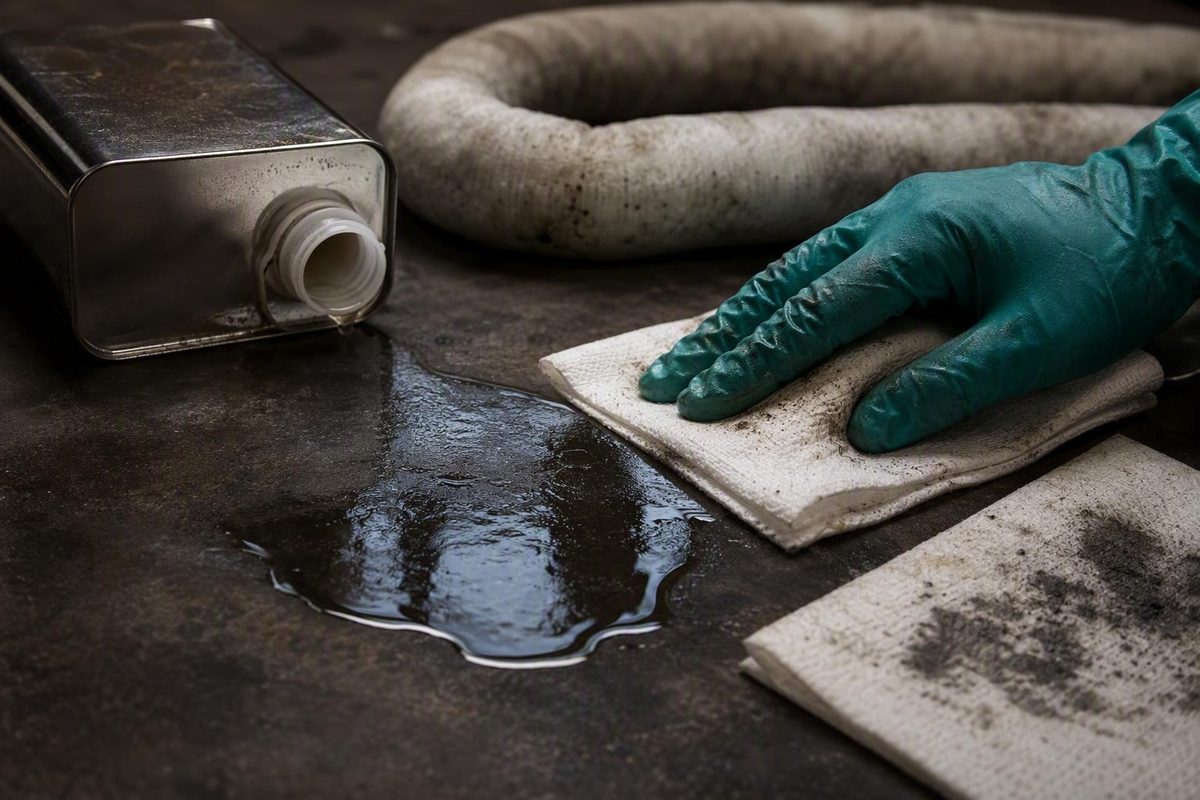
How to Clean Up a Mineral Spirits Spill
Overview
To clean up a small mineral spirits spill, first remove all ignition sources, ventilate the area, and keep other people away. Put on gloves and appropriate protection, contain the liquid so it cannot reach drains or soil, absorb it with a compatible sorbent material, then collect the contaminated waste for hazardous-waste disposal — never pour it down a drain. If the spill is large, near a drain or soil, or someone shows symptoms of exposure, stop and get outside help instead of continuing.
Mineral spirits are a solvent commonly used for thinning oil-based paint, cleaning brushes, degreasing, and general surface cleanup, which is exactly why spills happen at the workbench or brush-cleaning station. They are also flammable, so a spill is both a fire risk and a disposal problem, as disposal guides such as Angi’s overview note. The rest of this guide walks through the decision to proceed, the materials to gather, a four-step cleanup procedure, disposal, and first-aid checks.
Decide whether the spill is safe to clean up yourself
Before touching anything, decide whether this is a spill you should handle. Product safety data sheets for mineral spirits consistently direct responders to isolate the hazard area, keep unnecessary and unprotected personnel away, eliminate ignition sources, and avoid touching or walking through spilled material without appropriate protection (Odorless Mineral Spirits MSDS; CORECHEM Mineral Spirits SDS). Those same conditions give you a practical proceed-or-stop test. There is no universal spill-size cutoff you can rely on; judge by risk conditions, not volume alone.
| Situation | What it means | Next action |
|---|---|---|
| Small puddle on a hard floor, ignition sources off, area ventilated, you have gloves and absorbent | Risks are controllable with basic precautions | Proceed with the four-step cleanup below |
| You cannot remove ignition sources, or vapors are strong enough to cause dizziness or irritation | Fire or inhalation risk is not controlled | Leave the area, keep others out, and get help before cleanup |
| Spill is flowing toward a drain, sewer, soil, or surface water | Environmental release is a real possibility | Block the flow only if safe; otherwise contact local emergency or hazardous-materials services |
| Spill happened in a workplace, shop, or job site with its own procedures | An SDS or employer spill procedure applies | Follow the product SDS and workplace spill procedure rather than improvising |
| Spill is large, spreading fast, or you cannot approach without walking through it | Beyond safe DIY response | Evacuate the area and call for professional or emergency assistance |
If you work in a shop or garage with an employer or a posted procedure, the product SDS and workplace spill plan take priority over general guidance. When any row above points to “stop,” treat that as the answer even if the spill looks small.
What not to do before or during cleanup
Most spill mistakes happen in the first minute, so rule these actions out before you start. Each one either adds an ignition source, spreads contamination, or exposes you directly, based on the accidental-release measures in mineral spirits SDS documents (CORECHEM SDS; Odorless Mineral Spirits MSDS):
- Do not smoke, light flames, or create sparks anywhere near the spill — SDS guidance calls for eliminating all ignition sources in the immediate area.
- Do not rinse or push the liquid toward a sink, floor drain, or storm drain; solvent should never go down a drain, a point DoItYourself also stresses for paint thinner.
- Do not touch or walk through the spilled product without appropriate protective clothing.
- Do not use a household vacuum or aggressive mopping that can spread vapors or contaminated liquid.
- Do not mix in other chemicals or cleaners while free solvent is still on the surface.
If you have already done one of these — for example, stepped in the spill — treat contaminated shoes or clothing as part of the cleanup waste and continue carefully from Step 1.
Gather the right cleanup materials first
Collect everything before you approach the spill so you are not making trips through solvent vapors. SDS release measures call for personal protective equipment and engineering controls before contact with spilled material, and for sorbing the liquid with a compatible sorbent material (Reladyne Mineral Spirits SDS; Odorless Mineral Spirits MSDS).
A practical kit for a small spill includes:
- Chemical-resistant gloves and appropriate protective clothing, per the product SDS
- A commercial spill kit or absorbent pads rated as compatible with solvents — the safest default choice
- A way to open windows or doors, or a fan positioned to move fresh air through without blowing across ignition sources
- A sealable, solvent-suitable container for collected waste
- The product label or SDS, if you have it, for product-specific instructions
Household absorbents can work in a pinch, but the SDS-backed standard is “compatible sorbent material,” so check your product’s SDS before assuming a given material is suitable. Loose paper towels alone are a weaker option for anything more than drips: they saturate quickly, and every soaked towel becomes flammable hazardous waste you must contain, the same way solvent-soaked rags are treated in disposal guidance from Angi. You are ready to start when your protection is on, your absorbent is in hand, and a waste container is open nearby.
Clean up the spill in four steps
The order of the steps matters because each one removes a specific risk before you take on the next: first fire and exposure, then spread, then the liquid itself, then residue. This sequence is a practical synthesis of the accidental-release measures published in mineral spirits SDS documents (CORECHEM; Odorless Mineral Spirits MSDS; Reladyne). Each step below ends with an observable check — an isolated area, a contained puddle, no free liquid, or a cleaned and ventilated surface — so you know it is safe to move on.
Step 1: Isolate, ventilate, and remove ignition sources
Start by controlling who and what is near the spill. Keep children, pets, and anyone without protection out of the area — SDS guidance is to isolate the hazard area and keep unnecessary and unprotected personnel from entering (Odorless Mineral Spirits MSDS).
Then remove ignition sources and get air moving:
- Eliminate all ignition sources: no smoking, flames, or sparks in the immediate area, per the CORECHEM SDS. Turn off nearby pilot lights, heaters, and spark-producing tools if you can do so safely.
- Ventilate the area and avoid breathing vapor or mist. Open doors and windows; SDS guidance also says to ventilate closed spaces before entering them.
- Put on gloves and appropriate protective clothing before you get close, and do not touch spilled material without that protection.
Fire risk is the reason this step comes first: mineral spirits are flammable, and vapors plus a spark are a worse emergency than any spill. Step 1 is complete when you can verify three things: the area is closed off to unprotected people, fresh air is moving through, and there is no obvious flame, spark source, or hot equipment near the spill.
Step 2: Stop the source and contain the spill
If liquid is still coming out of a tipped can or leaking container, stop it — but only if you can do it without risk, which is exactly how the Odorless Mineral Spirits MSDS frames it. Righting a knocked-over can with gloved hands is usually fine; handling a damaged container is not, and the CORECHEM SDS warns against touching damaged containers without appropriate protective clothing.
Next, keep the puddle from traveling. SDS release measures direct you to contain the spill away from surface water and sewers, and to contain it as a liquid for possible recovery or sorb it with compatible material. In practice:
- Watch which way the liquid is moving and place absorbent material, pads, or a physical barrier across that path first.
- Prioritize blocking any route toward a floor drain, doorway to soil, or slope toward the street.
- Work from the outside edge of the spill inward so you are not standing in it.
Containment matters more than speed: a spill that stays in one spot on a hard floor is a cleanup task, while a spill that reaches a drain or soil becomes an environmental problem. Step 2 is complete when the liquid has stopped spreading and is no longer moving toward people, drains, soil, or anything that could ignite it.
Step 3: Absorb and collect the liquid
With the spill contained, absorb it. Apply your compatible sorbent material or spill-kit absorbent over the puddle, working from the edges toward the center. SDS guidance for released mineral spirits is to contain the spill as a liquid for possible recovery or sorb it with compatible sorbent material (Odorless Mineral Spirits MSDS), while wearing the protective equipment specified in the product’s exposure-controls section (Reladyne SDS).
Give the absorbent time to take up the liquid rather than smearing it around. Then collect it:
- Scoop or sweep the saturated absorbent with a non-sparking tool such as a plastic dustpan.
- Place all of it into your sealable, solvent-suitable waste container as you go — do not pile soaked material loosely.
- Add more fresh absorbent to any remaining wet spots and repeat until the surface no longer shows liquid.
- Put used gloves, contaminated towels, and any disposable tools into the same waste container when you finish.
Every soaked pad or towel is now flammable, contaminated waste, which is why it goes straight into a container instead of sitting in a pile. Step 3 is complete when no free liquid remains on the surface — the floor may still look damp or stained, but nothing pools, drips, or flows — and all contaminated material is inside a closed container.
Step 4: Clean residue and air out the area
Once the free liquid is gone, deal with what is left. A thin film of solvent and odor usually remains, especially indoors. Keep ventilating: SDS guidance to ventilate the area and avoid breathing vapor or mist applies until the odor has clearly faded, not just until the puddle is gone (Odorless Mineral Spirits MSDS). There is no reliable universal number for how long that takes — it depends on the spill size, the room, and airflow — so use your nose and any symptoms as the check rather than a clock.
For the residue itself, wipe the surface cautiously with disposable cloths appropriate to the material, and treat those cloths as contaminated waste too. On a sealed hard floor, gentle wiping is usually enough; DoItYourself’s guidance on working with mineral spirits similarly emphasizes gentle surface wiping and proper disposal of soaked rags. Avoid flooding the area with water, which can spread solvent film rather than remove it, and avoid harsh scrubbing on finished surfaces until you have tested a small spot.
Step 4 is complete when visible residue is removed or stabilized, wiping cloths are in the waste container, and air is still moving through the space. If a strong odor persists despite continued ventilation, keep the area closed to normal use and see the troubleshooting section below.
Surface and location notes
The same spill behaves very differently depending on what it lands on, and your judgment should change with it. The steps above assume the most common case — a hard, nonporous surface like sealed concrete, tile, or a finished workbench — where the liquid sits on top and can be contained and absorbed cleanly.
- Sealed concrete, tile, and other nonporous floors: The most straightforward case. Contain, absorb, wipe residue, and ventilate. A faint mark may remain; do not expect the procedure to guarantee a stain-free surface.
- Unfinished wood: Solvent soaks in quickly. Absorb surface liquid fast, then accept that some has penetrated; continue ventilating and avoid heat or flame near the area while it off-gasses.
- Carpet, upholstery, and fabric: Blot — do not rub — with absorbent material, keep the room ventilated, and treat the blotting material as contaminated waste. Deep saturation may not be fully recoverable with DIY methods.
- Clothing: Remove contaminated clothing rather than continuing to wear it; SDS first-aid guidance repeatedly directs removal of contaminated clothing, and the Reladyne SDS says to wash clothing separately and clean shoes before reuse.
- Outdoor concrete or asphalt near drains: Containment away from drains is the priority; see the next subsection.
The dividing line is porosity and location: hard surfaces let you recover the liquid, while porous materials, soil, and drain-adjacent spills raise the stakes.
Porous materials, soil, and drains need extra caution
If the spill has reached carpet padding, soil, or is heading toward a drain, shift from “clean it” to “stop it and assess.” SDS guidance is explicit that spills must be contained away from surface water and sewers (Odorless Mineral Spirits MSDS), and precautionary statements direct users to avoid release to the environment (Mineral Spirits SDS).
For deeply saturated carpet or fabric, blot up what you can, ventilate, and recognize that solvent trapped in padding may keep releasing vapor; if odor persists, the material may need professional cleaning or removal rather than more DIY effort. For soil, absorb any surface liquid you can reach safely, but do not assume the ground is clean once the surface looks dry — soil remediation is beyond a household procedure, and the honest next step is contacting your local environmental or hazardous-materials authority for guidance.
If any amount of solvent has actually entered a storm drain, sewer, or waterway, report it to local emergency or environmental services. The check for this subsection is simple: nothing is still flowing toward a drain or soil, and anything already released has been reported rather than ignored.
Dispose of absorbents, rags, gloves, and used mineral spirits
Cleanup is not finished until the waste is handled, because the container of soaked absorbent, rags, and gloves you just filled is now the main hazard. Objects contaminated with mineral spirits — including rags used for cleanup — should be treated as hazardous waste and disposed of accordingly, not thrown in regular household trash, as Angi’s disposal guide explains. The same source notes mineral spirits are flammable and toxic, which is why the trash can and the drain are both off the table.
Handle the waste in this order:
- Keep all contaminated absorbents, towels, rags, gloves, and wiping cloths sealed in a closed, solvent-suitable container. Closed containers isolate the material from ignition sources, the same principle behind approved flammable-liquid containers described by Eagle Manufacturing.
- Keep any recovered liquid mineral spirits in its own sealed, clearly labeled container. If the solvent is only dirty rather than mixed with other waste, guides such as The Craftsman Blog describe letting solids settle and filtering it for reuse instead of discarding it.
- Store the sealed containers in a cool spot away from flames, heat, and living spaces until you can dispose of them.
- Contact your local household hazardous waste program or waste authority to confirm accepted containers, drop-off locations, and rules. Disposal requirements vary by jurisdiction, and no single procedure applies everywhere.
Do not pour leftover or recovered solvent down any drain, and do not let soaked rags sit loose or piled — solvent-soaked rags are a recognized fire and hazardous-waste concern in both use and disposal guidance. Disposal is complete when every contaminated item is sealed, labeled where appropriate, stored away from ignition sources, and scheduled for a route your local program actually accepts.
Check for exposure and use first aid when needed
After the cleanup, check yourself and anyone nearby for exposure. The guidance below reflects general first-aid measures published in mineral spirits SDS documents; formulations vary, so the SDS or label for your specific product is the authoritative reference.
- Inhalation: If you feel dizzy, nauseated, or notice respiratory irritation after breathing vapors, move to fresh air and rest in a comfortable position for breathing. Seek immediate medical help if irritation, dizziness, nausea, or unconsciousness occurs (Mineral Spirits SDS); one SDS directs calling a poison center or doctor after inhalation exposure (2020 mineral spirits SDS).
- Skin contact: Remove contaminated clothing and wash the skin with plenty of soap and water. Get medical attention if irritation persists, per SDS first-aid procedures.
- Eye contact: Flush eyes with water immediately. The Reladyne SDS specifies flushing for a minimum of 15 minutes, occasionally lifting and lowering the upper lids, and getting medical attention promptly.
- Ingestion: Do not induce vomiting. Immediately call a poison center or doctor — SDS precautionary statements are explicit on both points.
If someone has difficulty breathing or loses consciousness, treat it as an emergency and call emergency services; SDS guidance includes administering oxygen if breathing is difficult and getting medical attention immediately (CORECHEM SDS). The general rule across every SDS reviewed here: when in doubt, or if you simply feel unwell after exposure, get medical advice rather than waiting it out.
Success check and troubleshooting
Before the area returns to normal use, verify the outcome rather than assuming it. A successful cleanup looks like this:
- No free liquid remains anywhere on the surface, including under nearby objects.
- All contaminated absorbents, rags, gloves, and cloths are sealed in a suitable container, stored away from heat and flame, and routed toward local hazardous-waste disposal.
- No solvent reached a drain, sewer, soil, or surface water — and if any did, it has been reported.
- The area has been continuously ventilated, and the odor is clearly fading.
- No one involved has symptoms such as dizziness, nausea, or persistent irritation.
If something still seems wrong, match the symptom to the fix. A persistent strong odor despite ongoing ventilation usually means solvent soaked into a porous material — recheck unfinished wood, carpet padding, or fabric, and keep the space ventilated and ignition-free rather than reopening it for normal use. A reappearing wet spot means liquid was trapped under or inside something; contain and absorb it as a fresh small spill. If you discover the spill reached a drain or soil after the fact, contact local emergency or environmental services rather than treating it as finished. And if anyone develops symptoms hours later, use the first-aid guidance above and seek medical advice. There is no supported universal re-entry time, so let these observable conditions — not a clock — decide when the job is done.
A small garage-floor example
Suppose you knock over an open can of mineral spirits while cleaning brushes, leaving a dinner-plate-sized puddle on sealed garage concrete. You move the kids and dog inside, open the garage door, and confirm the water heater pilot and any tools are well away from the spill. Wearing gloves, you right the can — the source is stopped — and lay absorbent pads across the side of the puddle closest to the driveway drain so nothing can flow that way. You cover the rest of the puddle, wait for it to soak up, scoop everything into a sealable container, and repeat until no liquid remains. A quick wipe with a disposable cloth handles the residue, and the cloth and gloves go into the same container. You leave the garage door open, seal and label the container, and check your local household hazardous waste program for drop-off rules. When the odor has faded and nothing wet remains, the garage goes back to normal use.