 StainList
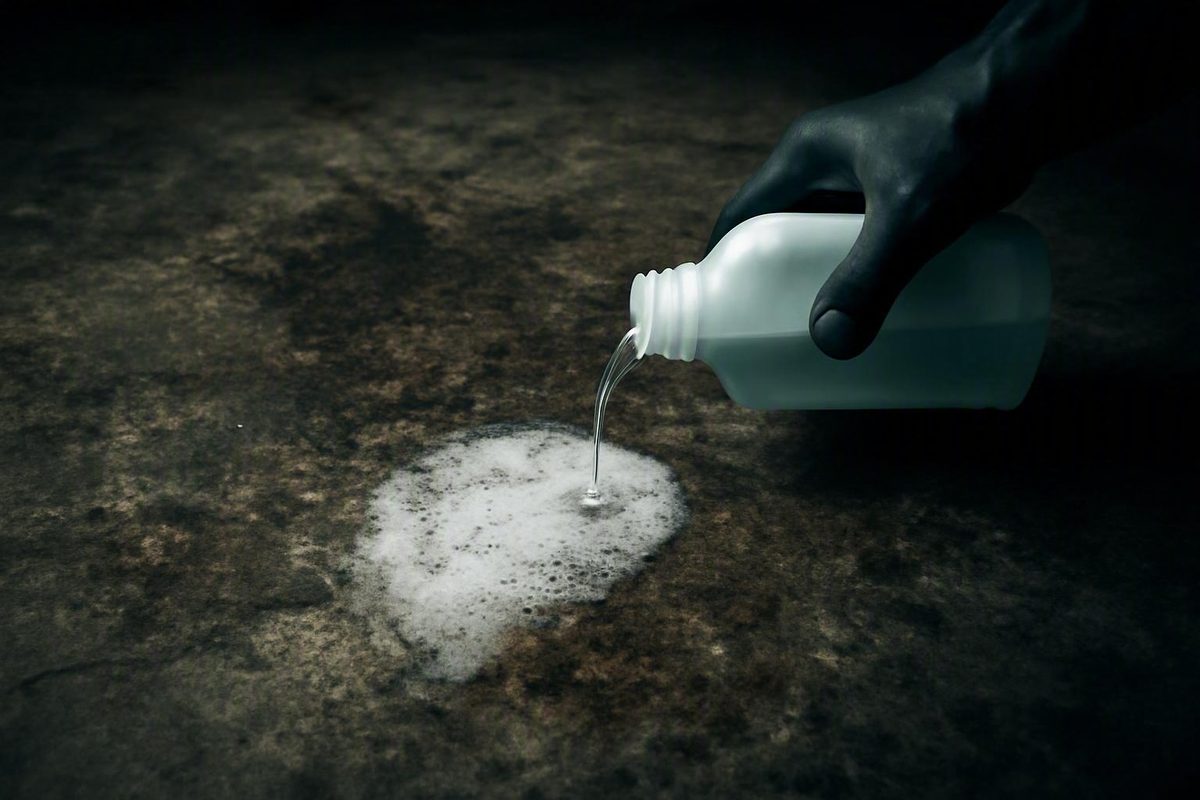
Cleaning concrete with muriatic acid is not simply a stronger form of washing. Muriatic acid is aqueous hydrochloric acid—a corrosive chemical that reacts with calcium-containing material and can remove part of the concrete surface itself.
That reaction gives acid a narrow role in removing certain mineral deposits and, where expressly permitted, etching concrete before a coating. It also makes acid ineffective or unnecessarily destructive for many ordinary stains.
Before opening a container, identify three things:
- What is on the concrete?
- What condition is the concrete in?
- Is the goal deposit removal or preparation for a coating?
If any answer is uncertain, the next step is diagnosis—not a stronger acid mixture. This article is a decision and risk guide, not a complete chemical-handling protocol. The current label and complete safety data sheet for the exact product must control any product-specific work.
First Decide Whether the Concrete Actually Needs Acid
Use both the contaminant and the project goal to choose a method.
| What you see or need to do | Is muriatic acid appropriate? | Better first step |
|---|---|---|
| Loose white powder or a suspected mineral deposit | Possibly, but only after identification | Dry-brush and collect loose material; investigate the moisture source |
| Calcium-based residue or mortar smear | Possibly, if the product documentation and substrate permit it | Begin mechanically where practical; seek product-specific guidance before using acid |
| Dirt, mud or tracked-in soil | Usually not | Use detergent or a cleaner selected for the contaminant |
| Oil or grease | No—not as the primary cleaner | Absorb fresh oil, then use an appropriate alkaline degreaser |
| Paint, sealer or an existing coating | No—acid is not a reliable stripper | Use coating-specific stripping or mechanical removal |
| Preparation for paint or epoxy | Only if the coating manufacturer expressly permits it | Check the required surface profile; mechanical preparation is often preferred |
| Unknown stain or unidentified white material | Stop | Identify it or consult the relevant manufacturer or a concrete professional |
Muriatic acid may dissolve some calcium-based deposits, including some efflorescence and mortar residue. It can also chemically etch a cementitious surface. These are different tasks: deposit removal aims to remove unwanted material, while etching intentionally changes the concrete itself.
Acid is not a general-purpose concrete cleaner. It does not reliably remove oil, grease, curing compounds, paint, sealers or existing coatings. If those barriers remain, acid may react with exposed areas while leaving covered areas substantially unchanged.
For fresh grease, use an absorb-first method instead. Press cat litter or sawdust into the spill, allow it to collect free oil, remove it, and then use an appropriate alkaline degreaser according to its label. This follows Stain List’s grease guidance for concrete and pavers. Keep degreasing and any later chemical process separate; never combine cleaners.
White material requires more diagnosis than its color suggests. It may be loose efflorescence, mortar residue, another lime-rich deposit or a different material entirely.
Bubbling during acid contact is also not a conclusive identification test. Concrete contains acid-reactive cementitious material, so fizzing may mean only that acid has reached the slab. It does not prove that the material is efflorescence, that the treatment is suitable or that more acid is required.
If you cannot distinguish a mineral deposit from paint, sealer, oil, biological growth or deteriorated concrete, stop. Consult the chemical manufacturer, the maker of any intended coating or a concrete-preparation professional.
What Muriatic Acid Does to Deposits—and to Concrete
Hydrochloric acid reacts with calcium carbonate to form calcium chloride, water and carbon dioxide:
CaCO₃ + 2HCl → CaCl₂ + H₂O + CO₂
The released carbon dioxide accounts for bubbling when this particular reaction occurs. A chemical supplier describes the reaction as the basis for dissolving calcium-based scale, mortar residue and related deposits while warning that concentration and substrate sensitivity affect the result (Alliance Chemical’s technical guide).
The problem is that acid does not recognize a boundary between an unwanted deposit and sound concrete. Once it penetrates the deposit—or is placed directly on exposed concrete—it can react with the cement paste at the surface. At that point, it is etching rather than merely removing a stain.
A limited, controlled reaction may remove a thin calcium-based residue. Excessive or uneven exposure can instead cause:
- A rough or patchy finish
- Uneven porosity
The risk increases when the chemical is unsuitable for the task, the working strength is wrong for the product, contact is prolonged, the surface is treated unevenly or applications are repeated. Differences in finishing, curing, contamination and existing porosity can also make one part of a slab react faster than another.
Over-etching does not automatically mean that an entire slab has suffered structural failure. Severity depends on the concrete, the chemical strength and the depth and duration of attack. Increased surface porosity can nevertheless create moisture-management concerns and, in relevant reinforced concrete, contribute to conditions associated with corrosion.
Do not use the intensity of bubbling as a dosage indicator. Vigorous fizzing does not measure deposit thickness or cleaning success. Little or no bubbling does not prove that the mixture is too weak; the material may not be calcium-based, or a coating or oily contaminant may be blocking contact.
That is the central tradeoff: the reaction that allows muriatic acid to dissolve calcium-containing material is also the reaction that allows it to attack concrete.
Stop-Work Checklist: Surfaces and Conditions That Need Another Method
Do not begin—or stop immediately—if any of the following applies:
- [ ] The deposit or stain has not been identified with reasonable confidence.
- [ ] The exact product label and complete, current safety data sheet are unavailable.
- [ ] The hydrochloric-acid concentration cannot be verified.
- [ ] You cannot meet every protective-equipment requirement in the product documentation.
- [ ] The required ventilation and exposure controls cannot be provided.
- [ ] Other people, children or animals cannot be excluded from the work area.
- [ ] Nearby surfaces and fixtures cannot be isolated from liquid and vapor exposure.
- [ ] You do not have location-specific instructions for containing and disposing of wastewater.
- [ ] The work is near an uncontrolled drain, soil, landscaping or waterway.
- [ ] The concrete is decorative, colored, stamped, polished, cracked, spalled, scaling, weak or otherwise damaged.
- [ ] The surface is sealed, painted, oily or previously coated.
- [ ] The project is indoors, extensive or difficult to control.
- [ ] You do not know what condition an intended coating requires.
- [ ] The product documentation does not expressly support the intended use.
Do not use muriatic acid on marble or limestone. Both are calcium-rich stones that can be visibly etched or dissolved. Keep it away from aluminum and uncoated steel as well.
Metal pails, watering cans, brushes and mixing tools are unsuitable. Hydrochloric acid corrodes many metals and may generate flammable hydrogen when it reacts with some of them. A supplier guide calls for compatible plastic equipment and warns against aluminum, uncoated steel and reverse mixing, but its general article cannot replace the exact product label or complete SDS (Alliance Chemical’s material and handling guidance).
Water beading can suggest that a sealer may be present, but it is not a definitive coating test. If a sealer or coating is present, acid cannot etch effectively through it; appropriate stripping or mechanical removal may be necessary.
Decorative and damaged concrete require particular caution. Cracks, spalls, scaling, dusting and soft areas may indicate conditions that cannot be addressed through generic washing.
Survey the surrounding area, not only the slab. Natural stone, metal fixtures, appliance components, garage-door tracks, drains, landscaping, joints and adjacent soil can all be affected by vapor, splashes or uncontrolled liquid movement.
Professional concrete-preparation help is the safer choice when the project is indoors or poorly ventilated, covers a large area, involves a valuable finish or cannot be completed under the chemical manufacturer’s required controls.
Dilution Starts With the Percentage on the Label or SDS
Commercial muriatic-acid products are sold at different hydrochloric-acid concentrations. The percentage on the label or in the SDS is therefore the starting point—not a ratio copied from a forum, video or general article.
A water-to-acid ratio developed for one starting concentration will produce a different working strength when used with a weaker or stronger product.
Some supplier literature publishes different ratios for light deposits, heavier mortar residue and deliberate etching. Those figures are product- and concentration-specific examples, not independent industry standards or universal recipes. Repeating them without the exact product documentation would turn limited supplier guidance into a potentially unsafe generic procedure.
For that reason, this article does not provide a dilution recipe or calculator. Before any dilution is considered:
- Verify the exact product and hydrochloric-acid percentage.
- Obtain the current label and complete SDS.
- Confirm that the intended use is permitted.
- Follow the manufacturer’s specified equipment, sequence and controls.
- Contact the manufacturer if the product concentration or task differs from the documented procedure.
Do not extrapolate casually from instructions written for another product. Nominal acid percentage is not the only variable; the deposit, concrete condition, additives and intended outcome can also affect suitability.
More acid is not automatically the answer to a persistent mark. Lack of improvement may indicate the wrong contaminant, a sealer, oil, paint, incompatible concrete or continuing moisture movement. Increasing strength, extending contact or repeating treatment can deepen etching without removing the original material.
The Cautious Workflow for a Confirmed Mineral Deposit
Because the available general guidance does not supply a complete product-specific safety, emergency and wastewater protocol, the following is a go/no-go workflow, not an executable acid-washing recipe.
1. Confirm the task and inspect the substrate
Establish that the material is plausibly a calcium-based deposit and that the surface is sound, uncoated concrete. Look for color treatments, polishing, repairs, cracks, soft areas, spalling and exposed aggregate.
Determine whether moisture is continuing to carry salts to the surface. If so, deposit removal may improve appearance without preventing recurrence.
2. Remove loose material and incompatible contamination
Dry-brush and collect loose mineral material first. A powdery deposit may be reduced substantially without exposing the slab to acid.
If oil or grease is present, use an appropriate degreasing process instead. Acid does not reliably remove petroleum contamination, and oily areas can cause an uneven reaction.
Do not move between chemical products unless the applicable manufacturers provide a compatible sequence. Never combine cleaners.
3. Obtain the exact product documentation
Read the complete label and SDS before deciding whether the work can proceed. Those documents—not a generic article—must govern:
- Required protective equipment
- Ventilation and exposure controls
- Compatible containers and tools
- Dilution and application, if permitted
- Chemical incompatibilities
- Spill and exposure response
- First aid
- Storage and handling
- Rinsing or neutralization
- Waste collection and disposal
A general supplier guide cannot fill gaps in a missing or incomplete SDS. If the documents are unavailable, unclear or inconsistent with the proposed use, stop and contact the manufacturer.
Do not reuse a container that may contain chemical residue, and do not improvise a household neutralizer or mixing sequence.
4. Decide whether the location is controllable
Before opening the chemical, determine whether you can:
- Exclude other people and animals
- Protect vulnerable stone, metal and finished surfaces
- Provide the required ventilation
- Prevent liquid from reaching drains, soil or landscaping
- Collect all working liquid and rinse water
- Follow the product’s spill and emergency instructions
- Complete the process without leaving the treated surface or waste unattended
If containment depends on deciding what to do after rinsing begins, the project is not ready.
5. Confirm that a test is permitted
Product-specific guidance may require an inconspicuous test area to evaluate deposit response, color change and surface attack. Do not conduct an informal acid test merely to identify an unknown stain.
Any test still creates corrosive liquid and wastewater. It should proceed only when the exact product documentation supports the substrate, application and containment method.
An unacceptable test result is a reason to select another method—not an invitation to keep changing the mixture.
6. Follow only the documented product method
Supplier procedures may include prewetting, limited section sizes, agitation, controlled contact and prevention of drying. The appropriate conditions depend on the exact product and task.
This article intentionally does not generalize supplier contact times, prewetting periods or mixing ratios. Applying a duration or strength from another product can produce a materially different exposure.
If the product documentation does not provide enough information to perform the task safely and control the wastewater, do not proceed.
7. Treat loss of control as a stop condition
Stop if the work departs from the documented method or if you cannot maintain the required access, ventilation or containment controls.
Unexpected finish loss, pronounced color change, aggregate exposure or surface softening may indicate damaging attack, but visual observations do not provide a complete assessment. Follow the product’s shutdown, rinsing and spill instructions rather than improvising additional chemicals.
8. Complete the specified rinsing and waste process
Rinsing is not proof that the surface is neutral, that residues are absent or that the liquid can be discharged. Complete every manufacturer-specified rinsing, verification and collection step.
Keep people and animals away until the surface, equipment and collected waste have been handled as directed.
9. Reassess only after the surface is dry
Once the documented process and waste handling are complete, inspect the dry surface under consistent lighting.
If the deposit remains, reassess its identity and source. Do not schedule repeated acid applications by default. Recurrence may reflect continuing moisture movement rather than an inadequate acid dose.
Rinsing, Neutralization, pH Checks and Runoff Control
Rinsing, any specified neutralization, surface verification and wastewater management are integral parts of the project. They are not optional housekeeping after the visible cleaning is finished.
General supplier literature discusses several neutralizing chemicals and example quantities. Those examples are not safe universal instructions because the required amount depends on the acid product, concentration, quantity and material already consumed through reaction. This article therefore does not provide a household neutralizer recipe.
Do not use ammonia as an improvised neutralizer. Do not mix acid with bleach, ammonia or other cleaners.
If the exact product requires a neutralization step, follow that procedure without substituting household mixtures. Where the manufacturer specifies surface pH testing, use the stated measurement method and acceptable range. Appearance, touch or lack of bubbling cannot establish that the surface is ready for use or coating.
Surface pH and wastewater condition are separate questions. A satisfactory reading from one location on a slab does not establish that collected liquid is suitable for disposal.
Neutralizing acidity also does not grant permission to release the liquid. Sherwin-Williams notes that disposal of acid-etching rinse solution may be restricted because of risks to waterways; the applicable wastewater authority must determine what collection or disposal method is permitted at the project location (Sherwin-Williams on acid etching and rinse-water concerns).
Before beginning, obtain location-specific instructions covering potential discharge to:
- Storm drains
- Sanitary sewers
- Streets or gutters
- Soil or gravel
- Landscaping
- Ponds, streams or other waterways
No general article can grant disposal permission. If the applicable authority or waste provider has not confirmed a lawful route, do not begin a process that will generate corrosive or contaminated wastewater.
Why Acid Etching Often Falls Short Before Paint or Epoxy
Mineral-deposit removal and coating preparation are separate projects. A slab may look cleaner after a deposit is removed yet still lack the cleanliness, soundness, profile, pH or moisture condition required for paint or epoxy.
Acid cannot etch effectively through oil, grease, curing compounds, sealers, paint or existing coatings. Those barriers must be removed using appropriate cleaning, stripping or mechanical methods. Otherwise, exposed areas may etch while protected areas remain comparatively smooth.
Sherwin-Williams states that most coating manufacturers no longer recommend acid etching for concrete preparation and describes mechanical methods as more consistent for modern resinous flooring. It reports that acid etching generally creates only a CSP-1 to CSP-2 Concrete Surface Profile, while many thicker resinous systems require profiles within the CSP-3 to CSP-9 range (Sherwin-Williams’ concrete-preparation comparison).
A CSP number describes surface roughness; it is not a general quality score. A more aggressive profile is not automatically better. The required profile depends on the coating system, thickness, slab condition and manufacturer instructions.
Common preparation options include:
| Method | General role | Selection question |
|---|---|---|
| Diamond grinding | Mechanical removal and profiling | Does the coating specification permit it, and what tooling and dust controls are required? |
| Shot-blasting | Mechanical profiling across suitable floor areas | Is it appropriate for the slab condition and required profile? |
| Scabbling | Aggressive removal of surface material | Is that degree of removal required, or would it be excessive? |
| Coating-specific stripping | Chemical removal of certain paint or sealer systems | Is the stripper compatible, and how must residue be removed? |
| Acid etching | Shallow chemical alteration of exposed cement paste | Does the coating manufacturer expressly allow it for this slab and system? |
The preparation method must come from the intended coating’s technical data. A floor can feel rough while remaining contaminated, or it can be clean but have the wrong profile.
Acid etching also introduces substantial water. That can extend drying and affect moisture-management decisions. A stated waiting period alone cannot establish coating readiness.
Before coating, confirm all of the following:
- [ ] Oil, grease, curing compounds, sealer, paint and old coatings have been removed.
- [ ] Weak or unsound surface material has been addressed.
- [ ] The specified surface profile has been achieved uniformly.
- [ ] Acid, neutralizer and rinse residues are absent.
- [ ] Final surface pH meets the coating manufacturer’s test method and range.
- [ ] The slab’s moisture condition has been evaluated as required.
- [ ] Repairs and joints comply with the coating specification.
- [ ] Environmental and drying conditions meet the technical data sheet.
- [ ] The preparation method complies with warranty requirements.
If the coating manufacturer requires grinding, shot-blasting or another mechanical process, acid washing is not an equivalent substitute.
Troubleshooting: What Patchy, Weak or Absent Reactions May Mean
A disappointing reaction is diagnostic information. It is not an automatic instruction to increase chemical strength or contact.
Little or no reaction
Possible explanations include:
- The deposit is not primarily calcium-based.
- Oil or grease is preventing contact.
- Paint, sealer or another coating is present.
- The concrete is highly polished or otherwise unsuitable.
- The product or proposed method does not match the task.
- The surface should not be acid-treated at all.
Water beading may justify further investigation for a sealer, but it does not prove that a coating is present. Identify the surface treatment through manufacturer records or qualified assessment rather than escalating the acid.
Patchy reaction
Uneven reaction or appearance can reflect:
- Variable contamination
- Residual coating
- Uneven application
- Previous repairs
- Differences in finishing or curing
- Existing porosity variation
- Areas already worn or etched
- Different deposit thicknesses
Do not chase low-reaction areas with stronger or undiluted acid. The protected or misidentified material may remain while the surrounding concrete becomes more deeply etched.
The surface looks rougher, lighter or more exposed
Pronounced aggregate exposure, sudden roughness, marked color change or surface softening may indicate damaging attack. Follow the product’s shutdown and containment instructions and do not resume treatment until the condition has been assessed.
The appropriate response depends on the depth of attack, the original finish, the intended use and whether the remaining surface is sound. Decorative, cracked, spalled, weak or heavily etched concrete may require professional evaluation.
Choose the alternative that matches the problem
| Problem | First-line alternative | Why it fits better |
|---|---|---|
| Loose white powder | Dry brushing and collection | Removes loose material without attacking the slab |
| Recurring efflorescence | Investigate moisture entry or movement | Cleaning alone does not stop continued salt transport |
| Fresh oil or grease | Absorbent material, then an appropriate alkaline degreaser | Targets oily contamination rather than cement paste |
| Paint | Coating-specific removal or mechanical preparation | Acid is not a reliable paint stripper |
| Sealer or existing coating | Compatible stripping or specified mechanical removal | The barrier must be removed before profiling |
| Ordinary soil | Detergent and controlled scrubbing | Acid is unnecessarily aggressive |
| Deeper coating profile required | Grinding, shot-blasting or the specified mechanical method | Produces the profile required by the coating system |
| Decorative or damaged concrete | Professional assessment | Generic acid treatment may irreversibly alter the finish |
The practical rule is simple: when the surface response does not match the confirmed task and product instructions, reassess the diagnosis instead of increasing chemical aggressiveness.
Frequently Asked Questions
Will muriatic acid remove oil or grease stains from concrete?
Not reliably. Oil and grease are not calcium-based mineral deposits, and acid does not provide the degreasing action needed to remove them. It may etch exposed concrete around oily areas and leave an uneven surface.
For fresh contamination, collect free oil with a suitable absorbent and then use an appropriate alkaline degreaser according to its label. Do not combine the degreaser with acid.
What dilution of muriatic acid should be used on concrete?
There is no universal ratio. The hydrochloric-acid percentage, exact product, intended task and substrate condition must all be considered.
Use only instructions for the exact product and application. Do not copy a ratio developed for another acid concentration, and do not use a generic calculator to extrapolate one. If the current label and complete SDS do not provide adequate direction, contact the manufacturer or do not proceed.
Does bubbling prove that a white deposit is efflorescence?
No. Bubbling may indicate a reaction with calcium-containing material and the release of carbon dioxide, but it does not identify the material conclusively.
The acid may be reacting with a deposit, mortar residue or the concrete itself. Fizzing does not measure cleaning success or establish that continued acid treatment is appropriate. Lack of bubbling does not mean that stronger acid is required.
Is muriatic acid a good way to prepare concrete for epoxy?
Often not. Acid cannot etch effectively through oil, curing compounds, paint, sealers or existing coatings, and it may produce an uneven or insufficient surface profile.
Check the epoxy manufacturer’s technical data before choosing a method. Many resinous systems require mechanical preparation such as grinding or shot-blasting. Even when acid etching is expressly permitted, coating readiness still depends on cleanliness, profile, residue removal, pH, moisture condition and warranty compliance.
Can neutralized muriatic-acid rinse water go down a drain?
Not automatically. Changing the pH does not prove that the liquid is free of dissolved concrete, metals, coating residue, oil or other contaminants. It also does not grant permission to discharge the water into a storm drain, sanitary sewer, soil or waterway.
Obtain instructions from the applicable local wastewater or environmental authority before beginning. Plan collection and disposal in advance. If a permitted route has not been confirmed, do not start the project.
Muriatic acid has a narrow role when a confirmed calcium-based deposit or an expressly permitted etching task justifies it. It is the wrong tool for many common concrete stains and modern coating projects.
If you cannot verify the contaminant, product concentration, substrate compatibility, required protective measures, ventilation, runoff controls and downstream coating specifications, choose a problem-specific cleaner or specified mechanical method—or stop and consult the chemical manufacturer, coating manufacturer or a concrete-preparation professional.