 StainList
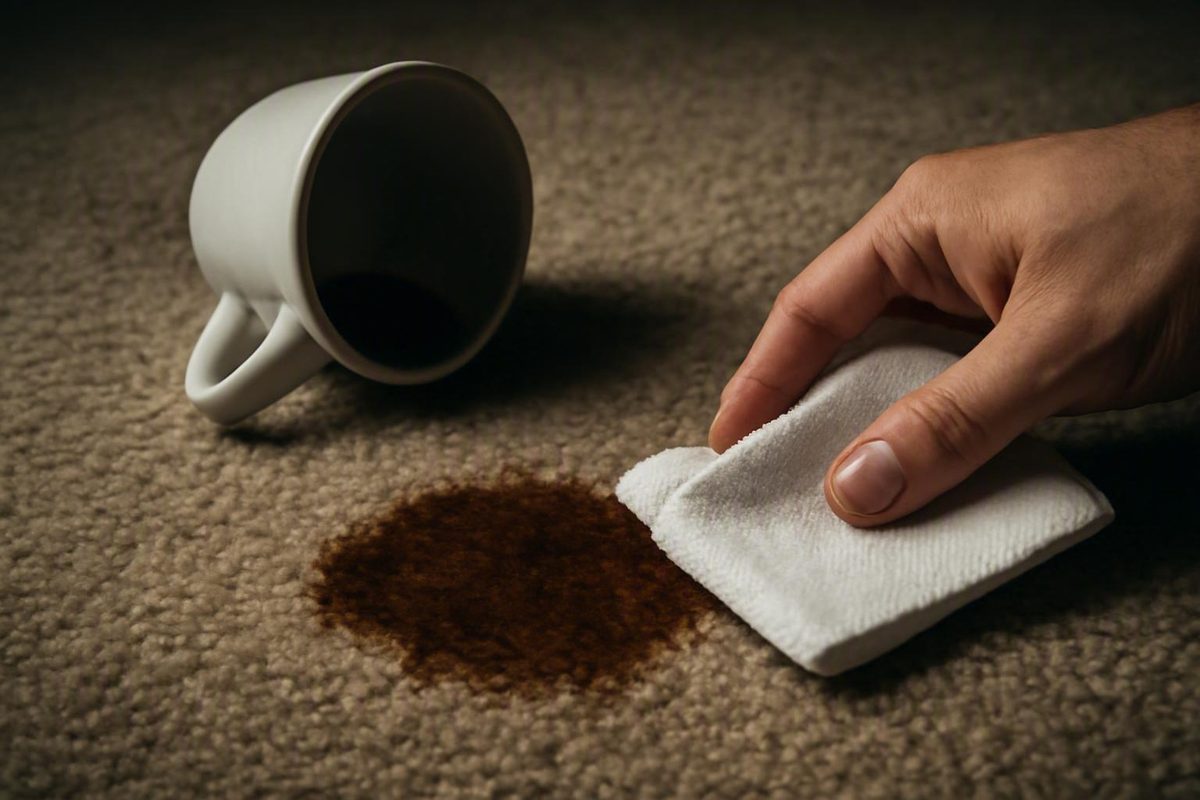
Coffee is easiest to manage while it is still wet, but speed should not come at the expense of the carpet.
Complete removal cannot be guaranteed, especially if coffee has reached the backing or padding, dried after heat exposure, or discolored an absorbent natural fiber.
Evidence note: This procedure synthesizes common guidance from commercial flooring retailers, carpet cleaners, and cleaning-service publishers. The available sources do not provide controlled comparative testing that establishes one universal formula for every carpet, so the carpet manufacturer’s instructions and the cleaner label take priority.
What to do in the first few minutes
For a fresh spill, begin with this emergency checklist:
- Pick up the cup and remove any solids without pressing them into the pile.
- Cover the spill with a clean white cloth or plain white paper towels.
- Press to absorb the liquid, then lift the cloth.
- Rotate to a clean section and repeat.
- Work from the outer edge toward the center.
- Continue until little or no coffee transfers.
Blot—do not rub or scrub. Rubbing can spread the wet boundary, push coffee farther into the pile, and distort or fray carpet fibers. Working inward helps prevent the affected area from expanding. These precautions are reflected in COIT’s carpet-stain guidance.
Use white absorbent material rather than a colored towel. A colored cloth may transfer its own dye, while a white cloth makes it easier to monitor what is coming out of the carpet. If carpet dye appears on the cloth, stop adding water or cleaner.
Do not begin by:
- Flooding the spot with water
- Scrubbing with a brush or abrasive sponge
- Applying steam, a hair dryer, or another heat source
- Combining several cleaners
- Covering the spill with cleaner before absorbing the free liquid
- Assuming a stronger or more concentrated formula will work better
Excess water can carry the spill into the backing, extend drying, and contribute to a spot returning. Excessive heat may also make a stain more difficult to remove. Carpet One cautions against vigorous scrubbing, excessive water, and excessive heat in its coffee-stain treatment guidance.
Keep replacing or repositioning the towels until they no longer become quickly saturated. For a substantial spill, use fresh towels instead of pressing a coffee-soaked section back into the carpet.
It also cannot guarantee reversal of discoloration on wool, cotton, or another absorbent natural fiber. The immediate goal is controlled extraction, not instant perfection.
A low-risk method for a fresh coffee stain
After absorbing the free liquid, use a gradual blot–dilute–blot process:
- Dampen a clean white cloth with cool water.
- Dab the remaining mark without saturating the pile.
- Blot immediately with a separate dry white cloth.
- Check whether coffee is transferring.
- Repeat cautiously while transfer and visible improvement continue.
- If water is insufficient, move to a compatible carpet cleaner.
- Rinse away cleaner residue sparingly and blot until nearly dry.
Cool water is a conservative default because published recommendations vary among cold, cool, lukewarm, and warm water. If the carpet manufacturer, rug care label, or cleaner label specifies a temperature, follow that instruction instead.
Apply water with a damp cloth rather than pouring it onto the carpet. This gives you more control over the treatment boundary and the amount entering the pile. Blot after each application instead of continuously adding liquid.
There is no evidence-supported universal volume of water or cleaner for a stain of a particular diameter. Add liquid incrementally and stop before the backing becomes saturated. Flooring America likewise recommends using only a small amount of water and warns that excessive moisture can affect the backing in its fresh and dried coffee-stain instructions.
If water stops producing improvement, check the carpet’s care information. Choose a cleaner explicitly labeled for the carpet or fiber, then follow its directions for quantity, dilution, application, and dwell time. Do not improvise a stronger concentration.
Patch-test the cleaner before treating the visible spot. Even a product broadly described as carpet-safe may not be suitable for every dye, blend, backing, adhesive, or applied finish.
To apply an approved cleaner:
- Put the specified amount on a white cloth rather than directly on the carpet.
- Dab from the outside toward the center.
- Allow only the dwell time stated on the label.
- Blot with a clean, dry cloth.
- Reapply only if the label permits it and the carpet remains stable.
Afterward, dampen another cloth with a small amount of clean cool water and dab the treated area to remove residue, unless the product specifies a different rinse procedure. Blot repeatedly until the carpet is only slightly damp.
Rinsing matters because excess soap or cleaning solution can dry in the pile. More cleaner is therefore not necessarily more effective. Commercial carpet-care guidance also warns against excessive cleaning solution, residue buildup, scrubbing, and over-wetting; see TruRinse’s discussion of common DIY carpet-cleaning mistakes.
How to remove a dried or old coffee stain
A dried stain needs gentle rehydration before extraction. The purpose is to loosen dried material, not to soak the carpet.
- Dampen a white cloth with cool water.
- Dab the dried area lightly.
- Pause only long enough for the mark to soften.
- Blot with a dry white cloth from the perimeter inward.
- Continue until loosened coffee stops transferring.
- Patch-test a carpet-compatible cleaner.
- Dampen a cloth with the cleaner and dab the stain.
- Follow the cleaner’s labeled dwell time.
- Blot out the cleaner, rinse sparingly, and extract moisture.
Some published methods use warm water to rehydrate old coffee, while others recommend cool or lukewarm water. In the absence of carpet-specific instructions, cool water is the cautious default. Molly Maid illustrates the broader rehydrate-and-blot sequence in its instructions for old coffee stains, although its homemade formula should not be treated as universally compatible.
Do not pour cleaner directly onto the mark. Dampen a cloth and dab the pile so you can control the amount and treatment area. Follow the product’s stated dwell time and dilution. If the label does not provide those directions, do not invent them.
After the labeled contact time, blot with a fresh white towel. Rinse with a small amount of cool water applied through a cloth, then blot until only slight dampness remains.
A cautious second treatment may be reasonable if the carpet remains stable and the cleaner allows it, but there is no universally safe number of treatment cycles. Stop if:
- The spot expands
- The carpet becomes progressively wetter
- Carpet color transfers to the cloth
- The treated area becomes lighter
- The pile becomes rough, stiff, fuzzy, or distorted
- The backing appears wet
- The stain stops improving
Age, previous heat exposure, deep penetration, and fiber type can all limit removal. An old mark on wool or another natural fiber may remain visible even after responsible treatment.
If somebody previously applied an unidentified product, do not layer a new cleaner over it. Consult the carpet or cleaner manufacturer where possible. If a minimal water rinse is permitted for that carpet, it may help remove residue; otherwise, obtain professional advice before applying another treatment.
Black coffee versus coffee with milk, cream, or sugar
Plain coffee leaves a visible brown mark and residue. Coffee containing milk, cream, flavored creamer, syrup, or sugar can leave additional material in the carpet.
Milk and creamer may contribute protein and fat. Sugar and syrup may leave a sticky film, while flavorings can add oils, dyes, or odor. The brown color can therefore disappear even though dairy, oil, sweetener, or cleaner residue remains.
Begin with the same conservative sequence:
- Absorb the free spill.
- Dab with a small amount of cool water or a compatible cleaner.
- Blot after every application.
- Rinse sparingly.
- Extract as much moisture as possible.
- Let the area dry completely before judging the result.
Once dry, assess the area by sight, touch, and smell. Tackiness can indicate sugar or cleaner residue. A sour or stale smell may indicate remaining dairy contamination. A spot that darkens by attracting soil may reflect residue rather than the original coffee color.
If dairy residue or odor remains, consider an enzyme treatment only when the product is labeled for carpet and compatible with the particular fiber, dye, backing, and finish. Patch-test it first, then follow the label for application, dwell time, rinsing, and ventilation. Do not use a homemade laundry-detergent dilution as a universal standard.
Commercial guidance recognizes that cream, sugar, flavored creamer, and syrup can leave proteins, fats, oils, sugars, dyes, or odors beyond the visible stain. It also recommends additional caution for delicate carpets, as summarized in Mint Condition’s coffee-stain guidance.
Remove enzyme-cleaner residue according to its label and extract moisture thoroughly. Leaving sugar or cleaner in the pile can cause stickiness, hold soil, and make it difficult to tell whether the original spill is gone.
Seek professional assessment when:
- A sour dairy odor remains after drying
- A large quantity of milk or creamer was spilled
- The carpet remains sticky after a careful rinse
- The liquid probably reached the backing or pad
- The treated area repeatedly darkens
- Carpet color or texture changes appear
A small surface drip and an entire mug of sweetened latte should not be treated as equivalent.
Check the carpet before using vinegar, peroxide, or other remedies
Household remedies are widely recommended, but no single mixture is safe for every carpet. The manufacturer’s care instructions, the cleaner label, and the terms of any applicable warranty should guide the decision. Warranty conditions vary, so consult the terms for the particular carpet rather than assuming that a treatment will or will not affect coverage.
Two carpets described as nylon, polyester, polypropylene, or wool may use different dyes, blends, backings, adhesives, stain-resistant treatments, and construction methods.
Before applying any cleaner, use this patch-test protocol:
- Choose a hidden area, such as inside a closet or beneath furniture.
- Apply a tiny amount with a white cloth.
- Blot rather than rub.
- Remove excess moisture as you would on the stain.
- Let the test area dry completely.
- Inspect it in good light.
- Compare its color and texture with the untreated carpet.
Look for fading, color transfer, darkening, stiffness, fuzziness, pile distortion, backing changes, or a visible boundary. The supplied evidence does not establish a universal drying period for every carpet and treatment, so evaluate the test only after it is fully dry. As a conservative precaution, do not assume that a small successful test authorizes a larger quantity or longer exposure than the product label permits.
Dish soap and vinegar
Several commercial guides publish mixtures of liquid dish soap, white vinegar, and water. A commonly repeated recipe is:
- 1 tablespoon liquid dish soap
- 1 tablespoon white vinegar
- 2 cups water
Those exact proportions appear in Molly Maid’s dish-soap-and-vinegar coffee-stain method. This is recurring commercial guidance, not independent proof that the mixture is optimal or safe for every carpet.
Dish soap can leave residue if it is too concentrated or inadequately rinsed. Vinegar compatibility depends on the carpet, dye, backing, finish, and manufacturer instructions. For an unknown, delicate, or natural-fiber carpet, a product specifically approved for that carpet is a more controlled choice than an improvised mixture.
Peroxide, oxygen cleaner, lemon juice, and bleach
Treat hydrogen peroxide, oxygen cleaner, lemon juice, and bleach as potentially color-altering options rather than routine next steps. A treatment may make a dark mark less visible by lightening the carpet itself, which is damage rather than successful stain removal. Mint Condition specifically cautions that peroxide, lemon juice, and oxygen-based cleaners may lighten colored or delicate carpet.
Do not use general bleach instructions on carpet. One commercial source limits a diluted-bleach method specifically to confirmed polypropylene, but that narrow recommendation cannot be generalized to an unknown carpet. Without reliable documentation of the fiber, dye, backing, and manufacturer compatibility, do not attempt it.
Wool, antique rugs, saturated colors, and unknown dyes require particular caution. Patch testing is a screening step, not permission to depart from the cleaner label or carpet-care instructions.
Baking soda
Baking soda is optional, not necessary. Some commercial articles include it in multistep methods, but the supplied evidence does not establish that it improves removal of coffee pigment. Do not add it merely because water or an approved cleaner has not produced an immediate result.
Never layer treatments
Familiar household products can contain additional ingredients, and compatibility cannot be assumed.
Stop immediately if:
- Carpet dye appears on the cloth
- The treated area becomes lighter
- The pile changes texture
- The stain boundary spreads
- The backing becomes wet
- A new odor develops
- The area becomes sticky or stiff
Blot away what you safely can, avoid adding more chemistry, and consult the manufacturer or a qualified carpet or rug cleaner.
Adjust the method for wool, natural fibers, and unknown rugs
Wool, cotton, other natural fibers, antique or handmade rugs, and carpets with unknown dyes require more restraint than a documented synthetic carpet.
Coffee may leave lasting discoloration on natural fibers, especially wool. COIT’s guidance notes both the risk of excessive liquid reaching the padding and the historical use of coffee and tea as colorants for wool rugs, illustrating why complete removal cannot be promised on wool.
For wool or an unknown fiber:
- Blot with a dry white cloth.
- Use only minimal cool water unless the care instructions authorize more.
- Avoid rubbing, brushing, or repeatedly compressing the wet pile.
- Do not default to vinegar, peroxide, oxygen cleaner, lemon juice, alkaline products, or bleach.
- Use a cleaner only when its label and the carpet instructions confirm compatibility.
- Stop at the first sign of dye transfer or texture change.
Some synthetic fibers may tolerate a wider range of products, but “synthetic” is not a compatibility guarantee. The face-fiber label does not disclose every dye, backing, adhesive, blend, or applied finish. Do not infer that a household acid, oxidizer, or bleaching treatment is safe solely because the face fiber is synthetic.
For an area rug, check the care label, face, backing, and floor beneath it. Wet treatment can be risky when dye stability or construction is unknown. If moisture has passed through or the rug is valuable, delicate, handmade, or difficult to move safely, stop surface treatment and seek qualified help.
Use a qualified carpet or rug cleaner for:
- Antiques or handmade rugs
- Valuable or sentimental pieces
- Wool or another delicate natural fiber
- Unknown dyes or construction
- Rugs without usable care instructions
- Visible color transfer
- Fading, stiffness, rippling, or pile distortion
Professional assessment cannot guarantee restoration. Its purpose is to reduce the chance of turning a localized coffee mark into broader dye loss, structural distortion, or backing damage.
Rinse, dry, and troubleshoot a stain that comes back
Drying is part of stain removal.
After treatment, dab the area with a small amount of clean cool water to remove cleaner residue, unless the product label specifies a different procedure. Apply the water with a damp cloth rather than pouring it over the carpet.
Then:
- Place a dry white towel over the area.
- Press evenly to absorb moisture.
- Move to a dry section and repeat.
- Continue until the carpet is only slightly damp.
- If additional extraction is needed, place a thick pad of plain white paper towels over the spot.
- Apply light, even weight.
- Replace the paper as soon as it becomes wet.
Do not leave saturated paper against the carpet. The purpose is to draw moisture upward, not trap it in the pile. Carpet One describes weighted white paper towels as an extraction method after rinsing, although the required time depends on how much moisture remains and how the carpet is constructed.
Let the carpet air-dry completely. Keep people and pets off the area while it is damp, and do not vacuum it yet. Once fully dry, vacuum gently to lift pile compressed during blotting.
Why a stain may return
A spot that disappears while wet but returns during drying may be caused by wick-back. Excess liquid increases the opportunity for this to happen.
A returning mark can also result from cleaner, sugar, or other residue remaining near the surface and holding soil.
If the stain returns:
- Do not repeatedly soak it.
- Blot any material that still transfers.
- Use a minimal rinse only if it is appropriate for the carpet and previous cleaner.
- Improve extraction with clean, dry white towels.
- Let the area dry completely before reassessing.
- Seek professional assessment if recurrence continues.
Flooring America similarly identifies a reappearing spot as a possible sign that a spill reached the carpet padding.
Stop DIY treatment and call a qualified carpet or rug cleaner when there is:
- A large or deeply soaked spill
- Persistent dairy or stale odor
- Repeated wick-back
- Uncertain cleaner compatibility
- An unidentified previous treatment
- Visible carpet-dye transfer
- Fading or a new light patch
- Fiber or pile distortion
- Wet backing or suspected pad contamination
- A valuable, delicate, antique, wool, or unknown rug
- No improvement after cautious treatment
The practical hierarchy is simple: blot first, add as little cool water or compatible cleaner as necessary, rinse out residue, and dry thoroughly. Treat unknown, wool, delicate, valuable, deeply soaked, odorous, and recurring stains conservatively. Stop as soon as dye or texture changes appear.
Repeated soaking and increasingly aggressive household remedies can create a second problem without guaranteeing removal. A faint remaining mark is often preferable to a bleached patch, distorted pile, sticky residue, or damaged backing.
Frequently asked questions
Can dish soap and white vinegar remove coffee from carpet?
They may reduce a coffee stain on some compatible carpets. A commonly published recipe uses 1 tablespoon each of liquid dish soap and white vinegar in 2 cups of water, but it is not universally safe.
Check the carpet-care instructions, patch-test first, apply the mixture with a cloth, and rinse sparingly. Do not use it as the default on wool, delicate rugs, unstable dyes, or unknown fibers.
Should I use cold or warm water on a coffee stain?
Use cool water as the conservative default unless the carpet or cleaner instructions specify otherwise. Published recommendations conflict, so no single temperature overrides product-specific directions.
Apply water with a damp cloth and blot after each application. Avoid saturating the backing or using heat or steam as an improvised treatment.
Can baking soda or hydrogen peroxide bleach colored carpet?
Hydrogen peroxide can lighten colored carpet and should be treated as a potentially color-altering option. Baking soda is not bleach in the same sense, but the supplied evidence does not establish that it is necessary for coffee-pigment removal.
Avoid peroxide and other oxidizing treatments on unknown, dark, wool, delicate, or valuable carpet unless compatibility has been confirmed.
Why did the coffee stain come back after the carpet dried?
Coffee or cleaner may have reached the lower pile, backing, or padding and traveled upward during drying. This is called wick-back. Surface cleaner or sugar residue can also create a returning dark spot by holding soil.
Do not respond by repeatedly soaking the carpet. Blot, improve towel extraction, allow complete drying, and seek professional assessment if the mark continues to return.
When should I call a professional carpet or rug cleaner?
Call for help when the spill is large, deeply soaked, odorous, repeatedly returns, or shows no improvement after cautious treatment. Stop immediately if carpet dye transfers, the color fades, the pile changes texture, or the backing becomes wet.
Professional advice is also appropriate for antiques, valuable rugs, wool, delicate natural fibers, unknown dyes, unknown construction, or a spot previously treated with an unidentified cleaner.