 StainList
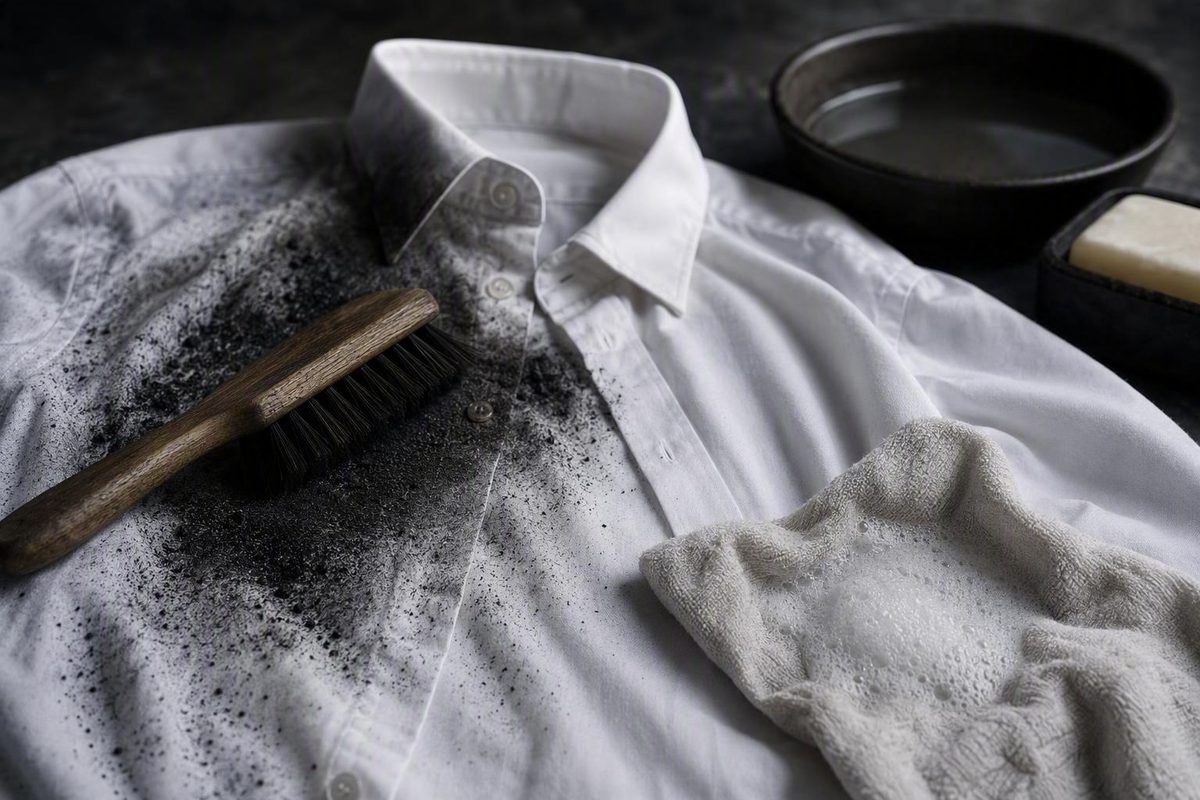
Remove the dry soot first, then treat what remains.
Getting soot out of clothes depends less on one powerful cleaner than on using the right sequence. Assess the garment and the extent of exposure, remove loose particles without rubbing, pretreat only washable and colorfast fabric, wash within the care label’s limits, and inspect before drying.
A small candle or fireplace mark on an ordinary washable shirt may be manageable at home. Widespread residue from a major fire requires professional assessment.
Before You Start: A 60-Second Soot Triage
Before reaching for water or detergent:
- Do not rub or scrub the soot.
- Do not put the garment in a dryer.
- Check the care label.
- Keep water and liquid cleaners away from the mark until you have removed as much loose soot as possible.
- Decide whether this is a small surface mark or extensive smoke and fire exposure.
Home treatment is most appropriate for a limited mark on an ordinary washable garment. The fabric, dyes, trims, finishes, and construction must all tolerate the proposed cleaner and washing method.
Before applying detergent or dishwashing liquid to the visible mark, test it on an inside seam, hem allowance, or another inconspicuous area. These precautions are consistent with the University of Georgia’s guidance for smoke- and soot-affected apparel.
If the label says dry clean only, gently shake off or lift loose surface soot without rubbing, then arrange professional cleaning. Do not experiment with hand-washing.
Professional assessment is also the prudent choice for:
- Wool, silk, leather, suede, or another delicate or specialty material
- Valuable, vintage, tailored, or sentimental clothing
- Beading, embroidery, sequins, glued decoration, or non-washable trim
- Coated, laminated, reflective, or waterproof materials
- Extensive soot deposits or smoke exposure
- Garments affected by a major appliance or structure fire
- Melted, scorched, brittle, or visibly distorted fibers
The available evidence does not establish one complete home method that is safe across these categories. Gentle removal of loose surface particles may be reasonable, but further treatment should be left to a textile-care or fire-restoration professional.
Step 1: Remove Loose Soot While It Is Dry
Treat loose soot as a particle-removal problem before treating the remaining discoloration as a stain. Position the garment so dislodged material falls away from clean fabric, and avoid folding the soiled area against another part of the item.
For a light surface deposit, use one of these methods:
- Gently shake the garment. Use small movements rather than snapping or whipping it.
- Lift particles with a soft brush. Brush lightly in one direction and away from clean areas. Do not scrub back and forth.
- Carefully vacuum particles caught in the weave. Use a fabric nozzle at reduced suction, holding it approximately 1–2 cm above the material rather than pressing it against the garment. This standoff method appears in commercial laundry guidance for soot-affected fabric.
Rubbing is the main mistake to avoid. It can enlarge the affected area and work fine residue farther into the weave. If brushing creates a broader gray mark, stop rather than applying more pressure.
Published instructions differ on when to introduce water. Tide recommends brushing off excess soot and then rinsing the garment under cold running water. Another commercial laundry guide advises completing dry removal before using any liquid.
The cautious way to reconcile that disagreement is to remove as much loose material as possible while the garment is dry. Once particles are no longer lifting away, water may be introduced only if the care label permits it and the item is continuing through the washable-clothing process.
If the soot has already been wetted or rubbed, avoid further scrubbing. If the mark spreads or the fabric changes, stop home treatment.
Dry removal is preparation, not proof that the garment is clean. A gray shadow, greasy-looking deposit, or smoke odor may remain after the loose black particles are gone.
Step 2: Pretreat the Remaining Mark on Washable Clothes
This step is for washable, colorfast clothing only. Check the care label and complete a hidden-area test before putting cleaner on the visible mark.
After removing the dry particles, choose one mild pretreatment:
- A compatible liquid laundry detergent
- A small amount of clear, neutral-pH, non-bleach dishwashing liquid
Apply a small quantity to the remaining gray or greasy-looking mark. Spread it gently with a fingertip or the back of a spoon without forceful rubbing, twisting, or aggressive brushing.
Leave the cleaner in contact with the fabric only for the period permitted by its label. When that period ends, follow both the cleaner instructions and the garment care label.
Clear non-bleach dishwashing liquid is included in a commercial soot spot-treatment procedure from Fiber Clean. That source also uses additional chemicals, however, and does not establish that its full procedure is appropriate for every garment. Dishwashing liquid should therefore be treated as a restrained option for compatible washable fabric, not as a universal remedy. Review Fiber Clean’s procedure and cautions.
Tide publishes a product-specific presoak: after brushing and a cold rinse, soak for up to five minutes in a solution containing 1 ounce, or 1.5 tablespoons, of Tide Ultra Stain Release Liquid per gallon of cold water. That is Tide’s branded procedure, not an independently established formula for other detergents. If using another product, follow its own dosing and pretreatment directions rather than copying Tide’s concentration. See Tide’s complete soot-stain procedure.
Do not make rubbing alcohol, ammonia, dry-cleaning solvent, oxygen bleach, baking soda, or vinegar the default next step. The available support for these treatments is commercial, limited to particular procedures, or insufficient to establish universal compatibility with garment dyes, elastic, finishes, coatings, and delicate fibers.
If the mild treatment does not work, do not cycle through stronger cleaners or create a chemical mixture. Rinse as directed, confirm that the fabric remains stable, and either repeat the same compatible treatment or consult a professional.
Step 3: Wash at the Temperature the Care Label Allows
There is no single correct water temperature for every soot-stained garment. Separate the process into stages:
- Remove loose soot while it is dry.
- Use a cold initial rinse or presoak if the chosen procedure calls for one and the garment permits it.
- Keep the final wash at or below the care label’s maximum temperature.
Tide’s sequence uses a cold rinse and cold presoak followed by the usual cycle at the hottest temperature permitted by the garment care label. The company also advises repeating treatment before machine drying if the stain remains. These are branded instructions rather than an independent textile-care standard, but they illustrate why rinsing, soaking, and final washing should not be treated as one temperature decision. Read Tide’s temperature and drying directions.
For a product-neutral approach, use the garment’s normal suitable cycle with a compatible liquid laundry detergent. If the label requires cold water, use cold water. If it permits a warmer wash and the detergent instructions support that temperature, a warmer wash may be appropriate. Never exceed the label’s limit.
When washing several smoke-affected items, use a small load so the garments have room to move. Keep dry-clean-only clothing and any item whose label prohibits the proposed method out of the washer.
Use products intended for garment care. Do not use gasoline or lighter fluid, which Fiber Clean identifies as unsafe flammable solvents. Do not use automatic dishwasher detergent; the same source warns that it may contain bleaching ingredients that harm textiles. Do not substitute an improvised sequence of solvents, bleach, alcohol, or ammonia for an appropriate laundry product. See the product warnings in Fiber Clean’s soot guide.
Step 4: Inspect, Repeat, and Air-Dry Before Using the Dryer
Remove the garment promptly when the wash cycle ends and inspect it in good light. Check both sides for:
- Loose black particles
- A gray or brown shadow
- A greasy-looking or stiffened area
- Residue that transfers when lightly blotted with a clean white cloth
- Objectionable smoke odor
- Dye loss, distortion, roughness, shine, or another fabric change
If the mark is improving and the garment remains stable, repeat the same gentle pretreatment and wash. Repetition is preferable to abruptly escalating to bleach or solvents.
Do not machine-dry while visible residue or unwanted smoke odor remains. This is a precaution because published cleaning guidance warns that drying can make later removal more difficult; it does not establish that every soot mark becomes permanent immediately after one dryer cycle.
If the garment needs to dry between attempts, air-dry it.
Do not assume that every remaining shadow is removable soot.
Stop home treatment if:
- Dye transfers during testing or cleaning.
- The fabric distorts, pills, stiffens, or becomes shiny.
- The mark spreads.
- A coating, print, adhesive, or decoration changes.
- Repeated careful treatment produces no meaningful improvement.
- The garment is too valuable to risk further experimentation.
There is no validated number of attempts suitable for every garment. If the mark continues to improve and the fabric remains stable, another mild wash may be reasonable. If progress has stalled, professional cleaning is safer than progressively stronger household chemistry.
Choose the Path That Matches the Garment
A washable cotton T-shirt and a structured cotton jacket may need different care, as may two polyester garments with different dyes, coatings, trims, or construction.
| Garment category | Safe first action | Home-treatment boundary | When to stop |
|---|---|---|---|
| Washable cotton, polyester, and ordinary blends | Check the label, remove dry soot gently, and patch-test a compatible liquid detergent or clear non-bleach dish liquid | Pretreat mildly, wash within the label’s limits, and inspect before drying | Stop for dye transfer, distortion, spreading, surface change, or stalled improvement |
| Strongly colored or unfamiliar synthetic garments | Remove loose soot and conduct a careful hidden-area test | Use only a cleaner and cycle compatible with the label; do not make alcohol or oxygen bleach routine treatments | Stop at any color loss, coating change, or surface damage |
| Wool or silk | Gently remove loose surface soot without rubbing | No complete universal home procedure is established by the available evidence | Consult a specialist before wet treatment |
| Delicate, embellished, tailored, coated, or mixed-material garments | Shake or lightly lift loose particles | Avoid wet treatment unless the care instructions clearly permit it and every component is compatible | Stop before risking trims, adhesives, structure, or finish |
| Dry-clean-only clothing | Gently shake off or lift loose soot | Do not wash at home | Arrange professional cleaning promptly |
| Valuable, vintage, or sentimental garments | Minimize handling and remove only easily lifted particles | Avoid trial-and-error chemistry | Seek professional textile care |
| Extensively smoke- or fire-exposed clothing | Limit handling and obtain an assessment | Do not treat the item as an ordinary household stain | Consult a cleaner or restoration professional familiar with smoke-damaged textiles |
| Scorched, melted, brittle, or visibly altered fabric | Avoid rubbing or stretching the damaged area | Cleaning cannot reverse physical fiber damage | Obtain professional assessment or retire the garment |
A washable cotton, polyester, or ordinary blend with a small mark is the clearest candidate for home treatment: remove dry particles, patch-test a mild compatible cleaner, wash according to the label, and inspect before drying.
Strong colors and unfamiliar synthetics require extra caution. Even when the base fiber is washable, dyes, prints, elastic, membranes, and finishes may respond differently.
For wool, silk, delicate fabrics, non-washable trims, coatings, and embellishments, limit home action to gentle removal of loose soot. The evidence does not support one complete household process that is safe across these categories.
This article also cannot provide validated methods for leather, suede, reflective materials, waterproof coatings, or melted and scorched fibers. Those materials require advice matched to their construction and condition.
For clothing with widespread exposure from a major fire, seek specialist assessment instead of treating it like a candle smudge. Commercial laundry guidance similarly recommends professional restoration or specialist cleaning for fire-exposed or heavily contaminated textiles. See the fire-exposure boundary in the Speed Queen guide.
Treat Smoke Odor as a Separate Laundry Problem
Begin odor treatment only after loose soot has been removed and any visible stain on washable fabric has been appropriately pretreated.
For washable apparel:
- Check the care label.
- Use a small load.
- Wash with a compatible liquid laundry detergent or a detergent formulated for odor removal.
- Leave out fabric softener while the unwanted odor remains.
- Inspect and smell the garment after washing.
- Air-dry if it must be dried before another wash.
The University of Georgia recommends three to five washes for smoke-affected apparel, using small loads and avoiding machine drying between washes. Treat that as its guidance for smoke-damaged clothing, not as a fixed requirement for every slightly smoky garment. A lightly affected item may need fewer washes, while a delicate or unstable item may not tolerate repeated laundering. Review the university’s smoke-odor laundering guidance.
Avoid fabric softener until the unwanted odor is gone.
Do not default to improvised baking-soda or vinegar recipes. The available evidence does not establish one universal odor-removal formula compatible with every garment, detergent, washer, dye, and finish.
If repeated label-compliant washing produces no meaningful improvement, contact a professional cleaner that offers deodorizing services. Ozone is mentioned by the University of Georgia as one example of a professional service, not as a home treatment or a universal necessity.
It does mean the result is not yet acceptable if the goal is odor-free clothing. Extensive exposure or an uncertain fire source warrants professional assessment for reasons beyond smell alone.
Mistakes to Avoid and When to Call a Professional
Most avoidable problems come from using the right action at the wrong stage or choosing a treatment the garment cannot tolerate.
Rubbing loose soot
Scrubbing can enlarge the affected area and work fine residue into the weave. Shake, lift, softly brush, or carefully vacuum instead.
Applying liquid too soon
Do not make water or cleaner the first response to loose surface soot. Complete dry particle removal first. A cold rinse may follow if the garment is washable and the chosen procedure calls for one.
Ignoring the care label
A stain-removal method is unsuitable if it violates the garment’s instructions. “Washable” does not mean every temperature, bleach, solvent, or pretreatment is acceptable.
Skipping the colorfastness test
A cleaner may alter the dye, finish, or surface along with the residue. Test a concealed area and stop if color transfers or the material changes.
Drying before inspection
Inspect the garment immediately after washing. If visible residue or unwanted odor remains, air-dry if necessary and repeat only a mild, compatible treatment.
Using unsuitable products
Laundry products are not interchangeable with household solvents or dish-machine chemicals. Follow the product boundaries described in the washing step rather than substituting gasoline, lighter fluid, or automatic dishwasher detergent.
Improvising a chemical sequence
If the first mild treatment fails, do not cycle through alcohol, ammonia, bleach, solvents, vinegar, and other cleaners. Rinse according to the product directions and reassess instead of escalating blindly.
Call a textile-care professional for:
- Dry-clean-only garments
- Wool, silk, leather, suede, or other specialty materials
- Valuable, vintage, tailored, or sentimental items
- Embellished garments or items with non-washable trims
- Widespread residue or extensive fire exposure
- Persistent discoloration that has stopped improving
- Dye transfer, distortion, coating changes, or other treatment-related damage
Before returning a garment to normal use and machine drying, apply a simple success check:
- No loose particles remain.
- No visible residue transfers.
- No objectionable smoke odor remains.
- The fabric, dye, trim, finish, and shape appear unchanged.
Frequently Asked Questions
Can I put soot-stained clothes straight into the washing machine?
Usually, no. Remove as much loose soot as possible first by gently shaking, soft brushing, or carefully vacuuming at reduced suction.
Once the dry particles are gone, a washable, colorfast garment can proceed to mild pretreatment and laundering within its care-label limits. Do not machine-wash anything labeled dry clean only.
Should I use hot or cold water to remove soot from clothes?
There is no universal temperature. Remove loose soot while dry first. An initial rinse or presoak may use cold water, while the final wash must remain within the care label’s permitted range.
Tide’s branded procedure uses a cold rinse and cold presoak followed by the hottest wash temperature the label permits. That does not mean every garment should be washed hot. If the label requires cold water, use cold water.
Can clear dish soap remove a greasy soot mark?
A small amount of clear, neutral-pH, non-bleach dishwashing liquid can be a reasonable pretreatment for a greasy-looking mark on washable, colorfast fabric after loose soot has been removed.
Patch-test it first, apply it gently, and follow its contact and rinsing instructions. Do not use automatic dishwasher detergent, and do not assume dishwashing liquid is suitable for wool, silk, coated materials, dry-clean-only garments, or non-washable trim.
How do I remove smoke odor after the visible soot is gone?
Wash suitable garments in small loads with a compatible liquid detergent or a detergent formulated for odor removal. Skip fabric softener while the odor remains, inspect after each wash, and avoid machine drying between attempts.
If repeated label-compliant washing does not produce meaningful improvement, ask a professional cleaner about deodorizing services rather than adding a succession of household chemicals.
When should soot-stained clothing go to a dry cleaner?
Arrange professional care when the garment is labeled dry clean only or is made from wool, silk, leather, suede, delicate, coated, or embellished materials. Professional assessment is also appropriate for valuable clothing, widespread residue, persistent marks, dye transfer, distortion, and items exposed to a major fire.
For a dry-clean-only garment, remove only loose surface soot without rubbing and arrange cleaning promptly.
The sequence to remember is straightforward: check the label, remove loose soot while it is dry, patch-test and pretreat only washable fabric, wash within the label’s limits, and inspect before using the dryer. Treat lingering odor separately, and stop home treatment when the garment is delicate, dry-clean-only, unstable, extensively fire-exposed, or no longer improving.