 StainList
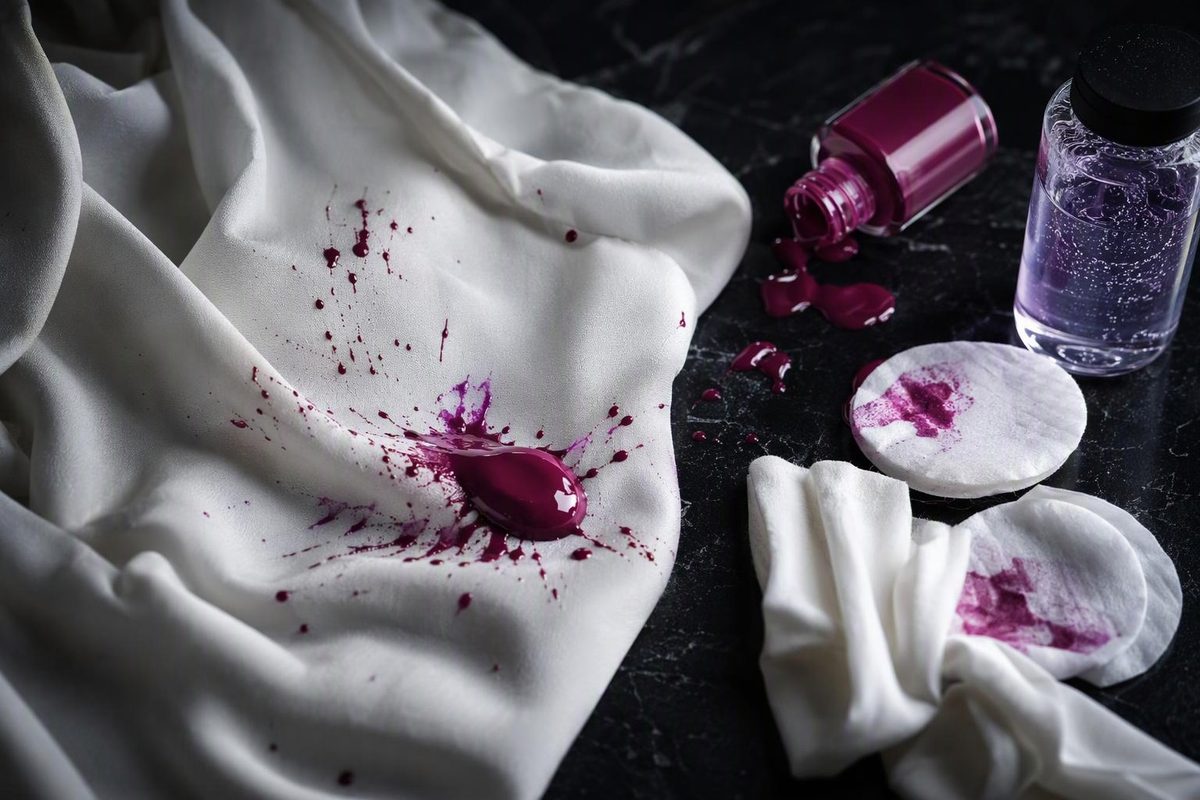
Lift off excess gel polish without rubbing, check the garment’s fiber label, then spot-test remover before treating the stain. On an ordinary washable garment, acetone-based nail polish remover may help with no-lamp, gel-effect lacquer. For UV/LED gel, solvent treatment is only a cautious attempt—not a proven fabric-removal method. Cured gel and dried stains may not come out completely.
Do not start with a hot wash or put the garment in the dryer. If the label lists acetate, triacetate or modacrylic, or the fiber content is unknown, skip home solvent treatment.
Choose the fabric, polish type and spot-test result to find your next safe step.
Find Your Safe Next Step
Skip Home Solvent Treatment
The fiber content is unknown. Establish it from the garment label before using remover, or take the garment to a professional cleaner.
If wet UV/LED gel is touching your skin, remove the garment and avoid touching the spill with bare fingers. Do not cure it under a nail lamp.
Sources: UGA and Clorox nail-lacquer guidance; Tide fabric precautions; AAFA gel-allergy guidance; Maytag appliance precautions. UV/LED gel removal from fabric is not established by these sources.
Identify the Polish Before Choosing a Treatment
“Gel” describes different products, and their removal instructions are not interchangeable.
| Polish Type | What That Means for Clothing |
|---|---|
| No-lamp, gel-effect lacquer | A nail-lacquer removal method may help if the fabric passes a solvent test. |
| Wet, uncured UV/LED gel | Avoid skin contact; any solvent treatment remains a cautious attempt. |
| Already-cured UV/LED gel | Lift only loose pieces; do not copy a manicure soak-off procedure. |
Sally Hansen says Miracle Gel requires no UV lamp and removes with regular nail polish remover. That describes removal from nails, not a guarantee for clothing or other products sold as gel polish. See the Sally Hansen product instructions.
For wet, uncured UV/LED gel, remove the garment if the spill is touching your skin, and avoid handling it with bare fingers. Uncured gel chemicals can cause irritation or allergic contact dermatitis. Do not deliberately cure the spill under a nail lamp. AAFA guidance explains the allergy risk.
For already-cured gel, nail-removal instructions do not establish a safe clothing treatment. OPI’s GelColor softens during remover-wrap treatment on nails, but that is not a fabric-treatment instruction. Do not copy its wrapping, filing or prolonged solvent contact onto clothing. See OPI’s gel-removal instructions.
Skip Solvents on Sensitive or Unidentified Fabrics
Do not attempt home solvent treatment if the label lists acetate, triacetate or modacrylic—even in a blend—or if you cannot establish the fiber content. UGA specifically warns that acetone destroys acetate in its fiber reference.
Also refer silk, wool, dry-clean-only, valuable or decorated garments to a professional cleaner. Tide’s fabric precautions advise against solvent pretreatment for sensitive fibers and delicate items.
Bring the polish bottle or a photo of its label, and explain any treatment already attempted. A cleaner needs to distinguish nail lacquer from UV/LED gel as well as identify the fabric.
Blot an Ordinary Washable Garment From the Back
For a washable garment that is not in the excluded categories, gather a plastic spoon or blunt card, white paper towels, cotton swabs or a white cloth, clear non-oily acetone-based nail polish remover, and liquid laundry detergent.
Work with ventilation, away from flames and heat. Follow the remover’s handling and disposal instructions, and protect the work surface: acetone can damage furniture finishes. UGA’s nail-lacquer removal guidance provides the solvent precautions and reverse-side blotting method below. Its guidance concerns nail lacquer, not a validated method for cured UV/LED gel on fabric.
Lift Excess Without Spreading It
For wet polish, scoop up raised material with the spoon or card, lifting rather than wiping sideways. Blot remaining surface liquid straight up with a white towel.
For a dry or cured deposit, remove only pieces that release easily with a blunt edge. Stop if the fabric pulls with the polish. Do not use a razor, nail file or stiff scrubbing brush.
Spot-Test the Remover and Let the Test Dry
Apply a few drops to an inside seam or hem. Wait a few minutes, blot with a white paper towel, then allow the test area to dry.
Stop if garment dye transfers, the color changes, or the fabric becomes distorted. Check texture as well as color. A label saying “cotton” or “polyester” does not establish that every dye, print or finish is solvent-safe. Clorox’s nail-polish guidance covers spot-testing, hand-washing and the limits of removing dried stains.
Transfer the Polish Onto Fresh Towels
Place the stain face down on several white paper towels, keeping it separate from other garment layers. Lightly dampen a swab or white cloth with remover and dab the back of the stain.
Move the garment onto fresh towels as polish transfers. Keep the application local; do not pour remover over the garment or soak it in a bowl.
For UV/LED gel, regard this as a cautious attempt, not a proven complete-removal method. Continue only while polish is transferring and the fabric remains unchanged. If a cured patch stays firmly attached, or repeated gentle dabs produce no transfer, stop rather than increasing solvent contact or scraping harder.
Rinse, Hand-Wash and Air-Dry
Rinse the treated spot with cool water. Apply a little liquid laundry detergent, then hand-wash in cool water if the care label permits. Rinse thoroughly and air-dry.
Keep the solvent-treated garment out of the washer and dryer. Maytag’s appliance precautions warn against putting fabrics treated with nail polish remover or other flammable substances into either appliance. Use hand-washing and air-drying for this treatment.
Stop When Transfer Stops or the Fabric Changes
Inspect the garment when dry. If the polish film is gone but a colored shadow remains, more solvent may not help: dissolved polish can be difficult to extract from the fabric structure. Full removal of dried stains is uncertain.
Do not bleach or scrub harder simply because the first attempt left a mark. A persistent cured patch, failed spot test or fabric distortion is a reason to stop home treatment and consult a cleaner—not to try a longer soak.
If the spill also reached the floor, use the separate nail-polish removal method for carpet; clothing instructions do not account for carpet backing.