 StainList
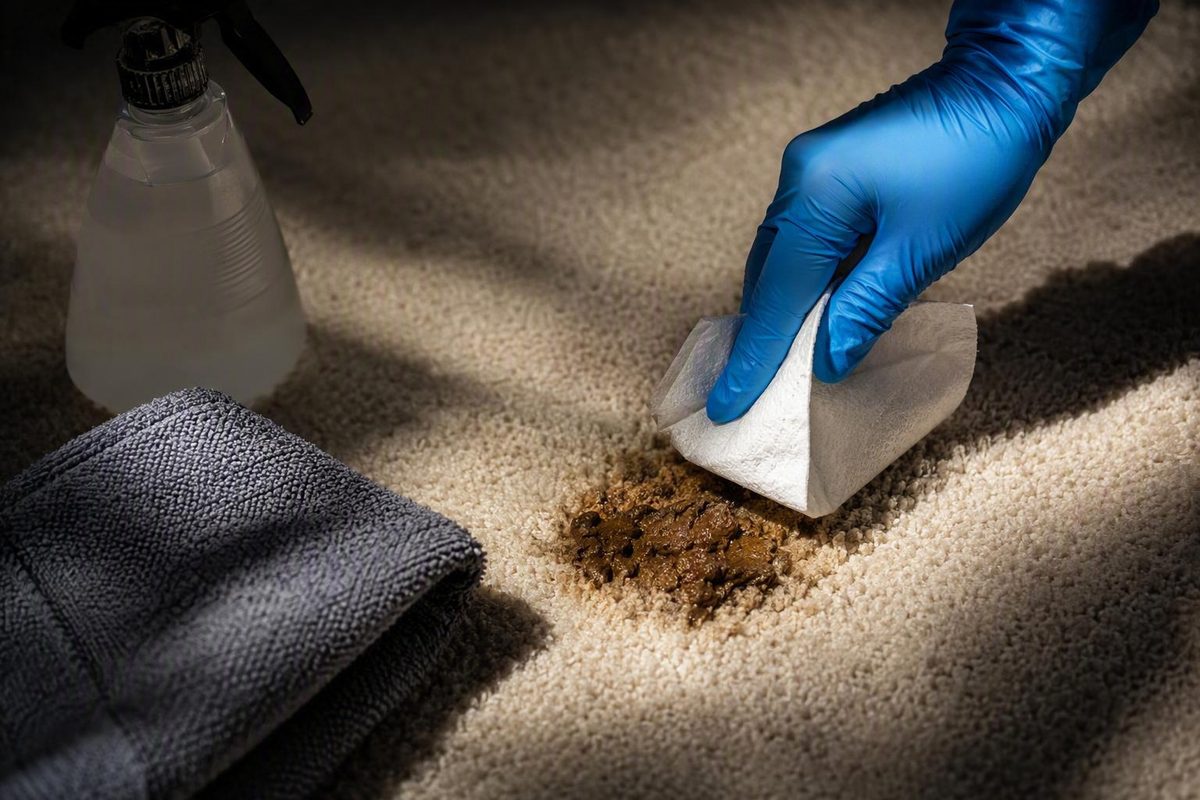
Removing poop stains from carpet is mainly an exercise in containment and moisture control. Pick up solid material without pressing it into the pile, absorb what remains instead of scrubbing, test any cleaner before use, and keep added liquid to a minimum. Only judge the result after the carpet has dried completely.
A carpet-approved enzyme cleaner is a sensible option when both residue and odor remain. On a compatible, colorfast carpet, a weak detergent solution can be an alternative. Neither is safe for every material: fiber type, dye stability, backing, finishes, previous cleaning products, and the age and consistency of the accident can all affect the result.
Stain removal, odor control, and pathogen reduction are also different objectives. A carpet that looks and smells clean has not necessarily been disinfected. Widespread liquid waste, suspected illness, blood, persistent dampness, or likely contamination below the pile requires more caution than a small surface accident.
Editorial note: This guide synthesizes carpet-care sources with differing commercial interests. Where their instructions conflict—particularly on vinegar, peroxide, ammonia, and enzyme dwell times—it favors product labels, carpet-manufacturer guidance, spot-testing, and the least aggressive supported method. The available carpet-care evidence does not establish a universal home disinfection protocol for fecal contamination.
Quick answer: what to do as soon as you find the mess
For a small accident that appears limited to the carpet surface:
- Keep people and animals away.
- Put on disposable gloves.
- Collect your supplies: disposable towels, a blunt spoon or scraper, a sealable waste bag, clean white cloths, and a carpet-safe treatment.
- Scoop or lift solid material without pushing down.
- Start at the outside and move inward so the affected area does not expand.
- Blot remaining moisture, switching to a clean part of the towel whenever material transfers.
- Test the proposed cleaner in a hidden area.
- Apply only a controlled amount and follow its label.
- Blot, rinse, or extract only as directed.
- Let the carpet dry fully before checking the stain and odor.
A white cloth makes the cleanup easier to monitor. It shows both fecal residue and carpet color that may be transferring. If the carpet’s dye appears on the cloth, stop using the product.
Do not run an ordinary dry household vacuum over visible feces. The waste can contaminate the vacuum, be dispersed through the machine, or be forced farther into the carpet. Carpet-cleaning guidance instead recommends removing visible material manually before treating the remaining stain with limited moisture (Hobbs Carpet Cleaning).
Prepare the work area before touching the mess. Open the waste bag and place it within reach so used towels, gloves, and disposable tools can go directly into it. Avoid walking between the carpet, sink, storage cupboard, and rubbish bin while carrying exposed waste.
If the accident came from a child, adult, or animal who also needs cleaning, prevent them from moving through the home and spreading residue. When possible, have another person attend to them while you deal with the carpet.
Check the carpet before choosing a cleaner
Read both of these before applying any treatment:
- The carpet or rug maker’s care instructions
- The cleaner’s directions for compatible surfaces and use
No homemade recipe or commercial product is universally suitable. Nylon, polyester, triexta, wool, natural fibers, specialty blends, and unidentified materials can react differently. Dye stability, backing, construction, stain-resistant finishes, previous treatments, and the age of the mark can also change the outcome.
If you cannot identify the carpet, act as though it is delicate. Avoid combining products, restrict moisture, and do not progress through increasingly strong chemicals.
To spot-test a cleaner:
- Select an inconspicuous area, such as inside a closet or under furniture.
- Apply only enough product to reproduce the planned treatment.
- Wait for the period specified by the product.
- Press a clean white cloth against the test area.
- Let the carpet dry completely.
- Check for dye on the cloth, fading, lightening, stiffness, fuzzing, shrinkage, texture changes, or distortion.
Inspection after drying matters because some changes are difficult to see while the fibers are wet. Hidden-area testing followed by a check for color transfer and changes in the dried pile is also recommended in carpet-care guidance for pet stains (Chem-Dry of Allen County).
Stop if carpet color transfers or the test area changes. Do not assume that diluting the product, shortening its contact time, or following it with another chemical will repair the damage. Blot away removable moisture and consult the carpet manufacturer, rug maker, or an experienced cleaner.
For many colorfast synthetic carpets, lower-risk starting points include:
- An enzyme cleaner whose label approves it for that carpet
- A weak solution of clear, non-bleaching liquid dish detergent
- A treatment specifically recommended by the carpet or rug manufacturer
Wool, dark or highly saturated colors, handmade rugs, antique rugs, delicate construction, specialty fibers, and unidentified materials warrant extra caution. Ammonia should not be used on wool, while ammonia and hydrogen peroxide may remove color—especially from dark or saturated carpet (Good Housekeeping).
For a valuable, wool, handmade, antique, or otherwise delicate rug, favor the maker’s instructions or a cleaner familiar with that construction. Experimenting with household chemicals can produce dye migration, shrinkage, pile damage, or backing distortion that is harder to correct than the original stain.
Step-by-step method for a fresh, solid accident
This procedure is intended for a small, fresh deposit that appears to be on the carpet pile rather than deeply soaked through it. Skip to the escalation guidance if the waste is widespread, highly liquid, mixed with blood, or associated with suspected illness.
Step 1: Close off the area and put on gloves.
Keep children and pets out of the room. Wear disposable gloves before handling waste, carpet fibers, towels, or tools. Open a waste bag and keep it beside the affected area.
Step 2: Pick up the main deposit.
Use folded dry paper, an inverted plastic bag, a blunt spoon, or a disposable scraper. Begin at the outer boundary and work toward the middle.
Support the material with the tool and raise it away from the carpet. Avoid pushing down, wiping sideways, or compressing the pile, all of which can move residue between the fibers.
Step 3: Lift pieces caught at the top of the pile.
Use folded paper towel to pinch or lift small remnants from the fiber tips. Move upward rather than rubbing across the surface. Discard the towel as soon as it becomes soiled.
Do not keep scraping harder to remove tiny traces.
Step 4: Absorb residual moisture.
Place a clean white disposable towel against the affected fibers and apply light, controlled pressure. Lift it straight up, inspect it, and repeat with a clean section.
Continue from the outside toward the center until transfer has substantially decreased. Do not drag the towel through surrounding carpet.
Step 5: Test the treatment.
Test the cleaner even if you have used it successfully elsewhere. Different rooms can contain different carpet, dye lots, finishes, or residues from earlier products.
Allow the test to dry when the directions permit. Do not proceed if you see color transfer, fading, stiffness, swelling, fuzzing, or distortion.
Step 6: Apply a small, controlled amount.
Use only enough product to contact the affected fibers.
For a spray, keep the application controlled so it does not reach clean carpet. For a mixed solution, transfer it with a cloth instead of pouring from the container.
Step 7: Let an approved enzyme cleaner work as directed.
Confirm that the label permits use on the carpet. Follow its instructions for the amount, contact time, ventilation, agitation, rinsing, extraction, and when children or animals may return.
Do not use a generic online dwell time in place of the label. Enzyme products differ considerably. Do not add another cleaner unless the label expressly allows it.
Step 8: Remove the treatment as instructed.
A no-rinse cleaner should not automatically be followed with water. Blot or extract it only as its directions specify.
If you used a detergent treatment that requires removal, press a separate water-dampened cloth against the fibers and then blot with a dry towel. Use modest amounts of water. Removing detergent residue matters because a sticky residue may attract dirt and leave another visible spot.
Step 9: Draw out moisture and provide airflow.
Press dry, colorfast towels against the carpet.
Leave the carpet uncovered afterward. Provide safe airflow with ventilation or a fan. Do not place furniture, bedding, plastic, cushions, or another rug over damp carpet.
Step 10: Reassess after complete drying.
Check for:
- Remaining discoloration
- A lighter area that could indicate dye loss
- Sticky, stiff, fuzzy, or misshapen fibers
- Persistent odor
- Dampness
- A stain that disappeared when wet but returned
- A mark extending beyond the original boundary
Blotting is preferable to aggressive scrubbing because side-to-side force can spread residue, push it into the pile, or damage fibers. Guidance on pet-waste cleanup likewise recommends lifting solids, blotting with clean sections of disposable cloth, limiting moisture, and allowing complete drying before deciding whether more treatment is needed (Pogi’s).
Afterward, remove the gloves and wash your hands. Discard disposable tools or clean reusable ones according to their manufacturer’s directions. If you used compatible extraction equipment, follow its instructions for cleaning contaminated tanks, hoses, and attachments.
How the method changes for runny or dried poop
The overall method remains the same: physically remove what you can, absorb moisture, test a compatible treatment, apply it conservatively, and dry the carpet. The first stage changes according to the consistency of the waste.
For a runny accident
Contain the boundary before working on the center. Lay absorbent disposable towels around the wet perimeter without bearing down on them.
Then:
- Begin at the outermost wet edge.
- Press lightly and lift the towel.
- Replace it as soon as it is contaminated.
- Work gradually toward the center.
- Watch for expansion of the damp boundary and stop if the process is spreading it.
Use very little added liquid. Pouring water or cleaner onto diarrhea before absorbing it can enlarge the affected area or carry material toward the backing and padding. Do not scrub, use heavy pressure, or repeatedly soak and extract the same spot.
A small, superficial liquid accident may be manageable. Stop DIY treatment if the waste is widespread, the carpet is visibly damp beyond the original area, dampness persists, or other circumstances make deeper involvement plausible. Surface inspection alone cannot confirm how far liquid has traveled.
For a dried accident
Do not begin with a standard dry vacuum. Use a blunt spoon, disposable card, or scraper to raise loose pieces slowly. Avoid crushing brittle material into the carpet or scattering it.
Once loose material is gone, hold a lightly dampened cloth briefly against residue attached to the fibers. The aim is to soften the deposit, not saturate the pile. Lift or blot a small amount at a time and switch to a clean section of cloth as residue transfers.
Avoid vigorous scraping, which can fray the pile, pull loops, or create a pale-looking patch. After this physical removal, follow the same spot-testing, limited application, label-directed removal, and drying process used for a fresh accident.
An older stain may require another compatible treatment, but let the carpet dry before deciding. Set-in discoloration may also remain even after careful or professional treatment.
A dry surface deposit differs from a mark or odor that reappears after cleaning. Recurrence may result from wicking out of deeper layers, residual detergent attracting soil, incomplete removal, or new contamination. It cannot be diagnosed from appearance alone.
Choosing between an enzyme cleaner and a mild detergent solution
When fecal residue and odor are both present, a carpet-approved enzyme cleaner is a reasonable first option. Enzymatic formulas are intended to break organic waste into smaller components rather than simply covering the smell. Protease enzymes are relevant to protein-based material, including fecal residue.
That mechanism does not guarantee complete stain or odor removal. A product may not be compatible with every fiber or reach material that has entered the backing or padding.
Let the label determine:
- Carpet and rug compatibility
- Application quantity
- Contact time
- Whether the area should stay damp or be covered
- Permitted agitation
- Ventilation
- Restrictions for children or pets
- Whether blotting, rinsing, or extraction is required
- Drying and repeat-application instructions
Supported product examples use contact periods ranging from minutes to several hours, so there is no defensible universal dwell time. Enzyme guidance emphasizes following the individual product’s directions and checking surface compatibility rather than applying one procedure to every formula (Rover).
A second application may be needed for dried residue or a lingering smell. Wait until the carpet has dried and been reassessed. Repetition should not turn into repeated saturation.
If no compatible enzyme product is available, a conservative detergent alternative for a suitable, colorfast carpet is:
- 1 teaspoon clear, non-bleaching liquid dish detergent
- 2 cups warm water
Test the mixture first. Apply a small amount with a white cloth, blot the affected fibers, remove detergent with a separate water-dampened cloth, and press with dry towels. This concentration is given in a flooring company’s feces-stain procedure, which also warns against soaking and notes the color-loss risk of stronger agents (Wolfe Flooring).
It may help release surface residue, but it does not have the same targeted mechanism as an appropriate enzymatic product.
Published vinegar-and-dish-soap recipes use inconsistent proportions, and the supplied evidence does not establish that one is superior. Vinegar is therefore not part of this general method. Carpet-care sources also raise compatibility concerns for wool, delicate rugs, dark colors, and unstable or unidentified dyes.
Hydrogen peroxide and ammonia likewise fall outside the routine workflow. Both may cause color loss, and ammonia is unsuitable for wool. Even when the carpet manufacturer permits one of them, a dried hidden-area test remains essential. In most situations, it is safer to stop after a compatible enzyme or mild detergent treatment than to apply a succession of stronger household chemicals.
Choose by carpet approval, compatibility, relevant enzyme type, and label instructions—not by fragrance, brand prominence, or an assumption that the strongest cleaner will perform best.
Treat the stain, odor, and infection risk as separate problems
Carpet cleanup may involve three distinct goals:
- Stain removal: reducing visible residue or discoloration
- Odor control: removing or breaking down odor-producing organic material
- Pathogen reduction: using a validated process intended to reduce infectious microorganisms
Success at one does not establish success at the others. A treatment may lift visible residue while leaving an odor source below the pile. Fragrance can mask a smell temporarily. An enzymatic product may address organic material without disinfecting the carpet.
Enzyme cleaners should not be assumed to remove viruses from feces or provide disinfection; the available enzyme-cleaner guidance expressly distinguishes organic-residue treatment from disinfection (Rover). A clean appearance or the absence of odor is therefore not proof that a porous carpet has undergone pathogen reduction.
The available carpet-care sources do not identify one household disinfectant, concentration, and contact time that is both effective for every relevant organism and compatible with every carpet. Hard-surface disinfectants and bleach may discolor fibers or damage dyes, backing, and finishes.
Never mix bleach with vinegar, ammonia, or another cleaning product. Carpet-cleaning safety guidance warns against those combinations and against assuming that hard-surface disinfectants are suitable for carpet (Hobbs Carpet Cleaning).
Treat the following as situations requiring more than an ordinary stain recipe:
- Visible blood
- Suspected infectious diarrhea
- Illness-related human waste
- Widespread or deeply soaked contamination
- Possible exposure of a medically vulnerable person
Restrict access and seek guidance appropriate to the circumstances, such as a qualified cleaning professional or a relevant healthcare, infection-control, or public-health resource. This is a precaution, not a diagnosis or an assurance that any visibly clean porous surface is free of risk. The carpet-care evidence available here supports escalation in these circumstances but does not establish a home disinfection protocol.
Rinse, dry, deodorize, and check for wicking
Finishing the job correctly helps prevent a cleaned spot from turning into a recurring mark. Too much rinse water can move dissolved material downward; leaving detergent behind can create a tacky area that attracts soil.
Follow the product label first. Do not rinse a no-rinse formula merely because rinsing is common with detergent. Unnecessary water may dilute the treatment and extend drying time.
When detergent must be removed, press a clean water-dampened cloth into the fibers, lift it, and follow with a dry towel. Repeat with small amounts of moisture rather than pouring water onto the carpet. Guidance on detergent cleanup similarly advises removing soap residue because it can attract dirt, while avoiding saturation (eufy).
Compatible wet-extraction equipment may be used after visible solids are gone, but only when both the equipment and cleaner instructions allow it. A wet extractor is not interchangeable with an ordinary dry vacuum. Do not draw untreated visible waste into a machine’s hoses, filters, or tank.
Avoid soaking the backing and padding. Excess liquid can prolong dampness, contribute to odor, and allow dissolved material to move back toward the surface as the carpet dries. It can also make it harder to distinguish moisture from the original accident from moisture introduced during cleaning.
Leave the area uncovered and provide airflow until it is completely dry. Do not replace furniture, floor protectors, bedding, cushions, or rugs while moisture remains. Keep wood stain, metal, and furniture dye away from wet fibers.
Baking soda is optional and should be considered only an odor-management measure. If the carpet is fully dry and its care directions permit powder, a light application may be removed later with a vacuum. Do not apply it over wet fecal residue, and do not treat it as a substitute for removal, cleaning, or disinfection.
After drying, check:
- Whether discoloration remains
- Whether a pale patch suggests color loss
- Whether the pile feels sticky, stiff, rough, or distorted
- Whether odor persists
- Whether the carpet or floor beneath it is still damp
- Whether the mark has returned or widened
Detergent residue that attracts fresh soil is another possibility. Do not respond automatically by pouring on more cleaner. Blot what has appeared, allow the carpet to dry, and consider whether the backing or padding needs assessment.
An odor that becomes more noticeable during warm or humid conditions may indicate residue in the lower pile, backing, padding, carpet edge, or subfloor. Surface deodorizer may alter the smell without reaching its source.
Mistakes to avoid and when to call a professional
Avoid these common errors:
- Do not scrub aggressively.
- Do not flood the carpet.
- Do not use an ordinary dry vacuum on visible feces.
- Do not combine cleaning products.
- Do not cover damp carpet.
- Do not carry exposed waste or soiled towels through the home.
- Do not let children or pets return before cleanup and drying are complete.
- Do not assume that a pleasant smell proves disinfection.
- Do not continue applying products after an unexpected change.
Stop if carpet dye transfers to a white cloth, the treated area becomes lighter or darker, the fibers swell or distort, or a product causes unexpected heat, odor, foaming, or another reaction. Blot away removable moisture without adding a second chemical.
Professional assessment is appropriate when:
- Contamination is large or widely spread
- Substantial diarrhea is involved
- Dampness persists
- The stain repeatedly returns
- Odor persists or becomes stronger in humid conditions
- Backing or padding involvement is plausible
- More than one careful treatment has failed
- Blood is present
- Infectious illness is suspected
- A medically vulnerable person may be exposed
- The carpet is valuable, handmade, antique, wool, delicate, or unidentified
- Dye transfers or the pile changes during treatment
Hiring a service does not guarantee sanitation, complete odor removal, or full restoration. The purpose of escalation is to permit inspection, material-specific treatment, controlled extraction, and a better-informed decision about deeper components.
A surface check cannot reliably determine whether contamination has reached the backing, padding, carpet edge, or subfloor. Depending on the inspection, the appropriate response could involve further cleaning, access beneath the carpet, treatment of deeper materials, or replacement of affected components. There is no universal size threshold that settles that decision.
Old, heat-exposed, set-in, or deeply penetrated stains may remain visible despite repeated or professional treatment. A pale mark may be permanent dye loss rather than remaining fecal pigment. Commercial carpet guidance also identifies large areas, likely padding involvement, recurring marks, unknown carpet materials, and failed DIY treatment as reasons to stop experimenting (Marathon Carpet Cleaning).
Frequently asked questions
Can I use vinegar and dish soap to remove a poop stain from carpet?
A mild detergent treatment can be considered for a compatible, colorfast carpet, but vinegar is not universally safe or necessary.
The cautious detergent-only option described above uses 1 teaspoon of clear, non-bleaching liquid dish detergent in 2 cups of warm water. Spot-test it, apply it sparingly with a cloth, blot, remove the detergent with a water-dampened cloth, and dry completely (Wolfe Flooring).
Published detergent-and-vinegar recipes use conflicting proportions. Vinegar may also be unsuitable for wool, delicate rugs, dark carpet, unstable dyes, and unknown materials. Do not combine it with bleach or add several household chemicals to the same spot.
When residue and odor are both present, a carpet-approved enzyme treatment used according to its label is generally the more targeted starting point.
How long should an enzyme cleaner sit on a poop stain?
Use the contact time stated on the product label. There is no universal dwell time for enzyme carpet cleaners.
Formulas differ in concentration, enzyme systems, moisture requirements, and intended surfaces. Reviewed product examples have instructions ranging from about an hour to as long as 12 hours under specified conditions, demonstrating why one generic timing rule should not override the product directions (Good Housekeeping).
Follow the label on application quantity, ventilation, covering, blotting, rinsing, extraction, access by children or pets, and drying. Leaving a product indefinitely does not necessarily improve the result, and repeated soaking can create a deeper moisture problem.
Can hydrogen peroxide remove a stubborn poop stain without bleaching the carpet?
Hydrogen peroxide may reduce some remaining discoloration, but it may also lighten carpet dye.
Treat peroxide as a higher-risk option rather than a standard step. Check the carpet maker’s directions and test it in a hidden location. Let the test dry before evaluating it.
Peroxide guidance for persistent fecal staining likewise requires an inconspicuous-area test because some materials may be discolored or damaged (Good Housekeeping). Stop if color transfers or the test area becomes lighter. A pale patch after treatment may be dye loss rather than a stain that still needs cleaning.
Does an enzymatic carpet cleaner disinfect fecal contamination?
Not necessarily. Enzyme cleaners may break down organic residue associated with fecal stains and odor, but that is not the same as validated disinfection. They should not be assumed to remove viruses.
Do not infer disinfection from the disappearance of a mark or smell. For blood, suspected infectious diarrhea, illness-related human waste, extensive contamination, or possible exposure of a medically vulnerable person, isolate the area and obtain qualified, public-health-informed guidance rather than relying on a routine carpet-stain recipe.
Why did the stain or odor return after the carpet dried?
Several explanations are possible. Dissolved material may have moved toward the surface during drying, a process commonly called wicking. Material may also remain in the lower pile, backing, or padding. Alternatively, detergent residue may have attracted new soil, the original residue may not have been fully removed, or new contamination may have occurred.
Do not keep adding cleaner automatically. Blot any material that has returned, let the carpet dry, and check for persistent dampness or a widening boundary. Arrange an assessment if recurrence continues, odor becomes stronger in humid conditions, or deeper involvement is plausible.
For a small surface accident, use this decision rule: remove the deposit, blot the residue, spot-test, treat with limited moisture, dry completely, and inspect. If dye transfers, dampness or odor persists, the mark returns, or contamination may extend below the pile, stop adding products and seek an appropriate assessment. Stain removal, odor control, and disinfection are separate outcomes, and no method can guarantee complete recovery of every carpet.