 StainList
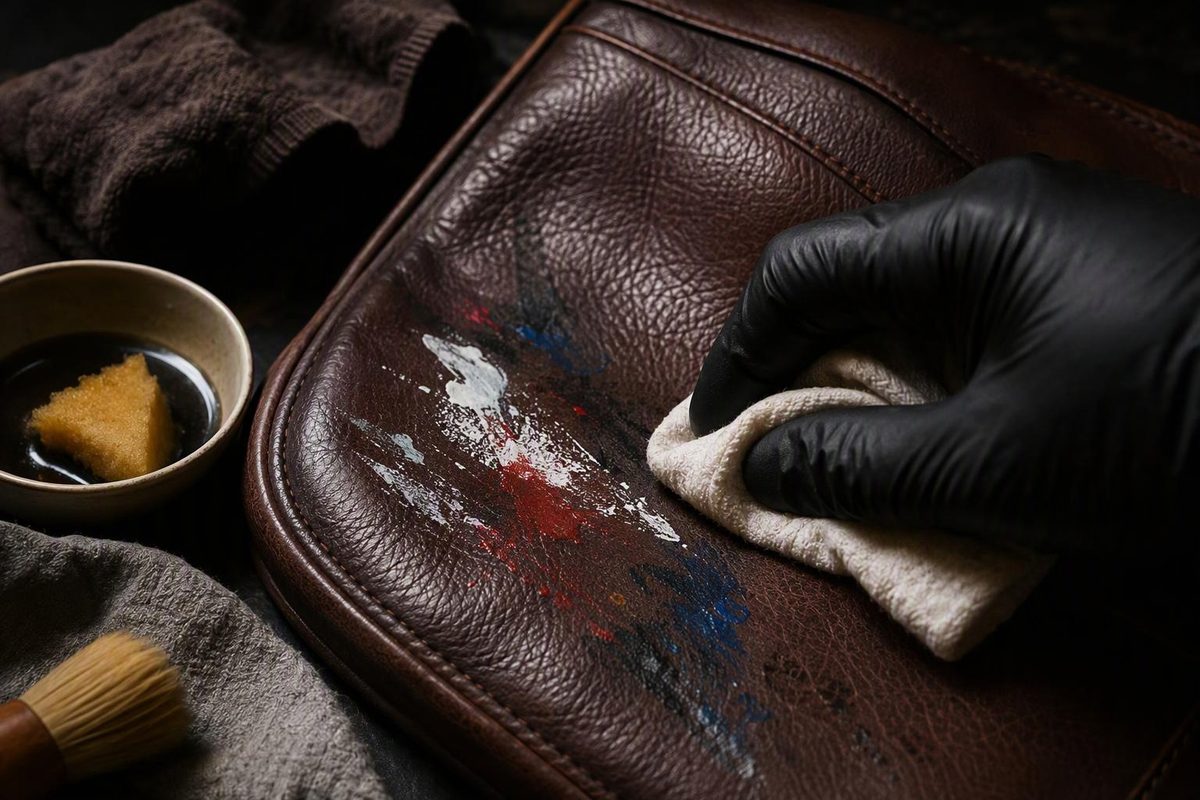
For a small paint spill on intact, coated leather, lift the excess without rubbing, then try a barely damp cloth for wet water-based paint after a hidden-area test. Follow with a compatible leather cleaner if needed. Dried paint may require a leather-specific stain remover or professional restoration. On suede, nubuck, absorbent or damaged leather, lift loose wet paint and get specialist advice rather than wet-cleaning. Avoid acetone, rubbing alcohol and paint thinner: removing the leather’s own color is not successful stain removal.
Select your leather finish, paint condition and paint type to find the safest starting step.
Blot, Then Test a Barely Damp Cloth
Lift wet excess with a clean white cloth without rubbing. Test a barely damp cloth on a hidden area and let it dry. If the finish is unchanged, dab the remaining paint and blot dry. Use a compatible leather cleaner if needed.
Stop if leather color transfers or the surface changes. Do not soak the spot.
Compare the Starting Routes
| Leather / Paint | Starting Route |
|---|---|
| Intact coated / wet water-based | Blot; hidden-area test with a barely damp cloth. |
| Intact coated / wet oil-based or unknown | Blot dry; test a compatible leather cleaner or seek advice. |
| Intact coated / dried paint | Test a compatible leather cleaner. If paint remains, consider a finish-approved paint-stain remover or a specialist. |
| Absorbent, suede or nubuck | Lift loose wet paint; get specialist advice. Do not use the coated-leather wet-cleaning route. |
| Damaged, special or unknown finish | Lift loose wet paint; seek manufacturer or specialist advice before treatment. |
Special finishes include bicast, two-tone, rub-off and antique leather. A stain remover can remove topcoat color on some finishes.
Source: the finish limits and cleaning instructions from Furniture Clinic and Lederzentrum, and paint-cleanup guidance from Sherwin-Williams, cited in the article. Product labels and the item’s care instructions govern treatment.
Check the Leather Finish Before Cleaning
Look at the item’s care instructions and the paint container before choosing a treatment.
| Leather Finish | Starting Approach |
|---|---|
| Intact, pigmented or protected leather | Use the mild cleaning sequence below after testing. |
| Aniline, absorbent pull-up, suede or nubuck | Lift or blot loose wet paint; contact a leather specialist. |
| Peeling, cracked, two-tone, rub-off or antique finish | Get specialist advice before using a stain remover. |
| Unidentified leather | Ask the manufacturer before wetting or treating it. |
Furniture Clinic warns that its Leather Stain Remover can take off topcoat color on bicast, two-tone and rub-off leather, and is less effective on absorbent leather. It excludes suede and nubuck. Check the product’s limitations rather than assuming that a product labeled for leather suits every finish.
Smooth leather is not necessarily sealed. Lederzentrum distinguishes surface-sealed leather from open-pore leather by whether a small water drop beads or absorbs in a concealed area. If moisture soaks in and darkens the leather, stop wet cleaning. For a valuable or unidentified item, ask the manufacturer rather than deliberately wetting it to find out. Lederzentrum’s car-leather guidance also stresses limiting moisture on worn and perforated leather.
Check whether the paint is water-based latex/acrylic, oil-based/alkyd, or unknown. “Spray paint” describes how paint is applied, not enough information to choose a cleaner.
Lift Wet Paint Without Spreading It
Use a clean white absorbent cloth to lift or blot the paint. Change to a clean section frequently. Avoid broad wiping strokes that carry paint across the leather, and do not press it into seams or perforations. Leather-repair guidance recommends blotting spills rather than rubbing.
For wet water-based paint on intact, coated leather, test a barely damp soft cloth on a hidden area and let that area dry. If there is no color transfer or change in appearance or feel, dab the remaining paint with another barely damp cloth, then blot dry. Do not soak the spot or leave a wet cloth resting on it.
Sherwin-Williams recommends cleaning water-based paint spills before they dry with a water-dampened towel. Its oil-based cleanup instructions use mineral spirits or thinner—but those are paint-cleanup instructions, not permission to use those solvents on leather.
For oil-based or unknown paint, blot the excess dry. On intact, coated leather, move to a compatible leather cleaner or seek professional advice; do not substitute the solvent listed on the paint can.
Spot-Test a Compatible Leather Cleaner
Use a cleaner approved for the item’s leather finish. Household dish soap is not a universal substitute; use it only if the item’s care instructions permit it, at their stated dilution.
- Test the cleaner on a hidden area with the same finish, using a white cloth or the label-specified applicator.
- Let the test area dry completely. Check for color transfer, a pale patch, changed sheen, tackiness or stiffness.
- If unchanged, treat a small section of the paint mark gently, following the cleaner’s instructions.
- Remove the cleaner as directed and let the leather dry naturally before assessing the result.
Foam can help limit wetting. For example, Furniture Clinic’s water-based cleaner instructions call for creating foam in a squeezed-out sponge, cleaning with it, then wiping away the dirty foam with an absorbent cloth. Follow those Leather Ultra Clean instructions only when using that product on suitable leather.
Stop if the leather’s own color transfers or its surface changes. More pressure is not the next step.
Treat Dried Paint Without Scraping the Grain
Do not expect dried acrylic to dissolve simply because it was water-based when wet. Liquitex describes its Heavy Body acrylic paint as water-resistant when dry. Longer soaking is therefore not a dependable solution.
Avoid digging under paint with a blade or scraping the grain. If gentle cleaning does not release it, consult a specialist or choose a stain remover whose instructions explicitly cover paint stains and your leather finish.
As one documented option, Furniture Clinic directs users of its Leather Stain Remover to clean first, apply the remover to a dry cloth—not directly to leather—and gently dab from the outside inward. It then specifies wiping away excess with a dry cloth and drying thoroughly. Spot-test first and follow the actual stain-remover instructions, including ventilation and protective-equipment requirements. Do not borrow this procedure for a different remover.
If a careful treatment produces no improvement, stop rather than repeatedly wetting or rubbing the same spot.
Avoid Solvents and Products That Strip Leather
Skip acetone, nail-polish remover, rubbing alcohol, mineral spirits, paint thinner, cooking oil and abrasive cleaning pads. Leather Repair Company specifically advises against these common treatments. Fibrenew also warns that nail-polish remover can remove leather color and dissolve its protective finish.
Distinguish a paint-stain remover from a leather paint stripper. Geist’s Dissolve intentionally removes leather topcoats; its instructions say renewing the topcoat is essential afterward. That is a refinishing operation, not ordinary spot cleaning. Geist’s stripping-product instructions make that distinction explicit.
Assess the Finish After the Paint Is Removed
After successful cleaning, let the item dry away from direct sun and heat. Apply only the conditioner or protector recommended for that finish. A pale, sticky or rough patch needs assessment—not another coat of conditioner.
For large spills, paint embedded in seams, delicate leather or lost finish color, ask a leather-restoration specialist whether removal and finish repair are feasible.