 StainList
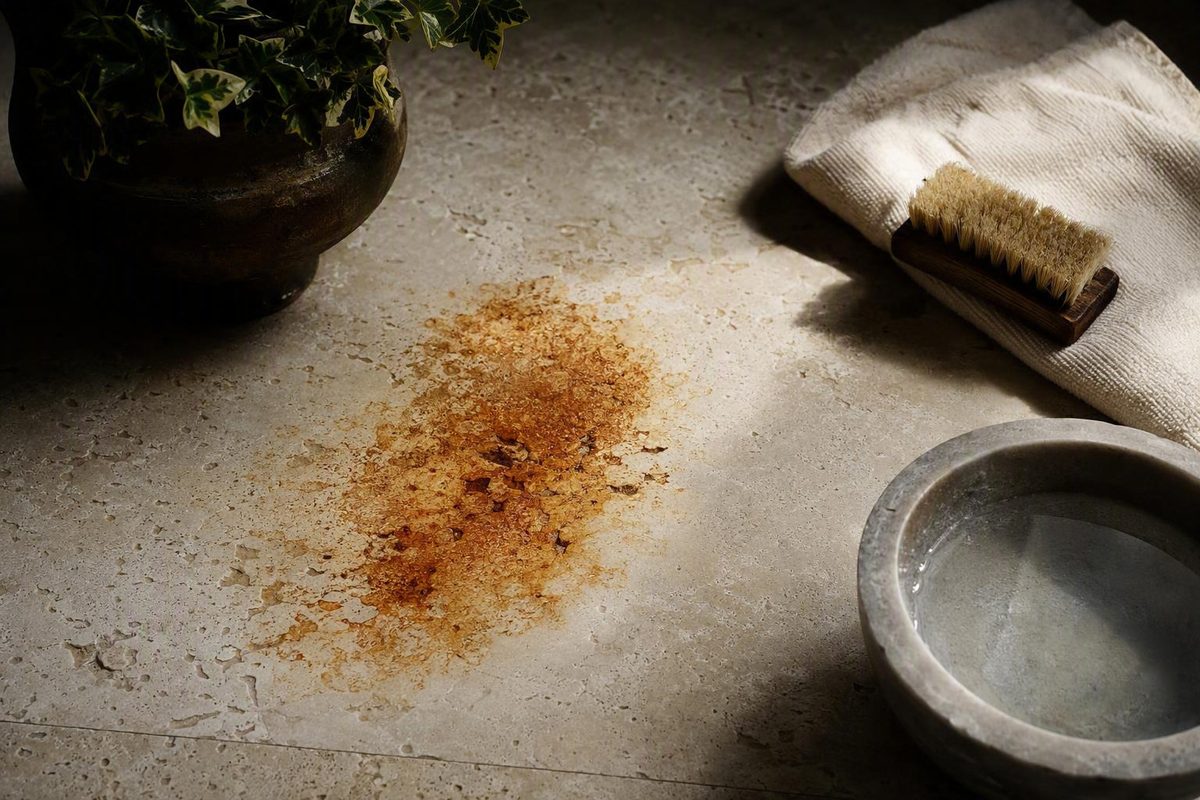
Limestone Rust: How to Remove Rust Stains Without Damaging the Stone
Overview
Rust stains on limestone can often be removed, but the safe path is fixing the rust source first, then starting with the least aggressive stone-safe treatment, escalating to a poultice for stubborn stains, rinsing with clean water, and reassessing before repeating. If the stain is deep-set or the stone is valuable, professional restoration is usually the safer call.
That sequence matters because limestone is porous and chemically sensitive, so the wrong cleaner can trade an orange-brown stain for permanent etching or discoloration. Trade guidance emphasizes non-acidic chemicals for removing rust stains from marble and limestone precisely because these stones react badly to acid contact, according to Stone Repairs. Deeply embedded rust stains in limestone are usually resistant to ordinary cleaners, which is why poulticing with a rust remover is the standard next step rather than scrubbing harder, as SurfaceCarePros explains.
The most authoritative procedure in this space comes from the U.S. General Services Administration, whose preservation guidance covers poulticing rust stains from limestone and marble and distinguishes between light, normal, and stubborn stains. This article organizes that scattered advice into one cautious decision path: diagnose, treat conservatively, reassess, and know when to stop.
Find the rust source before treating the stain
Treating a rust stain without finding what caused it is the most common way to end up cleaning the same spot again in a few months. Rust on limestone is almost always transferred from something else — a metal object sitting on the stone, iron-bearing runoff washing over it, or iron that has already penetrated the pores. Each situation calls for a different first move.
Stone Repairs advises removing any metal objects from the stone and letting the surface dry before treatment begins, which handles the most common residential case: planters, furniture feet, tools, or fixtures left in contact with damp limestone. The GSA procedure goes further for building stone, directing that the source of rust runoff — such as corroding fasteners, gutters, or adjacent metalwork — be identified and corrected, because a stain removed under an active runoff path will simply reform. SurfaceCarePros adds the third category: rust that has penetrated the limestone’s pores, which behaves differently from surface transfer and usually resists ordinary cleaners.
Use the matrix below to match what you can see to a safer first step before you open any product.
| What you observe | Likely cause | Safer first step |
|---|---|---|
| Stain outline matches a metal object (planter, furniture leg, fixture) | Direct metal-to-stone transfer | Remove the object, let the stone dry, then treat conservatively |
| Streaks or trails below gutters, fasteners, railings, or metalwork | Rust-laden runoff washing over the stone | Identify and correct the runoff source before treating the stain |
| Diffuse orange-brown discoloration that earlier cleaning did not shift | Deep-set iron staining in the stone’s pores | Skip surface cleaners; plan a poultice or consult a professional |
If you cannot correct the source yet — for example, corroded structural fasteners you cannot access — it is still worth knowing that any stain removal will be temporary. Fix or isolate the source first, then treat.
Choose the safest treatment path for limestone
Match the treatment to the stain’s severity and the stone’s value, and always start with the least aggressive option that fits. The supplied evidence supports three treatment categories plus professional restoration, but it does not support ranking specific brands or publishing exact chemical recipes, so this comparison stays at the category level.
The core compatibility rule is simple: limestone is calcium-based and porous, so acidic products and harsh chemicals can etch or discolor it even while they attack the rust. That is why Stone Repairs frames its entire method around non-acidic chemicals, and why SurfaceCarePros warns against common household shortcuts. The right category depends mainly on how deep the stain has gone:
- Stone-safe, non-acidic rust remover — light or fresh surface staining.
- Poultice with rust remover — stubborn or embedded stains that surface treatment did not shift.
- Oxalic acid or reducing-agent methods — specialist territory; use only with source-specific instructions.
- Professional restoration — deep-set stains, valuable or finished stone, or repeated failed attempts.
One further compatibility caution: much published stone-care guidance is written around polished marble, while limestone appears in honed floors, tumbled pavers, exterior paving, and architectural elements like columns. If you are unsure how your particular finish will react, treat that uncertainty itself as a reason to spot test carefully or seek professional input rather than assuming marble guidance transfers directly.
Stone-safe rust removers for light stains
For a light, recent stain — say, a faint ring where a metal planter sat over a wet weekend — a rust remover formulated as stone-safe and non-acidic is a reasonable first step. Stone Repairs states that rust stains can be removed from marble and limestone with non-acidic chemicals, and its workflow includes a list of needed items, detailed application steps, blotting, handling larger areas, and washing the treated area with clean water afterwards.
The critical discipline is to follow the specific product’s directions rather than improvising dwell times or concentrations, because the supplied evidence supports the category, not universal instructions. Confirm the product explicitly states it is safe for limestone or calcareous natural stone; “safe for tile” or “safe for masonry” is not the same claim.
Apply to the stain only, blot rather than scrub aggressively, rinse thoroughly with clean water, and let the stone dry fully before judging the result. If the stain has faded meaningfully, a careful repeat may finish the job. If it has barely changed, stop — that is your signal the rust is deeper than a surface treatment can reach, and a poultice is the appropriate escalation.
Poultices for stubborn or embedded rust
When rust has penetrated the limestone’s pores, a poultice is the evidence-supported escalation. SurfaceCarePros notes that deeply embedded rust stains in limestone are usually resistant to cleaners and that poulticing with rust remover may help, while the GSA’s technical procedure provides step-by-step poulticing guidance for limestone and marble using different chemical solvents, organized around light, normal, and stubborn stains.
A poultice works differently from a liquid cleaner: instead of dissolving the stain at the surface, an absorbent paste holds the active chemical against the stone long enough to draw dissolved iron out of the pores. That makes it the right tool for a stain that sits in the stone rather than on it — the classic example being a diffuse orange bloom that survived a stone-safe liquid remover.
Poulticing is still an escalation, not a casual first move for every mark. It involves longer chemical contact with the stone, protection of surrounding surfaces, and careful removal and rinsing, which is why the GSA treats it as a defined technical procedure rather than routine cleaning. Reserve it for stains that a conservative treatment has already failed to lift, follow the procedure or product instructions exactly, and rinse the area with clean water when the poultice comes off. Stubborn stains may need a repeat application — more on judging that below.
Oxalic acid and reducing-agent methods need extra caution
Oxalic acid and other reducing-agent approaches appear in stone-care guidance for iron staining, and SurfaceCarePros references oxalic acid alongside off-the-shelf rust removers in its discussion of limestone stain removal. The GSA procedure likewise describes poulticing with different chemical solvents depending on stain severity. These methods can be effective on iron precisely because they chemically convert or bind the rust rather than bleaching over it.
The caution is that this article cannot responsibly give you formulations, concentrations, dwell times, or safety procedures for these chemicals, because the supplied evidence does not spell them out and getting them wrong on limestone risks both the stone and the user. Oxalic acid is still an acid; on a calcium-based stone, the margin between removing a stain and dulling or etching the surface depends on details that must come from the specific product’s instructions or a formal procedure like the GSA’s.
Treat this category as one for experienced users working from source-specific directions, or as a reason to bring in a professional who uses these chemistries routinely. If you cannot find explicit limestone-safe instructions for the product in front of you, do not experiment on visible stone.
Follow a practical escalation sequence for DIY treatment
The individual steps below all appear in the supplied guidance — source removal and drying from Stone Repairs, poulticing and rinsing from the GSA procedure, and deep-stain escalation from SurfaceCarePros — but competitors present them piecemeal. Sequenced together, they form a path that keeps each move conservative and gives you a clear stopping rule before the next one.
- Remove or correct the rust source. Take metal objects off the stone and address runoff paths such as corroding gutters or fasteners, per the GSA’s source-correction guidance. Treating before this step wastes effort.
- Let the stone dry. Stone Repairs recommends drying the surface before treatment; a wet, porous stone can dilute the treatment and mask the stain’s true extent.
- Spot test in an inconspicuous area. Before applying any remover or poultice broadly, test a small hidden patch and check for etching, dulling, or color change once dry. This is a practical safeguard, not a formality — limestone finishes vary.
- Protect adjacent surfaces. Mask or shield nearby metal, grout, wood, or planting so the treatment touches only the stain.
- Apply the conservative treatment first. For light stains, use a stone-safe non-acidic remover per its directions, blotting rather than scrubbing.
- Rinse with clean water. Both the Stone Repairs workflow and the GSA procedure include washing the treated area with clean water; leftover chemical residue can keep working on the stone or attract soiling.
- Dry and reassess. Judge the result only on fully dry stone. Check for remaining stain, residue, and any change in surface sheen or texture.
- Escalate deliberately. If the stain lightened but persists, repeat the same treatment once, or move to a poultice for a stubborn stain. If two rounds produce no visible improvement, stop.
- Hand off when stuck. A stain that resists a properly applied poultice is a professional-restoration candidate, not an invitation to try harsher chemistry.
The sequence’s value is the stopping rules between steps. Each reassessment tells you whether to repeat, escalate, or stop — which is exactly the judgment that scattered how-to fragments never provide.
What not to use on limestone rust stains
The fastest way to turn a removable stain into permanent damage is reaching for a familiar household cleaner that was never meant for calcareous stone. Limestone’s calcium carbonate chemistry reacts with acids, and its porosity lets aggressive chemicals travel below the surface, so the avoid-list matters as much as the treatment choice.
Based on the supplied evidence, avoid the following on limestone rust stains:
- Bleach. SurfaceCarePros warns against bleach on limestone rust stains; it does not resolve iron staining and risks discoloring the stone.
- Hydrofluoric acid and products containing it. SurfaceCarePros flags hydrofluoric acid misuse as hazardous — this chemical is dangerous to handle and inappropriate for DIY limestone work.
- Acidic household cleaners generally. Stone Repairs’ method is built explicitly around non-acidic chemicals for marble and limestone, which is the practical inverse of a warning: acidic products are the wrong category for this stone.
- Rust removers not labeled stone-safe. Many rust removers designed for metal, concrete, or fabric rely on acids that will attack limestone along with the rust.
The pattern behind the list is consistent: products that work by acid action or strong oxidation can etch, dull, or discolor limestone even when they lighten the rust, leaving damage that is harder to fix than the original stain. When in doubt about a product, the safest reading of the evidence is simple — if it is not explicitly non-acidic and stone-safe, do not put it on limestone. Skipping one questionable shortcut is cheaper than restoring an etched floor.
Set realistic expectations before you repeat treatment
Do not expect one application to fix every stain, and do not treat “not gone yet” as a license to keep applying chemicals indefinitely. The evidence supports a graded picture: the GSA procedure explicitly separates its instructions for light, normal, and stubborn stains, which tells you that severity drives both the method and the number of attempts, while SurfaceCarePros is direct that deeply embedded rust stains are usually resistant to cleaners.
For a light surface transfer stain — the planter ring caught early — a single round of stone-safe treatment followed by rinsing may resolve it, and Stone Repairs describes this kind of removal as achievable with non-acidic chemicals. A stubborn stain that has had time to soak in typically needs a poultice, and may need a repeat poultice; the Stone Repairs workflow includes a dedicated section on removing stubborn rust stains, and the GSA’s stubborn-stain track exists for the same reason. Some improvement per round is the signal that repetition is worthwhile.
The honest limit is that complete removal cannot be promised. Iron that has penetrated deep into the pores may only lighten, and none of the supplied sources claims a universal success rate. A practical stopping rule: if a properly applied treatment produces no visible improvement across two attempts, further repetition adds chemical exposure and risk to the stone without adding results. At that point the question is no longer “which product next” but “is this a professional job” — and repeating failed treatments on a valuable surface is usually the more expensive path.
When to stop DIY and call a stone professional
Call a professional when the risk of another DIY attempt outweighs the cost of expert help — and on limestone, that threshold arrives earlier than most owners expect. SurfaceCarePros positions professional restoration as the appropriate route for difficult limestone stains, and the GSA’s treatment of poulticing as a formal preservation procedure underlines that serious stain removal on architectural stone is skilled work, not casual cleaning.
The evidence does not support quantified thresholds or cost figures, but it does support clear qualitative triggers:
- Deep-set staining that resisted a correctly applied poultice — the stain is beyond surface-level chemistry.
- Prior failed attempts, especially with unknown or harsh products, which may have complicated the stain or the surface.
- Valuable, historic, or architecturally significant stone, where the GSA’s preservation framing applies: mistakes here are costly and sometimes irreversible.
- Uncertain finish or stone type, where you cannot predict how the surface will react to treatment.
- Chemistry you are not equipped to handle safely, such as oxalic acid work without source-specific instructions or anything involving hazardous acids.
There is also a plain economic logic, even without published price data: repeated failed DIY rounds consume product, time, and stone condition, and a professional who diagnoses the stain correctly on the first visit may cost less overall than restoring stone damaged by successive wrong treatments. Professionals also bring options this article deliberately does not detail — controlled use of stronger chemistries, refinishing, and honing — that can address both the stain and any secondary damage. If any trigger above applies, stop treating and get an assessment first.
Prevent rust stains from coming back
A removed stain is only half the job; if the iron source is still there, the stain will return. Recurrence control is mostly about eliminating contact between rusting metal and damp limestone, which both the GSA and Stone Repairs guidance point toward.
Practical prevention steps supported by the evidence and basic stone-care logic:
- Correct runoff sources permanently. The GSA procedure calls for identifying and correcting the source of rust runoff — repair or replace corroding gutters, fasteners, and adjacent metalwork rather than just cleaning below them.
- Remove or isolate metal objects. Stone Repairs’ first step — removing metal objects from the stone — is also the lasting fix. Keep planters, furniture feet, and tools off bare limestone, or use non-metal risers and pads so metal never sits in contact with the surface.
- Manage wet contact where practical. Rust transfer needs moisture. Reduce standing water on limestone paving and avoid leaving damp metal items on the stone, particularly outdoors.
- Monitor the treated area. Check the spot over the following weeks and after wet weather. A returning stain in the same place usually means an uncorrected source — or iron deeper in the stone wicking back to the surface — and is a diagnosis clue, not just a cleaning task.
One boundary worth stating plainly: the supplied evidence does not address sealing limestone against rust, so no claim is made here about whether a sealer would help or hinder. If a stain keeps returning despite corrected sources and dry conditions, that persistence itself is a signal to involve a stone professional, because recurring iron staining can indicate a source you have not yet found.