 StainList
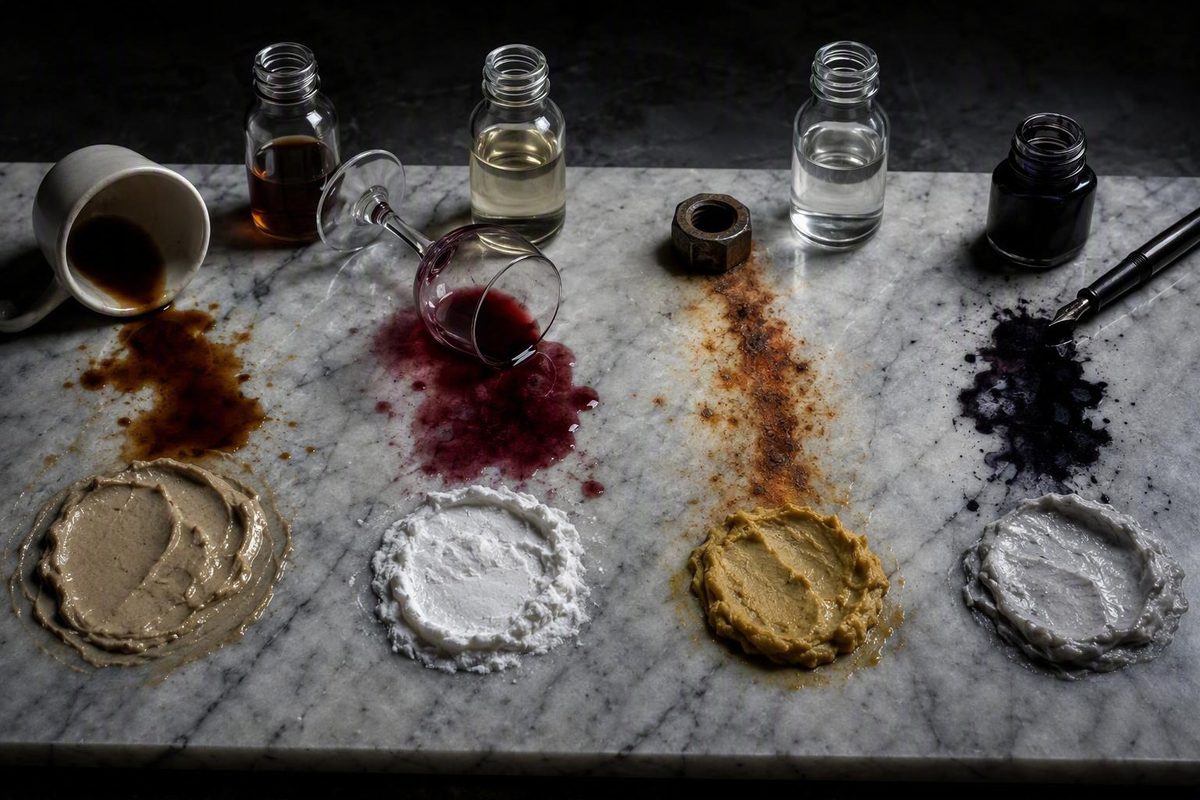
Marble doesn’t get “stained” the way people think — half of what looks like a stain is actually an etch, a chemical burn into the calcite itself, and no poultice fixes that. The other half really is a stain, and the right poultice material, solvent, and dwell time depend entirely on what caused it. Below is the full lookup: 15 rows covering oil, organic stains, metals, biological growth, paint, and the two non-stain cautions (etching and abrasive damage) that get mistaken for one.
Pick your stain.
Chemical Family At A Glance
Each stain type is marked in every chemical family its recipe calls for (OR options included) — empty circles mean that family plays no role. Dwell bars show the 24–48 hour poultice-cycle range where the source gives one number; em dash marks rows that are mechanical-only, N/A, or split across several sub-treatments with different times.
The poultice matrix — all 15 rows
| Stain Type | Poultice Material | Chemical / Solvent | Dwell Time | Cautions | Source |
|---|---|---|---|---|---|
| Oil / grease (cooking oil, tar, cosmetics) | Baking soda OR kaolin/fuller's earth/whiting/diatomaceous earth | Baking soda + water, OR mineral spirits, OR acetone; surface clean with liquid cleanser with bleach, detergent, or ammonia | 24-48 hours, covered with plastic; repeat up to ~5x for stubborn stains | Do not combine whiting/clay poultice bases with acid chemicals - cancels the poultice reaction. Oxidized (yellowed) oil stains resist this method. | Natural Stone Institute, Remove Stains from Stone Applications (naturalstoneinstitute.org/consumers/stains/) |
| Coffee / tea (organic) | Kaolin, fuller's earth, whiting, diatomaceous earth, powdered chalk, or talc | 12% hydrogen peroxide (hair-bleaching strength) with a few drops of ammonia, OR acetone | 24-48 hours, covered with plastic | Never mix bleach and ammonia in the same treatment - creates toxic gas. Some organic stains never fully clear. | Natural Stone Institute, Remove Stains from Stone Applications |
| Wine (and other fruit-acid stains) | Kaolin, fuller's earth, whiting, diatomaceous earth, powdered chalk, or talc | 12% hydrogen peroxide + ammonia, OR acetone (treated as an organic/fruit stain) | 24-48 hours, covered with plastic | Wine is acidic: if the spill sat before wiping, check for an etch (dull ring) underneath any color stain - poulticing removes the color but will not restore the polish if the surface etched. | Natural Stone Institute, Remove Stains from Stone Applications |
| Ink / marker | Kaolin, fuller's earth, whiting, diatomaceous earth, powdered chalk, or talc | Light-colored stone: bleach or hydrogen peroxide. Dark stone: lacquer thinner or acetone | 24-48 hours, covered with plastic | Bleach and hydrogen peroxide can lighten or blotch dark/colored stone permanently - use only on light stone. | Natural Stone Institute, Remove Stains from Stone Applications |
| Rust / iron | Diatomaceous earth or clay filler with commercial rust remover; alternatively molding plaster, untreated flour, white tissue, powdered chalk, talc, or acid-free paper pulp (GSA procedure) | Commercial rust remover, OR oxalic acid (1 part acid powder to 10 parts water) for light stains, OR glycerine/sodium citrate/water mix for normal treatment, OR sodium hydrosulfite/sodium hypochlorite for stubborn stains | Normal/light: ~48 hours. Sodium hydrosulfite: max 30 minutes per application. Commercial rust removers: max 24 hours | Deep-seated rust stains are extremely difficult to remove and the stone may be permanently stained. GSA notes this treatment 'may cause some etching of polished surfaces but can be corrected by re-polishing.' Never use products with hydrofluoric acid (common in laundry rust removers/toilet bowl cleaners) - attacks all stone types. | GSA Technical Procedure, Poulticing Rust Stains from Limestone and Marble (gsa.gov); Natural Stone Institute, Remove Stains from Stone Applications; Natural Stone Institute, Learn About Cleaning Products (naturalstoneinstitute.org/consumers/care/) |
| Copper / bronze | Kaolin, fuller's earth, whiting, diatomaceous earth, powdered chalk, or talc | Powdered poultice material with ammonia | 24-48 hours, covered with plastic | Metal stains (green or muddy-brown) must be removed with a poultice, not surface wiping - the metal has migrated into the stone. | Natural Stone Institute, Remove Stains from Stone Applications |
| Biological (algae, mildew, moss, fungi, lichens) | Not typically poulticed - surface application | Diluted ammonia OR bleach OR hydrogen peroxide (1/2 cup per gallon of water) - use only ONE of these, never combined | Apply, scrub, rinse; repeat as needed | NEVER mix bleach and ammonia - creates a toxic and lethal gas. Overuse of ammonia can dull some stone surfaces over time. | Natural Stone Institute, Remove Stains from Stone Applications; Natural Stone Institute, Learn About Cleaning Products |
| Paint | None for light amounts; commercial paint stripper for heavy coverage | Light: lacquer thinner or careful razor-blade scraping. Heavy: commercial paint stripper (caustic soda/lye based) | Per stripper manufacturer instructions | Do not use acids or flame tools to strip paint - paint strippers themselves can etch the stone surface. Oil-based paint residue can leave a secondary oily stain requiring oil-stain treatment. | Natural Stone Institute, Remove Stains from Stone Applications |
| Water spots / rings | None (mechanical, not chemical) | None - buff with dry 0000-grade steel wool | N/A - mechanical buffing until spot clears | This is a surface residue/mineral deposit, not a stain that a poultice draws out. Confirm it isn't actually an etch (acid-caused, will not buff out with steel wool alone and needs polishing powder). | Natural Stone Institute, Remove Stains from Stone Applications |
| Etch marks (NOT a stain) | None - not a stain-removal poultice at all | Marble polishing powder applied with a damp cloth or buffing pad (low-speed power drill for larger areas) | Buff until shine returns; deep etches are not DIY-fixable | Etching is physical damage, not discoloration: acid dissolves a microscopic layer of calcite, disrupting the flat crystal arrangement that gives marble its polish. No poultice, stain remover, or cleaner reverses this - the dulled area must be mechanically re-polished or professionally refinished. Damage can start within 30 seconds of acid contact. | Natural Stone Institute, Remove Stains from Stone Applications; Natural Stone Institute, Learn About Cleaning Products; NPS Preservation Brief 1, Assessing Cleaning and Water-Repellent Treatments for Historic Masonry Buildings (nps.gov/orgs/1739) |
| Urine | Kaolin, fuller's earth, whiting, diatomaceous earth, powdered chalk, or talc | 12% hydrogen peroxide + ammonia, OR acetone (classified as an organic stain by NSI) | 24-48 hours, covered with plastic | Never mix bleach and ammonia. Repeated/aged urine exposure can also etch the surface if it sat long enough for the acid/ammonia in it to react with the calcite - poulticing addresses only the discoloration. | Natural Stone Institute, Remove Stains from Stone Applications |
| Smoke / fire damage | Commercially available smoke remover per product instructions | Commercial smoke-remover product | Per product label | We couldn't find a specific NSI or NPS poultice recipe (material + solvent + dwell time) for smoke damage beyond 'use a commercial smoke remover' - treat any DIY smoke-stain recipe found elsewhere as unverified. | Natural Stone Institute, Remove Stains from Stone Applications |
| Efflorescence (white powdery mineral salts - often mistaken for a stain) | None - not poulticed | None - dry mechanical removal only | Dust mop or vacuum; may need repeating as it recurs | Do not use water to remove it - water only makes the powder disappear temporarily; the salts return as the area dries. This is a moisture/salt migration issue, not a stain a poultice will pull out. | Natural Stone Institute, Remove Stains from Stone Applications |
| General acid-etching cause / cross-cutting caution | N/A | N/A | N/A | Acidic cleaners are 'extremely damaging to acid-sensitive stones, such as marble and limestone, resulting in etching and dissolution.' Alkaline cleaners are the correct chemical family for marble; acidic ones are not. High-pressure water washing can also etch marble. | NPS Preservation Brief 1, Assessing Cleaning and Water-Repellent Treatments for Historic Masonry Buildings |
| Abrasive damage (cross-cutting caution, not a stain type) | N/A | N/A | N/A | Abrasive cleaning methods (sandblasting, scouring pads, aggressive buffing) physically erode the stone surface, erase tooling/polish, and expose more surface area to future staining and weathering. 'The gentlest means possible' is the standard; test any method on an inconspicuous area first. | NPS Preservation Brief 6, Dangers of Abrasive Cleaning to Historic Buildings (nps.gov/orgs/1739) |
Rows are grouped by Natural Stone Institute’s own stain taxonomy, plus two rows that are NOT stains at all: etch marks (physical damage, fixed only by re-polishing) and a general acid/abrasive-damage caution.
Sources
Method
9 WebSearch queries covering poultice basics, the etch-vs-stain distinction, and per-stain treatments, plus a WebFetch of every URL used as a row source. Two NPS preservation-brief PDFs returned only image-encoded text under direct fetch and were re-pulled through the r.jina.ai reader proxy; all Natural Stone Institute and GSA pages fetched directly with no errors.
Gaps
We couldn’t find a Getty Conservation Institute or Smithsonian MCI technical bulletin specifically about marble/calcareous-stone stain removal (as opposed to textiles/paper) — MCI’s public stain-removal guide is textile-focused, so it was excluded rather than misapplied to stone. We couldn’t find a specific poultice recipe (material + solvent + numeric dwell time) for smoke/fire damage beyond NSI’s generic “use a commercial smoke remover” — any more detailed DIY smoke recipe circulating online is unverified and was excluded. We couldn’t find a Marble Institute of America bulletin distinct from Natural Stone Institute’s current pages — MIA merged into NSI in 2015, so NSI’s consumer pages are treated as the continuation of MIA’s technical guidance rather than a separate corroborating source.