 StainList
Oil vs Water Based Stain: How to Choose the Right Wood Stain
Overview
Neither oil-based nor water-based stain is universally better. The right choice depends on where the project lives, how much weather or wear it faces, whether the wood was previously finished, how fast you need it to dry, and how much odor and solvent cleanup you can tolerate. Match the stain base to the project, not to a general ranking.
That conditional answer is the consistent conclusion across comparison guides on this topic. Astins Designs explicitly concludes there is no one-size-fits-all answer after weighing drying time, smell, durability, and finish. Storm Stain frames the decision around factors such as wood type, previous wood treatment, and weather exposure, while Ready Seal breaks the choice into where each type excels.
This guide walks through the main differences first, then maps them to specific projects — decks, fences, furniture, cabinets, trim, and confined indoor spaces — so you can leave with a defensible decision and a short list of things to verify on the product label before you buy.
Oil-Based vs Water-Based Stain: The Main Differences
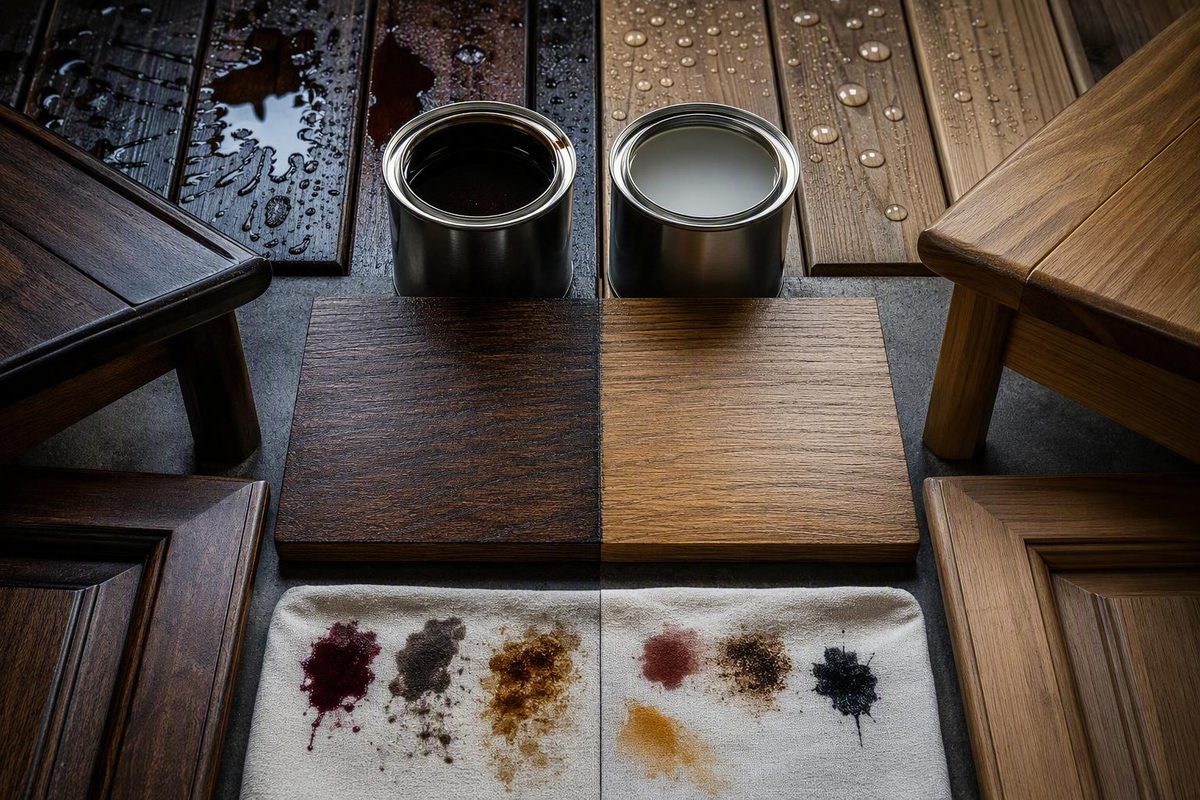
The core difference between the two stain bases comes down to how each one interacts with the wood and how it behaves during and after application. According to Ready Seal’s comparison, water-based stains tend to form a protective film on top of the wood surface and dry much faster than oil-based alternatives, while oil-based stains are typically associated with deeper penetration into the wood. That single behavioral difference — penetrating oil versus faster-drying film — drives most of the practical trade-offs readers care about.
The table below summarizes the recurring comparison points that appear across the sources cited in this article. Treat the entries as general tendencies, not guarantees: exact dry times, coverage, and durability depend on the specific product, the wood, and the conditions, so always confirm specifics on the label.
| Factor | Oil-based stain (typical tendency) | Water-based stain (typical tendency) |
|---|---|---|
| How it works | Penetrates into the wood | Forms a protective film on the surface |
| Drying speed | Slower; longer working time | Much faster; quicker project turnaround |
| Odor | Stronger solvent smell | Milder; generally more tolerable indoors |
| Cleanup | Solvent cleanup (e.g., mineral spirits) | Soap and water |
| Finish character | Often described as richer, grain-enhancing | Cleaner, more contemporary look; can dry before blending |
| Application forgiveness | Longer open time helps blend strokes | Fast drying can cause streaks or lap marks if you work slowly |
| Recoating and maintenance | Recoat approach depends on product and condition | Recoat approach depends on product and condition |
A few of these rows deserve emphasis because they change how the project feels to do. Drying speed is a double-edged trait: fast drying is convenient when you want the piece back in service quickly, but it shortens your working time and raises the risk of visible lap marks on large surfaces — a practical concern Astins Designs raises from first-hand DIY experience. Slower-drying oil-based stain gives a beginner more time to spread and blend, at the cost of a longer wait before recoating or using the surface.
Odor and cleanup are the other everyday differences. Oil-based products carry a stronger solvent smell and require solvent cleanup, while water-based products clean up with soap and water and are generally easier to live with indoors. Neither column above makes one type “the winner” — Storm Stain notes that the level of protection and coverage you actually get depends on the type of wood, previous treatment, and weather exposure, which is exactly why the next section moves from general differences to project-specific guidance.
Choose by Project, Not by Stain Type Alone
The most reliable way to pick a stain base is to start from your project’s conditions rather than from a pros-and-cons list. All three sources reviewed for this article converge on the same structure: Ready Seal organizes its guidance around when to choose each type, Astins Designs offers choose-this-if lists grounded in DIY experience, and Storm Stain makes recommendations situational based on wood type, previous treatment, and weather exposure.
The decision matrix below synthesizes those recurring use cases into one place. It uses conditional language deliberately: “leans toward” means the typical trade-offs favor that base for that scenario, not that the other base will fail. Product-specific formulations vary widely, so treat this as a starting hypothesis to confirm against the label of the product you’re considering.
| Project scenario | Leans toward | Why, in brief |
|---|---|---|
| Deck exposed to weather | Depends on exposure and product | Weather exposure and previous treatment drive the choice; penetrating oils and film-forming water-based products protect differently |
| Fence | Depends on wood type and condition | Coverage and protection vary with wood type and prior treatment; verify the product’s exterior rating |
| Outdoor furniture | Either, per label exterior suitability | Moisture and sun exposure matter more than base alone; check recoat and maintenance guidance |
| Indoor furniture | Often water-based | Milder odor, fast drying, and soap-and-water cleanup suit indoor work |
| Cabinets and trim | Often water-based, unless matching an oil finish | Indoor odor tolerance and quick turnaround matter; existing finish may dictate the base |
| Confined indoor space (closet, small room) | Water-based | Strong solvent odor from oil-based stain is hardest to manage where ventilation is limited |
| Large flat surface where blending matters | Often oil-based | Slower drying gives more working time to avoid lap marks and streaks |
| Previously stained or sealed wood | Whatever the existing finish and label allow | Compatibility with the prior coating outranks base preference; test first |
Two scenarios deserve extra comment. For outdoor projects like decks and fences, resist the assumption that one base always outperforms the other. Storm Stain’s framing is the honest one: protection and coverage depend on the wood, its previous treatment, and the weather it faces. A weathered, previously coated deck presents a different problem than fresh fence boards, and the product’s own exterior guidance is the deciding evidence.
For indoor projects, the practical experience factors — odor, drying speed, and cleanup — tend to dominate, which is why water-based stain appears so often in the indoor rows. Astins Designs highlights exactly this from a DIY perspective: smell and quick drying are decisive in confined spaces, even though quick drying demands a faster application rhythm.
The matrix also doubles as a neutral buying framework. Instead of comparing brands, compare each candidate product against your row: Is it rated for your setting? Does its dry and recoat guidance fit your schedule? Does its cleanup requirement fit your workspace? Does the label address your existing finish? A product that answers those questions well is a better choice than a “better” base that doesn’t.
Application, Timing, and Cleanup Trade-Offs
The day-of-application experience differs meaningfully between the two bases, and for beginners this often matters as much as long-term performance. The central variable is working time. Water-based stains dry much faster than oil-based alternatives, per Ready Seal, which means less time to spread, blend, and wipe before the surface starts setting. Oil-based stain’s slower dry gives you a more forgiving window — helpful on a long dining table or a run of deck boards where you need edges to stay wet while you work.
Cleanup is the second workflow difference. Water-based stain cleans off brushes and hands with soap and water, while oil-based stain requires a solvent such as mineral spirits. That difference affects more than convenience: it determines what you need to have on hand, how you handle used rags and solvent, and how practical the job is in a kitchen or apartment versus a garage or yard.
Before you open the can, a short pre-application check saves most timing mistakes:
- Confirm the label’s dry, recoat, and cure guidance fits your schedule and the weather window.
- Plan your application path so you can keep a wet edge, especially with fast-drying water-based products.
- Have the right cleanup supplies ready — soap and water, or mineral spirits — before you start, not after.
None of these checks favors one base over the other. They simply expose whether the base you’re leaning toward fits how, where, and how fast you actually work.
Dry Time, Recoat Time, and Cure Time Are Not the Same
Dry time, recoat time, and cure time describe three different milestones, and treating them as interchangeable is a common cause of ruined finishes. Dry to the touch means the surface no longer feels wet or tacky — it does not mean the finish is ready for another coat or for use. Recoat time is the manufacturer’s window for applying the next coat so the layers bond properly. Cure time is the longest interval: the point at which the finish has fully hardened and can handle normal use, furniture placement, or outdoor exposure.
The sources reviewed here support the broad pattern — water-based stains dry much faster than oil-based ones, per Ready Seal — but they do not support exact universal intervals, and no article can, because these times vary by product, temperature, humidity, and how heavily the stain was applied. The only authoritative source for your specific product is its label or technical data sheet.
The practical takeaway: schedule your project around the label’s cure time, not its dry time. A deck that feels dry the same afternoon may still need days before furniture, foot traffic, or rain, depending on the product.
Common Finish Problems to Prevent Before They Happen
Most bad staining results are prevention problems, not repair problems, and the stain base you choose influences which failure mode you’re most exposed to. Astins Designs flags streaking as a real-world risk with fast-drying water-based stain: if one section sets before you blend the next, you get visible lap marks and uneven color. Oil-based stain’s slower dry reduces that risk but introduces its own — stain left sitting too long without wiping can stay tacky or sticky rather than drying properly.
The most common preventable problems map to a small set of causes:
- Streaks and lap marks: working too slowly with a fast-drying stain, or losing the wet edge on a large surface.
- Sticky or tacky areas: excess stain not wiped per the label, or recoating before the previous coat was ready.
- Blotchy or uneven absorption: inconsistent prep, or wood that absorbs stain unevenly by nature — a test patch reveals this before the whole surface does.
- Uneven color at edges and end grain: absorbent areas drinking more stain than flat faces.
The pattern across all of these is the same: the failure is usually decided before or during application, not after. Test on a hidden area or scrap of the same wood, follow the label’s application and wipe instructions, and match the stain’s working time to the size of the surface and your pace. If you know you work slowly, that alone is a legitimate reason to prefer a slower-drying product.
Compatibility, Prep, and Existing Finish Checks
Before the oil-versus-water question, ask a prior question: what is already on the wood, and what do you plan to put over the stain? Storm Stain lists previous wood treatment among the primary factors that determine how much protection and coverage a stain actually delivers, and it belongs at the front of your decision, not the end. Stain needs to reach or bond with the wood; an old sealer, film, or coating standing in the way can defeat either base.
Topcoat plans matter for the same reason in reverse. If you intend to seal the stained surface with a clear coat or protective finish, the stain and the topcoat need to be compatible with each other — and the reliable authority on that pairing is the manufacturer’s label and directions for both products, not a general rule of thumb. Some stains are designed to work under specific finishes; others are formulated to stand alone. Checking this before purchase prevents the frustrating discovery that your chosen stain and your chosen topcoat don’t play well together.
A short compatibility check before buying:
- Identify whether the wood is bare, previously stained, sealed, or coated.
- Read the stain label’s guidance on previously finished surfaces and required prep.
- If you plan a topcoat or sealer, confirm the label supports that combination.
- Test the full system — prep, stain, topcoat — on a hidden spot before committing.
These checks take minutes and remove most of the guesswork. The subsections below cover the two situations where compatibility most often changes the answer: wood with an existing finish, and wood whose species or condition affects absorption.
Previously Stained or Sealed Wood Needs Extra Caution
If your wood was previously stained or sealed, the existing finish — not your preference — is the biggest constraint on your next stain. A penetrating stain cannot penetrate wood that a previous sealer has closed off, and a new coating applied over an incompatible old one may not adhere or wear evenly. This is why Storm Stain treats previous treatment as a core selection factor rather than a footnote.
The first step is identification: figure out, as best you can, whether the existing finish is oil-based or water-based, penetrating or film-forming, and how much of it remains. Simple observation helps — whether water beads on the surface, whether the finish sits as a visible film, how weathered or worn it is — but a test patch in an inconspicuous area is the most honest evidence. Apply your candidate stain to a prepared test spot and check whether it absorbs, adheres, and dries as expected before committing to the whole surface.
Whether you can switch bases — water-based over a previously oil-stained surface, or the reverse — depends on the specific products and the condition of the old finish, and the answer belongs to the new product’s label. Some situations call for sanding back to sound wood; heavily sealed or failing finishes may need stripping before any stain can perform. If the label’s guidance and your test patch disagree with your plan, change the plan, not the prep. Cutting corners here is the most expensive shortcut in staining, because failures on top of an old finish typically mean redoing everything.
Wood Type and Prep Can Change the Result
The same stain can look and perform differently on different wood, which is why Storm Stain names wood type alongside previous treatment and weather exposure as a deciding factor. Softwoods, hardwoods, and pressure-treated lumber absorb stain differently, and some species take color unevenly by nature — the blotchy result many first-time refinishers blame on the product is often the wood itself.
That said, be wary of confident species-by-species rules. The sources reviewed here support wood type as a factor to evaluate, not a lookup table of “always use oil on cedar” or “always use water-based on pine.” The honest method is empirical: test your actual stain on your actual wood — a scrap offcut or a hidden face — and judge the absorption, color, and evenness before staining the visible surfaces. For blotch-prone woods, the test patch is also where you find out whether the label recommends additional prep steps for even color.
Prep quality matters as much as species. Stain reveals rather than hides the surface underneath, so inconsistent sanding, leftover residue, or damp wood shows up in the final color regardless of which base you chose. Follow the label’s surface-preparation directions — including any guidance on sanding, cleaning, and how dry the wood should be — because those instructions are calibrated to that specific product. Good prep plus a test patch resolves most wood-type uncertainty better than any general rule can.
Odor, Ventilation, and Indoor-Use Considerations
For indoor and confined-space projects, odor and ventilation are often the deciding factors — sometimes more than any performance difference. Oil-based stains carry a noticeably stronger solvent smell, a drawback Astins Designs emphasizes from direct experience, particularly in confined spaces where the odor lingers and ventilation is hard to arrange. Water-based stains are generally milder-smelling, which is a large part of why they show up so often in indoor recommendations.
Odor is connected to the broader topic of solvent content. Comparisons of the two bases commonly discuss VOC content as a differentiator, with water-based formulations generally positioned as the lower-VOC option — but actual VOC levels vary by product and formulation, so read the specific can rather than assuming. If low odor and low solvent content are priorities for your household, that’s a label line item to check, not a property guaranteed by the word “stain” on the front.
The cleanup solvents extend the safety picture beyond application. Oil-based work means handling mineral spirits or similar solvents for brush cleaning, and oil-based products and oily rags carry flammability concerns that water-based soap-and-water cleanup avoids. The product label and safety data sheet are the authoritative source for exact handling, rag disposal, and storage precautions for whatever you buy — follow them rather than generic advice.
A few practical questions settle the indoor decision quickly:
- Can you genuinely ventilate the space during application and drying, or is it a closet, basement corner, or closed room?
- Will people, pets, or food preparation share the space while the stain dries and cures?
- Are you set up to handle and dispose of solvents and solvent-soaked rags safely?
If the honest answers are “limited ventilation, shared space, no solvent setup,” a water-based stain fits the constraints of the space far better. If you’re working in a detached garage or outdoors with good airflow and you want oil-based characteristics, the odor trade-off becomes manageable. Either way, the label’s ventilation and safety directions are part of the product choice — a stain whose requirements you can’t meet in your space is the wrong stain for that project, whatever its other merits.
Appearance, Durability, Maintenance, and Value
Appearance is usually the difference people can see, so start there. Oil-based stains are commonly described as producing a richer finish that enhances the wood grain — the warm, traditional look many people picture when they imagine stained wood. Water-based stains are associated with a cleaner appearance and faster-drying behavior, though as Astins Designs notes, that fast dry can translate into streaks if application isn’t kept moving. Beyond these general tendencies, the honest guidance is that appearance outcomes depend heavily on the specific product, color, wood species, and prep — which is why the test patch recommended earlier is also your best appearance preview. No written description substitutes for seeing your stain on your wood.
Durability follows the same conditional logic. The structural difference Ready Seal describes — penetrating oil versus a protective surface film — means the two bases protect wood in different ways, and Storm Stain is explicit that actual protection depends on wood type, previous treatment, and weather exposure. The sources reviewed for this article do not support quantified lifespan claims for either base, and you should be skeptical of any comparison that assigns confident year counts without naming a specific product and exposure condition. What you can act on: check the product’s own maintenance and recoat guidance for your setting, because that recurring effort is a real part of the cost of ownership for exterior wood especially.
That reframing is also how to think about value without invented numbers. The supplied evidence does not support price-per-gallon, coverage-rate, or cost-over-time comparisons between the bases, so a neutral value assessment weighs factors you can verify:
- How demanding is the setting — full weather exposure versus a sheltered indoor piece?
- What recoat or maintenance cycle does the product’s label describe, and will you realistically keep up with it?
- Does the product’s coverage and coat guidance on the label fit your project’s size and budget?
- Does the finish deliver the appearance you want, confirmed by a test patch rather than the can’s photo?
A stain whose maintenance schedule you’ll actually follow is worth more than a nominally tougher product left to fail unmaintained. Weigh candidates against these criteria using their own labels, and the value question usually resolves itself.
The bottom line across every section of this comparison is the same: oil-based and water-based stains are different tools, not ranked competitors. Decide from your project’s location, exposure, existing finish, timeline, and workspace constraints; confirm the specifics — dry, recoat, and cure times, prep, compatibility, and safety handling — on the label of the product in your hand; and test before you commit. That process beats any universal answer this query could have.