 StainList
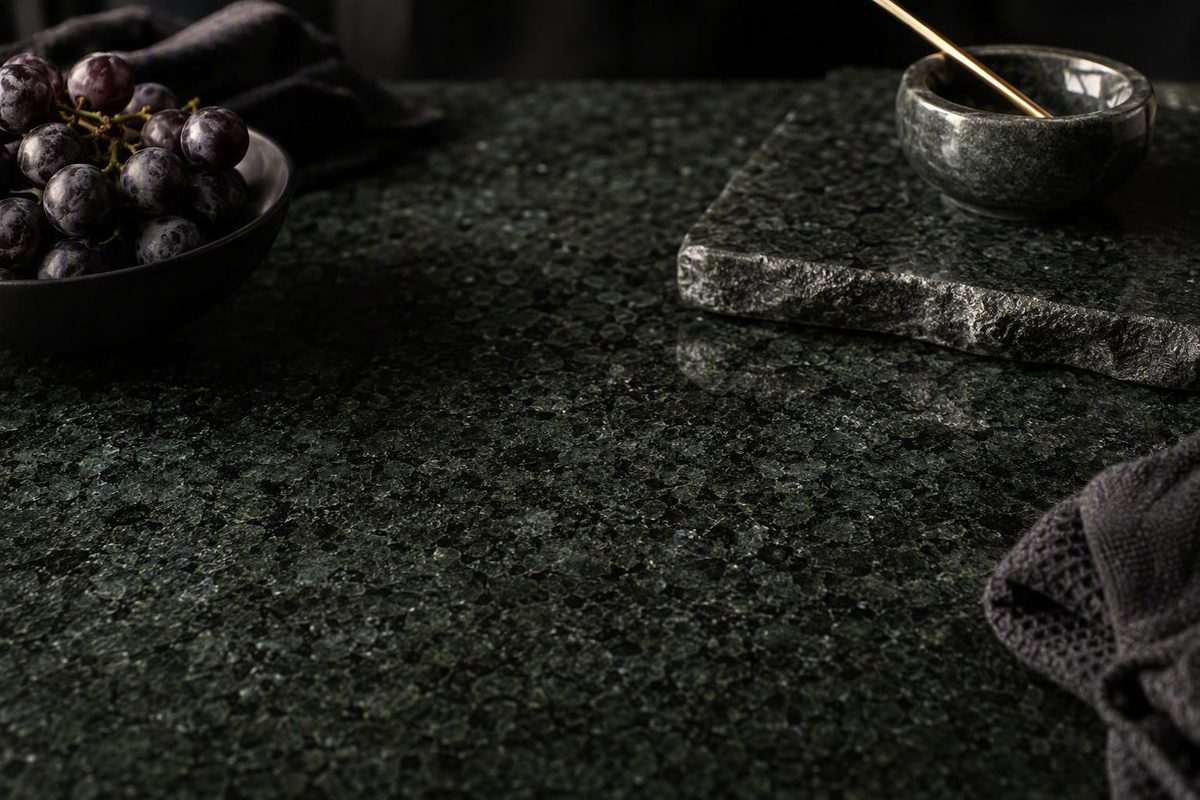
How to identify, specify, and care for this dark green Indian stone
Orissa Green Granite is marketed as a dark green Indian natural stone, often under the name Seaweed Green Granite. That description can begin a product search, but it is not enough to approve a slab, write a specification, or compare quotations.
Two suppliers may use the same name for visibly different stock, while others may apply different names to material they consider equivalent. Published performance figures may also be generic, dated, or unrelated to the slabs currently for sale.
The defensible approach is to verify the trade name, reported origin, exact slabs, finish, repairs, dimensions, test documents, fabrication scope, installed cost, and proposed care products before purchase. This guide supports preliminary evaluation; current supplier records and project-specific technical review should take priority.
What Orissa Green Granite Is—and Why the Name Needs Verification
A commercial stone library lists Orissa Green Granite as an alternate name for Seaweed Green Granite. Associated marketplace names include Sea Weed Green, Pocono Green, Titanic Green, Pine Green India, and Emerald Green. The same listing describes an Indian stone with a predominantly dark green appearance and small golden accents, but it is a commercial marketplace description rather than an independent geological record. See the StoneContact Seaweed Green Granite listing.
These aliases are useful search terms. They do not prove that every slab sold under those names is geologically, visually, or commercially identical. One distributor may adopt an established name because its stock has a similar color; another may reserve that name for material from a particular exporter or quarry area. An invoice name alone cannot resolve the difference.
Commercial naming is also distinct from petrographic classification. No petrographic report in the available evidence confirms the geological classification of current material sold as Orissa Green Granite.
A buyer should reconcile the proposed name with five forms of evidence:
- Full-slab photographs: Request current images showing the entire face rather than cropped marketing photographs.
- A physical sample: Preferably obtain a sample from the actual slab or current lot, finished as intended for the project.
- Consistent paperwork: Make sure the quotation, reservation, fabrication order, and final invoice use compatible names and slab identifiers.
- Provenance information: Ask for the quarry, block, exporter, supplier, bundle, or lot information available.
- Current-batch documents: Where performance matters, request reports connected to the supplied material rather than relying on a generic product page.
Three evidence labels are useful throughout the buying process:
- Supplier-reported: An origin, property, application, or description stated by a seller or marketplace but not independently confirmed.
- General granite guidance: Advice that may be reasonable for many granite surfaces but has not been tested specifically on Orissa Green Granite.
- Unknown or unverified: A characteristic for which relevant documentation has not been provided, such as petrography, abrasion resistance, slip performance, or freeze-thaw durability.
These distinctions prevent a common specification error: converting a broad seller statement into a guaranteed property of every slab. The material may suit a project well, but that conclusion should follow inspection and relevant documentation rather than the trade name alone.
Reported Origin, Color, Pattern, and Natural Variation
The most relevant marketplace account reports quarrying near Titlagarh in Bolangir district, Odisha, India.
Treat that location as supplier-reported marketplace information. No quarry record, geological survey, block ticket, chain-of-custody document, or independent source was supplied to corroborate the origin. If provenance matters to a contract, sourcing policy, or design narrative, require the seller to document it in writing.
A separate commercial guide describes Odisha more broadly as an emerging source of darker green granites. It does not identify or authenticate Orissa Green as a specific variety. This illustrates why “Indian green granite” is too broad a description for confirming identity.
What the stone is reported to look like
The Orissa-specific marketplace description emphasizes:
- A predominantly dark green field
- Small golden veins, highlights, or accents
- A comparatively consistent pattern
- Natural variation between pieces
Another passage in the same marketplace material refers to black and white streaks. That inconsistency may reflect natural variation, different lots, materials grouped under one commercial name, or inconsistent editing. It is a reason to inspect current stock—not a basis for choosing one description as universally correct.
A small sample can establish approximate color and finish, but it may omit the features that determine whether an installation looks calm or active. Online images can also shift the apparent green toward black, blue, olive, or gray because of exposure, white balance, screen settings, and surrounding colors.
Neither a website image nor a hand sample reliably shows the full distribution of:
- Veins and directional movement
- Mineral concentrations
- Natural fissures
- Resin-filled areas
- Patches and repairs
- Mesh backing
- Edge defects
- Gloss variation
- Differences between adjacent slabs
Inspect the exact slab under lighting similar to that planned for the room. A slab that looks nearly black in warehouse lighting may reveal green and gold details under daylight or task lighting. A bright showroom image may have the opposite effect, overstating color that appears subdued in a darker interior.
View each slab from two distances. From several steps away, assess overall color, pattern balance, and movement. At close range, examine fissures, fills, resin, surface texture, edge condition, and polish. If the project needs several slabs, compare them side by side whenever possible.
Use this inspection checklist:
- Green tone: Does the slab read as forest green, olive, gray-green, blue-green, or nearly black?
- Accent colors: Are the visible details gold, beige, white, black, gray, or mixed?
- Vein direction: Can movement continue acceptably through seams and around corners?
- Fissures: Are they stable natural features, open defects, or filled areas?
- Repairs: Are patches, resin fills, or color-matched repairs visible?
- Backing: Is mesh reinforcement present, and could it affect fabrication?
- Surface treatment: Has resin been applied across the face or only in selected areas?
- Gloss consistency: Is the sheen even across dark zones, fissures, and repairs?
- Edges: Are there chips, cracks, handling damage, or weak areas near planned cutouts?
- Lot matching: Are all slabs sufficiently similar for the intended layout?
Natural variation is not automatically a defect. The relevant question is whether the actual features are acceptable for the approved design and fabrication plan.
Applications and Finish Selection
Orissa Green Granite is advertised for kitchen and bathroom countertops, floors, interior and exterior walls, stairs, monuments, ornamental work, mosaics, landscaping, and other architectural uses. These are marketed product categories, not proof that every slab, thickness, finish, or installation system is appropriate for every application.
Reported surface options include polished, honed, leathered, brushed, flamed, bush-hammered, sandblasted, split, and tumbled treatments. Availability can depend on product form, slab condition, thickness, fabricator capability, and current stock.
General finish-by-application matrix
The following is general finish-selection guidance, not Orissa-specific performance data. Approve a finished sample made from the supplied material.
| Finish | Appearance and feel | Applications to consider | Questions to resolve |
|---|---|---|---|
| Polished | Reflective, often darker-looking, with stronger color and pattern contrast | Countertops, vanities, interior wall panels, decorative work | Will reflections, fingerprints, residue, repairs, or uneven gloss be conspicuous? |
| Honed | Lower sheen with softer visual contrast | Counters, walls, and selected interior floors | Does honing lighten the apparent color or make oils and handling marks more visible? |
| Leathered | Tactile texture with reduced uniform reflection | Counters, feature walls, decorative surfaces | Can the texture be cleaned adequately, especially near food preparation areas? |
| Brushed | Soft texture and weathered appearance | Walls, counters, and architectural details | Is the texture consistent across filled or resin-treated areas? |
| Flamed | Coarse, thermally produced texture | Exterior or traction-sensitive work to investigate | Is the material suitable for the process, and is finish-specific performance documented? |
| Bush-hammered | Pronounced mechanical texture | Paving, steps, and landscape elements to investigate | How does treatment affect thickness, edge integrity, cleaning, and installation tolerances? |
| Sandblasted | Matte, granular surface | Walls, signs, and exterior or traction-sensitive surfaces | Is the texture uniform, and how readily will it retain dirt or residue? |
| Split | Natural or mechanically cleft-looking face | Landscape work, walls, and rustic architectural components | What thickness variation and installation tolerances apply? |
| Tumbled | Rounded, aged appearance | Mosaics, small-format tile, and decorative or landscape work | Are dimensions and edges consistent enough for the intended joint pattern? |
The marketplace also lists water-jet among available treatments. Confirm tolerances, edge quality, backing, and any secondary finishing included in the quote.
A honed, brushed, or flamed sample should not be assumed to resemble a polished marketing image.
No Orissa-specific coefficient of friction or universal slip-resistance grade was found. A polished surface should therefore not be presumed suitable for wet floors, showers, stairs, pool surrounds, entrances, or exterior paving without finish-specific evidence.
For wet, high-traffic, structural, or public installations, request testing that applies to the proposed finish and product configuration. The responsible architect or specifier should compare the results with the project requirements and applicable local standards.
Exterior suitability likewise requires more than an “exterior use” listing. For freeze-thaw exposure, assess the supplied batch, finish, thickness, drainage, substrate, joints, anchoring or setting system, climate, and relevant laboratory evidence. The fabricator should address cut feasibility and slab repairs; an architect or stone consultant should address specification; and an engineer should review structural or mechanically anchored assemblies.
Reported Technical Properties—and What the Data Does Not Prove
A commercial marketplace publishes the following figures for Seaweed or Orissa Green Granite. They are supplier-reported values, and the source does not identify the laboratory, test standard, test date, sample, quarry batch, or certificate. StoneContact reports the values shown below.
| Property | Supplier-reported value | Limitation |
|---|---|---|
| Water absorption | 0.2–0.3% | No identified laboratory, standard, date, specimen, batch, or certificate |
| Density | 2693 kg/m³ | No test method or demonstrated connection to current stock |
| Flexural strength | 16.0 MPa | Finish, thickness, orientation, conditioning, and specimen details are not stated |
| Compressive strength | 159.6 MPa | No accredited report or quarry-batch reference is supplied |
These figures should not be represented as certified values for a slab currently offered for sale. A marketplace number can help a buyer formulate questions, but it is not a substitute for a traceable test report.
The figures also do not verify scratch resistance, stain resistance, abrasion resistance, chemical resistance, weather resistance, or freeze-thaw durability. Those characteristics involve different mechanisms and may require different tests.
No Orissa-specific evidence was found for:
- Coefficient of friction or finish-specific slip performance
- Abrasion resistance
- Petrographic classification
- Dimensional stability
- Freeze-thaw durability
- Chemical resistance
- Independently verified Mohs hardness
General green-granite commentary cannot establish those properties for Orissa Green Granite. Even when broad guidance is reasonable, it should not be transferred to a named stone without evidence connecting it to the supplied material.
What to request in a technical package
For a performance-sensitive specification, request documents identifying:
- The test method and standard
- The testing laboratory and its accreditation, where relevant
- The report date
- The specimen description
- The specimen finish, thickness, orientation, and conditioning
- The quarry, block, lot, or batch reference
- The relationship between the specimens and current stock
- All reported results, not only selected favorable values
- The project’s acceptance criteria
- Any limitations stated by the laboratory
Technical data matters most for exterior work in freezing climates, commercial floors, wet areas, stairs, thin panels, mechanically anchored cladding, heavily loaded components, and projects governed by architectural specifications.
Where safety, structure, severe weather exposure, or code compliance is material, involve the appropriate professional. A fabricator can assess repairs, cutouts, edge conditions, and fabrication risks. An architect or stone consultant can evaluate the specification and intended exposure. An engineer should review structural support and anchored assemblies. A supplier’s general recommendation should not carry responsibility that belongs to project-specific design and verification.
Cleaning, Spill Response, and Condition-Based Sealing
The available care sources discuss granite generally. They do not document cleaning or sealer tests performed on Orissa Green Granite, so a conservative routine is appropriate.
For normal cleaning:
- Remove loose grit that could be dragged across the surface.
- Use warm water with a small amount of mild dish soap, or a pH-neutral cleaner labeled for natural stone.
- Apply the solution with a soft cloth or non-abrasive sponge.
- Remove cleaner residue with a clean damp cloth when needed.
- Dry the surface to limit soap film, streaks, and water spots.
General commercial granite-care guidance also recommends prompt spill cleanup, soft cleaning tools, cutting boards, and trivets. The Stone Collection describes this general maintenance approach.
Blot spills rather than rubbing them across a larger area. Wine, citrus juice, vinegar, cooking oils, cosmetics, and other colored or acidic liquids should not be left standing. This does not mean every spill will stain or dull every slab; prompt removal simply reduces unnecessary exposure of the stone, resin repairs, finish, and sealer.
Use cutting boards instead of cutting directly on the counter. Place trivets or protective pads beneath hot cookware and heat-producing appliances. These precautions protect edges, seams, surface treatments, sealers, and adjacent materials rather than treating granite as damage-proof.
General granite-care sources advise avoiding:
- Vinegar and other acidic cleaning solutions
- Bleach
- Ammonia-based cleaners
- Abrasive powders
- Scouring pads
- Steel wool
- All-purpose cleaners not approved for natural stone
- Products that leave waxy or oily films
- Any cleaner whose compatibility with the stone and finish is unknown
These exclusions are general care guidance rather than Orissa-specific test results. A countertop fabricator’s maintenance guide likewise advises against bleach, ammonia, vinegar-based products, abrasives, and unapproved all-purpose sprays. Review Top South’s general granite-care guidance.
Does it need sealing?
No supported universal sealing interval exists for Orissa Green Granite. Commercial sources offer conflicting schedules: annual treatment, every one to two years, or every one to three years. None of those calendars is based on documented testing of this specific stone.
One general source recommends resealing every one to two years or when water appears to absorb in less than five minutes. Another proposes annual treatment for many granite surfaces. These are commercial recommendations, not Orissa-specific requirements.
A separate green-granite guide suggests intervals of one to three years and uses a 15-minute water observation period, demonstrating why the test should be treated as an indicator rather than a standardized diagnosis. SlabWise provides the longer interval and observation example.
The practical decision depends on the slab, finish, existing resin or sealer, exposure, cleaning routine, and use. A polished slab may behave differently from a textured tile, while a heavily used kitchen may not resemble a decorative wall.
A discreet water-absorption check can provide a preliminary indication:
- Clean the test area and let it dry fully.
- Choose an inconspicuous location.
- Place a small amount of water on the surface.
- Watch for darkening or apparent absorption.
- Remove the water and dry the area.
- If absorption occurs, follow the existing sealer manufacturer’s directions or ask a stone professional to evaluate the surface.
Do not test indiscriminately across a visible countertop. Before applying any cleaner or penetrating sealer broadly, test it on an offcut or hidden area. Allow the stated dwell and cure periods, then inspect for darkening, lightening, uneven sheen, tackiness, residue, or color change.
Confirm what was applied before delivery. A new surface may already contain factory resin, fabrication treatments, enhancer, penetrating sealer, or another coating.
What to Do About Stains, Dull Areas, Chips, and Other Damage
When routine cleaning does not remove a mark, begin with diagnosis rather than stronger chemistry. Different conditions can look similar but require different responses.
Possible causes include:
- Surface residue or soap film
- Hard-water deposits
- Absorbed oil or colored liquid
- A damaged or uneven sealer
- Scratches or abrasion
- A chip or impact bruise
- A natural or expanding fissure
- Resin or fill that has changed appearance
- A localized change in polish or texture
- An unknown topical coating
Document the condition before treating it. Photograph the area in diffuse and raking light, note when the mark appeared, and identify the spilled material if possible. Record the finish, known sealer, previous cleaning products, and whether the mark changes as it dries.
General granite sources describe poultices for some absorbed oil-based or organic stains. That does not validate a particular recipe for Orissa Green Granite. A treatment may behave differently on a dark stone, resin repair, enhancer, penetrating sealer, honed finish, or topical coating.
Do not assume hydrogen peroxide, solvents, bleach, strong alkaline products, or other aggressive treatments are universally safe. No supplied evidence establishes their compatibility with this stone. Use only a product approved for the identified surface and treatment, test discreetly, and follow its manufacturer’s instructions.
Diagnose existing discoloration before resealing.
Contact the original fabricator or a qualified stone-restoration professional for:
- Deep, darkening, or spreading stains
- Marks of unknown origin
- Altered gloss or suspected etching
- Chipped exposed edges
- Cracks or moving fissures
- Failed or discolored seams
- Loose panels or tiles
- Unknown topical coatings
- Valuable or difficult-to-replace work
The fabricator is usually the first contact for seam problems, cutout issues, chips, and known slab repairs. A stone-restoration professional is more appropriate for stains, coatings, or changes in polish and texture. Structural movement, loose cladding, or anchored components require review by the responsible design professional or engineer.
Provide photographs, product labels, installation records, and an offcut if available. These details can narrow the diagnosis and reduce unnecessary experimentation.
Apply a strict stop-work rule during any test: if the area darkens, lightens, loses gloss, becomes tacky, develops a halo, or otherwise differs from its surroundings, stop. Remove or rinse the product as its manufacturer directs, do not layer another treatment over it, and obtain professional advice.
Sizes, Availability, and the Real Drivers of Price
The Orissa-specific marketplace displays slabs, tiles, and related products, but it does not establish consistent current inventory, dimensions, thicknesses, grades, lead times, or regional availability. A displayed product may be held by a distant exporter, represent an earlier lot, or require a minimum order.
As broad market examples, one Indian seller describes green-granite slabs ranging from 4 to 10 feet long, 2.5 to 3 feet wide, and commonly 15 to 20 mm thick, with some 25 mm and 30 mm products. These are general seller examples for Indian green granite, not specifications for current Orissa Green stock. Petros Stone reports these general dimensions.
The same caution applies to price. General Indian green-granite prices and broad United States installed countertop ranges are not quotations for Orissa Green Granite. They may refer to different varieties, grades, currencies, locations, thicknesses, services, and publication dates.
What a complete quotation should separate
Ask the seller or fabricator to itemize:
- Raw slab or material cost
- Number of slabs
- Gross area, usable area, and expected waste
- Thickness
- Finish
- Grade or selection category
- Templating
- Edge profiles and built-up edges
- Sink, cooktop, faucet, and outlet cutouts
- Drain grooves or specialty machining
- Reinforcement around narrow sections
- Seam fabrication and placement
- Backsplash
- Crating and packaging
- Freight and delivery
- Site access and handling
- Breakage risk and responsibility
- Installation
- Initial cleaning or sealing
- Taxes and fees
- Removal and disposal of an existing surface
- Remake terms, warranty coverage, and exclusions
Extra material may be necessary to preserve vein direction, match color around an island, avoid a fissure at a sink rail, form a waterfall edge, or place seams in structurally and visually acceptable locations.
Plan these decisions before cutting. Mark the preferred slab orientation, principal features, cutouts, finished edges, and seam positions.
Compare competing quotations on equivalent terms: the same selected slabs, thickness, finish, edge details, cutouts, backsplash, delivery assumptions, installation scope, and warranty. A low material price can be misleading if fabrication, freight, waste, or installation is excluded.
Before payment, request written confirmation of:
- Stock location
- Exact slab or bundle identifiers
- Gross and usable dimensions
- Quantity reserved
- Reservation expiration date
- Expected lead time
- Replacement and cancellation policy
- Responsibility for transit damage
- Conditions that make cut material non-returnable
Without a dated, region-specific quotation tied to the exact slabs and scope, a definitive per-square-foot price would be misleading.
A Pre-Purchase and Pre-Fabrication Verification Checklist
Use this checklist before paying a deposit and again before fabrication.
Identity and provenance
- Confirm every trade name shown on the quotation.
- Ask whether the supplier treats Orissa Green and Seaweed Green as the same inventory.
- Record any additional label, including Sea Weed Green, Pocono Green, Titanic Green, Pine Green India, or Emerald Green.
- Ask whether those names represent one source, a visual category, or an internal inventory label.
- Request available quarry, block, exporter, bundle, lot, or supplier provenance.
- Do not treat the product name alone as proof of origin or geological identity.
Slab approval
- Approve the exact full slab or slabs.
- Do not approve solely from a website image, catalog photograph, or small sample.
- Inspect under lighting comparable to the installation.
- View each slab from a distance and close up.
- Compare all required slabs side by side where possible.
- Photograph the entire face and important details.
- Record dimensions, usable area, thickness, finish, quantity, and slab numbers.
- Note resin treatment, mesh backing, filled fissures, patches, and repairs.
- Identify edge damage or weak areas near proposed cutouts.
Layout and fabrication
- Mark the preferred orientation.
- Identify features to display or avoid.
- Approve seam positions and pattern transitions.
- Confirm edge profiles and buildup details.
- Mark backsplash dimensions.
- Verify sink type, reveal, and mounting method.
- Confirm faucet, dispenser, outlet, and cooktop cutouts.
- Review narrow rails, overhangs, unsupported areas, and reinforcement.
- Ask how visible fissures and repairs will interact with cuts.
- Retain a labeled offcut for future testing or repair when practical.
Technical verification
For performance-sensitive work, request batch-relevant certificates stating:
- Laboratory
- Test standard and method
- Report date
- Specimen description
- Finish, thickness, orientation, and conditioning
- Quarry, block, or lot connection
- Individual test values
- Acceptance criteria
- Stated limitations
For wet floors or stairs, request finish-specific slip data. For exterior work in freezing climates, request applicable absorption and freeze-thaw evidence. For cladding, thin panels, or heavily loaded components, obtain the structural and anchoring information required by the design team.
If the seller cannot connect a document to current stock, label the result as generic or unverified rather than incorporating it into a binding specification as a certified value.
Cleaning and sealing
- Ask what resin, enhancer, sealer, or coating has already been applied.
- Obtain product names and application records where available.
- Test the proposed cleaner on an offcut or inconspicuous area.
- Test the proposed penetrating sealer in the same way.
- Check for darkening, color shift, uneven sheen, residue, or tackiness.
- Keep written care directions for the installed finish.
- Do not commit to a fixed resealing calendar without observing surface condition.
Commercial terms
Obtain a complete installed quotation covering:
- Slab material and quantity
- Waste allowance
- Fabrication and templates
- Edge work and cutouts
- Reinforcement
- Delivery and access constraints
- Installation
- Sealing
- Taxes and fees
- Breakage and transit responsibility
- Remakes
- Warranty coverage and exclusions
- Removal of existing materials
Perform a final inspection before fabrication and another before installation.
Escalate unresolved provenance, structural, wet-area, commercial-floor, or exterior-performance questions to the appropriate professional rather than relying on a product name or generic seller assurance.
Frequently Asked Questions
Is Orissa Green Granite the same as Seaweed Green Granite?
A commercial stone library lists Orissa Green Granite as an alternate name for Seaweed Green Granite. That establishes a marketplace association, not universal equivalence across every supplier.
Ask whether the seller uses both names for the exact same inventory. Confirm the answer against full-slab photographs, slab numbers, provenance, dimensions, finish, and invoice wording. Do not assume that every stone sold as Seaweed Green—or under another listed alias—comes from the same quarry or has the same appearance.
Does Orissa Green Granite need to be sealed?
Possibly, but the decision should be based on the actual surface rather than a universal schedule. The slab’s absorption behavior, finish, existing resin or sealer, exposure, and use all matter.
Ask what treatment was applied before delivery. Use a discreet water check only as an indicator, then follow the existing sealer manufacturer’s instructions. Test any proposed penetrating sealer on an offcut or hidden area before broader application. Do not apply sealer over an unidentified stain or damaged coating in the hope that it will remove or conceal the problem.
Can Orissa Green Granite be used outdoors or in freezing climates?
Exterior applications are advertised, but that does not prove suitability for every climate or assembly. No independently verified freeze-thaw result connected to current Orissa Green inventory was provided.
Evaluate the supplied batch, finish, thickness, water absorption, drainage, substrate, setting or anchoring system, joints, exposure, and climate. In freezing conditions, request relevant batch-connected laboratory evidence and project-specific review rather than relying on the word “granite” or a generic exterior-use claim.
How much does Orissa Green Granite cost per square foot?
There is no defensible universal figure without a current quotation for the exact slabs, location, and scope. Generic Indian green-granite prices and broad installed ranges refer to wider product categories and may omit important costs.
The total depends on availability, quantity, waste, thickness, finish, selection, freight, templates, edges, cutouts, reinforcement, seams, backsplash, delivery, installation, sealing, taxes, and removal work. Compare complete quotations based on the same selected slabs and fabrication assumptions.
Which cleaners should be avoided on a green granite countertop?
General granite-care guidance advises avoiding vinegar and other acidic cleaners, bleach, ammonia-based products, abrasive powders, scouring pads, steel wool, and all-purpose cleaners not approved for natural stone. Do not use an untested stain remover, solvent, or poultice merely because it is recommended for generic granite.
Use warm water with a small amount of mild dish soap or a pH-neutral stone cleaner and a soft cloth or sponge. Blot spills promptly and dry the surface. If a test area changes color, gloss, or texture, stop using the product and consult the fabricator or a stone-care professional.
Final Buying Principle
Treat Orissa Green Granite as a commercially variable dark green stone, not a fully standardized product identity. Verify the alias and provenance, approve the exact slabs and finish, request batch-relevant performance documents where safety or weather exposure matters, test care products discreetly, and compare complete installed quotations rather than relying on generic descriptions, dimensions, or price ranges.