 StainList
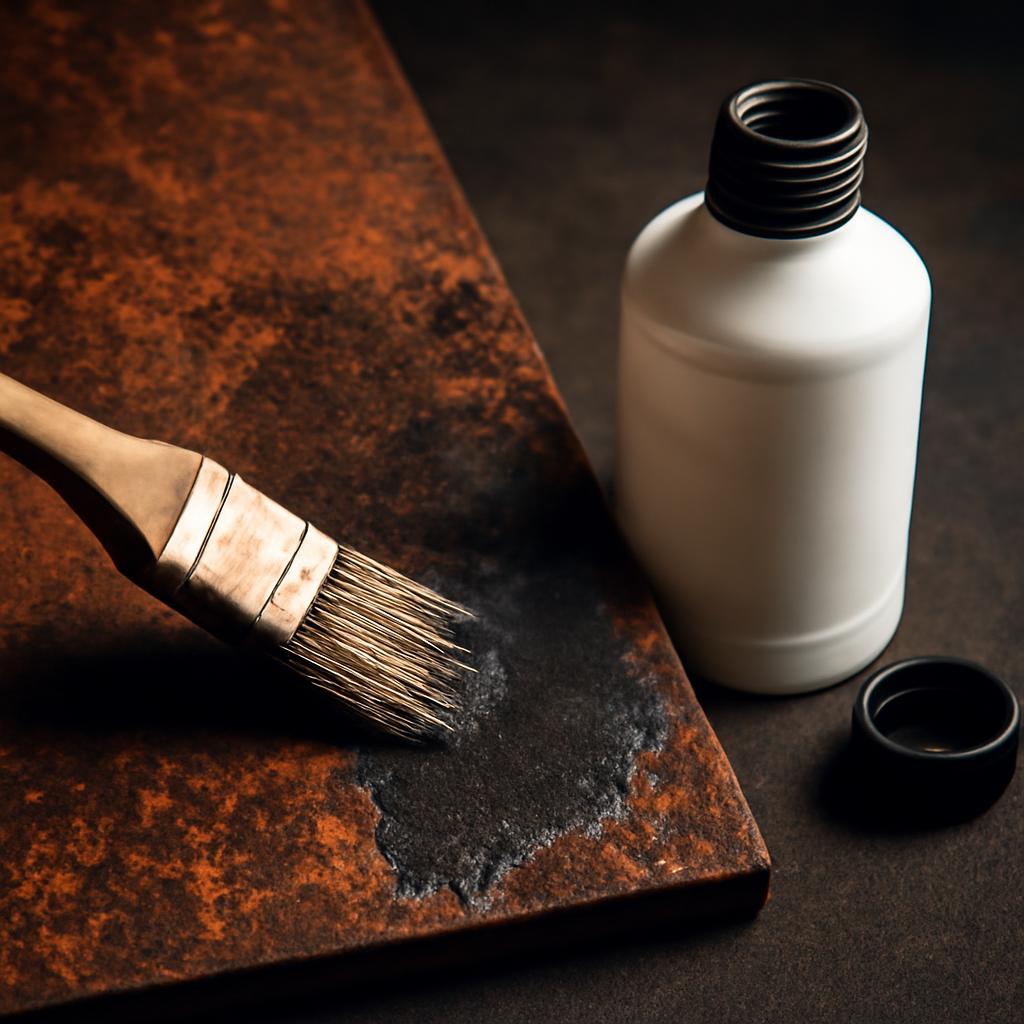
If you are researching an ospho rust converter, the most accurate short description is this: Ospho is a phosphoric-acid-based metal treatment used to convert existing rust into a more stable surface for primer and paint. It is not sold as a paint, not a complete rust-removal system, and not a permanent finish on its own (Ospho directions from the manufacturer).
The supported manufacturer workflow is also fairly specific: remove loose rust and contamination, apply a thin coat straight from the container, let it dry for at least 24 hours, brush off the powdery residue, wipe down with mineral spirits, and then topcoat (Ospho directions from the manufacturer).
Where this gets complicated is not the basic chemistry. It is everything around it: prep quality, residue control, seam access, and paint compatibility afterward. Manufacturer materials describe a dry, no-rinse process for normal use, especially under oil-based coatings, while restoration forums repeatedly warn that epoxy primers and seam-heavy automotive panels are where leftover residue can create the most trouble (Southern Polyurethanes forum discussion on Ospho and epoxy).
This guide keeps those boundaries clear. Manufacturer directions are treated as primary for product use. User forums are included only as anecdotal experience, mainly to show where real-world paint failures and cleanup problems tend to happen.
Related: Mold Encapsulation: Process, When to Use It vs Removal, and Key Limitations.
What Is Ospho Rust Converter?
Ospho is sold as a metal treatment, not a paint (manufacturer homepage for Ospho). Manufacturer materials say the product has been compounded by Skybryte since 1947 and marketed through Marine Enterprises, with smaller quantities available through independent retail channels rather than a single complete factory outlet list.
Its chemistry is consistently described in manufacturer materials as a blend of phosphoric acid, dichromates, wetting agents, and extenders, with the technical bulletin specifically listing sodium dichromate, surfactants, and extenders in the formula. That matters because Ospho is not just covering rust visually. Its intended job is to chemically change iron oxide into iron phosphate, which the manufacturer describes as an inert, hard substance that typically turns the metal black (Ace Hardware listing for 1-gallon Ospho).
That is why Ospho is better understood as a converter/passivator and paint-prep step than as a rust remover in the usual sense. The manufacturer positions it as a treatment that gives later coatings a sounder base by helping isolate the metal from moisture and oxygen attack once primed and painted.
Coverage is one of its main practical selling points. Manufacturer materials say Ospho is water-thin and can treat up to 600 square feet per gallon.
The important limit is that Ospho does not replace finishing. It converts remaining rust after basic cleanup, then hands the job off to the coating system that follows. If your expectation is “brush it on and leave it,” that does not match the manufacturer’s own description. If your expectation is “chemically prep rusty steel so primer and paint have a better starting surface,” that does.
Surface Preparation Before Applying Ospho
Prep is lighter than full blasting, but it is not optional. The manufacturer says you do not have to remove tight rust, but you do need to remove loose paint, loose rust scale, dirt, oil, grease, and other accumulations before application. The stated tools for that first pass are a wire brush or pressure washer (Amazon listing for Ospho 605, 32 fl oz).
That distinction is central to using Ospho correctly. It is meant for metal that still has rust present, but where the unstable, flaky, or contaminated material has already been removed. If rust is only light or tightly adhered, the manufacturer says it can stay in place for treatment (Amazon listing for Ospho 605, 32 fl oz).
That is anecdotal rather than official, but it shows up repeatedly in user discussions of Ospho and similar converters (Garage Journal discussion of Ospho do’s and don’ts). In practice, that means getting back to solid metal and solid rust rather than brushing Ospho over friable, layered scale.
The manufacturer also says to let the surface dry before treatment.
Surface protection around the job matters too. The manufacturer warns that Ospho will etch or bleach concrete, masonry, and stone almost immediately. That warning is echoed in forum discussions, where users describe white residue and etched shop-floor damage after spills or overspray reached concrete (ClassicBroncos forum discussion of Ospho on underbodies). A boat-focused third-party guide also recommends masking adjacent painted surfaces, fiberglass, gelcoat, and aluminum because acidic runoff can dull or stain surrounding materials.
A practical prep checklist, staying close to the supported directions, looks like this:
- Remove oil, grease, dirt, and similar contamination from the metal.
- Remove loose rust scale and loose paint with a wire brush, scraper, or pressure washer.
- Leave tight, attached rust in place if it is sound enough to treat.
- Let the surface dry before applying Ospho.
- Mask or protect concrete, masonry, stone, and nearby finished surfaces that could be etched, dulled, or stained.
Step-by-Step Ospho Application Guide
The manufacturer’s directions are direct: apply Ospho as it comes pre-diluted in the container in a thin coat over prepared metal. Because it has the consistency of water, the supported application methods are mainly brush and spray; third-party boat guidance also mentions rollers for large flat surfaces.
The manufacturer also sets a temperature floor: no lower than 36°F. Drying can take longer in high humidity or dew, and the technical bulletin says over-application can increase cure time and leave more powdery residue to remove later.
A supported application sequence is:
- Apply a thin coat straight from the container to the prepared surface.
- Use brush or spray, and keep the film thin rather than flooding the panel.
- If rust is exceedingly heavy, a second coat may be necessary to penetrate and blacken the surface fully.
- Let it dry overnight for a minimum of 24 hours before painting.
- After curing, remove the dry, grayish-white powdery residue by brushing off loose material.
- Wipe down with mineral spirits before painting.
The technical bulletin explicitly says a dry, powdery, greyish-white surface usually develops when cured and that loose powder should be brushed off before a mineral-spirits wipe and paint. If that residue is left behind under primer, later coating performance is no longer just about the converter itself.
The forum evidence adds useful but anecdotal caution here. In Garage Journal and restoration threads, users often report better results when they avoid soaking panels and instead wipe or brush on controlled amounts, especially on bodywork or irregular panels where dried residue can remain in texture and seams (Southern Polyurethanes forum thread on applying Ospho to an underfloor). That is not a separate official instruction, but it aligns with the manufacturer’s emphasis on a thin coat.
For cleanup afterward, the manufacturer says spray equipment and brushes should be flushed with water.
Post-Application: Neutralization and Topcoating
This is the point where Ospho advice diverges most sharply between official directions and restoration forums.
The manufacturer-supported workflow is a dry process. The directions and technical bulletin say to apply Ospho thinly, let it dry at least 24 hours, brush off loose powder, wipe the surface with mineral spirits, and then paint. Those same materials also say Ospho is recommended under oil-based primers or paints and that you should test trial samples before using epoxy or other paint systems.
If you are using a straightforward utility coating system that matches those directions, that is the most supported path.
Where the uncertainty starts is with epoxy primers, restoration work, and metal with seams, folds, or inaccessible cavities. On Southern Polyurethanes forum threads, users repeatedly describe epoxy success as depending on whether acid residue is fully removed or neutralized, and they note that SPI’s discussion centers on Ospho because it is the converter they had tested rather than proof that every phosphoric product is interchangeable (Southern Polyurethanes forum discussion on Ospho and epoxy). Team Camaro and other restoration threads also include reports of residue problems, including a milky film after rinsing, and warn against priming over that condition as if it were finished prep.
Forum users also report failures when residue remained trapped. Examples include epoxy or liner delamination and concern about Ospho drying inside seams where cleanup becomes uncertain afterward. Those are anecdotal reports, but they consistently point to the same failure mode: not “Ospho did nothing,” but “residue management was harder than expected.”
A useful decision rule is:
- Using oil-based primer or paint: the most directly supported process is the manufacturer’s no-rinse workflow of dry, brush off powder, wipe with mineral spirits, then coat.
- Using epoxy primer: treat Ospho as a test-first prep option, not automatic compatibility. The manufacturer says to test first with epoxy, and restoration forums repeatedly treat residue control as critical.
- Working on seam-heavy panels, lap joints, or underfloors: think carefully before using a water-thin acid treatment anywhere you cannot confidently clean afterward. That concern is repeated throughout the SPI underfloor thread.
Some third-party guides and forum users prefer a water rinse or water-plus-baking-soda neutralization before epoxy, arguing that it reduces adhesion risk. That advice does not match the basic manufacturer dry-process directions, so it is best understood as a paint-system-specific workaround, not universal instruction.
One point is much clearer than the rinse debate: Ospho still needs a topcoat. The product is sold as a metal treatment and base for paint, not a finished coating. Forum users treating frames and underbodies also report that if the converted surface is left exposed, rust can return in months, while better outcomes are reported when Ospho is followed by paint.
So the safe bottom line is simple: Ospho can be a useful prep layer, but it is not the finish line.
Safety Precautions and Handling Ospho
This is a chemical treatment, so the safety guidance should stay close to formal product documentation.
The technical bulletin says Ospho contains phosphoric acid and lists sodium dichromate among the ingredients. It also says contact with eyes or bare skin should be flushed with copious amounts of water, vapor exposure may cause respiratory irritation, and persistent irritation warrants medical attention. If taken internally, the bulletin says to administer milk or water and get medical attention. The manufacturer directions also describe Ospho as non-flammable.
In practical terms, that supports wearing chemical-resistant gloves, eye protection, and respiratory protection appropriate to the job, especially if you are spraying or working in limited ventilation. Forum users describe skin irritation and breathing discomfort as real-world concerns, which is consistent with the technical bulletin’s irritation warnings, but the formal handling directions should still come from the product documentation first.
Surface damage is another immediate hazard. The manufacturer warns that Ospho will etch or bleach concrete, masonry, and stone almost immediately. Forum reports back that up with examples of white residue and visible etching on shop floors after spills or overspray were left in place.
Runoff can also affect adjacent finished materials. The manufacturer says painted surfaces should be tested first because some may dull or peel. A third-party boating guide similarly recommends masking nearby gelcoat, fiberglass, aluminum, and painted surfaces because acid runoff can stain or dull them.
A cautious handling routine, grounded in the product documents, is:
- Wear gloves and eye protection before handling the liquid.
- Avoid breathing vapors; use respiratory protection that matches your ventilation and application method, especially when spraying.
- Mask or protect nearby concrete, masonry, stone, paint, gelcoat, and similar surfaces that could be etched or dulled.
- Flush brushes and spray equipment with water after use.
- For first aid, follow the product’s technical bulletin and the manufacturer’s SDS availability rather than relying on forum advice alone.
Where to Buy Ospho and Coverage Costs
The manufacturer says smaller quantities can be found at some Ace Hardware, True Value, Do-It-Best, Sherwin Williams, West Marine, and similar dealer networks, while also noting that it does not maintain a complete list of final retail outlets. In other words, local stock varies.
A cited Ace Hardware listing showed a 1-gallon bottle of Skyco Ospho at $29.99 (Ace Hardware listing for 1-gallon Ospho). Amazon also listed Ospho 605 Metal Treatment, 32 fl oz for buyers who want a smaller bottle for testing or spot treatment rather than a gallon purchase.
For bulk orders, the manufacturer lists direct case pricing of $209 for 4 gallons and $244 for 12 quarts, with an added $35 per case for orders shipping west of the Rockies. Those are manufacturer-posted figures and are best treated as comparison points rather than permanent market prices.
Coverage is where Ospho can look economical on larger steel jobs. The manufacturer says it treats up to 600 square feet per gallon. Using the cited Ace price of $29.99 per gallon, that works out to about $0.05 per square foot at the stated maximum coverage, before waste or heavy-rust overuse.
A practical buying breakdown is:
- Small test job or spot repair: the 32-ounce bottle makes sense when you want to check surface behavior or paint compatibility first.
- Large project: the 1-gallon size is more relevant for trailers, frames, railings, or multiple parts.
- Fleet or shop use: compare retail gallons with the manufacturer’s case pricing.
Because pricing and stock change, treat all retailer numbers here as examples tied to the cited listings rather than guaranteed current quotes.
Ospho vs Alternatives: User Experiences
This section is best read as user-reported comparison, not controlled testing. The clearest way to compare Ospho with other rust products is by category: converter/passivator, remover, or coating/encapsulator.
Ospho vs Evapo-Rust. In Hobby-Machinist discussions, users describe Ospho as a product that converts or passivates rust for later painting, while Evapo-Rust is treated as something that dissolves or removes rust instead (Hobby-Machinist thread comparing Ospho and Evapo-Rust). That leads to a practical split in use: Evapo-Rust is often preferred for removable parts that can soak, while Ospho is preferred when rust has to be treated in place on a frame, railing, panel, or tool too large to dip.
Ospho vs Naval Jelly and similar phosphoric products. User discussions often place Ospho in the same family as Naval Jelly, Klean-Strip prep products, and other phosphoric-acid treatments. What users seem to like about Ospho in that group is its water-thin liquid form, which spreads easily over broad surfaces and is widely treated as a paint-prep passivator rather than just a spot rust remover (JeepForum rust converter discussion mentioning Ospho).
Ospho vs Rust Reformer. In a Skoolie forum discussion, an experienced user described Rust-Oleum Rust Reformer as a product that leaves a more polymer-like protective layer, while Ospho was framed more as a chemical conversion step before another coating. That is still anecdotal, but it fits the general divide in how these products are used: Ospho is strongest as prep under paint, whereas reformer sprays compete more as quick protective coatings.
Ospho vs POR-15. POR-15 shows up in the same forum ecosystem, but users usually recommend it as a coating system after mechanical prep, not as a direct chemical equivalent to Ospho. In other words, POR-15 is usually being chosen as a heavy-duty finish strategy for frames or underbodies, while Ospho is being chosen as the prep chemistry that comes before primer and paint.
Across forums, Ospho gets its best anecdotal reviews on frames, chassis parts, underbodies, cabinets, rims, tools, and utility metal, especially when it is followed by a proper topcoat. Where the complaints start is usually not about the rust turning black. It is about one of four things:
- the surface stayed rough or chalky,
- the user skipped the topcoat,
- the user buried residue under epoxy,
- or the rust was actually coming from seams and hidden cavities that no bottle product can fully solve.
If you want a buyer-style verdict from the available evidence, it is this:
- Best fit: rusty steel you can reach, clean, let dry, and then topcoat.
- Less convincing fit: show-quality exterior bodywork, seam-heavy restorations, and any epoxy system you have not tested.
- Wrong expectation: treating Ospho as a permanent one-step cure.
Limitations and Best Use Cases for Ospho
Ospho works best on surface rust and light-to-moderate corrosion that is still accessible. That is the cleanest line running through both the manufacturer directions and the forum reports. The manufacturer says tight rust can stay, but very heavy rust may need two coats. Forum users go further and argue that deep scale, pitting, and perforation still require mechanical removal or repair, because converters only work as well as the metal that remains underneath.
That makes Ospho a strong fit for:
- frames and chassis parts with mostly surface rust,
- trailers, railings, fences, tools, and equipment,
- marine hardware and boat trailers,
- low-visibility or utility steel that will be painted afterward,
- lightly rusted sheet metal where full blasting is not practical.
It is a weaker fit for seams, lap joints, boxed sections, cracks, and hidden cavities where cleanup access is limited. That point comes up repeatedly in restoration discussions, especially around underfloors and body shells headed for epoxy primer. The difficulty there is not just the conversion reaction itself. It is whether dried residue or trapped solution can be managed well enough afterward for the coating system you plan to use.
It is also not a permanent answer by itself. Forum users treating underbodies report that without a finish coat, rust can return in a matter of months, which matches the manufacturer’s positioning of Ospho as a surface treatment under paint rather than a finish coat by itself.
For vehicle restorations, the most defensible use case is usually non-show or non-visible metal where a chemically converted, properly coated surface is good enough and full media blasting would be disproportionate. On visible exterior panels, Ospho may still be part of the process, but the burden of testing, cleanup, and coating compatibility rises sharply—especially if epoxy is involved.
Can Ospho be used under epoxy primers?
Sometimes, but not automatically. The manufacturer says Ospho is recommended under oil-based primers or paints and to test trial samples before using epoxy or other paint systems. Southern Polyurethanes forum discussions say Ospho is the rust converter they had tested, but those same discussions still stress that residue control and neutralization procedure matter for epoxy success. Other restoration threads report failures when acidic residue remained, especially in seams or on irregular panels.
Practical answer: yes, sometimes—but only after testing the exact primer system and cleanup method you intend to use.
Does Ospho etch clean metal or concrete?
Yes on concrete, and it can also be used as a prep treatment on some non-rusted metals. The manufacturer warns that Ospho will etch or bleach concrete, masonry, and stone almost immediately. Forum users back that up with reports of white residue and floor damage after accidental exposure.
On metal, Ospho is sold mainly for rusted steel, but the manufacturer also says it can be used on new metals for cleaning/protection and to etch galvanized metal before painting. So on clean metal, you are using it more as an acid prep than a rust converter.
How long does Ospho take to dry before painting?
The manufacturer says to let Ospho dry overnight for a minimum of 24 hours before painting. Those same directions say dry time can run longer with humidity, temperature, and over-application.
The manufacturer criterion is the 24-hour minimum plus residue cleanup. In forum discussions, some users describe lingering tacky/slimy areas or abnormal residue as signs that more cleanup was needed before coating, but that is anecdotal rather than a formal manufacturer readiness test.
Is Ospho safe for galvanized or painted metal?
It can be used there, but test first is the supported answer. The manufacturer says Ospho can be used on painted surfaces as long as the existing finish is not compromised, and specifically warns that some painted surfaces may dull or peel, so trial testing is advised. The same directions say it can be used to etch galvanized metal before painting.
So it is not automatically destructive, but it is also not something to spread over finished surfaces casually.
What if Ospho leaves milky residue after rinsing?
Treat that surface as not ready for paint yet. In a Team Camaro thread about this exact symptom, users responded that the dried material likely needed to be reactivated with more Ospho and rinsed again before it dried fully, rather than primed over as-is. That is forum advice, not the manufacturer’s standard dry-process instruction, but it is directly relevant to the symptom.
The more conservative takeaway is simply this: if you have a visible milky film after rinsing, do not assume you have a finished paint surface. Clean and test until the surface matches the prep requirements of the coating system you actually plan to use, especially with epoxy.
Used within those limits, Ospho is best understood as a paint-prep rust converter: effective on accessible surface rust, dependent on residue cleanup, and most reliable when followed promptly by the right primer and topcoat.