 StainList
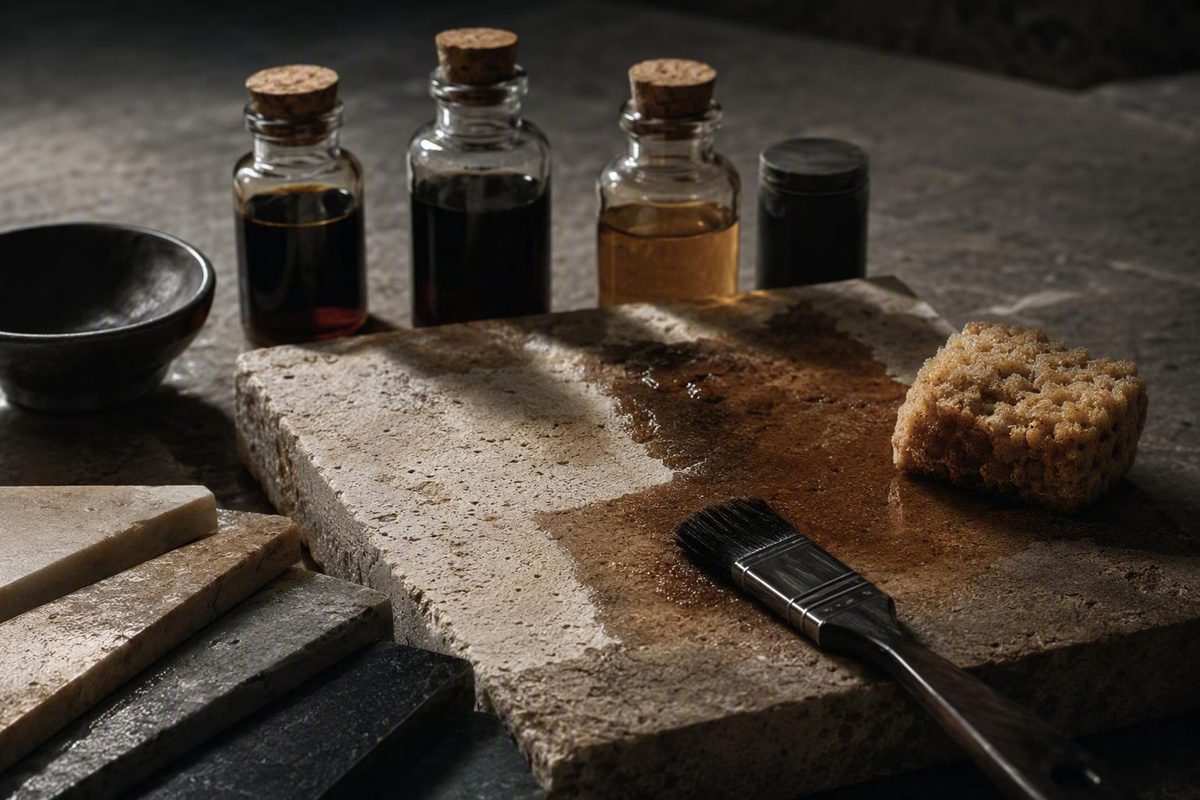
“Stone stain” can mean either a coloring product intentionally applied to masonry or an unwanted mark someone wants to remove. This guide concerns intentional recoloring. Rust, oil, paint, organic discoloration, and other contaminants require separate removal methods based on the stone, finish, and substance involved.
This is a cautious product-selection, exclusion, and test-patch guide—not a stone-by-stone compatibility standard. The available evidence does not establish one universal system for every natural stone, manufactured veneer, brick, mortar, or concrete surface.
Successful recoloring depends less on choosing an attractive swatch than on answering four questions:
- What is the substrate?
- Is it clean, dry, uncoated, and absorbent enough for the proposed product?
- Is that product expressly approved for the project’s location and exposure?
- Does a representative test of the complete stain-and-sealer system produce an acceptable result?
A generic “masonry” label is not enough to establish compatibility.
What “Stone Stain” Means—and What It Can Realistically Change
Stone stain is commonly considered when the goal is to:
- Darken or shift an existing tone
- Give new masonry an aged or antiqued appearance
- Neutralize an unwanted orange, red, yellow, or gray cast
- Blend replacement stone with older work
- Make an addition coordinate with an existing facade
- Add variation to manufactured stone that looks too uniform
The first distinction is between natural stone and materials made to resemble it.
Compatibility with one does not automatically establish compatibility with another.
A penetrating or semi-transparent stain works with the existing base color rather than fully concealing it. The result can remain influenced by:
- Original color
- Mineral and aggregate variation
- Texture and porosity
- Joint color
- Repairs and previous treatments
- Dilution
- Application rate
- Number of coats
- Overlap technique
That interaction is useful when the goal is a subtle shift that preserves variation. It also limits how dramatic the transformation can be.
As a practical expectation, penetrating stain is generally better at darkening stone or shifting its undertone than at making dark stone substantially lighter. One general stone-staining guide says stain can darken stone but cannot lighten dark-colored stone. That is useful design guidance, although it is not a universal rule for every coloring chemistry and substrate. The guide presents this limitation alongside general water-based and acid-stain procedures.
If the objective is to turn dark brown stone pale cream—or to make highly varied masonry look almost uniform—a transparent stain is unlikely to provide enough concealment. An opaque masonry coating, mineral-silicate coating, or suitable masonry paint may be the more realistic product category. Greater hiding power can also make the surface look more coated and conceal more of its natural variation.
The most natural-looking correction is not always one color spread across an entire wall. Mixed stone may benefit from several related colors applied selectively, with some stones left largely unchanged. Mortar can be included deliberately or protected from color. This technique can preserve depth, but it requires a larger sample, careful color planning, and more application skill.
Professional galleries illustrate why this work is commissioned, but they are not independent performance evidence. Masonry Cosmetics presents projects involving newly installed manufactured stone matched to a fireplace, installed stone corrected after differing from an approved sample, and addition stone blended with older masonry. The gallery says multiple colors were used in some cases, but it does not provide common test data, objective color measurements, or independently verified durability results. These projects are promotional examples of color-matching use cases, not proof that the same method will work on another wall.
Compatibility Check: Substrate, Porosity, Coatings, and Location
Before comparing colors or prices, work through the following sequence.
1. Identify the substrate
Determine whether the surface is:
- Natural stone
- Manufactured stone veneer
- Brick
- Mortar
- Cast or poured concrete
- A composite or engineered material
- A mixture of substrates
For natural stone, try to identify both the variety and finish. A rough, absorbent surface and a polished tile should not be assumed to accept the same treatment. For manufactured veneer, look for the manufacturer, product line, installation records, packaging, or leftover pieces.
The available evidence does not provide a dependable universal compatibility chart for limestone, sandstone, marble, granite, slate, travertine, or engineered stone. A label that says “stone” without addressing relevant exclusions still requires confirmation for the actual substrate.
2. Classify the orientation
Determine whether the surface is vertical or horizontal.
A product suitable for a wall may not be approved for foot traffic, abrasion, ponding water, deicing salts, or repeated floor cleaning. Even an “interior/exterior” product can exclude horizontal exterior applications.
3. Define the exposure
Record whether the area is:
- Indoors in a normally dry room
- Outdoors in sunlight and rain
- Near persistent moisture
- In a shower, pool, or fountain
- Subject to standing water
- Near direct flame or elevated temperatures
- Used as a residential or commercial floor
These are product-selection criteria, not details to investigate after purchase.
4. Investigate the finish and surface history
A clean, dry, sufficiently absorbent, unsealed surface is the most plausible candidate for a penetrating color treatment.
Previously painted masonry often cannot accept a penetrating stain unless the paint barrier is removed. Removal is not a neutral step: broad commercial masonry guidance warns that stripping or blasting may damage the substrate or affect the success of later staining. Nawkaw’s discussion of painted masonry identifies both the penetration barrier and the risks associated with coating removal.
Look for clues such as:
- Water beading over large areas
- Gloss that changes with the viewing angle
- Flaking or peeling film
- Different absorption around repairs
- Darkened areas around grease or soot
- Cleaner residue
- Paint remaining in pores, grooves, or joints
- Polished or burnished sections
Do not assume a matte surface is unsealed.
5. Perform a preliminary water-drop check
On a clean, completely dry, inconspicuous area, place a small amount of water on the surface and observe it:
- Prompt absorption and darkening suggest an absorbent surface.
- Beading or very slow absorption may indicate dense material, a polished finish, or an existing treatment.
- Uneven absorption suggests that different stones, repairs, or contaminated areas may color differently.
Commercial stain-versus-dye guidance recommends this type of water check while emphasizing the need for a separate product test. It also describes rough, open surfaces as generally more receptive to pigment stain than smooth or burnished ones and notes that paint, grease, and oil can impede penetration. These are vendor observations derived mainly from concrete-coloring guidance.
The water test does not prove that a stain:
- Is chemically compatible
- Will adhere or penetrate adequately
- Will produce an acceptable color
- Will remain durable outdoors
- Is approved for the project’s moisture or traffic exposure
It is only a preliminary indication of absorbency.
Polished, sealed, burnished, or painted surfaces need product-specific assessment. Do not automatically sand, strip, wire-brush, pressure-wash, or blast them to “open the pores.” General refinishing articles recommend some of these methods without distinguishing among individual stone types, which is precisely why substrate-specific guidance is necessary before using them. One broad refinishing guide lists sanding, wire brushing, pressure washing, and paint thinner without establishing compatibility for particular stones.
If you cannot identify the substrate or previous treatment confidently, pause before purchasing. Ask the original supplier, installer, veneer manufacturer, stain manufacturer, or a qualified stone professional to assess it.
Stone Stain Types Compared: Penetrating Stain, Acid Stain, Dye, and Coatings
“Stone stain” is not one standardized formulation. The term can refer loosely to penetrating masonry colorants, pigment products, dyes, reactive acid stains, or even opaque coatings. A clear sealer is not a stain, but it belongs in the comparison because it may deepen the existing color enough to meet a limited design goal.
The ratings below are general tendencies, not standardized performance grades. Achievable color change, application difficulty, and durability can vary materially by product, substrate, preparation, exposure, and application method.
| Option | Typical visual effect | Dependence on surface condition | Typical scale of change | General complexity tendency | Principal uncertainty | Evidence basis |
|---|---|---|---|---|---|---|
| Water-based penetrating masonry stain | Transparent or semi-transparent tone shift; aged or blended appearance | Usually depends heavily on absorption and cleanliness | Usually subtle to moderate | Often low to moderate when the label permits straightforward application | Exact compatibility with the stone and prior finish | Commercial masonry guidance; some brick and concrete guidance |
| Pigment stain | Fine color particles engage with an open surface profile | Rough, open surfaces are generally more receptive | Usually subtle to moderate | Moderate where layering and overlap control matter | Residue or uneven engagement on smoother surfaces | Mainly concrete-vendor guidance |
| Dye | More ink-like coloration on some smooth or fine-profile surfaces | Still affected by surface condition and carrier | Usually subtle to moderate | Moderate to high; some carriers dry quickly | Exterior fading, carrier compatibility, and limited stone-specific evidence | Mainly concrete-vendor guidance |
| Acid stain | Reactive, mottled color rather than predictable opaque coverage | Depends on substrate chemistry, not absorption alone | Usually tonal and variegated | High because handling and cleanup are system-specific | Whether a concrete-oriented product is appropriate for a particular stone | General concrete and instructional guidance |
| Mineral-silicate or other masonry coating | Matte or mineral-looking color with potentially greater coverage | Product- and primer-dependent | Moderate to major | Usually moderate | Stone-specific compatibility and behavior of the complete coating system | General masonry and promotional guidance |
| Opaque masonry paint or solid coating | More uniform color that hides the base | Less dependent on penetration, but preparation and adhesion remain critical | Major | Usually moderate | Adhesion, appearance, moisture interaction, and maintenance | Broad masonry guidance |
| Clear sealer | Deepens or enriches existing tones without adding a new hue | Product- and substrate-dependent | Minimal color transformation | Often low to moderate | Darkening, gloss, traction, vapor behavior, and maintenance | General stone guidance |
Water-based penetrating masonry stain
Water-based masonry stain is a commercially available category that may allow mixing, dilution, soap-and-water cleanup, and application by brush, roller, or sprayer. Those methods are not interchangeable across all products. Follow the selected product’s current instructions rather than assuming every water-based stain can be diluted or sprayed.
Semi-transparent products generally preserve more variation. Solid or opaque products can create a larger color change but may look more like a surface coating. Brick and masonry guidance similarly associates semi-transparent stain with subtler changes and opaque stain with larger transformations, while warning that original color and porosity affect the result. Sherwin-Williams also distinguishes stains formulated for highly porous brick from those intended for denser concrete.
Pigment stain
Pigment stains contain fine color particles carried in a liquid. Vendor guidance derived mainly from concrete applications says rough or open surfaces provide more opportunity for those particles to engage than smooth or burnished surfaces.
That explanation can help readers understand why surface profile matters. It should not be converted into a blanket recommendation for every natural stone.
Dye
The same vendor guidance describes dyes as using smaller particles that may enter finer surface profiles more readily. It also says dyes tend to fade under ultraviolet exposure. These are attributed commercial statements, not independent comparisons of every available dye and stain.
Dyes may use water, alcohol, acetone, or another carrier. The carrier changes the product’s working time and safety instructions. “Dye” therefore does not describe one application or safety profile.
Acid stain
Acid stain should be treated as a specialist option, not the default method for recoloring stone. General instructions for applying and neutralizing concrete acid stain do not establish compatibility with limestone, marble, granite, sandstone, slate, travertine, veneer, or engineered stone.
Do not apply a concrete acid stain to natural stone merely because a general article describes the process. Obtain explicit approval for the exact product, substrate, and location. Follow the current label and safety data sheet rather than a generalized neutralization recipe.
Mineral-silicate coatings and opaque paint
These categories are worth considering when the desired change is too pale, light, or uniform for a transparent stain. Their advantage is greater hiding power. Their tradeoff is a more coated appearance and potentially greater concealment of the original texture and color variation.
The available evidence does not support a universal ranking in which one coating chemistry is always more durable, breathable, or environmentally preferable. Performance depends on the specific product, substrate, preparation, wall assembly, and exposure.
Clear sealer
A compatible clear sealer may deepen existing tones and create a richer or “wet” appearance without adding a new hue. That may be enough when the stone looks washed out rather than incorrectly colored.
Test it as part of the proposed system rather than assuming the final appearance from a dry untreated sample.
How to Shop for a Stone-Compatible Product
Retail categories demonstrate how varied the market is. Products may be sorted by transparency, base material, container size, project location, and features such as ultraviolet, chemical, or abrasion resistance. A filter only indicates that some products may have a listed property; it does not prove that every result is suitable for stone or for a particular application. Home Depot’s stone-filtered concrete-stain category illustrates both the breadth and limitations of retailer classifications.
Use this checklist for every candidate:
- Exact substrates expressly listed
- Natural versus manufactured stone compatibility
- Interior, exterior, or both
- Vertical or horizontal approval
- Residential or commercial floor approval
- Restrictions for wet or persistently damp areas
- Transparency: transparent, semi-transparent, solid, or opaque
- Base chemistry and carrier
- Available colors and mixing rules
- Permitted dilution
- Approved application methods
- Cleanup method
- Temperature and humidity limits
- Drying, recoating, and full-cure requirements
- Whether a sealer is required, optional, or prohibited
- Compatible sealer products
- Package and sample sizes
- Stated coverage and its assumptions
- Label, technical data sheet, and safety data sheet availability
- Storage and disposal instructions
One seller product can illustrate the level of detail to seek without serving as a recommendation. ProMason Supply markets a ready-to-use water-based masonry stain for porous brick, stone, mortar, and concrete. Its seller page lists 12 colors, multiple package sizes, color mixing, water dilution, brush, roller, or spray application, and claimed average coverage of 250–500 square feet per gallon. These are seller specifications, not independent performance findings, and should be confirmed against current product documentation before purchase.
Actual coverage may vary with:
- Texture and porosity
- Dilution
- Number of coats
- Application method
- Overspray and spillage
- Sample work
- Uneven absorption
Use the conservative end of an applicable manufacturer range when planning an absorbent or heavily textured surface.
A simple quantity estimate is:
Required quantity = measured surface area × planned coats ÷ conservative coverage per container
Then add an allowance for samples, irregular texture, absorption, and application waste. If color consistency matters, reserve enough product from a consistent batch for the complete project rather than assuming a later purchase will match exactly.
Read exclusions more carefully than the phrase “interior/exterior.” The example product advises against horizontal exterior surfaces, water-pooling areas, pools, fountains, and showers. A product approved for an exterior wall is not automatically approved for a patio, walkway, shower, pool surround, fountain, or commercial floor.
The current technical data sheet, label, and safety data sheet should control. The specifications above were taken from a seller page; direct current technical and safety documents were not included in the reviewed evidence. Confirm them before purchase. Do not let a retailer category, review score, forum post, gallery, or generalized article override current product documentation.
The evidence also does not support an independent ranking of stone stains by longevity or overall performance.
Build a Representative Test Patch Before Committing
A proper test patch is a trial of the complete proposed system, not a quick dab used to compare two wet colors.
Choose an inconspicuous area that still represents the main project. Where applicable, include:
- The same stone or veneer
- Similar texture and color variation
- Typical mortar joints
- The same vertical or horizontal orientation
- Similar sun, rain, heat, or indoor exposure
- The same cleaning and prior-treatment history
A leftover loose stone is useful for preliminary experiments, but it may not reproduce installed mortar, weathering, preparation, or exposure.
Test the entire workflow
- Document the starting condition. Photograph the dry surface in neutral lighting and note gloss, discoloration, repairs, and absorption differences.
- Clean it cautiously. Use only a method known to be compatible with the substrate, then rinse if the selected cleaner requires it.
- Allow complete drying. Do not test over lingering surface or assembly moisture.
- Prepare the exact mixture. Record the product, color, dilution, mixing procedure, and batch.
- Apply at the planned rate. Use the intended brush, roller, or sprayer and reproduce the proposed overlap technique.
- Include the mortar—or mask it deliberately. Joint color can determine whether the result looks natural.
- Record every coat. Note application conditions, coat count, drying interval, and appearance.
- Wait for complete drying. Wet or newly applied color may not represent the final result.
- Test the sealer if one is planned. Apply it to only part of the sample so its effect can be compared.
- Approve the complete result, not only the hue.
For a multicolor treatment, include the full palette and the proposed individual-stone technique. Examine the result from normal viewing distance as well as close range.
Evaluate the patch for:
- Excessive darkening
- Blotches or halos
- Lap marks and hard overlap lines
- Unintended mortar discoloration
- Surface residue
- Increased or uneven gloss
- Loss of natural variation
- Beading or poor penetration
- Different results across repairs or stone types
There is no universal test-patch size or observation period established by the available evidence. Follow the manufacturer’s minimum requirements and use an area large enough to reveal variation, overlap behavior, and the interaction between stone and mortar.
For an exposed exterior project, ask the manufacturer whether a longer weather-exposure sample is appropriate. Sunlight, rain, or ordinary cleaning may reveal concerns that are not immediately visible. Even a longer sample cannot guarantee service life under ultraviolet exposure, freeze-thaw conditions, persistent moisture, or deicing salts.
Preparation and Application Without Treating Every Stone Alike
A cautious general workflow is possible, but the selected product must determine the actual cleaners, tools, temperature limits, drying periods, and coat schedule.
A bounded application workflow
- Confirm substrate, orientation, and exposure compatibility.
- Protect adjacent materials and plan overspray or runoff control.
- Clean using a substrate-compatible method.
- Rinse if the cleaner requires it.
- Allow the stone and joints to dry completely.
- Complete and approve a representative test patch.
- Mix the product consistently.
- Apply in manageable, logical sections.
- Control overlaps and maintain any wet edge required by the product.
- Follow the stated recoat, cure, and return-to-service instructions.
- Apply only an approved sealer, if the system calls for one.
Dust and dirt can interrupt color or remain visible in the finish. Grease, oil, paint, and sealer may interfere with penetration. Lingering moisture can contribute to uneven uptake in systems that require dry masonry.
Mask trim, siding, paving, landscaping, glass, metal, and any mortar intended to remain unchanged. Plan for overspray, drips, and runoff before opening the container.
For heavily textured stacked stone or veneer, brushing may help work color into grooves and surface variation. MSI recommends cleaning, complete drying, and bristle-brush application for textured stacked stone. Its method is general guidance and does not establish compatibility with every stone, stain, or installation.
Work in small, logical sections so overlaps remain controlled. On mixed stone, that may mean treating one stone or a small group bounded by joints. On a more uniform surface, it may mean maintaining the product’s required wet edge across a narrow section.
Do not generalize recommendations for wire brushing, sanding, pressure washing, paint thinner, stripping, or blasting. Whether any such method is acceptable depends on the stone, finish, joints, veneer installation, prior coating, and complete assembly. If pressure washing is being considered, obtain substrate- and assembly-specific limits from the stone or veneer supplier; the reviewed evidence provides no validated universal pressure setting.
Drying and curing times also vary. Follow the selected system’s requirements for temperature, humidity, recoat time, full cure, and return to service.
For example, ProMason instructs users of its product to allow new mortar to cure for at least 14 days before staining. That is the seller’s product-specific instruction, not a universal masonry standard.
For indoor work, plan ventilation and occupancy before starting. Requirements vary by formulation and application method, so use the selected product’s current label and safety data sheet to determine personal protection, ventilation, ignition controls, and re-entry requirements. “Water-based” does not by itself establish that a product can be sprayed or used in an occupied room without precautions.
Sealing, Wet Areas, and Other High-Risk Conditions
Sealing advice differs because staining products are not one standardized system. Some general stone guides recommend a protective sealer after staining, while at least one water-based masonry-stain seller says its product requires no topcoat.
Both instructions can be valid for their respective products. The wrong conclusion is that every stained surface should be sealed—or that none should be.
Before purchasing, confirm:
- Whether sealer is required, optional, or prohibited
- Which exact sealers are compatible
- How long the stain must cure before sealing
- Whether the sealer changes color or gloss
- Whether it affects traction on an approved walking surface
- Whether it changes the system’s vapor behavior
- How it changes cleaning and maintenance
- Whether reapplication is expected
General stacked-stone guidance also presents clear sealer alone as a way to deepen existing tones. That makes sealer a possible alternative when stone needs visual enrichment rather than a new hue. It still requires sampling because darkening and sheen may be uneven.
High-risk or commonly excluded applications
Do not use a stone-stain system in a shower, pool, fountain, standing-water zone, persistently damp masonry, or on a horizontal exterior surface unless the complete system expressly approves the exact substrate, orientation, moisture exposure, and traffic.
“Exterior,” “water-based,” “masonry,” and “stone-compatible” are not substitutes for that approval.
Abrasion resistance, chemical resistance, waterproofing, ultraviolet stability, and exterior durability are product-specific. A retailer filter or broad seller statement cannot establish those characteristics for every stain.
Fireplaces require another distinction. Decorative masonry surrounding a firebox is not the same exposure as a surface in contact with direct flame or temperatures beyond a product’s rating. Vendor stain-and-dye guidance notes that direct flame can darken or burn treated surfaces, as it can other stone-type surfaces. Obtain explicit approval for the actual fireplace location and anticipated heat.
Do not infer firebox suitability from a photograph of a stained fireplace surround.
The available evidence does not establish a dependable service life under those combined exposures.
Acid- or solvent-containing systems require their own product-specific controls. Do not rely on a household neutralization recipe or instructions borrowed from another formulation. Use the current label and safety data sheet for handling, ventilation, personal protection, ignition control, runoff, waste, and disposal requirements. If the documents do not clearly address the proposed application, contact the manufacturer or hire an experienced contractor.
When DIY Makes Sense—and When to Hire a Color-Matching Professional
A project is a more plausible DIY candidate when all of the following are true:
- The area is small and safely accessible.
- The substrate has been identified.
- The surface is porous, clean, dry, and apparently uncoated.
- The selected product expressly approves the substrate and exposure.
- Preparation does not require uncertain coating removal.
- A representative test patch has dried to an acceptable result.
- A mistake would not compromise a prominent or irreplaceable installation.
Pause when the stone is unknown, polished, sealed, previously painted, easily scratched, or potentially sensitive to the proposed chemistry. Persistent moisture, horizontal exterior use, commercial traffic, difficult access, and failure to create an acceptable sample are also reasons to stop.
Professional assessment is especially sensible for:
- Prominent exterior facades
- Two-story or otherwise inaccessible work
- Fireplaces with uncertain heat exposure
- Additions that must match aged masonry
- Mixed-color manufactured veneer
- Projects requiring individual-stone blending
- Valuable stone that would be difficult to replace
- Surfaces requiring coating identification or removal
A natural-looking correction may require several colors instead of one uniform coat. The applicator must decide which stones should become warmer, cooler, darker, or more muted while keeping the joints visually coherent. Poorly planned variation can look as artificial as one flat color.
Professional galleries show that matching services are marketed for manufactured stone, additions, and color complaints. They do not guarantee that another substrate can be matched identically or that a treatment will achieve a particular lifespan.
Troubleshooting the sample
| What happens in the test | What it may indicate | Decision |
|---|---|---|
| Liquid beads instead of absorbing | Dense, polished, sealed, or otherwise treated surface | Stop; identify the surface and confirm compatibility |
| Stone becomes much darker than expected | High absorption, concentrated color, or an unsuitable design target | Reassess the color, dilution, and product category |
| Mortar colors unintentionally | Overspray, uptake, or inadequate masking | Revise masking or include mortar deliberately |
| Blotches appear | Uneven porosity, contamination, repairs, moisture, or inconsistent application | Stop and diagnose before enlarging the area |
| Lap marks remain after drying | Sections may be too large or overlaps poorly controlled | Change the application plan and repeat the sample |
| Sealer changes gloss or color | The sealer is altering the finished appearance | Reject it or obtain an approved alternative |
| Residue remains on the surface | Possible overapplication, poor engagement, or unsuitable formulation | Ask the manufacturer how to assess it |
| Different stones react differently | Mixed materials, mineral variation, repairs, or prior treatments | Consider selective colors or professional matching |
Do not improvise a removal recipe after a failed test. Applied color may be difficult to reverse, and uncertain stripping methods can create additional substrate problems. The safest point to reject a system is before it covers the full surface.
Before buying project quantities, complete this go/no-go check:
- [ ] Substrate identified
- [ ] Finish and previous coatings investigated
- [ ] Porosity preliminarily assessed
- [ ] Interior or exterior location approved
- [ ] Vertical or horizontal orientation approved
- [ ] Moisture and traffic exposure approved
- [ ] Current technical data sheet reviewed
- [ ] Current label and safety data sheet reviewed
- [ ] Ventilation, protection, runoff, and access planned
- [ ] Representative test patch fully dried and accepted
- [ ] Mortar treatment decided
- [ ] Sealer requirement and compatibility confirmed
- [ ] Enough product reserved from a consistent color batch
The conservative decision rule is simple: do not buy or apply stone stain until you understand the substrate and prior finish, the product expressly permits the project’s orientation and moisture exposure, and a representative test of the entire proposed system has dried to an acceptable result.
If the stone is unknown, coated, polished, exposed to standing water, highly visible, or difficult to replace, professional identification and color matching are safer than relying on a generic masonry label.
Can stone stain make dark stone lighter?
Usually not by much when the product is transparent or semi-transparent. Penetrating stain is better suited to darkening stone, shifting its undertone, or muting an unwanted hue.
For substantial lightening or a highly uniform result, compare opaque masonry coatings approved for the substrate. Test the complete system because greater hiding power also conceals more natural variation.
Can previously sealed or painted stone be stained?
A penetrating stain may bead or absorb unevenly over paint, sealer, polish, or another barrier. A water check can reveal low absorption, but it cannot identify the treatment or prove staining will work.
Do not assume sanding, stripping, blasting, or pressure washing is suitable. Identify the existing treatment and obtain stone- and product-specific preparation guidance.
How can I tell whether stone is porous enough to accept stain?
Place a small amount of water on a clean, completely dry, inconspicuous area. Prompt darkening and absorption suggest porosity; beading or very slow absorption may indicate a dense, polished, sealed, or treated surface.
Repeat the check across representative stones and repairs. It is only a screening test; a complete product test patch is still required.
Do I need to seal stone after staining it?
It depends on the selected system. Confirm whether sealer is required, optional, or prohibited and which exact products are compatible.
If a sealer will be used, apply it to part of the test patch and evaluate color, gloss, uniformity, traction where relevant, and maintenance implications.
Can stone stain be used on patios, showers, pools, or fountains?
Only when the complete system expressly approves the exact substrate, orientation, moisture exposure, and traffic. Approval for an exterior vertical wall does not establish approval for a patio, walkway, pool surround, shower, or fountain.
If current technical documentation excludes the application—or does not clearly approve it—choose another system.