 StainList
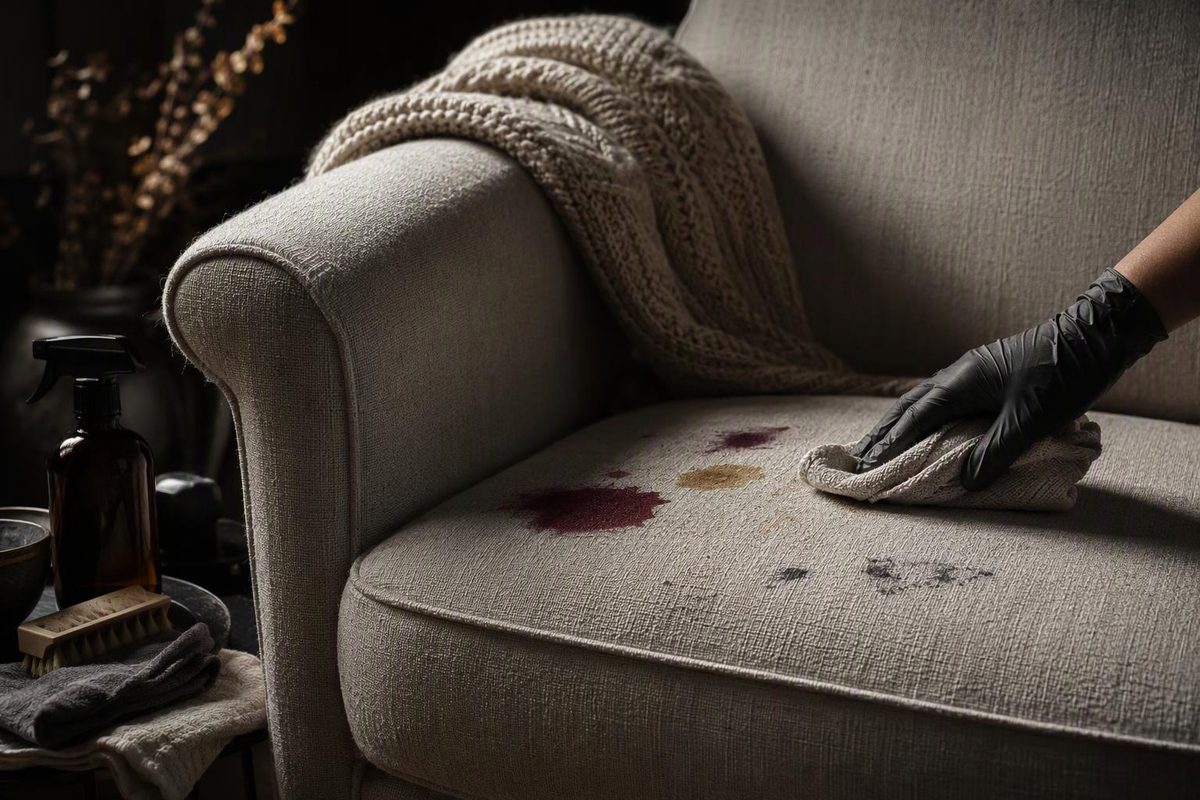
Choose cotton upholstery fabric by its specification sheet, not by the word “cotton.” Confirm that it is approved for upholstery, then check its fiber content, cleaning code, abrasion test, lightfastness, crocking and finishes. When a stain occurs, follow the cleaning code even if the face fabric is 100% cotton; the dye, backing, adhesive and cushion may not tolerate the same treatment as washable cotton clothing.
Select the furniture’s cleaning code to see which stain treatments it permits.
Upholstery Cleaning-Code Check
Look under cushions, beneath the furniture or on the care sheet.
Do Not Assume Water Is Safe
Ask the manufacturer or use a qualified upholstery cleaner before applying liquid.
Caution: Cotton face fiber does not establish how the dye, finish, backing or cushion will react.
W — Water-Based Foam
Use foam from a water-based cleaning agent as directed. W does not mean machine-washable.
S — Professional Solvent Treatment
Use a professional furniture-cleaning service. Water- or detergent-based products may cause shrinkage or permanent water marks.
W-S or WS — Water or Mild Solvent
After a concealed-area test, a mild solvent or water-based cleaner may be used. Use a professional for overall cleaning.
X — Vacuum or Light Brush Only
Do not apply water-based foam or other cleaning agents.
Source: Drycleaning & Laundry Institute cleanability-code definitions cited in the guide.
Cotton-containing upholstery may be canvas, duck, twill, velvet, chenille or jacquard. It may be 100% cotton or a blend. Those differences affect abrasion, fading, dye transfer, absorbency and cleaning.
CottonWorks identifies upholstery as one use for cotton. The Association for Contract Textiles (ACT), however, organizes its performance guidance by fabric construction, application and setting rather than by fiber name alone (ACT performance guidelines).
Check the Specification Sheet Before Buying
Ask the seller, furniture maker or fabric supplier for the complete specification sheet. A listing that says only “cotton upholstery fabric” leaves out the information needed to judge performance and cleanability.
Confirm these points:
- Face-fiber content: Determine whether the visible fabric is 100% cotton or a cotton blend. Ask separately about backing, coatings and applied finishes.
- Approved use: The sheet should explicitly list upholstery. Drapery, craft and vaguely described “multipurpose” fabrics are not necessarily suitable for a chair or sofa.
- Cleaning code: Choose a code compatible with the spills the furniture is likely to receive. A pale dining chair that requires solvent-only professional treatment may be impractical around food.
- Abrasion result and method: Record both the result and whether the test was Wyzenbeek or Martindale. Results from the two methods are not interchangeable.
- Colorfastness: Look for lightfastness and crocking results. Lightfastness matters near windows, while crocking indicates the possibility of color transferring through dry or damp rubbing.
- Finish and moisture barrier: Determine whether the material has a stain-repellent finish, a moisture barrier or both. They serve different purposes.
- Removable-cover care: Get written washing or cleaning instructions. A zipper does not establish that a cover is machine-washable.
Lightfastness Results Need Context
As a commercial benchmark rather than a residential requirement, ACT’s voluntary indoor woven-upholstery guideline specifies Grade 4 at 40 hours under named AATCC lightfastness tests. ACT cautions that laboratory exposure hours do not correspond directly to hours in service (ACT lightfastness guideline).
Ask for a large sample and inspect it in the room during daytime and evening. A fabric that looks neutral under showroom lighting can appear markedly different beside a window or under household lamps.
A Repellent Is Not a Moisture Barrier
A stain-repellent finish slows absorption; it does not make every liquid or cleaner safe. A moisture barrier is intended to prevent liquid from reaching the cushion below. ACT notes that a repellent’s effectiveness also varies with the stain, yarn, weave, fiber and cleaning agent (ACT guidance on stain-repellent finishes).
Neither feature overrides the cleaning code. If the product refers to a fluorinated finish, see what a “made with PFAS” label means.
Finished Furniture May Not Carry Full Fiber Labeling
In the United States, fabrics are among the products generally covered by federal textile fiber-labeling requirements, but the outer covering of finished upholstered furniture is exempt. The Federal Trade Commission lists furniture slipcovers and other furniture covers as covered products (FTC textile-labeling guidance).
For a finished sofa or chair, request the fabric maker, pattern name, fiber content and care sheet before buying. Do not assume the absence of fiber information means the covering is entirely cotton.
Do Not Shop by Double Rubs Alone
A higher abrasion result does not guarantee proportionally longer service life. ACT says Wyzenbeek and Martindale measure flat abrasion, do not account for edge wear and can produce substantial test-to-test variation. Twice the abrasion cycles does not mean twice the service life (ACT abrasion disclaimer).
For a busy household, documented cleanability and a construction suited to the intended setting may matter more than a large abrasion number. Examine the sample for loose loops, long floats and open areas that could snag or distort. If pets use the furniture, check whether claws can enter the weave.
The intended location matters as well. Window exposure makes lightfastness more consequential, while dining and family-room seating place greater emphasis on spill response. These considerations do not produce one universally best cotton fabric; they identify which specification matters for the particular chair or sofa.
Read the Cleaning Code Before Treating a Stain
Look beneath the furniture, under loose cushions and on the manufacturer’s care sheet. Upholstery care labeling is voluntary, so some furniture has no code.
The Drycleaning & Laundry Institute defines the codes as follows:
- W: Clean a soiled area with foam from a water-based cleaning agent, such as a mild detergent or upholstery shampoo. W does not mean the cover is machine-washable.
- S: Have the fabric treated by a professional furniture-cleaning service. Water- or detergent-based products may cause excessive shrinkage or permanent water marks.
- W-S or WS: A mild solvent or water-based cleaner may be used after a small-area test. Use a professional service when the piece needs overall cleaning.
- X: Vacuum or lightly brush only. Do not apply water-based foam or other cleaning agents.
The institute also warns against removing cushion covers for separate washing because tumbling can damage the backing or shrink the upholstery (DLI cleanability-code guidance). A zipper may exist for manufacturing or servicing rather than laundering.
If there is no code, do not treat cotton as proof that water is safe. Ask the manufacturer or consult a qualified upholstery cleaner, particularly for valuable, vintage, tufted or heavily soiled furniture.
Use the Least-Aggressive Compatible Spot Treatment
1. Identify the Stain and Cleaning Code
Determine whether the spill is water-based, oily, pigmented or adhesive. The stain’s chemistry helps identify a possible treatment, but the upholstery code sets the limit on what may be applied.
For stain-specific chemistry, see the guides to red wine and oil stains. Do not transfer clothing instructions to furniture unless the upholstery code and manufacturer permit the same treatment.
2. Remove Excess Without Spreading It
Lift solids with a spoon or dull edge. Blot liquid with a clean white absorbent cloth rather than rubbing it into a larger area. Work without pressing the spill farther into the cushion.
3. Test the Permitted Cleaner
Apply a small amount in a concealed location and let it dry completely. Check the test area for dye transfer, fading, texture change, shrinkage or a ring. ACT recommends inconspicuous-area testing to reduce the risk of fading and water rings.
A test does not authorize a cleaner prohibited by the code. It only checks a cleaner that the fabric supplier already permits.
4. Keep Moisture Out of the Cushion
Follow the textile or cleaner manufacturer’s directions. Apply a small amount to a white cloth—or use foam when the W-code directions specify it—instead of pouring cleaner onto the upholstery.
Avoid wetting the cushion, batting, wood or metal beneath the face fabric. Over-wetting can spread the stain and make drying less predictable, even when a water-based cleaner is allowed.
5. Remove Residue Only When Directed
ACT notes that cleaner residue can attract dirt and damage fabric over time. That does not make rinse water appropriate for S- or X-coded upholstery. Follow the fabric supplier’s directions for removing an approved product.
6. Let the Area Dry Before Repeating Treatment
Keep the area out of use until it is fully dry, then inspect it before applying anything else. A wet fabric can temporarily look darker or conceal a ring that appears during drying.
Stop if color transfers, the fabric puckers, the pile changes, a water line forms or the stain spreads. Do not improvise with bleach, steam, vinegar, alcohol or mixed household remedies merely because the face fiber is cotton. The dye, finish, backing, adhesive or cushion assembly may be less tolerant than the cotton itself.