 StainList
How to contain, clean, and assess a coolant mark on concrete
The short answer: coolant can leave a mark on concrete
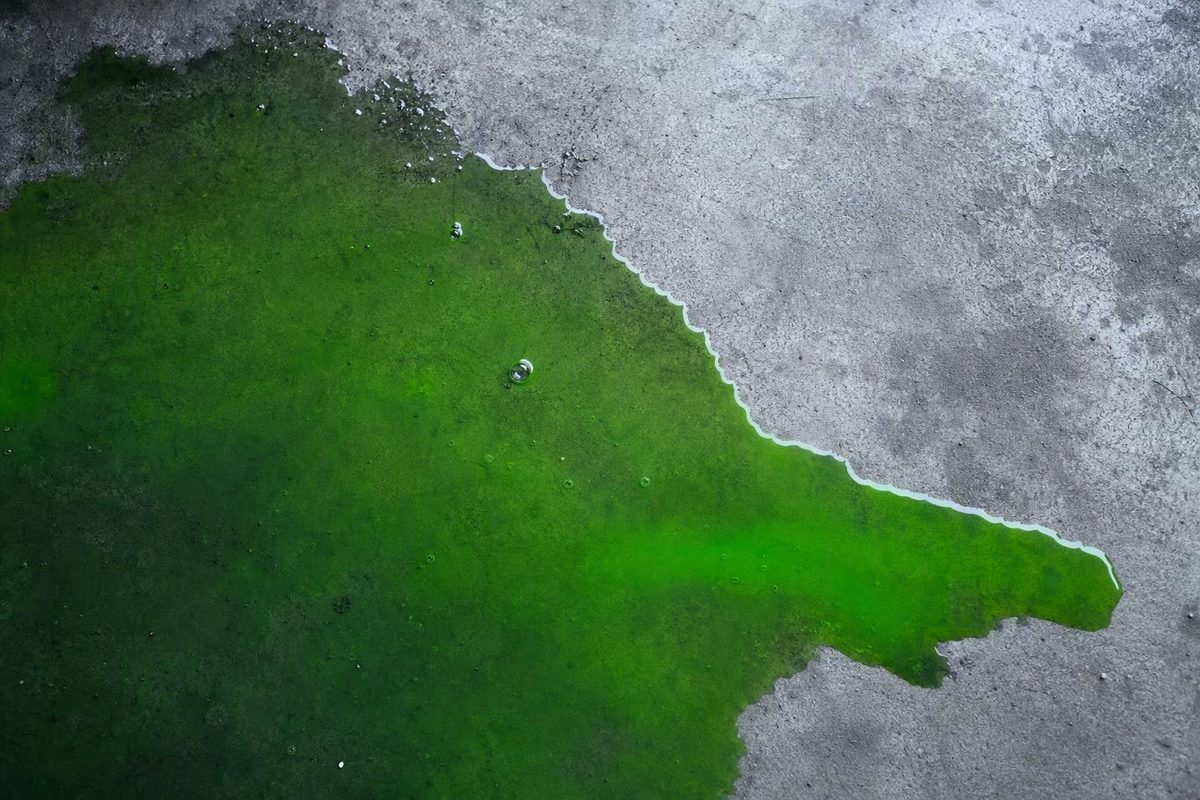
Yes. Automotive coolant can leave sticky residue and visible discoloration on concrete, particularly when a spill remains on bare, porous, weathered, or cracked material. Reported signs include pale green, orange, pink, yellow, or dark damp-looking patches, as well as sticky or slick residue. The appearance depends on the coolant, its dyes and additives, the amount spilled, and the condition and finish of the concrete. Some spills may leave a white or relatively colorless deposit instead of a mark matching the liquid’s original color. Commercial cleaning guidance describes these variations in coolant marks.
In this article, coolant and antifreeze refer to fluids commonly used in automotive cooling systems. The terms are often used interchangeably in ordinary conversation, but products do not all have the same formulation, concentration, dyes, or additives. Product-specific instructions therefore take priority over any general cleanup method.
It helps to divide the job into three goals:
- Collect the free liquid. Remove the puddle or wet coolant sitting on the surface.
- Remove remaining residue. Address the sticky or slick film left after absorption.
- Reduce residual discoloration. Treat any visible mark that remains after the liquid and residue are gone.
An absorbent may accomplish the first goal without completing the other two. Likewise, concrete may stop feeling sticky while still showing a faint dye mark. A puddle is not necessarily fully cleaned merely because it is no longer visible.
A visible mark cannot establish how deeply the liquid has penetrated or whether every trace of residue has been removed.
Practical commercial guides report sticky residue, white or colored marks, dirt buildup, and other appearance changes after antifreeze spills. However, the available evidence does not include controlled antifreeze-stain testing, so it cannot support a universal explanation or guarantee complete removal. One surface-cleaning guide summarizes the reported signs and the variables affecting results.
The practical answer to “does coolant stain concrete?” is therefore a qualified yes. Prompt containment gives you a better opportunity to limit spreading and residue, but the final appearance should be judged only after the spill has been collected, the remaining film has been cleaned, and the concrete has dried.
What determines whether the discoloration comes out
A small, fresh spill on sound sealed concrete presents a different problem from a large puddle that has dried on an old, unsealed driveway. That is why similar cleaning methods can produce different results.
The main variables are:
- Spill age: A fresh spill can be collected before it dries or spreads farther.
- Spill volume: A few drops are easier to control than a puddle extending through cracks, joints, or low areas.
- Surface condition: Rough, cracked, worn, or weathered concrete gives residue more places to remain.
- Apparent penetration: A surface film is generally more manageable than a persistent mark that remains after cleaning and drying.
- Surface finish: Bare concrete responds differently from sealed, painted, polished, stained, or resin-coated concrete.
- Previous contamination: Oil, road dirt, tire residue, and earlier cleaners can affect both appearance and cleaner selection.
- Time to containment: Acting promptly limits the opportunity for the liquid to spread, although no supplied evidence establishes a deadline after which the mark becomes permanent.
Commercial cleaning guides generally describe fresh spills as easier to address than old, dried, large, or apparently absorbed marks. They also acknowledge that an established stain may improve after repeated treatment without disappearing completely. Those are practical reports rather than results from controlled comparative testing.
Sealed concrete is reported to resist absorption better than bare concrete, but a sealer does not prevent every mark. Its condition matters, and the selected cleaner must be permitted for that particular finish.
Identify the surface before choosing a cleaner. Check installation records, leftover coating containers, maintenance documents, or information from the installer or property manager. If the finish cannot be identified, do not infer its type from appearance alone. Begin with the surface or coating manufacturer’s care instructions or obtain professional advice.
Do not evaluate the mark while the concrete is wet. Let the area dry fully under normal conditions before deciding whether another cleaning cycle is warranted.
If a mark seems to disappear during washing but returns after drying, the result is incomplete. That observation does not prove that coolant has risen from a particular depth or that a specific chemical reaction has occurred. Remaining residue, dye, moisture differences, prior finish damage, or another contaminant could affect the appearance.
No supplied evidence establishes a point measured in minutes, hours, or days after which discoloration becomes irreversible. Treat the spill promptly, but do not assume an older stain is automatically beyond improvement.
Fresh spill: protect the area and absorb the liquid first
The immediate priority is containment, not cosmetic stain removal.
Keep children, pets, and unnecessary foot or vehicle traffic away so the liquid is not tracked beyond the original area. Determine whether coolant is still leaking, but do not take actions around the vehicle that you cannot perform safely.
Read the coolant container, label, or safety data sheet before handling the spill. Product-specific documentation should determine the precautions required for that formulation. Commercial antifreeze guidance identifies ingestion as a danger to people and pets, reinforcing the need to restrict access and clean the spill promptly. The cited guide also recommends absorb-first cleanup for fresh spills.
Gloves and eye protection are commonly recommended in the supplied commercial cleanup guidance. Follow the product documentation if it calls for different or additional protection; general cleaning instructions cannot account for every concentrate, additive, exposure condition, or cleaner.
For a small spill that you can safely manage:
- Block access. Prevent footprints, paw prints, and tires from enlarging the affected area.
- Address the source if it can be done safely. Avoid moving the vehicle in a way that spreads the liquid.
- Cover the free coolant with absorbent. Commercial guides suggest cat litter, sand, sawdust, baking soda, or a spill absorbent.
- Contain a moving edge first. Place absorbent around the perimeter before covering the center if the puddle is spreading.
- Let the material collect the liquid. Follow any directions supplied with the absorbent rather than assuming every material requires the same waiting period.
- Gather the contaminated material carefully. Avoid scattering it or grinding it into the concrete.
Do not wipe the puddle outward with a rag or broom. Doing so can enlarge the affected area and push liquid toward cracks, joints, soil, landscaping, or drains. Do not begin by flooding the spill with water.
Absorption is only the containment stage. Cat litter, sand, sawdust, baking soda, and commercial granules can collect free coolant, but they may not remove the film or dye left behind. Remove all loose absorbent before deciding whether the surface is clean.
Commercial spill guidance advises keeping coolant out of drains and surrounding soil and checking local rules for contaminated cleanup material. Do not hose untreated coolant toward a storm drain, sewer opening, lawn, planting bed, or bare ground. The same guidance recommends controlled collection rather than dispersing the spill.
Place used absorbent in a closed container compatible with the material while you check the coolant label, safety data sheet, property procedure, and instructions from the relevant local waste authority. Waste classifications and accepted disposal routes differ by location, so do not assume that one legal classification or disposal method applies everywhere.
If the spill is too large to collect with the supplies available, is entering a drain or soil, or cannot be isolated, stop treating it as a routine stain. Use the applicable property spill procedure or contact an appropriate local authority or spill-cleanup service.
After containment: clean the remaining residue without over-treating the surface
Once the free liquid has been absorbed, sweep, scoop, or lift away the contaminated material without grinding it into the concrete.
Next, establish whether the surface is bare, sealed, painted, polished, stained, or coated. If the finish is unknown, consult its care documentation rather than choosing a product solely because its label says “for concrete.”
Choose one cleaner whose label permits use on:
- the particular surface or finish;
- the type of residue being treated;
- the indoor or outdoor location; and
- the cleanup conditions available.
Commercial guides mention detergent, concrete degreaser, enzyme cleaner, and oxidizing cleaner, but the available evidence does not show that one category is universally best for automotive coolant. A product labeled for plain concrete is not automatically suitable for paint, epoxy, decorative stain, polish, or sealer.
Before treating the full mark, test the cleaner in an inconspicuous area. Use its labeled dilution and contact time, remove it as directed, and allow the test area to dry. If the finish changes, do not proceed without guidance from its manufacturer or installer.
If the test is acceptable, use this core process:
- Prepare the area. Remove contaminated absorbent and loose debris.
- Apply the cleaner at its labeled dilution. Do not make it stronger in an attempt to accelerate the process.
- Observe the labeled dwell time. Do not invent a universal soaking period.
- Scrub with a nylon-bristled brush. Work on the residue without immediately resorting to wire tools or aggressive abrasion.
- Remove the loosened material as directed. Use only the water or removal method needed for the product.
- Keep the wash water contained. Check the cleaner instructions and local requirements rather than allowing it to flow toward drains, soil, lawns, or landscaping.
- Let the concrete dry completely.
- Reassess both feel and appearance.
A garage-floor contractor’s guide similarly recommends absorbing the spill first, following cleaner-label dilution instructions, scrubbing, and repeating treatment if necessary. It does not provide controlled antifreeze-specific performance testing, so its procedure should be treated as practical commercial guidance rather than a guaranteed protocol. See the contractor’s step-by-step coolant cleanup guidance.
After drying, assess the result:
- Still sticky or slick: Coolant residue or cleaner may remain.
- Clean-feeling but discolored: The liquid and film may be gone while a cosmetic mark remains.
- Visible change in the finish: Stop before applying another treatment.
- No visible or tactile difference: Further cosmetic cleaning may be unnecessary.
If residue or discoloration remains but the test and treated surface are unchanged, repeat the same label-compliant process. Do not automatically combine products or move to a stronger chemical.
Dried or established stain: re-treat cautiously and reassess
An established coolant mark requires the same core process—surface identification, compatibility testing, controlled cleaning, drying, and reassessment—but it may take more than one cycle.
Commercial guides often suggest wetting or otherwise preparing a dried mark before applying a detergent or suitable concrete cleaner. Re-wetting may help distribute a water-compatible cleaning solution across dried residue, but it does not guarantee that discoloration will release. Follow the chosen product’s instructions instead of soaking the area for an arbitrary period.
For an old mark:
- Inspect it for stickiness, colored residue, dirt buildup, cracks, coating failure, or signs of a continuing leak.
- Identify the surface or finish.
- Test the selected cleaner and allow the test area to dry.
- Prepare or wet the area only as the cleaner label directs.
- Apply one compatible product at its labeled concentration.
- Observe the labeled dwell time.
- Scrub with a nylon-bristled brush.
- Remove loosened material with controlled rinsing or the label-directed removal method.
- Let the surface dry fully.
- Compare the result with the surrounding area.
One frequently repeated household method uses water and detergent followed by wet newspaper placed over the treated area before scrubbing, rinsing, drying, and reassessing. A concrete-service company describes that approach for antifreeze marks. It should be treated as a reported household technique, not a scientifically validated protocol.
The cleaner and finish instructions still take priority.
An established mark may improve over multiple compatible cleaning cycles, but no supplied source establishes a guaranteed number of applications. Inspect the surface after each cycle has dried. Stop if treatment begins changing the concrete or finish rather than reducing the original mark.
If the stain disappears while wet and reappears as the area dries, return to assessment rather than assuming a specific subsurface mechanism. The observation establishes only that the visible result is incomplete.
Professional assessment is a better next step when the spill is large, residue keeps returning, the finish is sensitive or unknown, runoff cannot be controlled, or reasonable label-compliant attempts do not improve the mark. Tell the professional that the spilled material was automotive coolant and identify every cleaner already used.
Bare, sealed, and coated concrete require different decisions
Concrete surfaces should not all be treated alike.
Bare concrete has no intentional surface coating. It may retain liquid more readily when worn, cracked, rough, or weathered. A cleaner labeled for uncoated concrete may be appropriate, but aggressive chemistry or abrasion can still change the surface’s color or texture.
Sealed concrete has a treatment intended to reduce absorption or modify surface performance. Commercial guidance generally describes sealed concrete as more resistant to coolant absorption and easier to clean than unsealed concrete. That does not mean every sealer prevents staining or tolerates every cleaner.
Painted or epoxy-coated concrete should be treated according to the paint or coating manufacturer’s care instructions. Do not assume that a cleaner permitted for exposed concrete is also approved for the coating.
Polished concrete depends on a controlled finish for its appearance.
Decoratively stained or integrally colored concrete requires particular caution because uneven cleaning can alter the intended appearance. Removing a coolant mark by creating a lighter or differently colored patch is not a successful result.
Cleaner selection therefore depends on both the residue and the surface. A commercial concrete-cleaner review listed one product as compatible with antifreeze, but its described testing used other contaminants rather than antifreeze. That comparison supports checking stain and surface compatibility, not a claim of independently demonstrated coolant removal by a particular product. The review distinguishes testing on sealed and unsealed surfaces.
If the finish cannot be identified:
- Check installation records, maintenance instructions, and leftover product containers.
- Ask the owner or property manager before treating a rented or shared surface.
- Consult the finish manufacturer or installer.
- Test any permitted cleaner in a hidden area.
- Allow the test area to dry before expanding treatment.
Do not transfer motor-oil instructions to coolant simply because both spills occur beneath vehicles. Oil-cleaning chemistry addresses lipid residues, while automotive coolant presents a different cleanup problem. The absorb-first principle may overlap, but grease and oil stain guidance should not be treated as evidence that the same wet-cleaning method is suitable for coolant.
Also consider whether the spot contains more than coolant. An oily, multicolored, or unusually persistent spot may need diagnosis before further treatment.
Methods to avoid or use only with strict controls
Stronger and faster are not necessarily safer or more effective. Aggressive treatment may replace a manageable coolant mark with a permanent change to the surface.
Do not combine cleaners unless their labels expressly permit it. Use one surface-compatible product according to its instructions, remove it as directed, and assess the dry surface before considering another treatment.
Do not use bleach as the default treatment. Commercial cleaning guidance cautions that bleach may discolor concrete without reliably removing coolant. That does not establish that bleach always fails or damages every concrete surface, but it is not evidence for indiscriminate use—especially on sealed, colored, painted, or coated material. The same guidance advises against acids, wire brushes, aggressive abrasives, and mixed chemicals when treating coolant marks.
Avoid acids as a routine DIY response. The available evidence does not demonstrate an antifreeze-specific benefit that would justify making acid the default method.
Avoid wire brushes, grinding, and aggressive abrasion.
Do not assume pressure washing will remove an established stain. Pressure equipment may remove loose surface material, but it is not a guaranteed standalone remedy for persistent coolant residue or discoloration.
Before considering pressure equipment, confirm through the relevant surface and equipment instructions that:
- the concrete or coating can tolerate the proposed method;
- the selected settings and technique are suitable for the surface; and
- the resulting wash water can be contained and managed according to the applicable local instructions.
Commercial driveway guidance specifically warns against allowing coolant to reach drains and notes that pressure washing alone may not remove material that has entered porous concrete. Its recommendations emphasize absorption and controlled cleanup.
Avoid uncontrolled hosing. It can spread a contained spot into cracks, neighboring areas, drains, soil, lawns, or landscaping.
Do not keep increasing chemical strength when progress stops. If a repeated, label-compliant treatment does not improve the dry appearance, the remaining issue may be cosmetic discoloration or a changed finish rather than insufficient cleaning force.
When cleaning is no longer the right next step
Stop DIY treatment when the process begins altering the surface instead of reducing the original mark. A new color difference, changed gloss, roughness, or visible coating damage is reason to pause and consult the finish manufacturer, installer, or an appropriate professional.
Other reasons to escalate include:
- a large or spreading spill;
- coolant continuing to appear;
- persistent stickiness after controlled cleaning;
- discoloration that repeatedly returns after drying;
- an unknown, valuable, or sensitive finish;
- inability to control the cleaning water;
- coolant reaching joints, drains, soil, or landscaping; or
- no improvement after reasonable label-compliant treatment.
Address the vehicle leak before paying for cosmetic restoration. Otherwise, a new spill may recreate the mark immediately after cleaning.
Professional concrete cleaning is a reasonable option when the contamination or surface compatibility cannot be managed with confidence. For painted, epoxy-coated, polished, or decoratively finished floors, the installer or coating manufacturer may be more useful than a contractor who primarily cleans bare exterior concrete.
If residue has been addressed but discoloration remains, last-resort cosmetic options include refinishing, resurfacing, an overlay, or decorative staining. Concrete-service guidance presents these as ways to mask persistent or widespread discoloration when ordinary cleaning does not produce an acceptable appearance. These treatments conceal or integrate the mark; they do not establish that remaining coolant has been removed.
Resolve the leak, collect the free liquid, complete the appropriate cleaning process, and address the contaminated material before covering the area.
Sealing may improve resistance to future spills, but it cannot guarantee that concrete will never stain. Consider it only after the surface is clean, dry, appropriately prepared, and compatible with the selected sealer.
The practical hierarchy is:
- Contain and absorb free coolant.
- Collect the contaminated absorbent.
- Check the coolant and surface documentation.
- Use one label-approved cleaner compatible with the finish.
- Control the cleaning water.
- Let the concrete dry before judging the mark.
- Repeat cautiously only if the surface remains unchanged.
- Choose professional cleaning instead of increasingly aggressive DIY methods when the spill, finish, or wash water cannot be managed appropriately.
- Reserve resurfacing or decorative treatment for cosmetic restoration after the residue issue has been addressed.
Does coolant permanently stain concrete?
Not necessarily. Practical commercial guides report that fresh spills are generally easier to clean, while old, large, dried, or apparently absorbed marks may remain visible after repeated treatment.
No reliable universal deadline determines when a coolant mark becomes permanent. Results vary with the formulation, spill volume, age, concrete condition, previous contamination, and surface finish. Judge the result only after the concrete has dried.
Will cat litter or baking soda remove a coolant stain?
Cat litter and baking soda can absorb free liquid. Commercial guides also suggest sand, sawdust, and purpose-made spill absorbents.
Their main role is containment. They may reduce the amount of coolant available to spread, but they do not necessarily remove sticky residue or dye discoloration. After collecting the contaminated material, the surface may still require a compatible cleaner used according to its label.
Can I pressure-wash coolant off concrete?
Pressure washing may remove loose surface material, but it is not guaranteed to remove an established coolant mark.
It also produces contaminated wash water. Do not proceed unless the surface documentation permits the method and the water can be contained and managed according to the instructions applicable to your location. For a small spill, absorption followed by limited wet cleaning is generally easier to control.
Is coolant staining structural damage or mainly discoloration?
The supplied practical guidance generally treats a coolant mark as a residue and appearance problem rather than proof of structural damage. One driveway-cleaning guide says coolant does not usually cause structural damage while acknowledging that it can affect appearance and leave persistent residue. That statement comes from commercial surface-cleaning guidance, not an engineering assessment.
Color alone cannot establish either structural damage or structural safety. Cracking, spalling, soft areas, coating failure, or other physical deterioration should be assessed separately.
How should coolant-soaked absorbent and rinse water be disposed of?
Place coolant-soaked absorbent in a closed, compatible container while checking the coolant label, safety data sheet, property procedures, and instructions from the relevant local waste authority. Do not assume that the same legal classification or disposal route applies in every jurisdiction.
Keep the cleaning water controlled rather than sending it into drains, soil, lawns, or landscaping. A garage-floor cleanup guide emphasizes collecting the absorbent before wet cleaning and notes that contaminated material may require special handling. Its disposal discussion should be applied alongside product documentation and local instructions.
When asking for location-specific directions, describe the material accurately: automotive coolant or antifreeze, the contaminated absorbent, and any cleaner added. If the amount is too large to capture or store as directed, use an appropriate spill-cleanup service rather than diluting or dispersing it.