 StainList
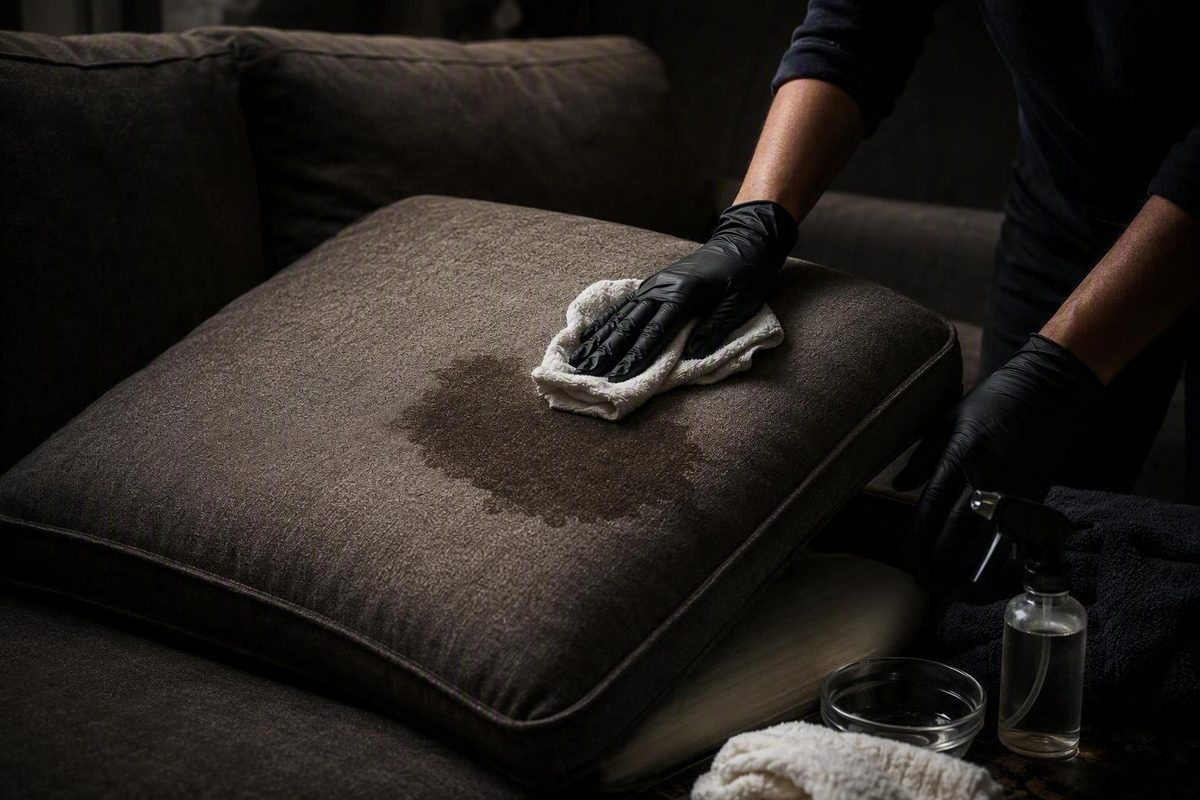
Blot up as much urine as possible with clean white towels, then check the sofa’s care code before applying any cleaner. If the accident appears superficial and the upholstery is coded W or SW/WS, you can cautiously test and use a compatible upholstery cleaner with minimal moisture. An apparently superficial spot on S-coded fabric may be treated only with an authorized water-free code-S product. Do not apply liquid cleaner to X-coded upholstery.
These steps can contain a fresh accident, reduce the risk of upholstery damage, and support drying. They do not provide a validated universal home method for removing urine from foam, batting, or other cushion filling. If urine may have reached the insert, or you cannot inspect and dry the affected layers, manufacturer or professional assessment is the safer next step.
The initial containment and care-code rules apply regardless of whether the urine came from a person or an animal. Cleaner effectiveness and odor treatment, however, should not be assumed to be identical for human, cat, dog, or other animal urine.
What to do immediately: blot without adding more liquid
For a fresh accident:
- Remove the cushion from the sofa only if it is designed to lift off.
- Press folded, clean white towels firmly into the wet area.
- Replace each towel as it becomes saturated.
- Continue until a fresh towel picks up little additional moisture.
- Check the seams, underside, and sofa platform beneath the cushion.
Blot rather than rub or scrub. Work from the outside edge toward the center to limit spreading and reduce the chance of creating a ring. Upholstery-care guidance likewise recommends immediate blotting and an outside-to-center approach (Grand Home Furnishings’ upholstery-care instructions).
Do not begin by spraying vinegar, peroxide, detergent, an enzyme cleaner, or another liquid. Do not steam the cushion. The upholstery code may prohibit water or all liquid cleaners; code-W guidance also does not automatically permit hot-water extraction or steam cleaning.
If moisture reached the sofa deck or frame, follow the care instructions for that material. Finished wood, upholstery, and cushion filling require different moisture controls, so a carpet or floor-cleaning procedure should not be transferred directly to the sofa.
Blotting is containment, not proof of removal. The surface may feel dry while moisture or residue remains in a seam, batting, foam, or the structure below.
Use the upholstery code as the decision table
Look for the care tag beneath a seat cushion or under the sofa. Follow the instructions for your exact furniture whenever they differ from a general code summary.
| Code | Permitted cleaner category | Prohibited action | Recommended response |
|---|---|---|---|
| W | Water-based upholstery shampoo or foam | Solvent spot cleaners, overwetting, and methods the manufacturer excludes | Blot, hidden-test a compatible water-based product, and use minimal moisture |
| S | Water-free upholstery solvent approved for code S | Water and water-based mixtures | For an apparently superficial spot, use only an authorized code-S product |
| SW or WS | Approved water-based upholstery cleaner or mild upholstery solvent | Saturation | Hidden-test the selected product and apply it sparingly |
| X | No liquid or foam cleaner | Water- and solvent-based spot cleaning | Blot removable surface liquid without cleaner, then seek guidance |
Manufacturer cleaning-code guidance defines these categories and repeatedly warns against saturating or overwetting upholstery. It also shows why a removable-looking or zippered cover must not automatically be laundered or dry-cleaned (Ashley Furniture Industries’ cleaning-code reference).
Two less common labels also require exact interpretation:
- DC means dry-clean only. It does not authorize ordinary code-S spot treatment unless the manufacturer says it does.
- W/B permits a specified bleach solution only on upholstery explicitly carrying that label. It does not make bleach suitable for ordinary W, S, SW/WS, or X fabrics (La-Z-Boy fabric-code guidance).
A permitted cleaner category establishes textile compatibility, not urine-removal performance. A water-based product allowed on a W cover is not thereby proven to remove urine or odor from the cushion interior. Likewise, a code-S solvent may be compatible with the cover without addressing residue beneath it.
Determine whether the accident stopped at the cover or reached the filling
Before adding cleaner, look for practical warning signs of deeper penetration:
- dampness beneath the upholstery;
- a wet area on the underside larger than the visible top spot;
- odor coming from the insert;
- continued coolness, dampness, or unusual weight after the surface feels dry;
- odor that returns after drying;
- liquid concentrated near seams, tufting, or piping.
These are warning signs, not diagnostic tests. A dry underside and lack of insert odor lower the suspicion of penetration but do not prove that the filling remained untouched.
Couch cushions are layered assemblies. The care code identifies an allowable cleaner category for the upholstery textile; it does not establish compatibility with every internal component.
A zipper is also not permission to remove or wash the cover. Remove, machine-wash, hand-wash, or dry-clean a cover only when the care label or sofa manufacturer explicitly authorizes that procedure.
Use these provisional decision branches:
Apparently superficial spot: If the amount was small, no moisture appears beneath the cover, the insert has no odor or other warning sign, and you can monitor drying, you may treat the upholstery within its care-code limits. This is a cautious working assessment, not proof that no liquid entered the filling.
Suspected filling penetration: If moisture or odor appears below the cover, the accident was substantial, or you cannot access and monitor the affected layers, check the manufacturer’s insert instructions. If those instructions do not authorize treatment and drying, stop before adding more liquid and consult a qualified upholstery cleaner.
Carpet and hardwood instructions are not substitutes. Carpet procedures may account for accessible backing, padding, and extraction equipment, while finished hardwood generally requires minimal surface moisture and immediate drying. A cushion can retain liquid unseen within several porous layers.
Clean only as far as the code and cushion construction allow
For W or SW/WS upholstery with an apparently superficial spot:
- Select an upholstery product permitted by both the sofa label and the product label.
- Test it on a concealed area and let the test area dry completely.
- Check for dye transfer, fading, texture change, rings, or distortion.
- Apply the product sparingly to the upholstery; do not pour it into the cushion.
- Dab with a clean white cloth rather than scrubbing.
- Remove residue according to the product directions without soaking the fabric.
- Press dry towels into the treated area to remove as much moisture as possible.
Manufacturer guidance for W and SW fabrics supports hidden-area testing, gentle dabbing, limited moisture, and blotting until the fabric is barely moist (Smith Brothers care and cleaning guidance). It does not establish that this general spot-cleaning procedure will remove urine or odor.
If you are considering a urine-labeled enzyme product, confirm that it is permitted by the upholstery code and expressly labeled for the material. The available evidence does not establish a universal enzyme formula, concentration, dwell time, application volume, foam compatibility, or guaranteed result.
For S upholstery, do not substitute vinegar, diluted detergent, a water-based enzyme product, or another water-based mixture. Use only a water-free spot-cleaning product explicitly authorized for code S and follow its directions. If urine may have penetrated beneath the S-coded cover, a surface solvent treatment is not established as a remedy for the insert; refer the cushion instead.
For X upholstery, an unknown code, or uncertain construction, do not experiment with liquid or foam. Contact the manufacturer, furniture retailer, protection-plan provider, or a qualified upholstery cleaner. If a protection plan may apply, contact its provider before attempting treatment.
Do not treat vinegar, peroxide, baking soda, bleach, ammonia, steam, or generous soaking as universal couch remedies. Water-based mixtures conflict with S restrictions, while X prohibits both water- and solvent-based liquid cleaners. Peroxide may also bleach upholstery, so its use cannot be assumed safe without material-specific authorization and colorfastness testing.
Repeated surface treatment is not necessarily progress. If residue is inside the insert, adding more cleaner can increase the cushion’s moisture load without demonstrating removal from the affected layer.
Stop home treatment if the code prohibits the proposed cleaner, urine may be inside an inaccessible insert, the cushion cannot be monitored for internal drying, dye transfers, the fabric changes, or dampness and odor persist.
Extract moisture and dry the cushion completely
Drying is part of the treatment. Continue pressing clean, dry towels into the treated area until little additional moisture transfers.
Do not assume a household water-extraction vacuum is suitable for a urine-wet cushion. EPA guidance discusses extraction for upholstered furniture damaged by clean water, not a urine-specific cleaning protocol. Use extraction equipment only if the sofa manufacturer and equipment instructions explicitly permit the application; otherwise, leave extraction to an upholstery professional.
Increase airflow around all accessible sides of the cushion. Open windows when conditions allow and use a dehumidifier to reduce room moisture. Fans can support drying, but they do not prove that the center is dry. Avoid improvised high heat unless the manufacturer specifically permits it.
If cover removal is explicitly authorized, dry the cover and insert separately. Do not reassemble the cushion or allow anyone to sit on it while the interior remains damp.
Surface touch and elapsed time are not enough. If you cannot inspect the insert and remain uncertain, seek professional assessment rather than assuming it is dry.
The EPA advises drying wet materials within 24 to 48 hours to reduce the likelihood of mold growth. This is a moisture-control target—not a guaranteed drying time for cushion foam and not evidence that urine residue or odor has been removed (EPA guidance on mold and moisture).
Actual drying time varies with cushion thickness, filling, absorbed volume, airflow, temperature, humidity, liners, and cover construction. Stop and seek guidance if you notice:
- persistent internal dampness, coolness, or unusual weight;
- a moldy odor or visible mold;
- color transferring onto clean towels;
- fading or discoloration;
- puckering or distortion;
- cleaner rings or spreading halos.
What to do when odor returns or the cushion was deeply soaked
Odor that returns after the surface has dried is a practical warning that the first treatment may not have resolved the source. It does not identify whether residue remains in foam, batting, seams, the sofa deck, or the frame. Repeatedly spraying the surface may simply prolong dampness.
Arrange professional upholstery cleaning or restoration when there is:
- deep or repeated saturation;
- persistent odor after a code-compatible surface treatment;
- suspected filling contamination beneath an S- or X-coded cover;
- an insert that remains damp or cannot be inspected;
- visible mold or a moldy smell;
- uncertain cushion construction;
- dye loss, rings, or distortion during testing;
- failure of the approved cleaner category.
Seek manufacturer or specialist guidance for leather, wool, silk, antiques, specialty finishes, valuable furniture, and warranty-sensitive pieces. These require material- and finish-specific decisions rather than a generic fabric procedure.
Mold can occupy spaces and crevices within porous materials, making complete removal difficult or impossible. There is no supported universal saturation threshold at which every urine-affected cushion can be saved or must be discarded.
Judge the result only after the cushion is fully dry:
- The cover remains undamaged: no fading, dye transfer, rings, shrinkage, or distortion.
- No urine odor returns: including after the cushion has returned to normal room conditions.
- No moisture or mold warning signs remain: no detectable dampness, moldy odor, or visible growth.
The defensible sequence is to blot first, read the care code, make a cautious assessment of whether the filling may be wet, use only a compatible low-moisture surface treatment, and dry the cushion thoroughly. This can reduce damage and contain a superficial accident, but it cannot promise removal from urine-soaked filling.