 StainList
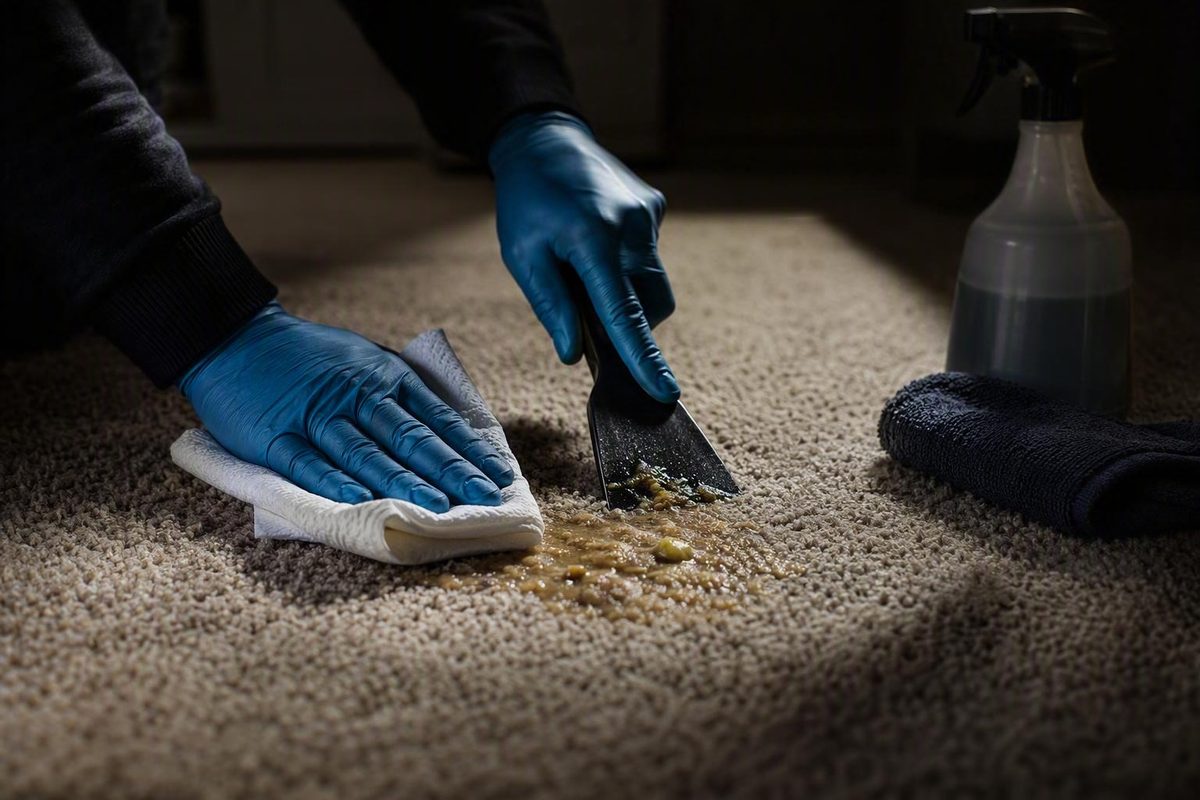
Treat stain removal, odor control, and disinfection as separate goals. A carpet can look clean but retain odor or cleaner residue, and a clean-looking, odor-free spot is not necessarily disinfected. Work through those problems in order instead of layering several household chemicals onto the carpet.
Results vary with the carpet fiber, dyes, pile, backing, padding, age of the mess, and previous treatments. Prompt action helps, but a dried stain is not automatically permanent.
What to Do in the First Five Minutes
Start with a short checklist:
- Keep children and pets away from the area.
- Ventilate the room if practical.
- Put on disposable gloves.
- Gather a spoon or dull scraper, clean white towels, a trash bag, water, mild dish soap, and a fan.
- Find the carpet or rug care instructions.
- If the carpet is under warranty, check whether it restricts DIY treatments or requires an approved product or service.
Do not begin by pouring water or cleaner onto the mess. Remove as much material as possible while it remains near the surface.
Use a spoon, plastic scraper, or another dull edge to lift solid material. Start at the outside and work toward the center so you do not enlarge the affected area. Keep the tool nearly level, apply light pressure, and place each scoop directly into the trash bag.
If the mess is mostly liquid, collect what you can with the spoon and then switch to absorbent towels. Working from the outside inward and avoiding heavy downward pressure helps limit spreading and reduces the chance of forcing moisture farther into the carpet structure, as described in this interim containment method.
Blot the remaining liquid with clean white towels. Place a towel over the damp fibers, apply light pressure, lift it, and move to a dry section. Replace the towel when it becomes saturated.
White towels make transferred residue easier to see and reduce the risk of adding dye from a colored cloth. Continue until a dry towel picks up little moisture.
Avoid:
- Rubbing back and forth
- Scrubbing with a brush
- Stomping on towels
- Kneeling on the spot with your full weight
- Pouring a large quantity of water over the area
- Trying several cleaners before assessing the carpet
Rubbing can spread residue sideways, while excessive pressure or liquid can move contamination toward the backing and padding. Prompt cleanup gives you more control, but older material can often be softened and removed with the cautious method described below.
Choose a Carpet-Safe Treatment Before You Add Liquid
Before selecting a cleaner, look for the carpet care label, purchase paperwork, fiber description, manufacturer maintenance guide, or warranty conditions. For a removable rug, use the rug’s instructions rather than assuming that wall-to-wall carpet guidance applies.
Manufacturer directions take priority over generic household recipes. Warranty terms may also restrict products or treatment methods, so check both the fiber-care instructions and the warranty before applying a cleaner, as recommended in Carpet One’s carpet-care guidance.
Spot-test every cleaner
Test the proposed cleaner in a hidden location, such as inside a closet or behind furniture. Use the same dilution, application method, and approximate contact time you intend to use on the stain.
Check for:
- Color loss or lightening
- Dye transfer to a white cloth
- Darkening after drying
- A stiff, fuzzy, matted, or distorted texture
- Rippling or backing changes
- A visible ring around the test area
When practical, let the test area dry before judging it. A damp patch may appear unchanged but reveal color or texture damage after drying.
A successful test reduces uncertainty; it does not make unlimited product or repeated saturation safe. Use the same low concentration and controlled moisture on the actual spot.
Use the care label to settle the water-temperature question
Published instructions vary between cool, cold, and warm water. Use this conservative rule:
- Follow the carpet or rug care instructions.
- Do not use hot or boiling water.
- If water is permitted but no temperature is specified, use cool or gently lukewarm water.
- Use only as much liquid as the treatment requires.
Ordinary synthetic carpet and delicate natural-fiber rugs may need different care. Do not apply generic synthetic-carpet advice to wool, handmade rugs, or floor coverings with unknown dyes or backing.
Basic option: very dilute dish soap
For ordinary, colorfast carpet that permits water-based spot cleaning, add only a few drops of mild dish soap to a small bowl or cup of compatible cool or lukewarm water. The mixture should be barely soapy rather than foamy; published carpet-cleaning guidance supports using a few drops rather than a concentrated detergent mixture (see the basic soap method).
Excess detergent can be difficult to remove without adding more water.
Choose a plain, mild formula when possible. If you cannot judge the dilution confidently, use a carpet-labeled spot cleaner instead.
Alternative: a carpet-labeled enzyme cleaner
An enzyme cleaner can be useful for organic residue, particularly pet vomit. Treat it as an alternative to the soap method, not an automatic second layer.
Confirm that the label permits use on the carpet fiber. Follow the stated dilution, application amount, dwell time, residue-removal method, drying instructions, and safety precautions. Some products are ready to use, while others require dilution; some require rinsing or extraction, while others do not.
Do not extend the dwell time or increase the quantity on the assumption that more product will work better. The correct process depends on the individual label.
When to avoid a generic recipe
Pause before DIY treatment if the affected material is:
- Wool or another natural fiber
- Handmade or hand-knotted
- Antique or irreplaceable
- A Persian or other valuable area rug
- Known to have unstable dyes
- Constructed with unfamiliar backing
- Covered by unclear care or warranty terms
Contact the manufacturer, retailer, rug specialist, or qualified carpet cleaner. Dish soap, vinegar, peroxide, baking soda, and enzyme products are not universally compatible simply because they are widely available.
Step-by-Step Method for Fresh Throw Up
Begin only after lifting the bulk material and blotting up as much free liquid as possible.
1. Prepare one mild treatment
Add a few drops of mild dish soap to a small amount of care-label-compatible cool or lukewarm water. Mix gently without creating dense suds.
If you have selected a carpet-labeled spot cleaner or enzyme product, prepare it according to its label and skip the soap mixture. Do not use both at the same time.
2. Control how the cleaner reaches the carpet
Dampen a clean white cloth with the solution and wring it out so it is wet but not dripping. Alternatively, use a clean spray bottle to apply a light mist.
Do not pour the solution directly onto the carpet. A damp cloth or fine mist provides better control and reduces the risk of saturating the backing or padding.
Treat only the smallest area containing visible or transferable residue. Do not enlarge the wet area “just in case.”
3. Blot from the edge toward the center
Begin at the outer boundary and work gradually inward. Press and lift the cloth instead of rubbing it across the pile.
Rotate to a clean section after each few contacts. Replace the cloth if it becomes dirty or saturated so that removed material is not deposited back onto the carpet.
For longer pile, you can gently lift or pinch the fibers through the cloth. Avoid twisting, grinding, brushing, or scrubbing.
4. Repeat only while residue transfers
Work in short cycles:
- Apply a small amount of solution.
- Blot with a clean section of cloth.
- Inspect the cloth for transferred residue.
- Pause before adding more liquid.
Stop adding cleaner when little material transfers. A faint difference in color while the carpet is damp is not a reason to flood it. The appearance may change as the fibers dry.
5. Remove cleaner residue if required
Follow the product directions. For the dilute dish-soap method, use a clean cloth barely dampened with compatible plain water to lift residual detergent.
Blot rather than pouring on rinse water. Follow with dry white towels until little moisture transfers.
A commercial cleaner may have different directions. If its label says not to rinse, follow that instruction. If it requires extraction or a defined rinse procedure, do not substitute a different process.
6. Dry and inspect the area
Blot thoroughly with dry towels, ventilate the room, and direct a fan across the carpet. Keep people and pets off the damp area until it is dry.
After drying, inspect the spot in normal light and check:
- Whether the pile feels normal rather than stiff or sticky
- Whether a visible ring has formed
- Whether a dry towel picks up moisture
- Whether odor remains after the room has aired out
One additional careful treatment may be reasonable on compatible carpet. Do not immediately stack soap, vinegar, peroxide, baking soda, and enzyme cleaner. One known treatment is easier to control than several interacting products.
How to Remove Dried Vomit or Handle a Delayed Cleanup
Dried throw up requires an extra loosening step, but the basic sequence remains the same: remove loose debris, soften only what is stuck, lift it, blot, and clean with minimal moisture.
Remove loose particles before wetting
Put on gloves and collect loose, dry material with a spoon or dull scraper. Work from the outside toward the center.
Do not use a stiff brush to grind crusted residue out of the pile. Aggressive brushing can abrade the carpet and move particles deeper.
Manual collection is usually easier to control than vacuuming potentially contaminated debris. If you use a vacuum, first confirm that its instructions permit the intended material and clean or empty the relevant components as directed.
Soften hardened residue briefly
Place a clean cloth dampened with care-label-compatible cool or lukewarm water over the hardened material. Leave it only long enough to soften the surface. You can instead apply a very light mist.
The goal is pliability, not saturation. If the water disappears immediately into the carpet, wait before applying more.
Once the residue softens, slide a spoon or dull scraper beneath it and lift it into a bag. Wipe the tool between passes. This soften-and-lift approach is also described in Merry Maids’ fresh and dried vomit guidance, which advises checking carpet instructions and spot-testing first.
Clean what remains
After removing the softened material:
- Blot remaining moisture with a white towel.
- Apply a small amount of dilute dish-soap solution or a label-directed enzyme cleaner.
- Blot from the outside inward.
- Rotate to clean cloth sections.
- Remove cleaner residue if required.
- Blot dry and use airflow.
Older residue may require more than one attempt. Let the carpet dry between treatments so you can judge the result and avoid cumulative oversaturation.
Stop if the color changes, the pile becomes distorted, the backing appears wet, or moisture repeatedly returns after blotting. Stronger chemicals and repeated soaking may cause additional damage.
If cleanup must be delayed
After removing as much bulk material and liquid as possible, dry baking soda may be used as a temporary absorbent. Apply it only over the affected area and keep children and pets away from the powder. Do not treat it as a sanitizer.
When you return, collect the powder without spreading it and complete the normal cleaning process. If it is damp or clumped, do not use an ordinary vacuum unless the equipment instructions permit that material. A scraper and dustpan may provide better control.
Temporary powder does not replace cleaning. It may absorb some surface moisture, but the underlying residue still needs to be removed.
Treat Lingering Odor Only After the Residue Is Gone
Odor treatment comes after bulk removal and stain cleaning. Spraying fragrance over untreated residue may change the smell temporarily, but it does not remove the source.
Before attempting deodorizing, confirm that:
- Solid material has been removed.
- The carpet has been cleaned.
- Cleaner residue has been removed if required.
- The carpet has been blotted as dry as possible.
- Moisture is not spreading beyond the original boundary.
Option 1: Use a carpet-labeled enzyme cleaner
If odor remains, a carpet-compatible enzyme cleaner may help address residual organic material, particularly after dog or cat vomit.
Check that the product is suitable for the carpet fiber and compatible with any earlier treatment. Spot-test it, follow its application and dwell-time directions, and complete any required rinse or extraction step.
Do not assume that additional product, repeated saturation, or a longer dwell time will produce a better result. Directions vary by product.
Option 2: Apply dry baking soda
Once the carpet is clean and mostly dry, apply a light, even layer of baking soda. Use baking soda, not baking powder; they are different products.
Leave the baking soda for several hours or overnight. Recommendations vary, so this is an optional finishing step rather than a universally exact process; one published method specifies a few hours or overnight before vacuuming (see the odor-control instructions).
Vacuum only after both the carpet and powder are completely dry and only if the vacuum manufacturer permits fine-powder pickup. If contaminated powder enters the machine, follow its manual for emptying the bag or canister and servicing the filters.
If the odor returns
Do not repeatedly pour deodorizer onto the spot. First establish whether the carpet is fully dry. If odor returns after complete drying, or if the area becomes damp again, seek a professional assessment.
Avoid essential oils, perfume sprays, and carpet fragrances as cleaning methods. They may add residue or mask the smell without removing its source.
Vinegar, Peroxide, Baking Soda, and Enzymes: What Not to Combine
Common products have different roles and risks:
- Diluted mild dish soap may help lift residue from compatible, colorfast carpet.
- A carpet-labeled enzyme cleaner is a targeted option for organic residue and odor.
-
Dry baking soda is an optional post-cleaning treatment for residual moisture or odor.
-
Bleach is not a general-purpose carpet spot cleaner.
More products do not necessarily produce a cleaner carpet.
Vinegar recommendations vary substantially
Published vinegar ratios are inconsistent. The Cleaning Authority gives a vomit spot-treatment ratio of one part vinegar to ten parts water but uses a different concentration elsewhere in the same guide (review its stated ratios).
Apartment Therapy presents equal parts vinegar and water as another household method, showing why no single concentration can be treated as universally carpet-safe (see its 1:1 method).
Vinegar is therefore not part of the primary workflow here. If the carpet manufacturer permits it and you choose to use it:
- Spot-test the proposed dilution.
- Let the test dry before judging it.
- Apply it sparingly through a cloth or light mist.
- Use it as the only treatment at that stage.
- Remove residue as the carpet instructions require.
- Stop if the carpet changes color or texture.
Do not casually apply vinegar over detergent, peroxide, bleach, disinfectant, or an enzyme product.
Hydrogen peroxide can alter carpet color
A 3% hydrogen peroxide solution is sometimes recommended for residual stains, but peroxide has mild bleaching potential and may discolor carpet (see the peroxide caution). It should not be a default treatment, especially on dark, saturated, delicate, valuable, or color-sensitive material.
A light-colored carpet is not automatically peroxide-safe. If the manufacturer does not permit peroxide, choose a carpet-labeled alternative or obtain professional guidance.
Do not mix or casually layer hydrogen peroxide and vinegar. Familiar household products can still create unnecessary chemical and carpet-compatibility risks when combined.
Never mix bleach and vinegar
Do not mix bleach with vinegar because the combination can create toxic gas. Published cleanup guidance explicitly warns against this mixture and separately emphasizes that disinfection depends on product-specific surface instructions (see the chemical-safety warning).
Avoid bleach on carpet unless both the carpet manufacturer and the bleach-product label explicitly authorize the exact application. Improvised dilution does not make an unauthorized use suitable.
Baking soda is not a disinfectant
Baking soda may be used dry after cleaning as an optional moisture- or odor-control step.
Do not substitute baking powder. Baking powder contains additional ingredients and is not interchangeable with the baking soda described here.
Enzymes are label-directed products
An enzyme cleaner is not a universal final layer to add after every household remedy. Use it as the sole cleaner at that treatment stage and follow its label.
If another product has already been applied, check whether the enzyme-cleaner instructions address pretreatment or incompatibility. Do not claim that enzyme cleaner, vinegar, peroxide, baking soda, club soda, or steam is categorically superior for every carpet.
Drying, Wicking, and Signs the Mess May Be Deeper
Drying is part of the treatment.
After cleaning:
- Blot repeatedly with clean, dry towels.
- Increase ventilation where practical.
- Direct a fan across the carpet.
- Prevent foot traffic while the area is damp.
- Keep furniture off the spot until it is dry.
- Recheck the area after several hours and after complete drying.
Dense pile, thin commercial carpet, absorbent padding, waterproof backing, natural-fiber rugs, and handmade floor coverings behave differently. Use the least liquid that completes the treatment.
What wicking can look like
The area may look improved when damp and then develop a ring, shadow, or renewed discoloration.
Possible warning signs include:
- A stain that returns after drying
- An odor that repeatedly reappears
- A spot that remains wet much longer than nearby carpet
- Dampness that returns after blotting
- A wet boundary spreading beyond the original area
- Moisture visible at an exposed edge or underside
These are warning signs, not conclusive tests of padding contamination.
If a stain returns, do not automatically add more cleaner. Repeated wetting can enlarge the affected area and slow drying. Blot renewed moisture and consider professional assessment.
When professional assessment is reasonable
Conservative guidance from carpet-cleaning providers commonly recommends escalation when:
- The spill involved a large volume of liquid.
- The carpet was soaked rather than surface-damp.
- Liquid reached an exposed edge, seam, backing, or pad.
- The spot remains wet despite blotting and airflow.
- Staining or odor returns after complete drying.
- Multiple low-moisture attempts have failed.
- You cannot determine whether the underside is dry.
- The carpet is wool, handmade, antique, valuable, or dye-unstable.
- The care instructions or warranty terms are unclear.
Rental extractors and steam machines
A rental extractor or steam machine is not automatically the next step. Verify that the carpet fiber, backing, adhesive, and warranty permit the equipment and method. You must also be able to remove enough liquid for timely drying.
Do not assume that steam disinfects the carpet or that hotter water is better.
For a small surface spot, controlled blotting may be safer than treating a broad area. For a genuinely soaked carpet, professional moisture assessment may be more controlled than repeated passes with unfamiliar equipment.
Cleanup Hygiene and the Limits of Ordinary Carpet Cleaning
A carpet that looks clean and no longer smells is not necessarily disinfected. Physical removal, stain treatment, odor reduction, and disinfection are different outcomes.
Wear disposable gloves while handling the mess, place solids and used disposable towels directly into a bag, and avoid transferring contaminated material to clean surfaces. Close the bag after cleanup and wash your hands after removing the gloves. Practical cleanup guidance consistently recommends gloves, prompt removal, and bagging the waste (see the basic handling sequence).
Follow the care instructions for any reusable cloths or tools. If contaminated material enters a vacuum, follow the vacuum manufacturer’s directions rather than improvising a decontamination method.
Do not infer pathogen control from appearance or odor. If disinfection is necessary because illness may be contagious, use only a product whose label authorizes use on the relevant carpet or soft surface and covers the intended purpose. A disinfectant labeled only for hard, nonporous surfaces should not be assumed suitable for carpet.
Follow the product label for application, contact time, ventilation, residue removal, drying, and access to the treated area. If you cannot identify a suitable labeled product, contact the carpet manufacturer, a qualified cleaner, or an appropriate public-health authority. Do not improvise with bleach or mixed household chemicals.
The most important mistakes to avoid are:
- Do not rub or scrub. Lift solids and blot liquid.
- Do not oversoak the carpet. Apply cleaner through a cloth or light mist.
- Do not use hot water without care-label approval.
- Do not combine or casually layer cleaners.
- Do not vacuum damp baking soda or other wet powder.
- Do not use fragrance as a substitute for residue removal.
- Do not assume stain removal equals disinfection.
- Do not continue DIY treatment when color, texture, or moisture problems appear.
Frequently Asked Questions
Are the steps different for dog or cat vomit?
The physical cleanup is essentially the same: keep the pet away, wear gloves, lift solids, blot liquid, apply one compatible cleaner sparingly, and dry the carpet thoroughly.
A carpet-labeled enzyme cleaner may be useful for pet vomit because it is intended for organic residue. One professional cleaning workflow uses an enzyme product after bulk removal and moisture absorption, but compatibility and application still depend on the carpet and cleaner labels (see the pet-vomit sequence).
Do not assume that a cleaner labeled for pet stains is suitable for every rug. Spot-test it and follow all dilution, dwell-time, residue-removal, and drying directions.
How long should baking soda stay on carpet after vomit?
Apply baking soda only after removing the vomit, cleaning the residue, and blotting the carpet until it is mostly dry. Leave the dry powder for several hours or overnight.
There is no universal dwell time for every carpet or odor. Longer is not automatically better, especially if the carpet remains damp or the powder is accessible to children or pets.
Vacuum only when the carpet and powder are completely dry and the equipment instructions permit fine-powder pickup. Collect damp or clumped powder manually unless your machine is specifically approved for it.
Can I use vinegar to clean throw up out of carpet?
Possibly, but vinegar is not required and is not universally carpet-safe. Published household methods range from one part vinegar to ten parts water to equal parts vinegar and water, so the evidence does not establish one concentration for every carpet.
Use vinegar only if the carpet-care instructions permit it. Spot-test the proposed dilution, let the test dry, apply it sparingly, and use it as the only cleaner at that stage.
Do not mix or layer vinegar with peroxide, bleach, disinfectant, or unidentified cleaner residue. When care instructions are unavailable, a carpet-labeled product or professional guidance is the more controlled option.
Will hydrogen peroxide bleach my carpet?
It can lighten or discolor carpet. The commonly suggested 3% concentration still has bleaching potential, so it is not a default treatment for dark, delicate, handmade, valuable, or color-sensitive material.
Do not judge compatibility by carpet color alone. Fiber type, dye chemistry, previous treatments, application amount, and contact time can affect the result.
Use peroxide only when the carpet manufacturer permits it, and test it in a hidden area first. Do not combine it with vinegar or apply it over unidentified residue.
When should I call a professional carpet cleaner?
Seek professional help when the spill is large, the backing or padding appears soaked, the carpet remains wet unusually long, or a stain or odor returns after complete drying. Professional assessment is also reasonable after a careful treatment fails or when you cannot identify the carpet construction or permitted cleaning method.
Contact a rug specialist early for wool, handmade rugs, Persian rugs, antiques, unstable dyes, and valuable floor coverings.
Before the appointment, tell the cleaner:
- What caused the spot
- Approximately when it occurred
- Which products were applied
- Whether those products were rinsed or extracted
- Whether the stain or odor returned after drying
- Whether the carpet is under warranty
While waiting, avoid adding more products unless the cleaner provides compatible interim instructions. Blot surface moisture, maintain airflow, and keep the area isolated.
A Simple Decision Rule
For a fresh mess, lift and blot. For dried material, soften it briefly and scrape gently. Use one spot-tested, carpet-compatible cleaner with minimal moisture, remove its residue as directed, and dry the carpet completely.
Treat odor only after removing the residue, never assume a clean-looking spot is disinfected, and stop DIY treatment when the spill is large, moisture may have reached the padding, the stain or odor returns, or the carpet is delicate or valuable.