 StainList
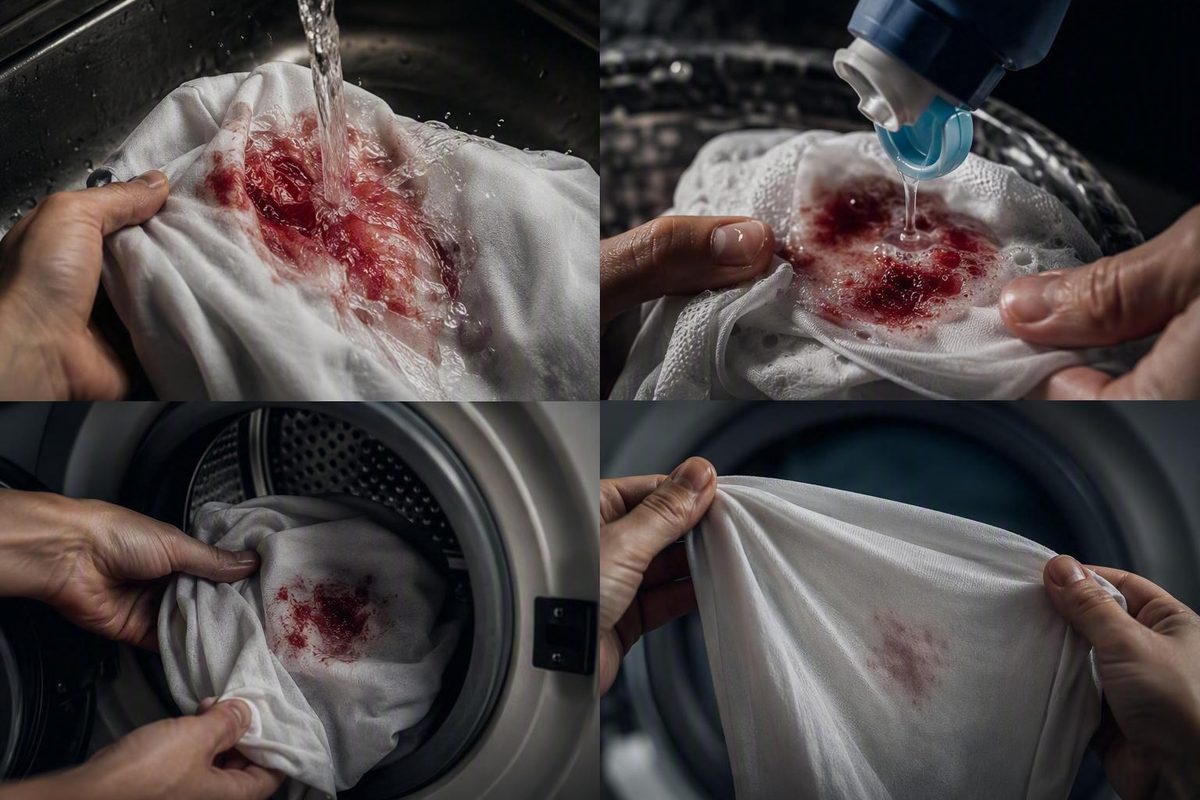
- A cold-water method for fresh, dried, and stubborn blood stains*
For a small stain on washable clothing, care for the injury first, flush the fabric from the back with cold water, pretreat with detergent, wash according to the care label, and inspect before applying heat.
Dried or previously washed stains require more patience.
This guide covers textile stain removal for small, routine clothing stains. It is not a blood-exposure, disinfection, or decontamination protocol.
The Quick Method: What to Do in the First Few Minutes
Care for any wound before turning to the garment. Clothing cleanup can wait while immediate first aid receives attention, a priority also stated in Seventh Generation’s blood-stain instructions.
The following method is intended for a small, routine stain on washable clothing:
- Blot away excess liquid. Use a clean white cloth or plain paper towel. Press gently and lift rather than rubbing, which can spread the stain.
- Flush from the back with cold water. Turn the garment inside out or position it with the stained surface facing downward. Run cold water through the back so loosened residue moves out of the fabric rather than farther into the weave.
- Apply detergent or mild soap. If the care label permits pretreatment, gently work a small amount of liquid laundry detergent or mild soap into the mark.
- Wait 10–15 minutes. This detergent contact time is supported for washable garments, subject to the garment and detergent instructions (Sinar Saredah).
- Rinse or wash. Follow the garment’s care label. Favor cold water while discoloration remains unless the garment or cleaning-product instructions require otherwise.
- Inspect before drying. Examine the damp fabric in good light. If you can still see a pink, red, brown, or gray shadow—or cannot tell whether the stain is gone—air-dry rather than using a machine dryer.
Quick summary
Cold rinse → detergent → wash → inspect → air-dry
Keep dryer and iron heat away from the garment while a visible stain remains.
If the first cycle improves the stain without removing it, repeat the same steps. Fresh stains are generally easier to treat, but one cycle is not guaranteed to finish the job.
Why Cold Water and Care-Label Checks Come First
Blood is a protein-based stain. Heat can make the residue bind more firmly to textile fibers, so hot water, an iron, and machine-dryer heat are poor first choices while a visible mark remains. University of Georgia textile guidance says heat-set blood stains are difficult to remove and recommends cold running water for fresh stains and cool-water soaking for persistent ones (UGA FACS).
Cold water does not guarantee removal. It is simply the lower-risk starting point because it can carry away fresh residue without adding heat. Dried, previously washed, and heat-exposed marks may require repeated treatment and may remain partly visible.
The garment care label is the controlling instruction. It determines whether the item can be washed, soaked, bleached, or treated at home. It may specify a maximum water temperature, gentle cycle, hand washing, or professional cleaning. General stain advice should not override instructions such as “do not bleach,” “do not soak,” or “dry clean only.”
Before using an enzyme treatment, oxygen bleach, hydrogen peroxide, or an unfamiliar detergent, perform a hidden-area test:
- Select an inside seam, hem allowance, or another concealed area made from the same fabric and dye.
- Apply a very small amount of the proposed treatment.
- Leave it for no longer than the product directions allow.
- Rinse as directed.
- Let the test area dry.
- Compare it with the untreated fabric.
Check the test area and any white towel beneath it for dye transfer. Do not proceed if you notice fading, bleeding color, whitening, roughness, stiffness, puckering, shrinkage, distortion, loss of sheen, or another surface change.
This caution also applies to white clothing. A white garment can still contain vulnerable fibers, finishes, printed details, elastic, colored stitching, coatings, adhesives, or trim.
Step by Step: Removing Fresh Blood from Washable Clothes
This workflow is a practical starting point for colorfast cotton, polyester, nylon, spandex, denim, and compatible blends that the care label identifies as washable.
-
Blot without rubbing. Lay the garment on a clean surface or hold it over a sink. Use an absorbent white cloth or plain paper towel to lift surface blood. Move to a clean section as the cloth absorbs liquid. Avoid pushing the stain outward.
-
Rinse from the back. Position the stained side face-down and direct cold running water through the reverse side. Continue until the water is no longer carrying away loose residue. If the garment cannot be turned fully inside out, arrange it so water still travels from the unstained back toward the stained face.
-
Pretreat gently. Apply a small amount of liquid laundry detergent. Mild bar soap is another basic option when compatible with the fabric. Work it through the fibers with your fingertips using a light pinching or massaging motion. Avoid aggressive brushing, which can abrade a knit, raise a fuzzy patch, or lighten denim.
-
Allow 10–15 minutes of contact time. Leave the detergent on the stain when the garment and product labels permit, then rinse with cold water and reassess (Sinar Saredah).
-
Wash according to the care label. Use the prescribed cycle and detergent amount. While visible staining remains, cold water is the cautious default unless the garment or product directions specify another temperature.
-
Inspect in good light. Examine both sides while the item is still damp. Laundry-room lighting can disguise a faint brown or gray shadow, so use bright, neutral light when possible.
-
Repeat or air-dry. If the mark remains, repeat the detergent pretreatment rather than putting the item in a dryer. If you need to pause, air-dry it and return to the stain later.
A small period-blood stain can generally be treated with the same process: cold water, compatible detergent, care-label-approved washing, and inspection before drying. Guidance from the Good Housekeeping Home Care and Cleaning Lab treats period blood like blood from a minor cut or scrape and notes that stains may require more than one attempt (Good Housekeeping).
For underwear or other garments containing elastic, lace, bonded seams, adhesives, or absorbent layers, follow the most restrictive care instruction. A treatment suitable for the main fabric may not be appropriate for every component.
How to Treat Dried, Washed, or Dryer-Set Blood
Once blood has dried, the aim is to rehydrate and loosen the residue before washing. Gentle soaking is preferable to forceful scraping or scrubbing that could damage the fabric.
-
Lift loose residue. Use the edge of a spoon, a dull butter knife, or another blunt tool to lift crusted material. Work slowly and stop if the fibers begin to snag, fuzz, or separate. Do not use a sharp blade.
-
Position the stain face-down. When practical, turn the garment inside out or place the stained face against a clean white towel. This allows water and treatment to approach from the back and encourages loosened residue to leave the weave.
-
Soak in cold or cool water. If the care label permits soaking, submerge the affected area for at least 30 minutes. University of Georgia guidance specifies a cool-water soak of 30 minutes or longer for a persistent blood stain (UGA Textiles). Older stains may require a longer soak or more than one soaking cycle, provided the garment remains stable.
-
Apply detergent or a compatible enzyme pretreatment. After soaking, gently work detergent into the remaining mark. If ordinary detergent has not been sufficient, consider a label-approved enzyme pretreatment for a compatible washable fabric.
-
Rinse and wash. Rinse out the pretreatment, then launder according to the garment label. Keep the wash cool or cold while discoloration remains unless the relevant labels direct otherwise.
-
Inspect and repeat. Repeat the soak–pretreat–wash–inspect cycle while the stain is improving and the fabric is unchanged. Air-dry between attempts.
If the garment has already been washed
A normal wash does not necessarily end your options. If the garment was washed but not tumble-dried, begin again with a cold soak and detergent pretreatment. The previous wash may have removed loose material even if a residual shadow remains.
Do not jump directly to several stronger treatments. Start again with the low-risk cycle, then choose one compatible escalation option only if the stain stops improving.
If the garment has been through a dryer
Dryer heat can make the remaining discoloration substantially harder to remove. Repeated cold soaking and a fabric-compatible pretreatment may still improve the mark, but complete removal is not assured.
Air-dry between attempts rather than adding more dryer heat. Guidance limited to very small dried stains likewise recommends cool-water soaking, working from the back, washing, and air-drying, while acknowledging that repetition may be necessary (Aftermath Services).
Stop home treatment if the fabric fades, becomes rough, develops a thin or shiny patch, puckers, stretches out of shape, or otherwise changes. Protecting the garment is more important than pursuing a faint shadow until the fibers are damaged.
Escalating Safely: Enzymes, Oxygen Bleach, and Hydrogen Peroxide
Use an escalation ladder rather than a multi-product recipe:
- Cold water and laundry detergent
- A compatible enzyme treatment or oxygen cleaner
- Carefully tested 3% hydrogen peroxide on suitable washable fabric
These are alternatives at different stages, not ingredients for one cleaning mixture. Follow the selected product’s directions, rinse it out thoroughly, inspect the garment, and reassess before trying something else. University guidance specifically calls for caution with commercial products and combinations of cleaning supplies (UGA FACS).
Enzyme pretreatments
Because blood is a protein stain, a product containing protease may help break down residual material on compatible washable fabric. Check both labels: the garment must permit the treatment, and the product must identify the material as suitable.
Ordinary protein-targeting enzyme products may damage protein fibers such as silk and wool. Guidance for dried blood therefore excludes enzymatic cleaners from those materials (Aftermath Services).
An enzyme detergent may be suitable for polyester, nylon, spandex, cotton, or compatible blends, but fiber content is not the only consideration. Dye, finishes, elastic, prints, coatings, and decorative trim can still limit treatment.
Use the prescribed concentration and contact time. Do not exceed the product directions in the hope that a stronger solution or longer dwell will work better.
Oxygen bleach
Products sold as oxygen cleaners have their own fiber exclusions, concentrations, soak times, and colorfastness requirements, so read the actual package rather than relying on terms such as “color-safe.”
Proceed only if:
- the garment’s care label permits bleach or the specified treatment;
- the product label includes the garment’s fiber and color;
- a hidden-area test shows no change after rinsing and drying; and
- no trim, print, coating, adhesive, or mixed-fiber component prohibits treatment.
Oxygen bleach is not automatically safe for every color or fiber. Stop if dye transfers during testing or if the test area changes shade or texture.
As a product-specific example, the manufacturer of OxiClean Versatile Stain Remover directs users to fill its scoop to line 4 per gallon of water and, for best results, soak the item for six hours. It limits the treatment to colorfast fabrics and excludes wool, wool blends, silk, silk blends, leather, and dry-clean-only material (OxiClean).
Those directions apply only to that product. They should not be transferred to a different oxygen cleaner, and they do not show that the product is universally best.
Hydrogen peroxide
For a persistent stain on white or confirmed colorfast washable fabric, 3% hydrogen peroxide can be a later-stage option:
- Test it on an inside seam.
- Rinse the test area and let it dry.
- If there is no color or texture change, place the stained area over a clean white towel.
- Apply a few drops of 3% hydrogen peroxide.
- Leave it for 1–3 minutes.
- Rinse thoroughly.
- Launder according to the care label.
- Inspect and air-dry.
The 3% concentration and 1–3 minute contact time come from the University of Georgia’s textile stain-removal procedure, which places peroxide after cool soaking, enzyme treatment, and detergent have failed (UGA Textiles).
Hydrogen peroxide can remove dye or affect some fibers. It is not automatically safe on colored clothing, and a white garment may still have vulnerable stitching, fibers, finishes, prints, adhesives, or trim.
Ammonia is intentionally omitted from this household workflow. Although it appears in some stain-removal guidance, the available instructions do not provide a sufficiently complete general household protocol across fabrics and other cleaners. A staged detergent, enzyme or oxygen-cleaner, and limited peroxide process is easier to keep separate.
Choose the Method by Fabric, Color, and Construction
The garment’s most sensitive component controls the treatment. A cotton shirt with silk embroidery should not be treated as plain cotton. Stretch denim includes elastic fibers, and a white formal garment may contain adhesive interfacing or delicate trim.
| Fabric or garment | Low-risk starting method | Treatments requiring caution | When to stop |
|---|---|---|---|
| Cotton and linen | Flush from the back with cold water; pretreat with liquid detergent; wash according to the care label | Enzymes, oxygen bleach, and peroxide still require label approval and patch testing | Stop for dye transfer, fading, thinning, roughness, or distortion |
| Polyester, nylon, and spandex | Cold water and detergent | An enzyme product may be suitable if both labels permit it; test oxygen cleaner or peroxide before use | Stop if the color changes, elastic weakens, or the surface becomes shiny or rough |
| Denim and colored clothing | Cold back-rinse followed by detergent | Do not assume peroxide or any bleach is color-safe; hard rubbing may produce a light patch | Stop at dye transfer, fading, streaking, or abrasion |
| White clothing | Cold water and detergent | Peroxide or oxygen bleach only after testing; account for prints, stitching, elastic, finishes, and trim | Stop if the fabric yellows, weakens, puckers, or changes texture |
| Wool | Cold water and a wool-safe detergent only when the label permits | Avoid ordinary protease enzymes, ammonia, casual peroxide use, and uncontrolled soaking | Stop for felting, shrinkage, dye transfer, stiffness, or distortion |
| Silk | Gentle cold-water blotting and a silk-safe cleaner only if the label permits | Avoid ordinary protease enzymes, ammonia, peroxide, rubbing, and casual soaking | Stop for water rings, fading, loss of sheen, texture change, or distortion |
| Mixed fibers | Follow the restrictions for the most sensitive fiber | Avoid any treatment prohibited for one component | Stop when any fiber, trim, dye, or finish changes |
| Lace, embroidery, sequins, formalwear, or valuable clothing | Gentle blotting only if permitted; otherwise seek professional care | Soaking, agitation, peroxide, bleach, and enzymes may affect trim, thread, adhesive, or construction | Stop immediately if decoration loosens, color runs, or the shape changes |
| Leather or dry-clean-only items | Blot only as the label permits and consult a professional | Do not improvise with soaking, laundry detergent, enzymes, bleach, or peroxide | Stop before wet treatment unless a specialist has approved it |
Wool and silk deserve particular restraint because ordinary protein-targeting enzymes may attack those protein-based fibers. Product restrictions also vary: for example, OxiClean’s cited oxygen-cleaner instructions exclude wool, silk, leather, and dry-clean-only fabrics, while Maytag’s fabric-specific blood-stain guidance distinguishes enzyme-compatible synthetics from fibers requiring gentler detergent.
For any material, stop if you see dye on the blotting cloth or in the rinse water, a lighter patch around the stain, rippling, shrinkage, fiber breakage, loss of softness, or a change in sheen. A cleaner stain surrounded by damaged fabric is not a successful result.
Household Remedies: What the Evidence Does and Does Not Show
The clearest core workflow remains cold water, laundry detergent, care-label-approved washing, inspection, and no dryer or iron while the stain remains. Household remedies appear in many cleaning guides, but the available support for them is less consistent.
Vinegar
Advice about vinegar conflicts. Some commercial guides suggest diluted white vinegar after a colorfastness test, while the Good Housekeeping Home Care and Cleaning Lab reports that vinegar has not been particularly effective for blood. Repeated or undiluted acidic treatment may also be inappropriate for some dyes and delicate materials (Good Housekeeping).
Vinegar is therefore not the preferred first treatment. If a garment manufacturer or trusted product instruction permits a diluted application, patch-test it and rinse thoroughly. Do not use it instead of the established cold-water-and-detergent process.
Baking soda
Baking soda is sometimes recommended as a water-based paste for dried stains, but the supplied evidence does not establish it as a reliable substitute for detergent or a compatible enzyme pretreatment.
At most, treat it as an optional fallback for a sturdy, washable, colorfast garment. Avoid rubbing a paste into silk, wool, or another delicate material because the application and removal can add mechanical stress.
Salt
Salt may absorb some surface liquid from a fresh spill, but that does not establish it as a dependable treatment for dried or set blood. If cold running water is available, flushing from the back is the clearer first action.
Do not rub dry salt into the fabric. Mechanical rubbing can spread the stain or abrade the surface without removing residue deeper in the weave.
Dish soap
A small amount of plain dish soap may help with a fresh stain on sturdy washable fabric. Laundry detergent, however, is the more direct textile-care choice, and a compatible enzyme-containing laundry product is a clearer escalation option for a dried protein stain.
If laundry detergent is unavailable, use dish soap sparingly, patch-test it, rinse thoroughly, and confirm that the care label permits wet treatment.
Toothpaste
Do not use toothpaste. Cleaning guidance reviewed by Good Housekeeping warns that it may create another mark or leave an odor rather than reliably treating the blood stain.
Branded stain removers
A product can perform well in one demonstration without becoming the universal best choice. In one informal Apartment Therapy comparison, OxiClean performed best among four treatments, but the test used simulated blood made from corn syrup, egg white, food coloring, and cocoa powder on white cotton T-shirts. It did not test real blood across colored, synthetic, or delicate garments, and the page discloses affiliate links (Apartment Therapy).
Use branded products according to their own labels. An informal comparison cannot override fiber exclusions, colorfastness testing, garment care instructions, or the differences between fresh, dried, and heat-set stains.
Final Inspection, Safety Boundaries, and Professional Help
Inspect the garment while it is still damp and in good light. Examine both the stained face and the reverse side. If a shadow remains—or wet fabric makes the result difficult to judge—air-dry the item.
Do not use a tumble dryer or iron merely to see whether the mark disappears. If the fabric remains stable, repeat only a compatible step, such as cold soaking followed by detergent pretreatment.
Set realistic expectations. An old stain, a mark that has passed through a dryer, or fabric that has undergone several treatments may remain partly visible. Repetition may improve it, but no home method guarantees complete removal.
Professional cleaning is the safer choice for:
- silk, wool, leather, lace, or specialty fibers;
- dry-clean-only garments;
- formalwear or valuable clothing;
- embroidery, beading, sequins, adhesive decorations, or fragile trim;
- unstable dye or fabric that changes color or texture during testing; and
- a stubborn stain on an item that cannot tolerate further treatment.
This guide is limited to small, routine clothing stains. Substantial contamination or an uncertain exposure falls outside ordinary spot-cleaning advice. Stop rather than improvising a decontamination procedure, and seek appropriate professional guidance for the situation.
This article addresses appearance and fabric care only; it does not provide a disinfection protocol.
Use this decision rule:
- If the item is washable, colorfast, structurally stable, and lightly stained, repeat the low-risk cold-water and detergent cycle.
- If it is delicate, damaged, valuable, dry-clean-only, or substantially contaminated, stop and seek appropriate help.
Frequently Asked Questions
Can period blood be removed using the same method?
Yes. Treat a small period-blood stain like blood from a minor cut: rinse or soak promptly in cold water, pretreat with compatible laundry detergent, wash according to the care label, and inspect before drying.
For dried period blood, use the dried-stain soaking process above. Follow the most restrictive care instruction when underwear contains elastic, lace, absorbent layers, adhesives, or bonded construction.
Can hydrogen peroxide remove blood from colored clothes?
It may lighten the blood stain, but it may also remove the garment’s dye. Do not assume 3% hydrogen peroxide is color-safe.
Use it only when the care label permits treatment and a concealed-area test remains unchanged after rinsing and drying. If appropriate, follow the cited peroxide procedure above: apply a few drops for 1–3 minutes, rinse thoroughly, launder, inspect, and air-dry.
For colored clothing, detergent followed by one label-approved enzyme product or oxygen cleaner is a more orderly escalation path. Those products still require label checks and colorfastness testing.
Can a blood stain come out after the clothes have been through the dryer?
It may improve, but complete removal is not guaranteed. Dryer heat can make residual blood more firmly set in the fibers.
Begin with a prolonged cold soak if the care label permits it. Follow with detergent or one compatible pretreatment, wash, inspect, and air-dry. Repeat only while the stain is improving and the fabric remains stable.
How long should dried blood soak before washing?
Start with at least 30 minutes in cold or cool water when the garment permits soaking; the University of Georgia procedure allows a cool-water soak of 30 minutes or longer.
An older stain may need a longer or repeated soak. Do not exceed the garment or cleaning-product instructions, and stop if you see dye bleeding, distortion, or another material change.
Is vinegar or baking soda better for removing blood?
Neither is the preferred first choice. Evidence and commercial advice conflict on vinegar, while baking soda is supported mainly as an optional household fallback rather than a proven replacement for detergent.
Start with cold water and laundry detergent. For a dried stain, soak before pretreating. If a compatible washable fabric still has a mark, one label-approved enzyme or oxygen cleaner offers a clearer escalation path than choosing between vinegar and baking soda.
If you nevertheless use either remedy, patch-test it, keep it separate from other treatments, rinse thoroughly, and avoid using it on silk, wool, or another delicate material without specialist guidance.
The repeatable rule is simple: use cold water, work from the back, start with detergent, keep stronger treatments fabric-specific and separate, and inspect before applying heat. Repeated treatment may improve an old stain, but protecting the garment—and knowing when to stop—is more important than promising complete removal.