 StainList
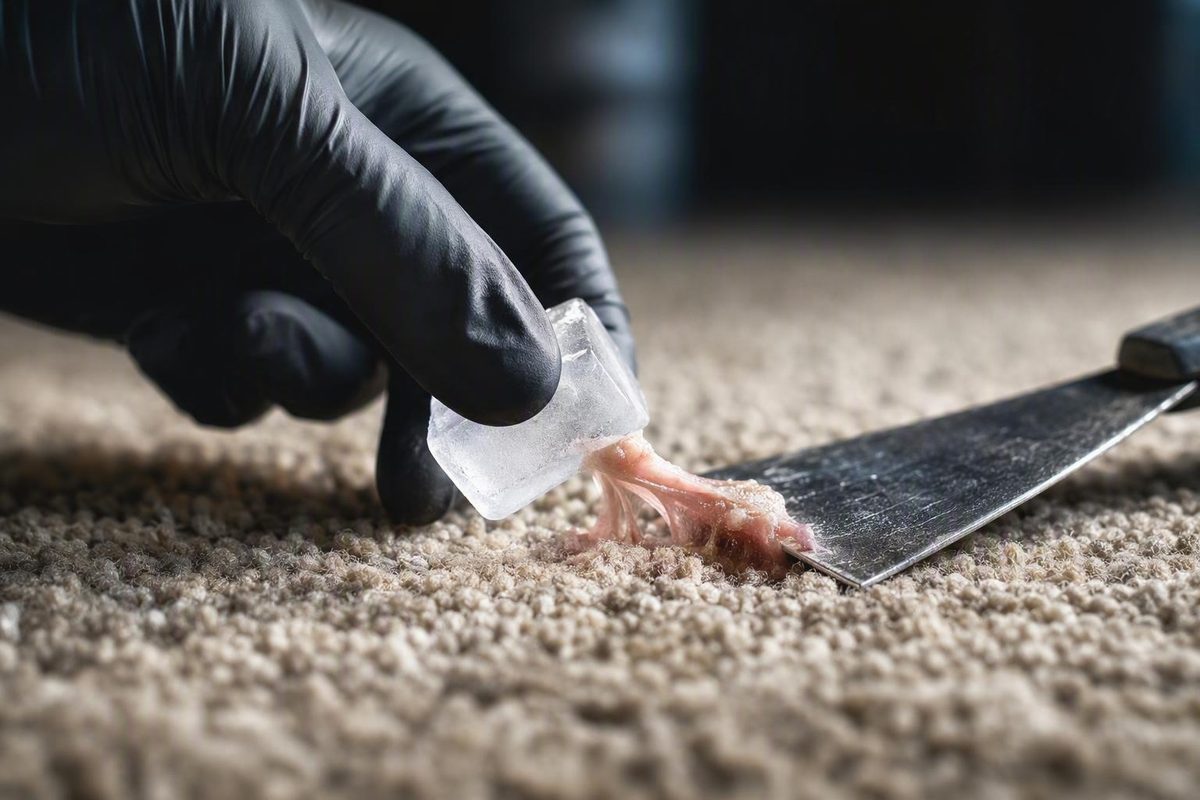
Freeze, lift, and clean the sticky spot without harming your rug.
Related: How to Get Sticker Residue Off Fabric: Check the Care Label.
The safest first response: cool the gum instead of scrubbing it
If you have just found chewing gum stuck to a rug, do not pull, rub, or scrub it while it is soft. Warm, flexible gum can stretch around individual fibers, spread beyond the original spot, and become harder to lift. The lowest-risk general response is to harden the gum first and then remove it gradually.
Place ice cubes or a cold pack inside a leak-resistant plastic bag. Hold the sealed bag against the gum without pressing the deposit deeper into the pile. Keeping the ice enclosed limits meltwater contact with the rug.
Wait until the gum feels firm, solid, and no longer stretchy. Use its condition—not a rigid timer—as the readiness test. Plenty recommends chilling for at least five minutes, while Ruggable gives a range of 15 to 30 minutes.
Once the gum is solid, lift it from the outside edges with a spoon, rounded plastic scraper, old plastic card, or dull butter knife. Remove small fragments instead of trying to pry away the entire mass at once. If the gum bends, stretches, or smears, stop and chill it again rather than applying more force.
The complete safest-first workflow is:
- Identify the rug and read its care instructions.
- Protect the floor beneath the affected area if necessary.
- Harden the gum with sealed ice.
- Lift the solid gum in small pieces with a blunt tool.
- Reassess the remaining spot in good light.
- Test any residue treatment in a hidden area.
- Blot the residue with the minimum amount of permitted solution.
- Rinse sparingly, absorb moisture, and dry the rug completely.
- Stop if the rug, its dyes, or its backing react unexpectedly.
This is not a universal procedure for every rug. Fresh gum resting on the surface of a sturdy synthetic rug is a better do-it-yourself candidate than old gum embedded in silk, wool, shag, unstable dyes, or an unidentified construction.
Check the rug before applying ice, cleaner, or moisture
Read the manufacturer’s label or online care instructions before using liquid, heat, alcohol, solvent, or a washing machine. Look for the fiber content, spot-cleaning restrictions, warnings about heat or solvents, and whether the specific rug or removable cover is machine washable. Manufacturer requirements take priority over general household advice.
A cautious DIY attempt is most reasonable when:
- The rug is a sturdy, colorfast synthetic.
- The gum is fresh and close to the surface.
- The pile is short enough to reach the gum without digging.
- The rug and backing are structurally sound.
- The care instructions allow limited spot cleaning.
Seek professional or material-specific advice when:
- The rug is silk, antique, hand-knotted, handwoven, valuable, damaged, or made from an unknown material.
- The rug has transferred color during previous cleaning.
- The gum is flattened close to the backing.
- The gum is tangled through shag, loops, or long pile.
- The backing is exposed, deteriorating, or moisture-sensitive.
- The care label prohibits wet spot cleaning or solvent use.
Fiber is only part of the decision. Construction matters too. Dyes, adhesives, and backing materials can also react differently even when two rugs have similar face fibers.
If the area rug can be moved, place a waterproof barrier beneath the affected section while working over hardwood or another moisture-sensitive floor.
Stop immediately if you notice:
- Color transferring to a white cloth
- Fuzzing, stretching, or distortion of the fibers
- A loop beginning to pull
- The tool exposing or abrading the backing
- Excess moisture reaching the backing
- Gum spreading instead of lifting
- No progress with gentle lifting
- A change in color, texture, sheen, stiffness, or feel during the hidden-area test
Continuing after one of these signs can increase the chance of fiber, dye, adhesive, or backing damage. General cleaning-company guidance likewise advises avoiding aggressive scraping, unsuitable solvents, and saturation, particularly on wool, valuable rugs, and delicate materials (Apple Clean).
Gather a small, low-risk tool kit
Begin with supplies for cooling, controlled lifting, and moisture management—not an assortment of solvents.
Gather:
- A sealable, leak-resistant plastic bag
- Ice cubes or a cold pack
- A spoon, rounded plastic scraper, old plastic card, or dull butter knife
- White or light-colored absorbent cloths
- A dry white towel
- A small bowl
- Clean water
- Mild dish detergent, only if the rug’s care instructions permit it
- A fan or access to good ventilation
A dark cloth can hide color released from the rug.
Choose a spoon or rounded plastic edge instead of a fork, nail file, razor blade, or sharp knife. Pointed, abrasive, and sharp implements can catch loops, cut fibers, or reach the backing. If you use a dull butter knife, keep it nearly level with the rug surface and never direct the edge downward.
Before using any cleaning solution on the visible spot, conduct a hidden-area test:
- Choose an inconspicuous area with the same material and construction, such as behind a corner or beneath furniture.
- Put a very small amount of the intended solution on a white cloth. Do not pour it directly onto the rug.
- Blot gently.
- Check the cloth for transferred dye.
- Inspect the rug for changes in shade, sheen, texture, pile direction, stiffness, adhesive, or backing.
- Stop if anything changes unexpectedly.
Observe the test as it dries and follow any timing supplied by the rug or cleaner manufacturer. There is no supported universal waiting period that can reveal every possible delayed reaction.
Do not include peanut butter, WD-40, acetone, a sharp implement, or an iron in the basic kit. These options introduce additional residue or damage risks before the simplest method has been attempted.
Step by step: freeze and lift the solid gum
The objective is to separate hardened gum from the rug without pulling the pile along with it.
-
Remove only what is already loose. Lift any raised piece that comes away without resistance. Do not tug at gum wrapped around fibers or pull on fibers trapped in the mass.
-
Seal the ice. Put ice cubes or a cold pack in a leak-resistant bag. Confirm that the seal is closed and the bag is not dripping.
-
Position the cold pack gently. Lay it over the gum with enough contact to cool the deposit, but do not press the gum farther into the pile.
-
Check the gum periodically. Continue chilling until it feels solid and does not stretch under a very light touch. Published timings differ, so the gum’s condition is more useful than the clock.
-
Set the tool at a shallow angle. Hold the spoon, card, scraper, or dull knife nearly level with the rug. Pointing the edge downward increases the risk of digging into the pile or backing.
-
Work from the outside inward. Ease the tool beneath an outer edge and lift a small fragment. Avoid sawing, chopping, or forceful scraping.
-
Collect fragments immediately. Place loosened pieces on a disposable cloth or in a bag.
-
Rechill whenever necessary. If the gum begins bending, stretching, or smearing, stop. Apply the sealed ice again and resume only after the gum becomes solid.
-
Repeat only while progress remains controlled. Several gentle chill-and-lift cycles are preferable to one forceful attempt.
For looped, shag, or high-pile rugs, work along the surface and around accessible fibers. Do not pull upward through the pile. Stop if the tool catches loops, long strands become trapped, fibers begin to distort, or the gum remains embedded near the backing.
Freezing may be less effective on old gum or deposits pressed deeply into the pile, according to Zerorez’s carpet guidance. A lack of progress is not a reason to scrape harder.
Once the solid mass is gone, put down the scraper. A remaining tacky sensation may come from a thin gum film, which requires cautious spot cleaning rather than additional mechanical force.
Clean the sticky film as a separate spot
Inspect the area in good light and from more than one direction. Confirm that no raised gum remains. If the pile only feels sticky, treat the film as a separate cleaning problem.
When the care label permits mild detergent spot cleaning, begin with the weakest practical mixture. Published guidance varies: Well Woven gives a formula of 1 teaspoon of mild dish soap in 1 cup of warm water, while other rug guidance recommends only a few drops in lukewarm water (Well Woven). The rug manufacturer’s directions should override either general formula.
After a successful hidden-area test:
- Mix only a small amount of diluted detergent.
- Dampen a white cloth with the solution; it should not drip.
- Blot from the outside boundary of the sticky area toward the center.
- Rotate to a clean portion of the cloth as residue transfers.
- Do not scrub, grind the cloth into the pile, or pour solution onto the rug.
- Stop when the tackiness lifts or if the rug begins reacting.
Next, lightly dampen a second clean cloth with plain water and blot the treated area to remove detergent. Keep this rinse minimal rather than saturating the pile.
Press a dry towel firmly over the spot to absorb moisture. Allow the rug to dry completely with good airflow or a fan. Remove any waterproof work barrier during drying.
Some rug guides suggest equal parts white vinegar and water for remaining residue, but that is a conditional option rather than universally safe chemistry (Well Woven). Consider it only if the rug’s care instructions permit the treatment and a hidden-area test shows no change. Do not pour the mixture onto the rug, and do not use it on a delicate or unidentified rug without material-specific advice.
If one cautious detergent treatment and minimal rinse do not resolve the tackiness, stop. Applying vinegar, alcohol, oil, detergent, and commercial remover in sequence makes the remaining residue—and any reaction—more difficult to identify.
Why heat, oils, and strong solvents are not default remedies
Commercial guides disagree about heat, peanut butter, WD-40, alcohol, vinegar, oil soap, and specialized gum removers. The available guidance does not include independent comparative textile testing showing that these alternatives are equally safe across rug fibers, dyes, adhesives, and backings. That uncertainty is why sealed ice and gradual lifting come first.
Heat: A hairdryer or iron softens gum, reversing the main freeze-and-lift strategy. Softening can spread gum through a larger area of pile. Plenty describes an iron-and-paper-towel technique but calls it messier than freezing and warns that the gum may spread or the paper towels may burn during the process (Plenty). An iron should therefore not be treated as a standard rug remedy.
Heat may also affect some synthetic carpet fibers, which is one reason commercial rug-cleaning guidance advises against using a hairdryer as a default treatment (Rubber Ducky Rug Cleaning). Do not improvise with heat when the fiber or backing is unknown.
Peanut butter, WD-40, oil soap, and similar oily products: These substances may loosen gum, but they can replace the original deposit with grease or solvent residue. Removing that second residue may require additional cleaning that the rug cannot tolerate. They are not appropriate first-line choices.
Rubbing alcohol: Alcohol is not a universal rug cleaner. Some retailer guidance limits it to synthetic rugs and advises against using it on wool or delicate fibers. Fiber identity alone still does not establish safety because dyes, adhesives, and backing materials also matter.
Acetone and nail-polish remover: Avoid both. Supplied rug guidance specifically lists them among treatments not to use, along with forceful pulling and hot water. The risk is not justified when the rug’s exact material and dye stability are uncertain.
Vinegar: Equal-parts diluted vinegar appears in some commercial rug guides, but repetition does not prove compatibility with every rug. It remains a secondary, care-label-dependent, spot-tested option—not a default treatment for wool, silk, jute, unstable dyes, adhesives, or unidentified backing.
Commercial gum remover: Read the complete label before buying or applying it. Confirm that it expressly permits use on the rug’s material rather than merely saying “carpet.” Follow the product’s ventilation, application, dwell-time, rinsing, and disposal directions. Test it behind a corner and use the minimum amount. If the label is ambiguous, do not improvise.
Above all, avoid remedy stacking. Applying oil, then alcohol, then vinegar, and finally detergent creates a mixture whose effects are difficult to diagnose. If the first cautious treatment fails, pause and identify the rug and residue before escalating.
Adjust the decision for delicate, deep-pile, and washable rugs
No procedure can be assumed safe for every fiber, dye, adhesive, and backing. Adjust the response to the rug rather than treating “rug” as a single material category.
| Rug type or construction | Safer decision |
|---|---|
| Sturdy, colorfast synthetic with fresh surface gum | Sealed ice and careful lifting are a reasonable DIY starting point. Test any residue cleaner first. |
| Wool | Limit moisture and mechanical force. Follow the care label; do not assume vinegar, alcohol, heat, or solvents are wool-safe. |
| Silk | Contact a rug specialist before applying liquid, heat, alcohol, or commercial solvent. |
| Antique, handwoven, hand-knotted, or valuable | Prioritize preservation and seek specialist advice early. |
| Jute or another moisture-sensitive material | Avoid a generic wet-cleaning formula; obtain material-specific instructions. |
| Shag or long pile | Surface gum may be chilled carefully, but deep entanglement lowers the threshold for professional treatment. |
| Looped pile | Stop if the tool catches or begins lifting loops. |
| Damaged or unstable-dye rug | Avoid DIY wet treatment. Color transfer and loose fibers are immediate stop signs. |
| Unknown material | Treat the uncertainty as a risk factor and seek identification or professional advice. |
| Explicitly machine-washable rug or removable cover | Remove loose gum first, then follow the manufacturer’s washing instructions exactly. |
For wool, even a blunt tool can disturb the pile when used forcefully. Use minimal pressure and moisture, and do not assume a household ingredient is safe because it is described as natural.
Silk, antique, handwoven, hand-knotted, valuable, or dye-unstable rugs can be difficult to assess at home. Photograph the gum and care label, then consult a rug specialist before introducing liquid, heat, alcohol, or commercial solvent.
Shag and looped rugs present a mechanical challenge. Gum may surround many fibers, while the removal tool can catch the construction. If hardened pieces will not separate with light surface-level work, stop rather than pulling upward.
Also distinguish an area rug from installed or automotive carpet. A successful method demonstrated on one does not establish suitability for the others.
Machine washing is appropriate only when the manufacturer explicitly identifies the specific rug or removable cover as machine washable. Ruggable, for example, limits its machine-washing directions to compatible washable rug covers, not rugs generally. Remove as much solid gum as possible first, then follow the stated directions for machine size, cycle, detergent, water temperature, and drying.
Troubleshooting and knowing when to stop
The gum starts smearing: Stop immediately. Collect any loose fragments without spreading them, then rechill the deposit. Continue only if it becomes solid and releases with little effort.
The gum is old or flattened: Freezing may not work as well when gum has been walked into the pile or left in place for a long time. Repeated force can fuzz, cut, or distort fibers. There is no supported universal home procedure for gum bonded near the backing.
Someone already used peanut butter, WD-40, or oil: Blot loose excess with a white absorbent cloth, working inward so the affected area does not expand. Do not immediately add alcohol, vinegar, or another solvent. First identify what was applied and check the rug’s care requirements.
The spot remains sticky after rinsing: Allow the area to dry fully and inspect it in good light. Avoid repeated treatment when the cause remains unclear.
The backing is wet: Stop applying liquid. Do not return the damp rug to a vulnerable floor until the pile and backing are dry.
A loop has pulled: Stop using the tool.
Arrange professional assessment if you notice:
- Dye transfer
- Fiber distortion
- Exposed or saturated backing
- Pulled loops
- Lingering odor
- Widespread oily or sticky residue
- Gum embedded deeply in dense or long pile
- No progress after gentle chill-and-lift cycles
Specialist care is also prudent for silk, antique, handwoven, valuable, damaged, unstable-dye, or unidentified rugs. Do not expect a guarantee of complete removal: the outcome depends on the gum’s age and depth, as well as the rug’s fiber, dye, construction, backing, and previous treatments.
The evidence should be kept in perspective. The broad agreement around freezing and gradual lifting comes mainly from rug retailers, household brands, demonstrations, and cleaning companies rather than controlled comparative textile trials. That consensus makes freeze-and-lift a reasonable low-risk starting point, not a guarantee of universal safety or complete removal.
Frequently asked questions
How long should I leave ice on gum before trying to remove it?
Leave the sealed ice bag in place until the gum is firm, solid, and no longer stretches under a gentle touch. Check it periodically rather than relying on a universal timer. Thick gum, warm rooms, and deposits extending into the pile may take longer than thin surface gum. If the gum bends or smears during lifting, chill it again.
Can I use vinegar to remove gum residue from a rug?
Possibly, but only as a secondary option. First check the care label and test the diluted vinegar in an inconspicuous area with a white cloth. Do not use it if color transfers or the rug’s pile, texture, adhesive, or backing changes. For delicate or unidentified rugs, obtain material-specific advice instead.
Will peanut butter or WD-40 get gum out of a rug?
They may loosen gum, but both can create an additional residue problem. That oily residue may spread or require further cleaning to remove. Freeze and lift the gum first.
If peanut butter or WD-40 has already been used, blot away loose excess without spreading it. Do not add another solvent or cleaner until you have checked the rug’s care requirements and identified the existing residue.
Can I remove gum from a wool or silk rug myself?
For wool, you may cautiously chill fresh, surface-level gum with sealed ice and attempt minimal lifting if the care label permits it. Avoid force, saturation, heat, and unapproved solvents. Do not assume vinegar or alcohol is safe for a particular wool rug.
For silk—or an antique, valuable, handwoven, damaged, or dye-unstable rug—contact a rug specialist before applying liquid, heat, alcohol, or commercial remover.
Can I machine wash the rug after removing the gum?
Only if the manufacturer explicitly identifies that specific rug or removable cover as machine washable. A washable cover does not establish that its pad, another rug, or another backing can be machine washed.
Remove loose gum first, then follow the manufacturer’s directions for machine capacity, cycle, detergent, water temperature, and drying. If the label says spot clean or professional clean only, do not put the rug in a washing machine.
The practical decision rule
If the rug is sturdy and the gum is on the surface, seal ice in a bag, chill until the gum is solid, lift small pieces with a blunt tool, and clean any remaining film separately with a spot-tested solution permitted by the care label.
If the gum smears, color transfers, fibers distort, the backing becomes wet, or the rug is delicate, valuable, deeply affected, or unidentified, stop experimenting and consult a qualified rug cleaner.