 StainList
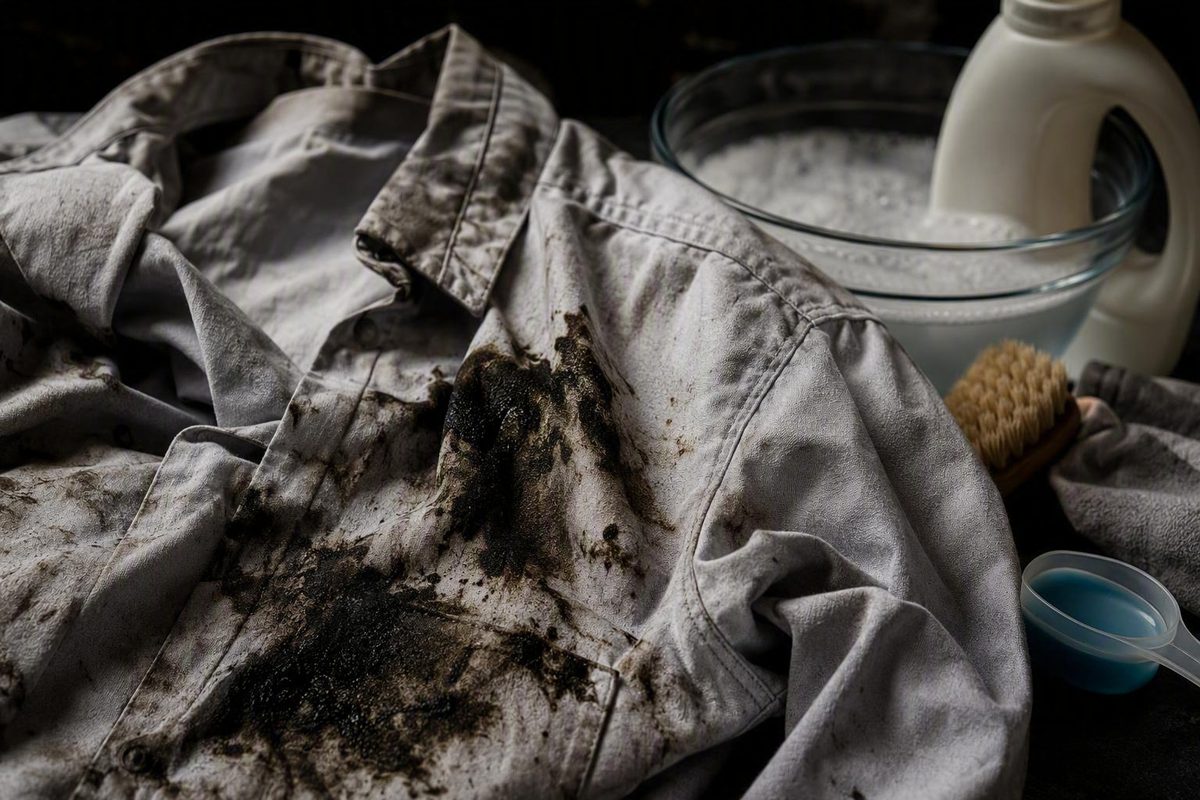
For a small hydraulic-fluid mark on ordinary washable clothing, check the care label, spot-test liquid laundry detergent or a prewash stain remover on a hidden seam, pretreat as directed, and wash at the hottest temperature the garment permits. Inspect before machine-drying; if the oily mark remains, pretreat and wash again. This is a cautious application of general grease-and-oil guidance, not a validated procedure for saturated clothing, every hydraulic-fluid formulation, or specialized workwear.
The short answer: pretreat, wash, inspect, and keep it out of the dryer
Use this sequence for a small or light mark:
- Read the garment’s care label.
- Test the pretreatment product on an inconspicuous seam.
- Apply liquid laundry detergent or a prewash stain remover according to its label.
- Launder at the hottest temperature permitted by the garment label.
- Inspect the garment before putting it in a dryer.
- If the mark remains, pretreat and wash again.
“Hottest safe water” does not automatically mean hot water. It means the warmest setting allowed for that fabric, dye, finish, and garment construction. The American Cleaning Institute recommends pretreating grease and oil stains, laundering according to fabric-care instructions, and repeating treatment rather than machine-drying if the stain remains in its stain-removal guidance.
That guidance addresses greasy and oily stains generally, not hydraulic fluid specifically. It is a restrained starting point for a small cosmetic mark on ordinary washable fabric, but it does not guarantee complete removal.
Choose the path that matches the contamination
A small spot, a heavily stained area, and a saturated work garment require different decisions.
| Condition | Recommended path | Key limit |
|---|---|---|
| Small or light stain | Spot-test, pretreat, wash, and inspect | Intended for ordinary washable fabric |
| Heavy localized stain | Use the transfer method below only if you already have an explicitly labeled, fabric-compatible spot treatment | The source does not identify a particular “cleaning fluid” |
| Stain remains after washing | Repeat pretreatment and laundering | Keep it out of the machine dryer |
| Saturated or specialized garment | Stop and seek fluid- and garment-specific guidance | Home decontamination is not validated here |
For a heavy but contained grease or oil mark, general guidance describes placing the stain face down on clean paper towels, treating it from the back with cleaning fluid, replacing the towels as they become soiled, allowing the area to dry, rinsing, and laundering. The source does not define cleaning fluid, so the term must not be interpreted as approval for gasoline, brake cleaner, carburetor cleaner, or any other automotive solvent.
If you do not already have a fabric treatment whose label explicitly permits both the material and the intended spot-cleaning use, stop and ask a qualified cleaner. Do not select a solvent by guesswork.
For a heavily saturated garment—or one that is dry-clean-only, coated, waterproof, reflective, or flame-resistant—consult the hydraulic fluid’s safety data sheet, garment manufacturer, employer laundering procedure, occupational-safety contact, or qualified cleaner. The available evidence does not establish a saturation threshold at which home washing becomes suitable or unsuitable.
Not knowing the exact formulation does not automatically rule out cautious treatment of one small cosmetic mark on ordinary washable clothing. It does become a reason to escalate when contamination is substantial, the garment has protective properties, or odor or an oily feel persists after washing.
Step-by-step treatment for a light stain
Consider a small hydraulic-oil mark on machine-washable jeans. This example applies general oil-stain guidance; it is not a hydraulic-fluid-specific test protocol.
1. Read both labels. Check the jeans’ care label for washing and temperature restrictions. Read the detergent or stain remover instructions as well. Do not assume that all denim can tolerate hot water or the same pretreatment.
2. Test a hidden seam. Apply the product to an inconspicuous area and check for fading or dye transfer. The American Cleaning Institute recommends testing pretreatments because some dyes may fade and identifies liquid laundry detergent or prewash stain remover as treatments for greasy, oily marks in its laundering problem guide.
3. Pretreat the mark. Apply liquid laundry detergent or a prewash stain remover as directed on the package. Use the product label’s quantity, handling directions, and treatment time rather than making a stronger mixture or extending the treatment arbitrarily.
4. Launder according to the care label. Select the hottest water permitted for the jeans and use detergent as directed on its package. If the care label permits only cool water, cool water is the correct setting.
5. Inspect before drying. Visually examine the treated area while the jeans are still out of the dryer. If a darkened or oily mark remains, pretreat and wash again. If you notice a continuing oily feel during normal handling or a persistent odor, stop treating the garment as a routine stain and seek fluid- or garment-specific guidance.
How to handle a heavier localized oil mark
Use the transfer method only for one heavily stained area on an otherwise unsaturated washable garment—and only when you already have a spot-treatment product whose label explicitly permits its use on that material.
- Put clean paper towels on a suitable work surface.
- Lay the stained area face down on the towels.
- Working from the back, apply the labeled fabric treatment according to its instructions.
- Replace the paper towels as oil transfers into them.
- Allow the treated area to dry as directed by the product label.
- Rinse and launder according to the garment’s care label.
- Inspect before machine-drying.
This sequence comes from the American Cleaning Institute’s general grease-and-oil stain method, but that source uses the term “cleaning fluid” without identifying a product. It therefore does not establish that any automotive solvent—or any particular household solvent—is fabric-safe.
If no suitable treatment can be identified from the product and garment labels, consult a qualified cleaner instead of improvising. Keep this method distinct from treatment of a soaked garment: transferring one localized mark into an absorbent layer is not evidence that home laundering can decontaminate saturated clothing.
Why dish soap is mentioned—and why it is not the primary recommendation
Dish soap appears frequently in hydraulic-fluid discussions because forum participants commonly report rubbing it into spots or adding it to a soak before laundering. One equipment-owner discussion includes personal reports involving dish soap and several other household cleaners.
A separate farm forum discussion about hydraulic-oil stains contains similar dish-soap reports alongside numerous improvised treatments. These accounts are anecdotal. They do not establish a reliable concentration, treatment time, fabric compatibility, comparative effectiveness, or complete decontamination.
Liquid laundry detergent or a labeled prewash stain remover therefore remains the primary recommendation. Higher-authority general laundry guidance directly recommends those products for greasy and oily stains. No named dish-soap brand, overnight soak, or exact dish-soap recipe should be treated as proven for hydraulic fluid.
Do not dry yet—and avoid improvised harsh remedies
Do not put the garment in a machine dryer while an oily mark remains. Pretreat and wash it again instead. The cited laundry guidance supports withholding machine-drying until the stain has been removed; it does not establish that a visibly clean garment is necessarily free of odor, irritating additives, or combustible residue after substantial contamination.
Do not present gasoline, brake cleaner, carburetor cleaner, WD-40, pressure washing, cola, or similar forum remedies as safe or effective fabric treatments. Such products and methods appear in anecdotal discussions, but those discussions provide no validated evidence of safety for the user, garment, protective finish, washer, or dryer.
Bleach is likewise not established here as a hydraulic-fluid treatment. The American Cleaning Institute warns that improper bleach use can cause irreversible color loss or fabric damage in its laundering guidance. Follow the garment-care label and the cleaning product’s instructions rather than adding bleach based on an anecdotal recommendation.
When to stop home treatment
Stop the routine home procedure and seek specific guidance when:
- The garment is heavily saturated rather than lightly spotted.
- The contamination is substantial and the hydraulic-fluid formulation is unknown.
- The item is labeled dry-clean-only.
- The garment is coated, waterproof, reflective, or flame-resistant.
- An oily feel or strong odor persists after washing.
- You cannot identify a pretreatment explicitly labeled for the garment material and intended use.
Workers should consult the hydraulic fluid’s safety data sheet and their employer’s contaminated-clothing or laundering procedure. The garment manufacturer, an occupational-safety contact, or a qualified professional cleaner may also be able to address the exact fabric, finish, and fluid involved.
Visual improvement is only a stain-removal observation. The available evidence does not provide a validated home test for complete decontamination or a procedure for resolving persistent odor. It also does not establish a household washer-cleaning process, a universal disposal method, a maximum number of treatment cycles, or a threshold at which every contaminated garment must be discarded.
For a small mark on ordinary washable clothing, use the restrained oil-stain process. Saturated clothing and specialized workwear require formulation- and garment-specific guidance rather than experiments with household or automotive solvents.
Can old hydraulic-fluid stains come out of clothes?
An old mark may become lighter or come out after repeated pretreatment and laundering, but removal is not guaranteed. Pretreat and rewash, keeping the garment out of the machine dryer while the oily mark remains.
What water temperature should I use for an oily stain?
Use the hottest water permitted by the garment’s care label. Depending on the fabric and finish, that may be hot, warm, cool, or cold. “Hottest safe” never means overriding the care instructions.
Can I use bleach on hydraulic-fluid stains?
Bleach is not established as a hydraulic-fluid treatment. Improper use can permanently remove color or damage fabric. Use liquid laundry detergent or a labeled prewash stain remover unless the garment and product instructions explicitly support a different treatment.