 StainList
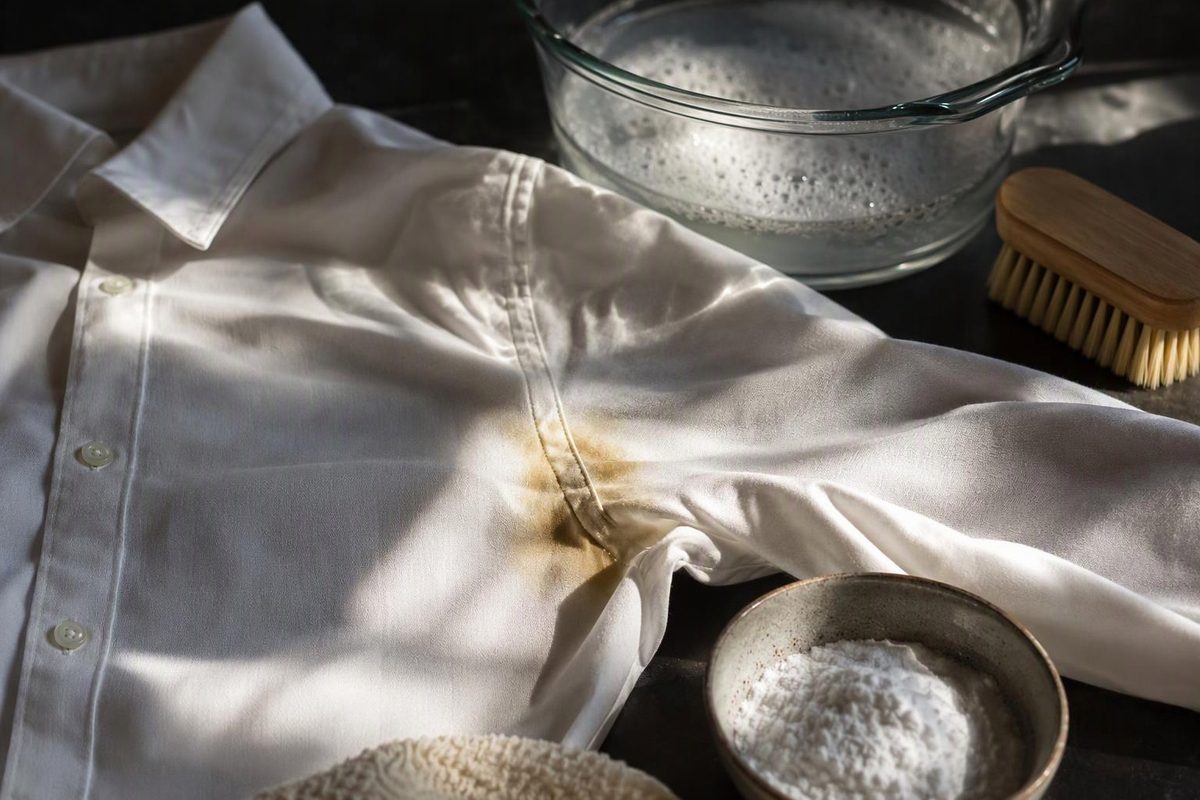
For a washable white cotton, linen or polyester shirt, pretreat sweat-stained underarms with liquid laundry detergent, then wash at the warmest temperature the care label permits. If yellowing remains, use an oxygen-bleach treatment only if both the garment and product labels allow it. Keep the shirt out of the dryer while stains remain. The American Cleaning Institute’s stain guide recommends detergent for light deodorant stains and oxygen bleach or enzymes for stubborn perspiration stains.
Choose your fabric, bleach instruction and stain stage to find the next safe step.
Find Your Next Treatment
Pretreat, Then Wash
Use liquid laundry detergent labeled for pretreating, or a labeled prewash remover. Work it in gently and wash at the warmest care-label-safe temperature.
Test the treatment on a hidden seam first. Inspect after washing; do not tumble-dry or iron while the stain remains.
Product-Specific Soak Example
For permitted garments, OxiClean White Revive powder instructions specify one scoop filled to line 4 per gallon of water and a 1–6-hour soak, then washing with detergent. This is not a dose for other formulations. Follow your exact package and garment labels.
Sources: American Cleaning Institute stain-removal and laundry guidance; OxiClean sweat-stain instructions; Clorox care-symbol guidance. No removal guarantee.
Check the Fabric Before Treating the Yellow Patch
Read the fiber content and the care instructions, not just the shirt’s color. A white shirt is not automatically bleach-safe. Cotton or polyester may be blended with elastane/spandex, and a white body may have colored trim. Those details matter when deciding whether a stronger treatment is appropriate. If you cannot establish what the shirt permits, do not use the oxygen-bleach soak as a trial-and-error test.
| Shirt or Mark | Starting Decision |
|---|---|
| Washable cotton, linen or polyester | Pretreat and wash within label limits |
| Silk, wool or their blends | Skip the oxygen-bleach soak described here |
| Dry-clean-only shirt | Ask a cleaner about treatment |
| Yellowing beyond underarms or collar | Check other causes before treating as sweat |
OxiClean’s sweat-stain instructions explicitly exclude silk, wool, their blends and dry-clean-only clothing from the treatment described there. Do not extend instructions for washable whites to those materials. Take valuable or delicate shirts to a cleaner, and explain what you have already applied. A treatment that was acceptable for a cotton T-shirt does not establish that it is acceptable for a silk blouse.
If the yellowing is scattered elsewhere, rather than concentrated around the underarms or collar, use the guide to yellow spots on white clothes. Location is a useful clue, not proof of the cause. Treating every yellow mark as perspiration can send you through repeated washes without addressing the actual problem.
Before applying a product over the whole stained area, test it on a hidden seam using its instructed dilution and contact time. Rinse the test area and let it dry, then check for a change in color, texture or finish. Stop if the test changes the fabric. The American Cleaning Institute’s laundry guidance recommends inconspicuous-area testing before pretreating or bleaching. A hidden-area test does not override a care-label prohibition; both checks need to pass.
Yellow Underarm Stains Often Include Product Buildup
The patch you are treating may contain body oils, sweat and antiperspirant residue—not simply dried perspiration. A stiff or crusty underarm suggests accumulated buildup, which may not dissolve readily in water alone. Clorox’s underarm-stain guide describes this mixed residue and notes that heavy buildup is difficult to remove.
That distinction explains why another ordinary wash may leave the same patch behind. Apply the pretreatment to the affected fabric rather than relying only on detergent added to the washer. It also explains why a successful first treatment may leave some discoloration: loosening the residue and removing all visible yellowing are not necessarily the same outcome. Inspect the shirt after each wash rather than assuming that a softer patch is fully clean.
Old, crusty or previously tumble-dried stains may need more than one attempt, and complete removal is not assured. There is no guaranteed number of treatments in the cited instructions. Use visible improvement and the condition of the fabric to decide whether a label-compliant repeat is worthwhile, rather than committing to a fixed number of soaks.
Pretreat With Detergent Before Washing
Start with detergent rather than immediately soaking the shirt in bleach. This gives light marks a chance to come out with the simpler treatment and lets you see what remains after laundering. Use a liquid laundry detergent labeled for pretreatment; if yours is not, choose a laundry prewash stain remover and follow its directions.
- Turn the shirt inside out. Lay it so the stained underarm fabric is accessible. Identify the full affected area, including any stiff edges around the visible yellow patch.
- Wet the patch with liquid laundry detergent. Apply enough to reach the affected fabric, then work it in gently with your fingertips. Do not substitute hard scrubbing for product contact.
- Use the product’s stated contact time. For heavy deodorant stains, ACI recommends letting a prewash remover stand for 5–10 minutes. That timing is not a universal instruction for every liquid detergent or stain remover; follow your product’s directions if they differ.
- Wash with the recommended detergent dose. Select the warmest temperature the shirt’s care label permits, not the hottest setting the machine offers.
These steps follow ACI’s deodorant and perspiration guidance. For light perspiration stains, rubbing with bar soap before laundering is another supported starting treatment. You do not need to buy a special remover immediately if that approach is suitable for the shirt. Whichever starting product you choose, keep the treatment within its instructions rather than layering several remedies onto the same patch.
After washing, inspect the underarms before drying. If the patch is gone, dry the shirt as its label permits. If discoloration remains, air-dry while deciding on the next treatment. Do not iron or tumble-dry the stained area: ACI warns that drying can permanently set remaining stains. The relevant check is whether the mark is gone, not simply whether the wash cycle is finished.
Use Oxygen Bleach Only When Both Labels Permit It
An oxygen-bleach soak is the next option for lingering yellowing on a suitable washable white shirt. It is not an automatic step for every white garment. Check the shirt’s bleach instruction and the product’s fabric exclusions before mixing a solution. A product described as chlorine-free still counts as bleach for this decision.
A “do not bleach” instruction or crossed-out triangle rules out this step. The symbol means no bleach of any kind, not merely no chlorine bleach. If the care label is missing or unreadable, you have not established permission to soak. Do not treat an unknown instruction as approval, particularly on a shirt with stretch fibers, trim or a finish you cannot identify.
For a permitted treatment, use this sequence:
- Prepare the labeled soaking solution in an open basin. Use the warmest water the shirt allows. Follow the product’s dilution instructions and dissolve powder completely before adding the garment.
- Submerge the stained area or whole shirt as directed. The product instructions determine how to apply the solution; do not assume that every oxygen-bleach formulation has the same soaking method.
- Soak for the labeled time. Do not increase the concentration or extend the soak beyond the instructions because the stain looks old.
- Wash with regular laundry detergent. Then inspect the underarms again before using heat to dry the shirt.
A concrete example is useful, but it must stay tied to the exact product. OxiClean’s instructions for White Revive powder on sweat-stained whites specify one scoop filled to line 4 per gallon of water, followed by a 1–6-hour soak. Use the scoop and directions supplied with your exact product. That dose does not establish a recipe for another powder, a liquid oxygen bleach or a different formulation sold under the same brand.
The draft sources do not supply a universal gram weight for that scoop or a universal soak time for all oxygen bleaches. Do not convert “one scoop” into an assumed household measure. If your package gives different directions, use those directions within the garment’s limits. If the garment and product instructions conflict, do not use that treatment.
Repeat Only While the Stain Improves and the Fabric Holds Up
After the oxygen-bleach treatment and wash, compare the remaining patch with its earlier appearance. If it has clearly lightened and the fabric remains sound, repeating a label-compliant treatment may be reasonable. Keep the same safeguards: permitted fabric, correct dilution, stated contact time and another inspection before heat drying.
If the shirt still has a crusty patch, do not assume that more force is the missing ingredient. Heavy buildup can be difficult to remove, and previously dried stains may resist treatment. Increasing the concentration or scrubbing harder is not a sensible escalation when a correctly used treatment has stopped producing improvement.
Stop if the underarm fabric looks thin, frays, develops holes or changes texture. Also stop if the hidden-area test shows a change. A paler stain is not a useful result if the treatment is damaging the shirt. For a garment worth saving, seek professional advice and report the products, dilution and treatment sequence you used. Do not keep experimenting simply because the shirt is white.
Avoid Boiling Water and Mixed Cleaning Products
Do not pour boiling water onto the shirt as a shortcut for dissolving underarm buildup. Stay within the garment’s care-label temperature instead of copying a high-heat treatment intended for a different fabric. OxiClean’s Versatile powder instructions also explicitly prohibit boiling water when mixing that product. That is a product-specific restriction as well as a reason not to improvise with heat.
Do not make chlorine bleach the automatic next step after detergent. Clorox’s underarm guidance distinguishes cotton/polyester shirts from shirts containing spandex; advice for the former does not establish safety for the latter. The oxygen-bleach sequence here is already conditional on the labels, and switching bleach types does not remove that condition. White color alone is never enough to choose the treatment.
Do not mix chlorine bleach with oxygen bleach, vinegar or ammonia, or combine household remedies. Poison Control warns against mixing cleaning products. Add an oxygen product to detergent only as its label permits, and rinse away earlier treatments before switching methods. Sequential, label-compliant treatment is different from putting several products together in a basin and hoping for a stronger effect.
Prevent Fresh Marks From Becoming Crusty Buildup
Treat new underarm marks promptly instead of waiting for a stiff patch to develop. Use the detergent’s recommended dose and avoid overloading the washer: clothing needs room to circulate for effective cleaning. Adding more detergent is not the stated solution to a packed load, nor does it replace pretreating a concentrated underarm stain.
If crusty buildup keeps returning despite appropriate laundering, changing the deodorant or antiperspirant may be worth considering, as Clorox’s prevention guidance suggests. That is a recurrence measure, not a way to remove the existing patch. For the shirt already stained, keep the order clear: pretreat, wash, inspect, then use a permitted oxygen-bleach treatment only if yellowing remains.